
Position Sizing
Six Allocation Methods for Every Investment Style
Pick the formula that sizes investor positions when a master opens a trade — proportional to balance or equity, multiplied by a risk ratio, or fixed lot. Selected per subscription in Back Office; Proportional to Equity × Ratio is the default.
- 6 allocation formulas
- Default: Equity × Ratio
- Locked after open
Allocation Calculator
Sub #INV-3120 · Master “Alpha Strategy”
- Master Position
- 2.50 lots
- Ratio
- × 0.5
- Master Equity
- $2,000
- Investor Equity
- $5,000
Investor Position
3.13 lots
2.50 × (5000 / 2000)
× 0.5 = 3.125
Allocation Methods
Six Formulas. One Default.
Every method runs at the moment a master position is copied to an investment account. The broker chooses which methods are available; investors (or money managers) pick the one that matches their risk profile when subscribing.
Proportional to Equity × Ratio
Default Formula in Social Trading
Equity-based scaling with a custom risk multiplier. The default for new copy-trading and MAM subscriptions.
Example
- Master equity
- $2,000
- Investor equity
- $5,000
- Master position
- 2.50 lots
- Ratio
- × 0.5
Proportional to Balance
Scales the investor's position by the ratio of investor-to-master account balance.
Example
- Master balance
- $8,000
- Investor balance
- $2,000
- Master position
- 2.00 lots
Proportional to Equity
Uses real-time equity instead of balance — better reflects available capital when floating P&L is significant.
Example
- Master equity
- $2,000
- Investor equity
- $5,000
- Master position
- 2.50 lots
Proportional to Balance × Ratio
Adds a risk multiplier on top of the balance ratio — investors dial up or dial down exposure beyond pure capital scaling.
Example
- Master balance
- $8,000
- Investor balance
- $2,000
- Master position
- 2.00 lots
- Ratio
- × 2.5
FIX Lot Allocation
Every copied trade opens with the same predefined size — ignores balance, equity, and free margin on both accounts.
Example
- Fixed size (Ratio)
- 0.10 lots
- Master position
- 0.85 lots
- Account balances
- irrelevant
Ratio Multiplier
Also Called Lot Allocation
Pure multiplier on the master's size — preserves master sizing intent regardless of account capital.
Example
- Ratio
- × 0.5
- Master position
- 2.50 lots
- Account balances
- irrelevant
Symbol Filter
Exclude Instruments Without Unsubscribing
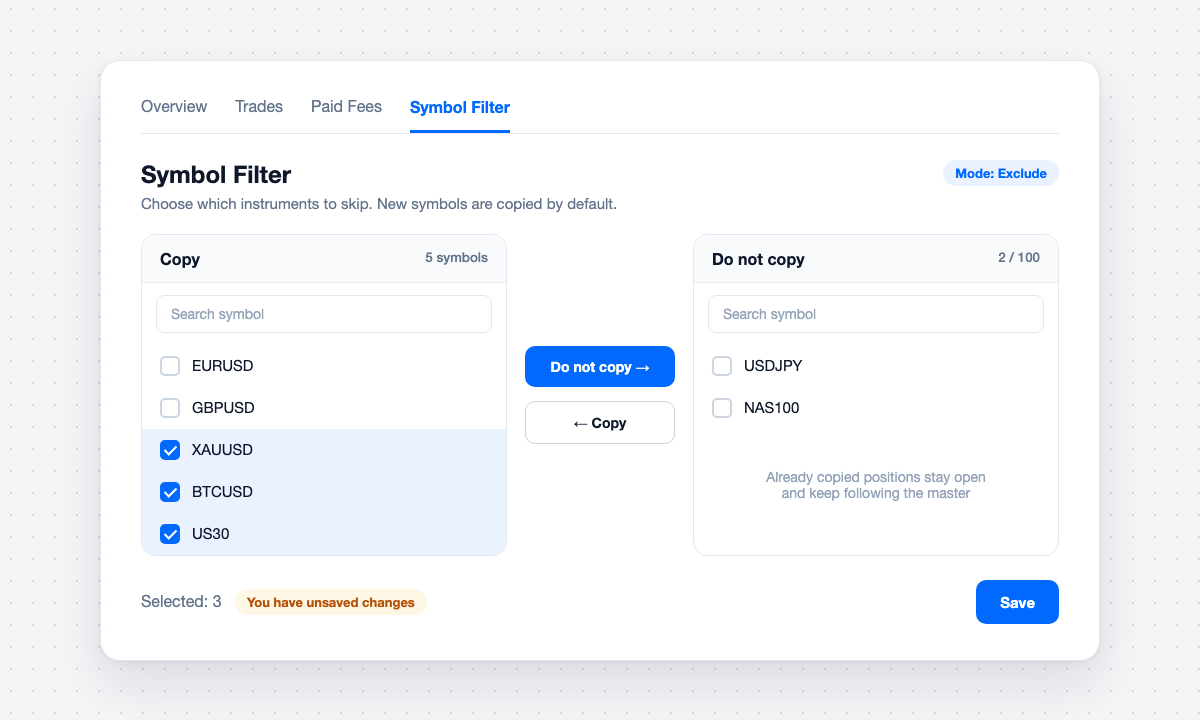
A subscription no longer has to copy every instrument the master trades. Investors move symbols to a Do not copy list on an existing Copy or MAM subscription and keep following everything else.
Up to 100 Excluded Symbols
Pick symbols in the Copy list, move them to Do not copy and save. New symbols added later are copied by default unless excluded.
No Forced Closures
Positions already copied stay open and keep following the master — including closing, Stop Loss and Take Profit. A filter change never creates unexpected P/L events.
Open Positions at Subscription
Copy Current Positions — Or Wait for the Next Signal
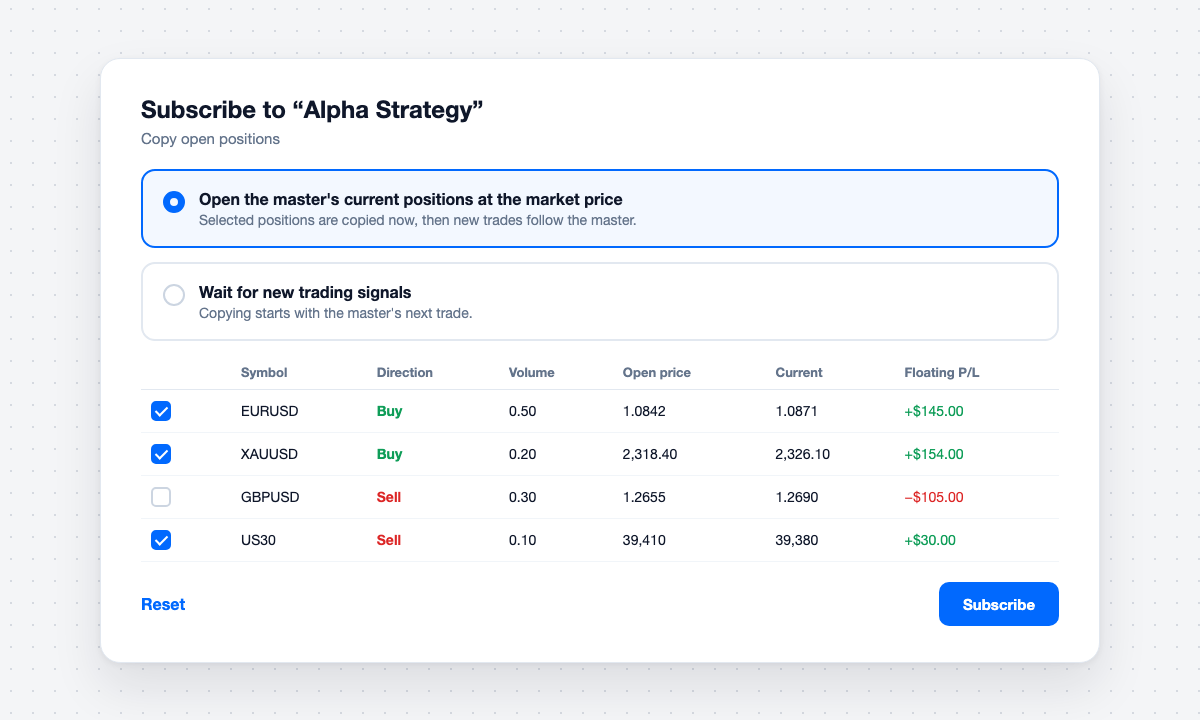
When the broker sets Open positions for new subscriptions to Let investor choose, investors decide at subscription whether to copy the master's current positions or start with new trades only.
Position-by-Position Control
See symbol, direction, volume, open and current prices and floating P/L. Clear any position you do not want; at least one must stay selected.
Always, Never or Investor’s Choice
Brokers set the policy separately for Copy Trading and MAM: Always copy, Never copy, or Let investor choose. It applies to new subscriptions only.
Key Principle
Sized Once at Copy, Locked Afterwards.
Allocation methods are applied at the moment a position is copied. The resulting size is then fixed — it doesn't recalculate when the balance, equity, or ratio between accounts changes. Investors stay in control of their own positions after copy.
Applied at Position Opening
The selected method runs once — when the trade is copied. After that, the position size is final and the formula doesn't fire again on the same trade.
Immune to Balance Changes
Subsequent deposits, withdrawals, or P&L swings on either account don't resize the open position. New trades use the same formula on the new balance.
Investors Stay in Control
After copying, investors can manually close, reduce, or modify their copied positions independently of the master — without breaking the platform.
Proportional Closure
The One Exception — Proportional Position Closure
When a master closes more than the investor has already trimmed, the system steps in and restores the original master-to-investor ratio. Walk through the same example from docs.b2copy.b2broker.com (initial 2:1 ratio).
Step 1 of 5
Copy at 2:1
Current ratio (investor : master)
2.00 : 1
Master opens 1.00 lot. The allocation method copies it as 2.00 lots on the investor account. Starting ratio is 2:1.
Baseline — ratio is intact

Need a Formula That Fits Your Clients?
Want to dig deeper into the six allocation methods, or didn't find what your investors and money managers need? Tell us about your strategy mix — we'll walk through every option live and help shape the setup that fits.
Explore more
See Related Capabilities
6 Fee Types
Performance, management, subscription, volume, joining, and profit fees.
Learn moreRisk Management
Daily limits, max drawdown controls, and personal loss limits.
Learn morePosition Sizing
Six allocation methods — proportional, ratio multiplier, or fixed lot.
Learn moreMulti-Server Copying
Copy trades across MT4, MT5, cTrader, and B2Trader servers.
Learn moreIntegration Options
Widget SSO, CRM integrations, REST, and gRPC APIs.
Learn more