What Brokers Need for Cross-Border Fintech Compliance

Financial institutions spent more than $206 billion on financial crime compliance in 2023, and for multi-jurisdiction brokers that figure is only the visible slice. The full compliance load grows with every new market, because each jurisdiction adds rules your systems must enforce, from leverage caps to the data fields a payment must carry.
Brokers that scale cleanly made cross border fintech compliance an architecture decision before launch, as retrofitting jurisdiction logic into a live back office costs far more than designing it in.
This guide maps that regulatory stack and translates it into system requirements: what your CRM, back office, and trader's room must handle natively, and when buying that capability beats building it.
Key Takeaways
- Compliance rules differ by jurisdiction, so regulatory requirements have to live inside onboarding, payment, and reporting workflows as configuration.
- A multi-asset broker can fall under MiCA, ESMA product intervention, MiFID II, and the FATF Travel Rule at the same time, inside one operating model.
- Configurable KYC flows outperform a single global onboarding path, because document standards, risk thresholds, and refresh cycles diverge by market.
- Stablecoin funding rails come with Travel Rule and licensing obligations today; the back office needs the required transfer fields in place before the first deposit.
- Purpose-built infrastructure absorbs jurisdictional complexity natively, which shortens market entry and protects banking relationships.
Why Cross-Border Compliance Starts in the Data Model
Fragmented rules break data models before they break policy manuals. If your back office cannot represent an EU retail CFD client and an offshore professional crypto trader as distinct objects with their own controls, the compliance failure is already built in.
Compliance-by-design expresses the rulebook as system behavior. Onboarding logic, transaction monitoring, and withdrawal limits all change with who the customer is and where they sit. An integrated brokerage ecosystem keeps that behavior consistent by giving every module one client record to read.
The Cost of Treating Compliance as a Process Overlay
Bolt-on compliance bills the business in ways no budget line shows. Duplicate client records force manual reviews, manual reviews delay cross-border payments, and every delayed payout raises a flag with the banks that process it.
Most of those symptoms trace back to one root cause — structured data the onboarding flow never captured. When sanctions screening runs incomplete identity records against the lists, false positives spike. Analysts then spend their days clearing alerts instead of investigating real risk.
Audit exceptions follow that path too. A KYC module that cannot see the payments ledger, or an IB module disconnected from both, leaves gaps that a regulator's data request will eventually find.
What Compliance-by-Design Means for CRM and Back-Office Infrastructure
In practice, compliance-by-design is configurable logic inside the back office. In B2CORE , that looks like jurisdiction-based onboarding flows, role permissions, and approval workflows that fire when a client crosses a risk threshold. Because the rules live in the system, they execute uniformly and produce their own evidence.
Generic CRM platforms can cover part of this. But product eligibility, funding rails, and affiliate structures all shift by jurisdiction, which turns every adaptation into custom code.
The Regulatory Stack a Multi-Asset Broker Must Navigate
Every layer of the stack runs through the same operating model. From conduct standards to anti-money laundering (AML) law, each regime touches account opening, funding, and regulatory reporting in its own way.
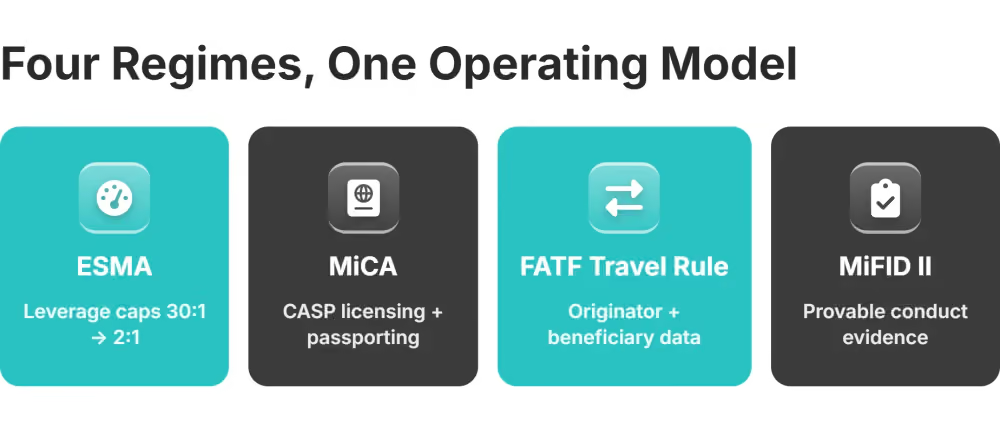
The four regulatory frameworks below rarely apply in isolation. Where you hold a license decides which compliance obligations you cannot outsource .
ESMA Product Intervention Rules for CFDs and Leveraged Products
ESMA's retail CFD measures, which national regulators have made permanent, are rules the trading stack itself has to enforce. Leverage caps run from 30:1 on major FX pairs down to 2:1 on crypto, together with negative balance protection and standardized risk warnings.
A group running EU and offshore entities under one roof therefore needs product eligibility to follow jurisdiction. The trader's room must know which client sees which leverage and which warning before the first order.
MiCA Licensing and Passporting Obligations for Crypto-Asset Services
MiCA attaches crypto-asset service provider (CASP) obligations the moment a broker offers in-scope services to EU clients. Authorization in one member state passports across the EU and pulls onboarding logic, disclosures, and record retention with it.
The regime is still moving. The European Commission's MiCA review already signals scope changes; a hardcoded assumption in wallet, custody, or transfer workflows becomes technical debt the day the rules shift.
FATF Travel Rule Requirements for VASP Crypto Transfers
Under the Travel Rule, systems must collect, verify, and transmit originator and beneficiary details before a qualifying crypto transfer executes. The Financial Action Task Force (FATF) sets the standard globally, while national regulators implement it locally.
A broker offering crypto withdrawals or stablecoin deposits can fall under VASP-style obligations even though trading is its core business. If the back office cannot attach counterparty data to a transfer at execution time, that transfer should not clear.
MiFID II Conduct Standards for Cross-Border FX Operations
MiFID II judges conduct by what the system can show. An appropriateness check the platform cannot reconstruct months later fails the standard, however sound the original decision was. For cross-border FX, that proof means call recording, language-specific disclosures, and retention policies working inside the CRM and trader's room.
When a regulator's request arrives years after the trade, the system has to produce the evidence on its own.
AML and KYC Obligations Across Jurisdictions
Cross-border know-your-customer (KYC) checks fail once a firm assumes one global standard. The identity proof one regulator accepts falls short for the next, so a single flow either blocks legitimate clients or waves through risky ones.
That is why cross border fintech compliance lives or dies in the onboarding engine. Jurisdiction logic has to govern which steps a client sees, how the system builds their risk score, and when a source-of-funds request fires.
Configurable Onboarding Flows for Jurisdiction-Specific KYC Standards
Configurable onboarding asks each client only for what their jurisdiction requires. An EEA retail CFD client, an offshore professional, and a crypto-funded account each should trigger their own document set and approval route.
A static flow forces the strictest path on everyone, causing drop-off to rise and filling queues with cases that never needed manual attention. The compliance team then grows with every new market, because the rules cannot.
AMLA and the Tightening of EU AML Supervision in 2026
AMLA moves EU AML oversight from a national patchwork toward one authority. From 2028 it will directly supervise up to 40 high-risk financial institutions , with the first selection round running through 2027.
The preparatory consultations closed in early 2026, which makes this the design window. Firms that keep AML thresholds and escalation rules as configuration can absorb the final wording without rebuilding workflows under supervisory pressure.
Stablecoin Funding Rails and the Compliance Obligations Brokers Face Now
Stablecoin funding already creates compliance exposure. In emerging-market corridors, it has become the default deposit method for crypto-first clients. Regulators treat each of those deposits as a payment, with licensing, sanctions, and data-capture obligations from the first transfer.
Treating those rails as a wallet feature is how a broker accumulates risk quietly. The controls that govern a fiat corridor apply here too, usually with less mature tooling behind them.
Travel Rule Application to Stablecoin Transfers Under MiCA and FinCEN
In the EU, the Transfer of Funds Regulation applies the Travel Rule to every CASP crypto transfer with no minimum threshold, effective since 30 December 2024. Transfers above EUR 1,000 involving self-hosted wallets add an ownership-verification step on top.
In the US, cross-border payment regulations run through FinCEN's funds transfer rules. Whether a transfer is covered depends on how the service is designed and who sits on each end. One product change can pull a corridor into scope, so the cross-border payment compliance controls have to exist before the rails go live.
How Back-Office Systems Must Be Structured to Capture Required Data Fields
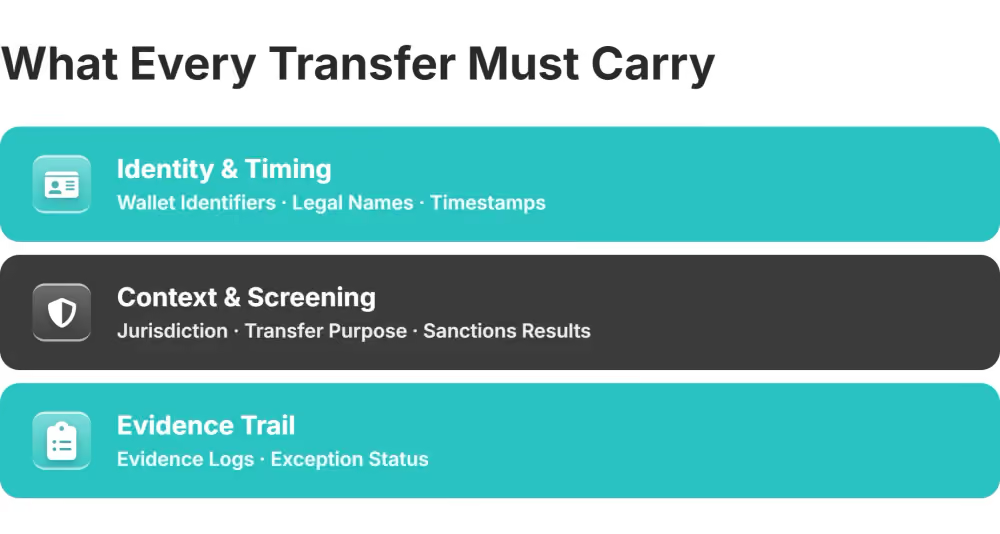
The required fields are specific and increasingly standardized through payment-message formats such as ISO 20022. Each one needs a home before a transfer can carry it:
- wallet identifiers, legal names, and timestamps;
- jurisdiction, transfer purpose, and sanctions-screening results;
- evidence logs and the status of any exception.
If onboarding never captured a beneficiary's legal name, no downstream process can transmit it. Because these fields hold personal data, data privacy law such as the General Data Protection Regulation (GDPR) also governs how you store and share them. The fields also have to move between modules without manual re-entry, because every hand-copied value is a place the audit trail can break.
IB and Affiliate Payout Compliance in Multi-Jurisdiction Brokerage Models
IB and affiliate payouts concentrate compliance risk. One commission run can send money across dozens of corridors, where every payout needs partner due diligence and sanctions screening.
Partner networks need the same discipline as clients:
- KYB checks at entity onboarding;
- beneficial-ownership and adverse media checks;
- approval controls on every payout;
- a deliberate decision on crypto versus fiat routing.
Running those checks in the platform that already handles client KYC gives the whole network one screening and risk management standard.
Correspondent Banking De-Risking and What Brokers Can Do About It
Correspondent banks have spent a decade de-risking. The Bank for International Settlements tracked a roughly 30% drop in active correspondent banks between 2011 and 2022 . Firms with opaque client flows or weak controls are the first to lose access to international payment rails.
A broker controls more of this than it assumes. Documented AML governance and auditable withdrawal decisions are exactly what a correspondent bank's risk team reviews. Add multi-jurisdiction licensing and liquidity governance , and those relationships stay open as volume grows.
Build vs. Buy: The CTO and COO Decision on Compliance Infrastructure
Compliance infrastructure now decides how quickly you can open in a new market, which is why the build-versus-buy call sits with the CTO and COO. The question underneath is whether engineering hours over the next three years go into rule maintenance and vendor integrations, or into the trading product itself.
That trade-off can be counted. Add up the rule updates a year brings and the release cycles they consume, plus every audit-evidence request in between. Building means your own engineers carry that total. When you evaluate partners for cross-border expansion , ask whether the vendor absorbs it.
The Technical Debt of Custom Compliance Modules
Custom compliance modules age badly. Every regulator update to a threshold or a field requirement becomes a release. Every release risks breaking already-certified behavior.
Duplicated schemas and brittle API connections compound with each market you add. Meanwhile, engineers who maintain KYC logic are not building the integrations that grow revenue.
What a Purpose-Built Platform Absorbs So Internal Teams Don't Have To
A purpose-built platform takes over the parts internal teams should not own. In B2CORE's case, that covers:
- jurisdiction-aware onboarding and KYC-provider integrations;
- trading-account provisioning and payment workflows;
- IB controls, role permissions, and immutable audit trails.
The vendor maintains those capabilities. When a regulation changes, the update ships with the platform instead of entering your release queue.
Compliance Infrastructure Is Now a Competitive Requirement for Brokers Scaling Globally
Every section above lands on the same conclusion: cross border fintech compliance belongs inside the operating infrastructure itself.
As the regulatory stack keeps getting denser, the brokers that enter new markets fastest are the ones whose systems already know which products each jurisdiction allows and which fields every transfer needs.
The cheapest moment to fix the architecture is before the technical debt compounds. B2BROKER's team can map the control model for your target jurisdictions against what B2CORE handles natively .
A dependable infrastructure partner should have done this at scale already. B2BROKER has operated in this market since 2014, holds 10 regulatory licenses, and has helped launch over 500 brokers worldwide.
Frequently Asked Questions about Cross-Border Fintech Compliance
What are the key compliance requirements for cross-border fintech operations at a multi-asset broker?
Licensing, AML and CFT controls, KYC, sanctions screening, product governance, payment data quality, and jurisdiction-specific reporting, often with several applying to one client at once. The operational challenge is enforcing all of them together, from one system of record.
How does the Travel Rule apply to crypto and stablecoin transfers across borders?
A broker acting as a VASP sends verified originator and beneficiary data along with every qualifying crypto or stablecoin transfer; in the EU there is no minimum threshold. The back office has to capture wallet metadata, counterparty details, and screening outcomes before release.
How can a brokerage platform automate KYC and AML compliance across jurisdictions?
Automation starts with onboarding rules configured by residency, entity type, risk score, and product access. The platform should keep document collection, sanctions screening, transaction monitoring, fraud prevention, and case management in a single audited data model. Scaling into a new jurisdiction then becomes a configuration task.
How do brokers comply with MiCA when serving EU clients from offshore jurisdictions?
Marketing into the EU or providing in-scope crypto services to EU residents triggers MiCA licensing, conduct, and disclosure obligations regardless of where the entity sits. Because the regime is evolving, client segmentation and eligibility logic in the trader's room need to stay configurable.
What back-office features should a broker look for to manage multi-jurisdictional compliance?
Jurisdiction-aware onboarding, rules-based product eligibility, integrated payment screening, Travel Rule data fields, case management, and immutable audit trails. Purpose-built systems such as B2CORE ship these as native brokerage workflows that generic CRM software only reaches through customization.
Recommended articles
Subscribe to our newsletter