Copy Trading Regulations by Region: A Broker Risk Map

文章 13m
Copy Trading Rules: A Broker Risk Map by Region

Founders ask whether copy trading is legal in a target market, but legality rarely stops a launch. It stalls on the category a regulator files the service under, and on the bank that has to agree to hold client money.

IOSCO's 2025 review found copy trading marketed and sold across borders , with selling from outside that makes a supervisor ask for a local license.

Copy trading regulations by region are the rules each market applies to a service that replicates one trader's orders into other clients' accounts. Three variables differ by market: the license category the service falls into, the regulator that supervises it, and how strictly that regulator enforces the rules.

This guide maps them across MENA, LATAM, SEA, CEE, and CIS, naming which of the three lands on your launch first.

Key Takeaways

  1. A regulator files copy trading under portfolio management, investment advice, or order transmission. That label sets the license, the capital, and the client checks.
  2. The five regions differ in what stops a launch: Gulf conduct reviews, Brazilian analyst accreditation, SEA warning lists, MiFID II passport scope, and Russian settlement friction.
  3. Copy trading in crypto-assets falls under securities law wherever the token or the linked product passes the local securities test, as it does under Brazil's CVM guidance.
  4. The platform has to produce suitability records, disclosures about the copied trader, an audit trail per copied order, exposure limits, and a kill switch on the master account.
  5. A classification or banking check done after launch shows up as licensing delay, lost payment rails, and lost accounts.

Who Holds Discretion Over Each Trade Decides Your Copy Trading License

The first thing a regulator looks at is who decides each trade. In the EU, that answer sorts the service into portfolio management, investment advice, or reception and transmission of orders (RTO). The other four regions build their own categories on the same fact. Every category comes with its own permission, making the same product licensable in one market and unauthorized in the next.

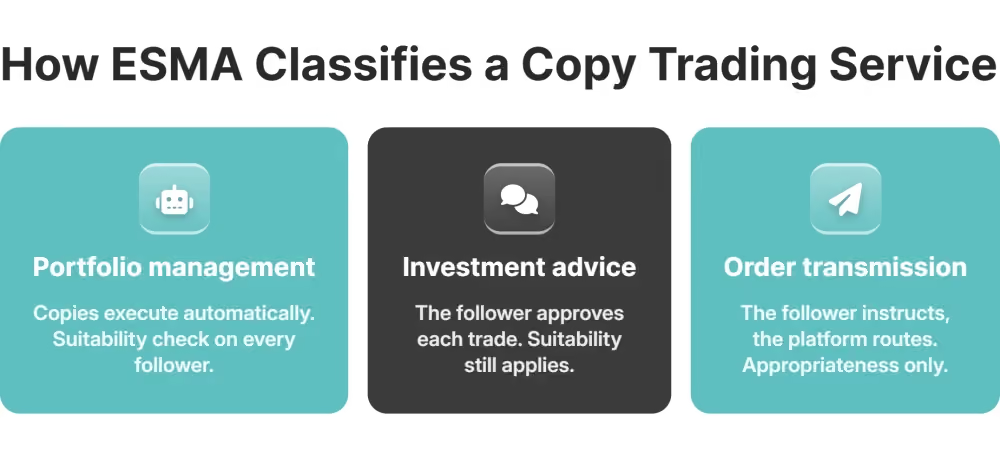
ESMA, the European Securities and Markets Authority, drew the line in its 2023 supervisory briefing. When the platform executes copied trades automatically, and the follower takes no action per trade, the service is portfolio management . A follower who approves each trade before it goes out moves the service toward advice or RTO.

A stop-loss level or a one-time blanket approval does not count as a per-trade action. That puts most trade copiers on the automatic side, including the one-click leaderboards eToro made familiar.

How ESMA classifies a copy trading service as portfolio management, investment advice, or order transmission

Portfolio management is the heaviest of the three labels. A broker under it needs:

  • permission for discretionary management over the client's financial instruments, with the capital that permission carries
  • a suitability assessment for every follower, where RTO would only require an appropriateness check
  • costs and charges disclosure before the mandate starts
  • records showing each copied trade stayed inside the follower's mandate

The same question sorts PAMM and MAM structures under MiFID II, where a manager trading a pooled account exercises the discretion a copied master does. IOSCO found the copied products skew to contracts for difference (CFDs) in both the forex market and crypto, pulling retail leverage rules into the same conversation.

Marketing labels change none of this. The regulators IOSCO surveyed treat copy, mirror, and social trading as one practice and test the execution flow behind whichever name a firm uses. The person being copied, the signal provider in ESMA's wording, comes under the Market Abuse Regulation once they put forward recommendations or present as an expert. Their positions read as recommendations to everyone following them.

MENA: Licensing Oversight and Governance Gaps in the Gulf

The DFSA does not ban copy trading. Its reviews test whether a broker's internal controls grew as fast as its trading volumes, starting with personal account dealing by staff.

The regulator published its first Conduct Supervisory Pulse in June 2026 after reviewing personal-account dealing across DIFC brokers. The sector had grown from 49 authorized brokerage firms in 2022 to 72 in March 2026. An earlier DFSA survey found that 18% of firms had no written personal-account-dealing policy , and 32% kept no register of staff trades at all.

For a copy-trading operator, that gap sits on the master account. With hundreds of client accounts attached to a master trader the broker employs, a missing pre-clearance rule becomes a conduct finding multiplied by the follower count.

Entry into the Gulf starts in the back office. In B2CORE , cross-border KYC and local marketing permissions run through role-based user groups with audit trails, capturing the approvals and the trade record a reviewer asks for from the first copied trade.

LATAM: Brazil's CVM Treats Paid Copy Trading as Securities Analysis

Since July 2025, a copy-trading service in Brazil that charges recurring fees has been counted as securities analysis, a regulated activity that the copied trader and the platform behind them must be accredited to perform. Circular Letter 3/2025 states that a trader who charges joining, monthly, or annual fees is producing investment recommendations , which only analysts accredited by APIMEC Brasil may do.

With analysts barred from trading the securities they cover during blackout periods, the CVM expects the analyst's copy-trading operations to run in a simulator environment while the followers' accounts execute the real trades. A platform built around the master's live account needs rework before it fits that design.

The same letter asks the platform to say plainly that the copied strategy can lose money and that past results promise nothing about future ones.

Crypto Copy Trading Answers to Two Regulators

Crypto adds a second regulator. Under CVM Guidance Opinion 40, a token is a security when it represents a listed security or works as a collective investment contract , which puts copy trading in such tokens under securities law. Tokens outside that test fall to the Central Bank, whose virtual-asset rules took effect in February 2026 and cover portfolio management of virtual assets.

Nothing in that regime carries into the rest of LATAM. Each other market needs its own counsel opinion, payment rails, and disclosures, including for a crypto product that was compliant offshore.

SEA: MAS, SFC, and Proactive Enforcement Models

In Singapore, Hong Kong, and Malaysia, the perimeter gets policed in public. Regulators publish the names of the firms they consider unlicensed, entries that stay online long after the campaign ends. Local clients use those lists to tell regulated platforms from the rest.

MAS names firms that could be mistaken for licensed ones on its Investor Alert List, an investor protection measure that carries no enforcement action with it. It added Bybit on June 17, 2026, and Hyperliquid nine days later , neither of them authorized to serve Singapore users. An entry is still a public statement about a platform's legal status in that market.

Securities Commission Malaysia works at volume. It added 273 names to its Investor Alert List in 2024 , and 59 more in the first quarter of 2025 alone. Over the same 2024 period, it blocked 153 websites and 261 social media pages with the communications regulator.

Check those lists before signing an influencer or an introducing broker in SEA. A partner already on one drags the broker's name in with them.

Hong Kong Turns Copy Trading Into a Licensed Activity

Hong Kong has settled what its perimeter will look like. Consultation conclusions published with the FSTB on May 26, 2026, state that copy or mirror trading in virtual assets will generally require a VA advisory license . Executing those trades would add a dealing license, and executing them at the platform's own discretion would add VA management, a regime aligned with the Type 9 asset-management license.

CEE: MiFID II, ESMA, and the EU/Non-EU Divide

In the EU members of Central and Eastern Europe, the MiFID directive applies as ESMA reads it. The classification you settle on at home fixes the activities your passport carries into Poland or Romania. A CySEC license from the Republic of Cyprus passports the same way, while a Mauritius license carries no passport into any of them.

Serbia and Ukraine sit outside the passport and need their own license analysis. So does the UK, where the Financial Conduct Authority (FCA) has flagged services sold as copy trading that turned out to be MAM or PAMM management.

The passport covers the activities named in the home-state license and nothing else. A firm licensed for RTO that runs automatic copy execution is providing portfolio management without permission in every European Union state it passports into. The complaints reach the host regulator first.

Every Copied Order Has to Be Reconstructable

Automated trading engines then put the recordkeeping rules under load. Every master order fans out into hundreds of near-identical client orders, each of which the firm has to be able to reconstruct. Any derivatives among them are reportable to a trade repository under EMIR. IOSCO warns that a flurry of identical trades also makes market abuse harder to trace. The audit trail has to tag every copied order back to its master.

IOSCO also flags the algorithmic trading layer itself, where security holes in the copying logic and biases built into it create risks of their own.

Those duties become platform requirements for a compliant copy trading provider : KYC gating before a follower can subscribe, risk controls that cap each follower's exposure, and a trade record that survives a regulator's request months later.

CIS: Russia's Capital Controls Versus Kazakhstan's Common-Law Alternative

Nothing in Russia prohibits copy trading, and the friction that does exist sits in settlement. Kazakhstan, next door, offers a license route through the AIFC under common law.

The Bank of Russia extended its foreign-cash restrictions on September 1, 2026, now running to March 9, 2027 . Individuals may withdraw at most $10,000 in foreign currency from balances held before March 9, 2022, and non-resident companies cannot withdraw dollars, euros, pounds, or yen in cash at all.

Those limits cover cash. Cash is the visible edge of a bigger problem. Before selling into Russia, a broker has to know whether a follower can fund an account at all and whether a correspondent bank will carry the flow.

If either answer changes, those clients have to be separable from the rest of the book. The launch plan needs an answer for open copied positions if the payment rail closes.

Kazakhstan's AIFC and AFSA as an Alternative Licensing Hub

The AIFC gives a CIS-facing broker a license inside an English-law regulatory framework, supervised by the AFSA, with published capital rules a bank can look up. Managing Investments, the permission that covers discretionary copy execution, requires base capital of USD 150,000 plus liquid assets equal to a quarter of annual operating expenditure, on top of a USD 7,000 authorization fee.

The AFSA also asks every applicant for a three-year regulatory business plan and a compliance monitoring program. After the license, that plan turns into daily work: who approves a master, what the supervisor receives, what an inspector can pull from the audit trail. The last two live in the back office, where B2CORE covers them through role-based approvals and audit logs.

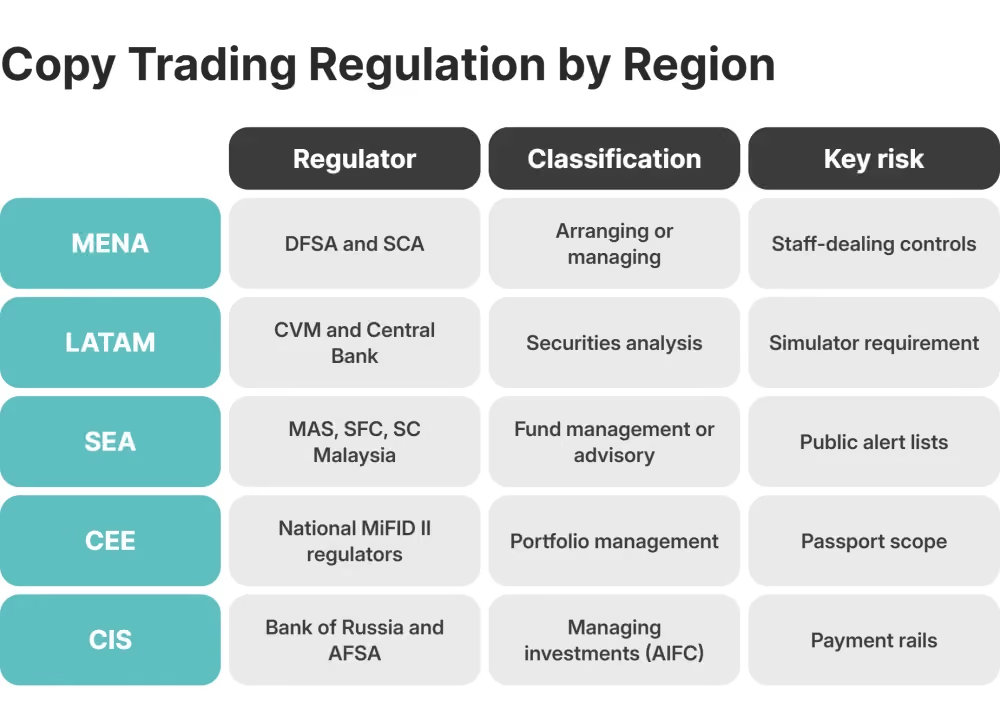
Copy Trading Regulation at a Glance: Regulator, Classification, and Key Risk by Region

Copy trading regulations by region come down to the same three things: the regulator that supervises the service, the label it takes there, and the delay that label creates. The five regions differ in operating risk more than in commercial appeal. Oversight in the US splits between the SEC and the CFTC, with retail leverage rules that differ sharply. That market needs its own analysis.

Copy trading regulation risk map for MENA, LATAM, SEA, CEE, and CIS

Where Jurisdiction Risk Costs a Broker One Account in Ten

Regulatory friction turns into churn at the point where a broker cannot onboard a client, keep a bank account, or complete a licensing process in a market it has already sold into. The one-in-ten ratio is an internal figure, not published market data. In each of those cases, the client named a licensing delay or a banking failure tied to jurisdiction as the reason for leaving.

The path usually runs through payments. A campaign goes live in a market the compliance review never cleared. Sign-ups arrive. The payment provider declines deposits from that jurisdiction. The support desk then opens a manual exception for each client while compliance argues with the provider. The clients who funded through another route leave when their first withdrawal stalls in the same queue.

Each step in that path is visible in the back office weeks before it appears in a churn report, as a blocked-jurisdiction list, KYB tickets aging past their target, or a campaign frozen mid-flight. A broker that reviews those three signals monthly catches the market that is quietly costing accounts.

Operating Compliantly Starts with the Right Infrastructure Partner

Operating under copy trading regulations by region takes infrastructure that produces the evidence each regulator asks for. B2BROKER supplies all of it as one stack:

The copy engine carries the mandate controls ESMA expects a portfolio manager to demonstrate. In B2COPY, the broker sets daily loss, maximum loss, and drawdown limits on every master account, none of which the master can edit. A breach closes the master's open positions, cancels pending orders, and blocks the account until the back office reviews it.

Followers get their own limit. Each subscription carries a loss limit that counts realized and floating losses plus fees. Crossing it ends that subscription, leaving everyone else in the book untouched. Whether the master trades on MetaTrader 4*, MetaTrader 5*, cTrader, or B2TRADER, the engine applies the same limits.

Onboarding, Permissions, and the Audit Trail

B2CORE supplies the onboarding and permissions layer. KYC providers sit among its 150+ ready integrations. Access rights tie every master approval to a named role, and the audit trail records who approved what in a form a supervisor can read. Crypto deposits and payouts run through B2BROKER's partner B2BINPAY, integrated with B2CORE.

The vendor behind those systems has a record that a regulator can check. B2BROKER has operated since 2014, holds 10+ regulatory licenses, and runs infrastructure for more than 1,000 corporate clients.

If copy trading is on your roadmap for any of these five regions, the classification decision and the banking check belong before the platform configuration. B2BROKER's team can map your target markets to the license, payment, and platform setup each one needs.

Frequently Asked Questions about Copy Trading Regulations

How do copy trading regulations differ across MENA, LATAM, SEA, CEE, and CIS markets?

The Gulf reviews internal conduct controls first, Brazil treats paid copy trading as securities analysis, and SEA regulators publish alert lists. EU-member CEE states enforce MiFID II through the passport, while Russia's constraints sit in settlement and Kazakhstan's AIFC offers a licensable route.

What licenses are required to offer copy trading services in MENA, LATAM, SEA, CEE, or CIS markets?

With no standalone copy-trading license anywhere in these markets, the service takes the permission of the nearest regulated activity, typically portfolio or investment management, arranging or dealing, securities intermediation, or virtual-asset authorization. Settle the entity design and the banking check before configuring the platform.

Is copy trading classified as portfolio management or execution-only brokerage?

Under ESMA's reading, automatic execution with no per-trade action from the follower is portfolio management. Only a follower who confirms each trade keeps the service under advice or RTO. That classification changes the capital requirement, the suitability versus appropriateness test, and how much of each copied trade the firm must be able to reconstruct.

Do crypto copy trading platforms need a securities license?

They do wherever the copied instruments qualify as securities or derivatives; the test Brazil's CVM applies to tokens under Guidance Opinion 40. Which permission applies then depends on whether the platform advises, manages portfolios, or only routes the orders.

How can brokers reduce jurisdiction-level churn when launching copy trading?

Map the classification, the regulator's expectations, the payment rails, and the technical controls for each market before the campaign goes live, then review blocked jurisdictions and aging KYB tickets monthly. An integrated stack such as B2BROKER's keeps the evidence a regulator asks for in one place.

Subscribe to our newsletter