Forex CRM. How to Find the Best Solution


A forex CRM decision shows its cost months after the contract is signed. Onboarding stalls in a compliance queue, a deposit fails to reconcile against the right account, and an introducing broker disputes a commission the system calculated wrong. By then the platform is wired into daily operations and switching it means rebuilding them.
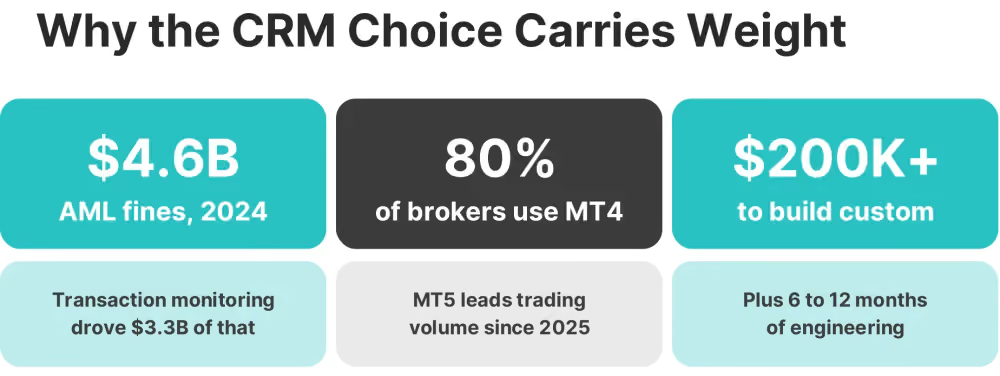
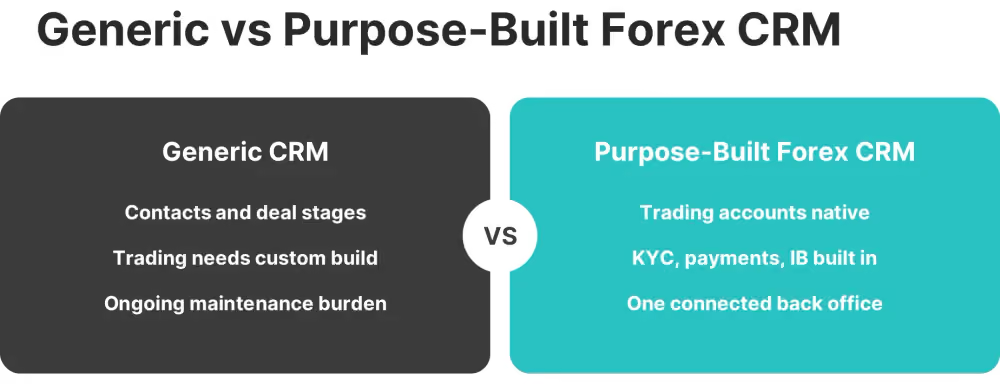
The reason a generic CRM struggles here is structural. Adapting one to run a forex brokerage can pass $100,000 and take six to twelve months of engineering before it provisions a single trading account. A platform designed for brokerage workflows ships those functions as standard, so the spend goes to operations rather than to custom code.
This guide sets out a 10-point framework for finding the best forex CRM and the decision-making it demands. It covers trading platform integration, KYC and AML workflows, payment infrastructure, IB payouts, and vendor reliability, plus what the decision costs after the license fee.
Key Takeaways
- A forex CRM works as an operating layer. It provisions trading accounts, moves KYC documents, processes payments, and attributes IB commissions at once, which a relabeled sales tool cannot do.
- Integration depth matters more than integration count. Check for native account creation, real-time status sync, and clear maintenance ownership rather than a wall of platform logos.
- IB and affiliate management deserves scrutiny at the level of commission logic, multilevel hierarchy, and payout transparency. For partner-led forex brokers it is one of the most consequential criteria.
- License price is a fraction of the real cost. Integration work, internal development, and the overhead of disconnected tools often exceed a purpose-built platform over a few years.
- Vendor reliability carries the same weight as feature coverage: 24/7 brokerage-specific support, maintenance ownership, and a track record in live brokerage operations.
Why Generic CRMs Fall Short for Brokerage Operations
Salesforce and HubSpot were built to track sales pipelines and customer conversations, and a brokerage needs neither as its core function. Running one as brokerage software means bolting trading account management, compliance workflows, and payment rails onto a system that assumes none of them exist.
The gap sits in the data model. A generic CRM runs lead management, stores contact records, and moves deals through stages.
A forex CRM carries heavier work. It opens trading accounts, moves documents through a KYC review queue, settles deposits and withdrawals, and calculates partner commissions, all while keeping the client cabinet and back office in sync. Those are different jobs, and bolting them onto sales software leaves you owning every workaround.
For a CTO, the first integration build is only the start. The larger cost is the maintenance after every platform update, the compliance gaps between systems, and the engineering time spent keeping tools talking that were never meant to. A purpose-built forex CRM such as B2CORE is designed around these workflows from the start.
What a Forex CRM Actually Manages
A forex CRM centralizes the full client lifecycle, from first signup through KYC, funding, trading, and IB payout, in one system. Its automation handles the handoffs a brokerage would otherwise run across spreadsheets, email, and separate portals.
Its work sits in a few operational layers:
- Lead and client management
- Client onboarding with KYC and AML compliance
- Trading account management across multiple platforms
- Payment gateway processing
- IB and affiliate management
- A client-facing Trader's Room
Each layer is a domain the evaluation below tests directly, because a forex CRM platform can list all of them and still handle most of them badly.
10 Criteria for Evaluating a Forex CRM
The framework below turns that operational scope into ten checks you can run against any forex CRM provider before a launch, a scale-up, or a consolidation of fragmented tools. Each criterion maps to a specific brokerage workflow, so the answers tell you how the system behaves in production rather than in a sales demo.
1. Purpose-Built Brokerage Fit
Start by asking whether the CRM was designed for brokerage operations or adapted from a sales platform. The answer sets how much custom development you inherit before the system runs core workflows.
A purpose-built forex CRM system treats trading account management, compliance queues, and IB attribution as standard capabilities. An adapted tool asks you to build or approximate each one. If your forex CRM provider's primary product is something other than dedicated forex CRM software, your team inherits the maintenance of every customization needed to run a general platform in a regulated environment, and that bill grows with each upgrade.
2. Trading Platform Integration Depth
Integration quality counts for far more than the length of the supported-platforms list. MT4 still sits behind roughly 80% of online brokers , and MT5 overtook it in total trading volume in 2025, so most forex brokers run more than one trading platform. Look for native account creation, real-time status synchronization, and client access provisioning on each connection.
The link has to work both ways. Account status should appear in the CRM as it changes, and a client action in the Trader's Room should reach the trading server without manual re-entry. For MetaTrader 4/5, cTrader, and B2TRADER, confirm the vendor maintains each integration natively rather than through a third-party API connector, and that compatibility holds as platforms update. The wider brokerage software stack a CRM plugs into shapes which integrations you actually depend on.
3. KYC/AML Workflow Support
Treat KYC and AML support as a primary criterion rather than a compliance checkbox. Regulators issued $4.6 billion in AML fines in 2024 , with transaction monitoring failures accounting for $3.3 billion of that, so the tooling that governs onboarding carries real operational weight.
Assess whether the CRM automates document collection, third-party verification, and review-queue management, with AML controls built in. For a COO, that depth decides onboarding throughput, compliance workload, and audit-ready records without manual handling. The CRM supports your compliance function; it does not replace jurisdiction-specific due diligence or guarantee a regulatory outcome, and any vendor claiming otherwise is overselling.
4. Trader's Room Functionality
Evaluate the client-facing portal as a layer distinct from the back office. Forex traders should manage accounts, fund them, and reach their trading platforms through one self-service interface. Portal quality feeds directly into retention and support load, because a clumsy cabinet generates tickets and adds friction at the deposit and withdrawal stages where trust is most exposed.
The Trader's Room and the back office have to stay synchronized. A client action should update back-office records as it happens, and a back-office status change should reach the client without someone re-keying it.
5. Payment Gateway Integrations
Read payment infrastructure as an operational requirement. Confirm the CRM connects to multiple payment gateways, tracks deposit and withdrawal status in real time, and gives operations reconciliation visibility without manual exports. Payment depth shapes both client experience and internal efficiency, since clients expect fast processing and your team needs accurate status data to manage exceptions.
When payment service providers (PSPs) sit outside the CRM, reconciliation turns manual, funding slows, and error risk climbs at the exact point where client money is in motion. That fragmentation is one of the most expensive habits a scaling brokerage can keep.
6. IB and Affiliate Management
Develop this criterion as a financial operations test. A capable CRM calculates commissions by lots and by volume and supports multilevel IB hierarchies. It should also attribute referral links, track promotional banners, and give partners portal access with transparent payouts.
For brokers with partner-led acquisition, the commission engine matters as much as the trading integration. A platform that lists an IB module but cannot compute multilevel commissions accurately, or cannot show partners real-time payouts, produces disputes and manual reconciliation instead of growth. Payout accuracy, attribution transparency, and hierarchy flexibility decide whether a partner network scales without adding back-office headcount at the same rate.

7. Reporting and Analytics
Reporting deserves its own criterion, well beyond a dashboard feature. Look for real-time metrics across onboarding conversion, KYC queue status, payment activity, trading activity, and IB performance. That depth sets how fast your team spots a bottleneck, a compliance backlog, or a payout discrepancy before it compounds.
Role-based access counts as much as coverage. Team members should reach the data their function needs without exposing client or financial records across the whole organization, since broad access is both an operational and a security problem.
8. Security Controls
Weigh security as infrastructure covering access control, data protection, and resilience. A brokerage CRM should include two-factor authentication over SMS or authenticator apps, SSL encryption, DDoS protection, and AML controls as standard.
Beyond protecting data, the access architecture supports risk management by deciding whether you can segment internal teams by role and function. That segmentation lowers the chance of unauthorized reach into client financial data, compliance records, and payment operations. No CRM removes operational, counterparty, financial, or compliance risk, so treat any absolute security promise as a warning sign.
9. Scalability and Configuration
Test whether the CRM absorbs growth in client volume, asset classes, and IB network complexity without custom development at each step. Multi-asset, crypto, and prop trading brokers carry specific needs that not every platform supports natively, such as PAMM and MAM account structures, asset-specific onboarding flows, and trading access across instrument types. Confirm these before selection rather than after go-live.
For a CTO, configuration flexibility decides independence. Either the brokerage adapts the CRM to new requirements on its own, or every change routes back through the vendor as a custom build. White-label deployment is one such configuration option, and its economics get more detailed below.
10. Vendor Reliability and Support
Judge the vendor as carefully as the software. Reliability rests on 24/7 support, brokerage-specific domain expertise, integration maintenance ownership, and incident response across your operating markets. Continuity depends on how fast the vendor moves when a payment route breaks, an onboarding flow stalls, or an integration degrades, and a team without brokerage expertise escalates problems a specialist would close on the spot.
Read commitment through observable signals: whether the forex CRM is the provider's primary product, whether it has a track record in live brokerage operations, and whether integration maintenance sits with the provider or lands back on your team.
The Real Cost of Getting This Decision Wrong
Total cost of ownership runs well past the license line. Adapting a generic CRM pulls in internal engineers, and industry pricing for custom builds runs from $50,000 to over $200,000 with six to twelve months of development. Hidden items add up on top: $3,000 to $15,000 for data migration and $1,500 to $10,000 per integration.
The operational drag compounds that. Fragmented KYC tooling delays compliance, disconnected payment systems add reconciliation work, and running separate CRM, cabinet, and back-office tools multiplies the maintenance. A cheaper generic or stitched-together setup often costs more over time, as manual processes and custom integration upkeep pile up with volume.
The build-versus-buy question turns on more than the purchase price. Engineering time, compliance risk, and delayed time-to-market usually dwarf the headline license fee when the infrastructure does not match how you operate. The economics of white-label CRM deployment and the tradeoffs between building in-house and buying ready-made work through both sides of that math.
How B2CORE Is Built for This Evaluation
B2CORE maps to the ten criteria above as B2BROKER's forex CRM and back-office system, purpose-built for multi-asset brokerage operations. It covers:
- Client onboarding with KYC and AML workflows and third-party provider integrations
- Multi-platform trading account management with native MetaTrader 4/5, cTrader, and B2TRADER connections
- Payment gateway integrations alongside IB and affiliate management
- Investment tools including PAMM, MAM, and social trading
- A Trader's Room secured with 2FA, SSL encryption, DDoS protection, and AML controls
B2CORE is one of as the most widely adopted forex CRM built specifically for multi-asset brokerages. This forex CRM platform ships as a white-label solution that carries the client lifecycle from onboarding and KYC through trading and IB payouts.
As a fintech and liquidity provider, B2BROKER has operated since 2014 and serves more than 1,000 institutional and corporate clients across one connected ecosystem. It won Best CRM Provider at the Finance Magnates London Summit and backs the product with 24/7 brokerage-specific support.
Next Steps: Consult a B2BROKER Expert
The criteria above give you a working framework. The next move is to test them against your own brokerage.
A conversation with a B2BROKER expert maps the top forex CRM solutions to your model, asset mix, and IB structure, so the evaluation reflects how you actually operate rather than a generic scorecard.
Frequently Asked Questions about Forex CRMs
What is the difference between a forex CRM and a regular CRM?
A regular CRM manages sales pipelines, contacts, and communication. A forex CRM adds trading account provisioning, KYC and AML workflows, payment integrations, IB commission attribution, and Trader's Room access, which a generic platform reaches only through heavy custom development.
What trading platforms should a forex CRM integrate with?
At minimum, the platforms your brokerage runs on, which for most multi-asset brokers means MetaTrader 4/5, cTrader, and proprietary platforms such as B2TRADER. Integration quality matters more than the list: check native account creation, real-time status sync, and vendor-owned maintenance.
Can a forex CRM handle KYC and compliance workflows automatically?
It can support them through document collection, third-party verification, status tracking, and AML controls, which cuts manual handling. It does not replace regulated compliance processes or jurisdiction-specific due diligence, which stay with your compliance team.
How do I know if a forex CRM can scale with my brokerage?
Check configuration flexibility before you need it: account structures, asset-specific onboarding, multilevel IB hierarchies, and regional compliance handled without custom development at each stage. Multi-asset and crypto brokers should confirm native support for their instrument mix.
Artigos recomendados


Assine a nossa newsletter