Flat Fee vs. Volume Fee: Which Fits a New Broker?


Flat fee vs volume fee is one of the first pricing decisions a new brokerage makes. The choice shapes how the business earns from day one and how stable cash flow looks once liquidity costs are paid. It also tends to stick: clients calibrate to the model you launch with, and migrating them to a different structure later costs trust and volume.
The right answer depends on the kind of flow your brokerage actually serves. A start-up working with low-activity retail clients needs steady, predictable account economics it can plan around. An ECN desk built around scalpers and prop clients needs pricing that absorbs high-volume, low-margin flow without eroding margin on every ticket.
Key Takeaways
- Flat fees stabilize revenue, while volume fees follow client activity more closely and squeeze margin during quiet, low-volatility months.
- The decision becomes a numbers question at the breakeven threshold, where expected client volume offsets the cost of running fixed pricing.
- Your client-facing model has to match upstream liquidity costs. Raw spread plus commission feeds into volume-style accounts. Spread markup hides per-lot cost inside the quote for clients who want a single number on the ticket.
- Retail scalpers, high-frequency clients, and institutional traders all gravitate toward volume fees with transparent commission. Lower-frequency retail clients with simple needs tolerate spread-markup pricing better.
- A full flat fee vs volume fee comparison also has to weigh maker-taker pricing, since rebates and fill incentives can quietly reshape order book depth.
The Decision That Shapes Your Entire Revenue Model
Your pricing model affects several sides of the business at once:
- Client profitability: Each client cohort either produces positive margin after acquisition and servicing costs, or it produces a loss the broker absorbs.
- LP economics: The terms your liquidity providers offer set a floor on how cheap your client-facing pricing can go before margin disappears.
- Revenue stability: Fixed charges keep top-line revenue steady through a quiet August. Commission-linked revenue follows market activity, so a slow quarter compresses margin while vendor bills and payroll stay where they were.
For a forex brokerage , the first question is which model holds margin steady for the kind of clients you can realistically acquire, given the LP credit lines and spread pass-through you already have. Once those inputs are clear, choosing between flat and volume becomes a numbers exercise.
How Each Pricing Model Works in a Brokerage Context
Three pricing models cover most brokerage situations today: flat fee, volume fee, and maker-taker rebate structures. Each one assigns broker revenue in a different way, so each behaves differently inside the P&L. The right test for any model is how it performs over a full quarter that includes both active and dormant accounts.
Flat Fee: Fixed Revenue Independent of Client Activity
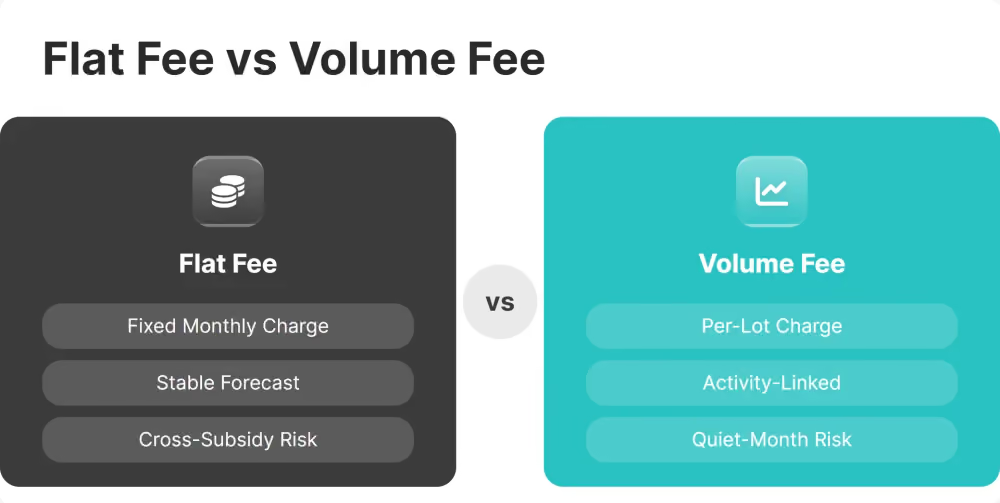
A flat fee is a fixed monthly charge that stays the same no matter how much the client trades. Platform subscriptions and connectivity fees often run this way. Spread-markup accounts work on a different principle: the embedded spread inside the quote produces variable revenue for the broker on every ticket, even when the client sees a "commission-free" label.
B2TRADER pricing shows a clean infrastructure-layer version of fixed pricing. The subscription bundles the platform and up to 10,000 active accounts, with no charges tied to executed notional or to the routing model.
The client-facing equivalent is a subscription account with unlimited trading inside a tier. Revenue gets easier to forecast that way. Quieter clients end up subsidizing active ones, and the tradeoff makes the account hard to position unless the tier targets a specific group.
Volume Fee: Per-Lot or Per-Contract Charges That Scale With Flow
Volume fee pricing charges clients for each unit of activity. In FX, that means per lot. In futures or options, it means per contract. Crypto derivatives often use notional value instead.
Volume fee schedules use three common patterns:
- Flat per-unit: The same commission applies at every volume level, so per-trade cost stays the same as activity grows.
- Graduated: The rate drops gradually as monthly volume rises, keeping client costs smooth across volume bands.
- Threshold: A flat rate applies only above a defined volume floor, with no charge below it.
A fourth design layered on top of these is the bracketed structure, where rates jump at fixed volume points. Brackets create cliffs around month-end, since clients tend to pace activity right up to the next tier. Smooth bands are usually the safer design, since clients do not change behavior just to clear a step.
Interactive Brokers shows the scale curve in its tiered options commissions. The base tier charges $0.65 per contract, and the rate falls to $0.15 once monthly volume crosses roughly 100,000 contracts. The 77% drop in unit cost shows the kind of scale advantage flat pricing rarely matches.
The Third Model Operators Often Overlook: Maker-Taker Rebate Structures
Maker-taker pricing assigns economics by order role. A maker posts a resting limit order and earns a rebate when the order gets filled. A taker crosses the spread with a market order and pays an explicit fee. Exchanges use this structure to subsidize displayed liquidity and monetize aggressive flow.
The model is rare in retail FX, common in equity venues, and increasingly visible in crypto derivatives. Polymarket fees show how it plays out in practice. Taker fees can run as high as 1.80% on crypto markets at 50% probability, and maker rebates sit at 20% for crypto markets and 25% for most other fee-enabled categories.
For a brokerage, maker-taker raises a tougher design question than flat-vs-volume. Rebates can deepen the book by paying market makers to post resting orders, and execution-quality controls have to be airtight once routing incentives start competing with best execution.
The Crossover Threshold: When One Model Becomes Cheaper
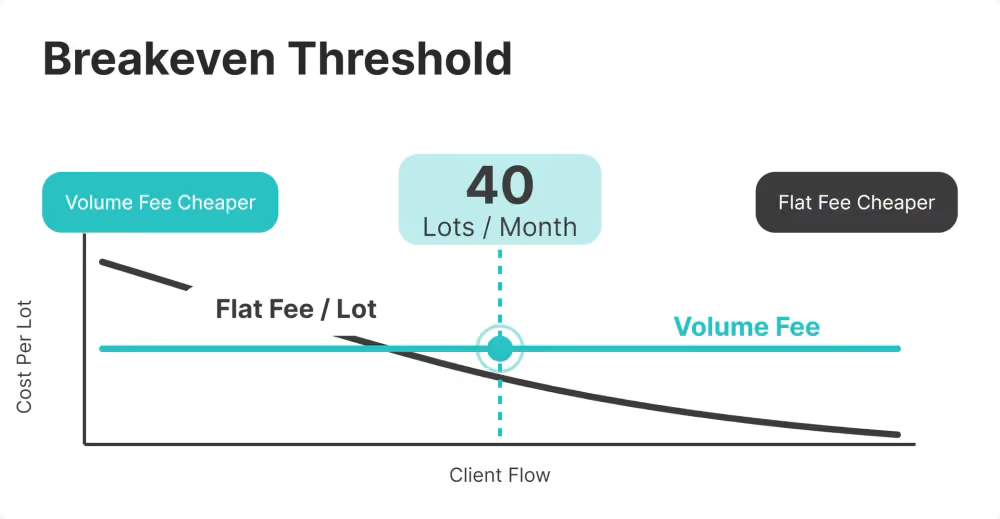
At low volume, flat pricing feels expensive to the client because the fixed charge has not been spread across enough flow. Once volume rises past a certain point, the flat fee becomes the cheaper option per lot. Where that crossover sits depends on the commission schedule and on cost-to-serve, so the threshold has to be modeled per account before pricing goes live.
Modeling the Breakeven Point With Real Commission Data
The breakeven formula is straightforward: monthly flat cost equals lots multiplied by commission per lot. A $200/month flat account with unlimited lots breaks even against a $5-per-lot schedule at 40 lots monthly.
Run the same math from the broker's side and the picture flips. Fixed pricing locks in revenue regardless of activity. Volume pricing only starts producing margin once the account has covered fixed servicing costs like support and KYC refreshes.
If your cost-to-serve on an active retail account runs $30/month, a 40-lot client paying $5 per lot brings in $200 against $30 in costs, while a 5-lot client at the same rate brings in just $25 against the same $30. Flat pricing would have covered the fixed cost in either case, and would also have given away the upside on the active client.
The same crossover dynamic appears in interchange-plus versus flat-rate merchant pricing: bundled charges sell more easily, but they get harder to audit when underlying costs shift. The brokerage version of that audit problem shows up when LP costs drift and a flat tier no longer covers them, but the client base has already calibrated to the published price.
Why Low-Volatility Months Expose the Risk of Pure Volume Pricing
A commission-only revenue model has one hidden weakness: the cost base barely moves when volumes fall. In a quiet month, a sharp drop in client activity pulls commission revenue down much faster than vendor bills or payroll can adjust.
Operators on fully volume-based books sometimes read this as a client-mix problem when the real issue sits in the pricing model. A small flat floor absorbs that swing. The floor is often a subscription fee, and higher-touch accounts may carry a minimum monthly commission or an activity fee instead of a minimum. The point is to make sure some part of revenue does not depend on volatility you cannot control.
How Your Upstream Liquidity Costs Should Inform Your Client-Facing Model
Breakeven math only works once it reflects the costs sitting upstream of the client account. Set pricing without LP economics in view and you usually create a quiet mismatch that grinds margin down over time.
If your LP charges raw spread plus $3 per lot, a spread-markup model on the client side hides that commission inside the quote. Active traders lose the cost signal, and scalpers will read the account as uncompetitive. The pricing model has to match the cost structure, or the broker pays for the mismatch on every ticket.
Spread-Based Accounts and the Cost-Pass-Through Dynamic
Spread-based accounts roll broker revenue into the quoted price, so the client sees a single number on the ticket. The setup simplifies UX and removes any need for client-facing commission reconciliation.
Wider markups protect margin when LP costs move around. Active clients compare raw-spread venues and basis-point differences in detail, so spread-based pricing fits lower-frequency retail flow with simple needs. Active and institutional flow rarely tolerates it.
ECN Commission Accounts and Margin Transparency
ECN-style accounts pass through the raw LP spread and charge an explicit per-lot commission. The client sees two numbers on the ticket instead of one. The operations side stays cleaner: commission revenue is cleanly attributable, and slippage sits outside the commission line.
Institutional clients evaluating your venue through FIX or API can also benchmark spread quality on its own. If your target segment includes any liquidity-sensitive traders , this is almost always the right structure, even when the pricing page looks more complex.
Matching Fee Structure to Trader Profile
Once LP costs are mapped, the client side needs the same kind of segmentation. A mixed book rarely fits one fee model. Push one model too hard and you either lose active clients to competitors or overcharge low-frequency clients to subsidize the rest of the book.
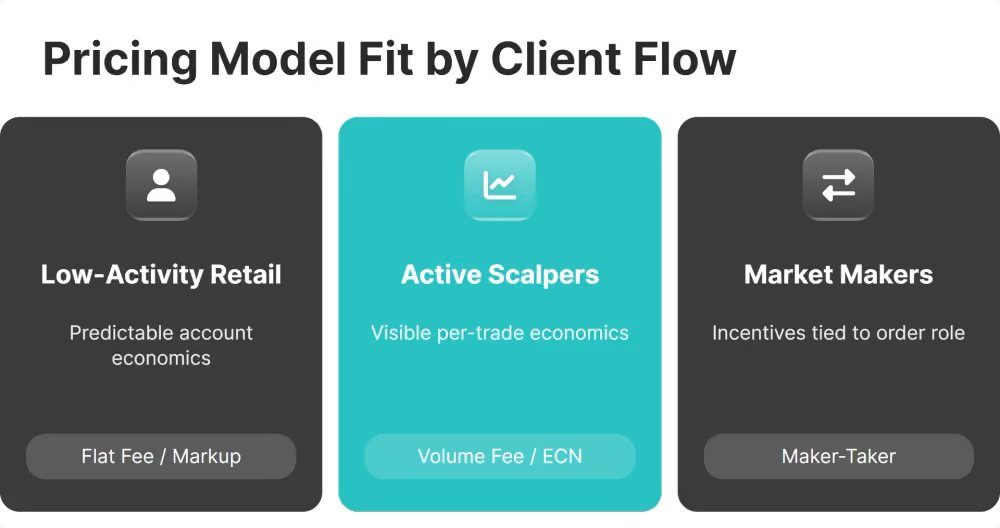
Most well-run brokers solve the problem by running multiple account types side by side. Three dimensions usually drive the segmentation:
- Trading frequency: How often the client opens and closes positions, the primary axis since it correlates with sensitivity to spread costs.
- Average order size: Whether the client trades retail-sized lots or larger institutional tickets, which changes how spread leakage affects them.
- Holding period: Whether positions close inside a session, span days, or run for weeks, which influences how much rollover and swap economics matter.
Frequency is the cleanest cut. Order size and holding period refine the segments further, especially for accounts that sit in the middle of the book.
Retail Scalpers and High-Frequency Clients
Scalpers care about raw spreads above everything else. Behind that, they look at fill speed and per-trade economics they can measure across venues. A commission-based or maker-rebate setup usually wins this segment because the cost is explicit and easy to compare.
Spread-only pricing looks simple on the surface. It turns uncompetitive fast once a scalper trading 200 lots a day starts comparing effective cost per trade across venues. For this group, transparency works as a conversion lever.
Institutional and Swing Traders With Large Average Order Size
Institutional and larger-ticket traders look at all-in execution quality more than at headline fee simplicity. On a 50-lot order, spread leakage and price impact usually outweigh any difference in commission.
Transparent commission or a custom hybrid model fits this segment because the client will judge you on fill quality and effective price. Operators comparing venue options generally find the segment responds better to disclosed commission and clean execution metrics than to embedded-spread models.

Build Your Pricing Model on Infrastructure That Can Execute It
Choosing flat, volume, or maker-taker is the strategy half of the problem. The execution half is harder: running multiple models in parallel without letting billing drift out of sync with routing, and swapping LPs without that swap leaking into client spreads. Homegrown systems usually fail there, and a pricing change that should take a week ends up taking a quarter.
B2TRADER absorbs that layer. Brokers configure commissions and markups inside one account structure, assign pricing plans per segment under role-based access, and route orders through A-Book, B-Book, or C-Book depending on the client. LP failover runs automatically when a feed slows down. The pricing decisions you've worked through in this article become configuration steps.
B2TRADER is part of the broader B2BROKER ecosystem, so get in touch to see how the full liquidity and execution stack can scale your brokerage.
Frequently Asked Questions About Flat Fee vs Volume Fee
What does flat fee mean in a brokerage pricing model?
A flat fee is a fixed charge that stays the same as trading volume changes, which makes revenue easier to forecast. In brokerage accounts, it usually shows up as a subscription-style tier with unlimited activity inside set limits.
When does volume-based pricing become cheaper than a flat fee?
Volume pricing is usually cheaper below the breakeven point, and a flat fee becomes cheaper once enough flow spreads the fixed charge across more lots. The exact crossover depends on cost-to-serve and expected lot count, and it shifts with the shape of the commission schedule.
What is the main downside of flat pricing for brokers?
The main drawback is cross-subsidy: lower-volume accounts end up paying for heavier users. If the flat tier is priced too broadly, the broker loses segmentation upside.
How do maker-taker fees differ from flat and volume fees?
Maker-taker pricing is role-based: makers post resting orders and may earn rebates, while takers cross the spread and pay explicit fees. The structure can deepen the order book, though routing incentives need strict execution-quality controls.
How should a new broker choose between flat fee and volume fee?
Start with client segmentation and upstream cost pass-through. Scalpers and institutional traders usually need raw spreads plus commission. Lower-frequency retail flow can tolerate spread markup better.
Recommended articles

Subscribe to our newsletter