What CTOs Miss When Choosing a White Label Prop Firm Solution


Most prop firm infrastructure decisions go wrong long before a trader completes a challenge. The mistake happens at vendor selection, when operators frame a white label prop firm solution as a software purchase.
A trading interface is software. The matching engine, compliance layer and liquidity feeds running on the backend are infrastructure, and that trading infrastructure is what your firm depends on every minute of every day. Once you blur that line, failure modes start compounding the moment you add a new trader cohort or a new asset class.
This guide is for CTOs and heads of operations at proprietary trading firms who already understand how the white label model works. It goes straight into the evaluation criteria that decide whether your operation scales cleanly or accumulates technical debt.
Key Takeaways
- Integrated stacks cut the contract management and integration overhead that operators inherit when they source trading, back-office and liquidity components separately.
- An in-house prop firm build typically runs 6 to 12 months of engineering work, which makes white label deployment the faster path to market for operators prioritizing launch speed.
- Regulatory shifts now raise the compliance baseline for every new white label deployment, from evolving crypto classification frameworks to the approaching T+1 settlement transition.
- Past client scale and licensing footprint signal vendor reliability far more than feature lists do, especially at shortlist stage.
White Label Prop Firm Market 2026
The proprietary trading sector has moved fast in the last 24 months. A forex-focused challenge model has grown into a full multi-asset business covering CFDs, crypto, equities, indices and commodities, and the buyers funding the infrastructure underneath it have changed too. Established brokerage technology providers now invest in this space alongside the fintech startups that once dominated it.
The platform layer has gone through a forced restructuring. MetaQuotes terminated MT4 and MT5 licenses for prop firms exposed to US clients in early 2024, and around 80 to 100 firms ceased operations by the end of 2025. That collapse took out roughly 13 to 14 percent of all global operators.
A stack locked to a single execution platform carries the same single-point-of-failure risk that took those firms out. The integrated providers worth shortlisting now offer optionality across cTrader , MT4 and MT5, and broker-backed alternatives.
Regulators are tightening from multiple angles. The FCA opened a review of algorithmic trading controls at principal trading firms in August 2025, and CySEC raised capital adequacy requirements for Cyprus Investment Firms at the start of the same year.
White label vendors competing for serious shortlists today have already extended their compliance tooling and licensing footprint across major jurisdictions. Anything less is risk that compounds with every new jurisdiction the operator enters.
What a White Label Solution Delivers
White label adoption usually gets framed around speed, and the speed argument is real. Compressing a 12-to-18-month in-house build into a multi-week deployment changes the entire launch economics and gets your own brand into the market while the window is still open.
The deeper win shows up after launch. You skip the original engineering scope (matching engine, compliance layer, risk controls, back-office integration) and the maintenance burden that follows for as long as the firm operates.
Infrastructure Over Software: The Right Frame
Most vendor evaluations stop at the software layer, listing the key features visible in the trading interface. The components running underneath that interface (execution, compliance, liquidity, back-office) form the infrastructure layer, and a serious evaluation has to cover both.
At B2BROKER, the platform, the CRM, and the liquidity aggregation platform work as a single, connected stack, with each layer designed to talk to the next from day one.
Why Integrated Stacks Outperform Point Solutions
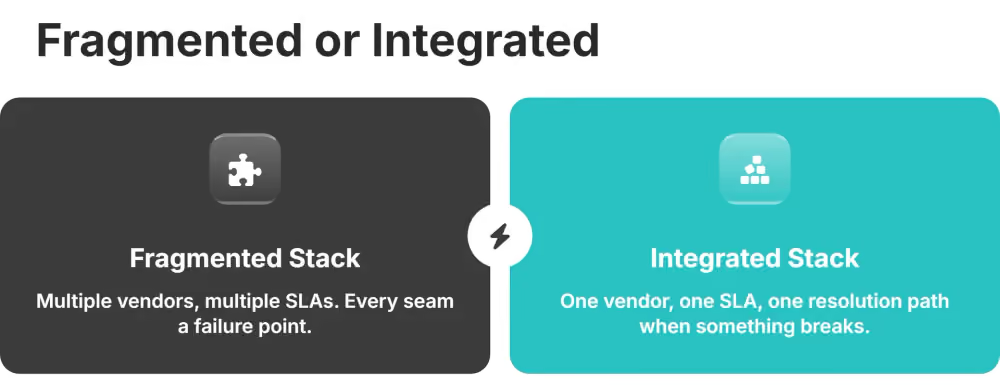
Fragmented vendor relationships compound operational risk. Every additional provider adds a contract to manage, an API to maintain, an upgrade cycle to coordinate and an SLA to monitor. Every seam in that stack becomes a potential failure point the moment your funded traders generate live order flow.
A single integrated provider consolidates SLA accountability into one place. When execution quality drops, you call one team. When a compliance workflow breaks, the same support desk owns the resolution.
Build vs. Buy: The Operational Case
No CTO should walk into a vendor evaluation without running the build-versus-buy numbers first. The numbers rarely favor building.
Time-to-Market and Engineering Cost Reality
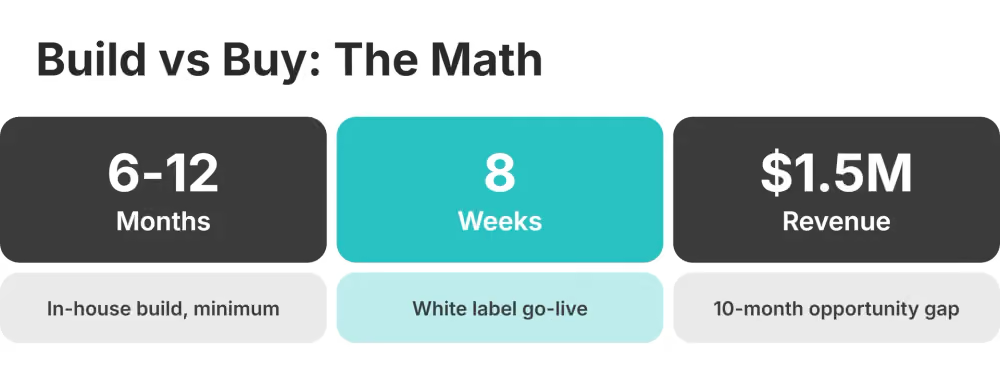
White label deployment runs in weeks. A custom build of a production-ready prop firm platform (matching engine, risk controls, compliance layer, back-office integration) typically runs 6 to 12 months as a minimum engineering project, and that estimate assumes experienced fintech engineers, no major scope changes and no regulatory delays.
The practical impact shows up on the revenue line. A firm launching via white label in week 8 captures roughly 10 months of challenge fee revenue that a competitor building in-house simply forfeits. At $150 per challenge and 1,000 monthly sign-ups, that's $1.5 million in top-line revenue alone. The hit to early profitability is even larger once you add engineering payroll, the opportunity cost of internal teams pulled off other priorities, and the revenue-sharing obligations every funded account triggers once it goes live.
Evaluating Any White Label Provider
This step-by-step framework compares white label providers across several standard criteria.
Platform Functionality and Flexibility
An institutional-grade white label platform delivers multi-asset instrument support, configurable leverage, native challenge-to-funded account workflow management, and proper mobile apps for traders managing positions on the go. A retail platform with plugins glued on top does not clear that bar.
Technology Infrastructure and Security
Ask vendors to specify their API connectivity standards. FIX 4.4/5.0, REST and WebSocket form the institutional baseline. Push further on uptime SLAs, latency benchmarks under load, disaster recovery RTO and RPO targets, and penetration test cadence. None of these are negotiable for any environment that holds live trader capital.
Regulatory Compliance Support
Compliance tooling and compliance judgment are two different things. The platform automates KYC workflows, AML monitoring and transaction screening, while interpretation of the underlying regulation stays with the operator.
Customer Support and Operational Coverage
Treat 24/7 support as a baseline requirement. Prop firm operators run live trader capital continuously across time zones and across volatile market conditions, and any gap in coverage hits during the wrong incident. Push vendors on average response time for critical incidents, escalation paths and dedicated account management availability during platform upgrades.
Pricing Structure and Scalability
Total cost of ownership covers spreads, connectivity fees, support tiers and per-account costs. Upfront licensing is rarely the biggest line item once your account volume grows. Ask the vendor exactly how their pricing scales with trader account growth, because a model that becomes punitive at scale creates a switching-cost trap that hits your trading business at precisely the worst moment.
Product Roadmap and Evolution
Ask for a concrete roadmap with committed delivery dates. Probe specifically on multi-asset expansion and regulatory update cadence. Roadmap delivery history matters more than future feature promises, so weigh past release velocity heavily when you compare providers.
References, Case Studies and Client Scale
Case studies need to match your operational profile to be useful: similar asset classes, similar trader volume and similar jurisdictional footprint. Generic case studies don't transfer. Evaluating top white label trading platforms for brokerages as part of your due diligence helps calibrate what institutional track records actually look like in this market.
What B2BROKER's Prop Firm Solution Includes
Mapped against the criteria above, B2BROKER's prop firm offering covers four components designed to run as one operating model:
- Trading Platforms: matching engine with margin and netting modes, dynamic leverage, partial liquidation logic, and the risk management tools that enforce real-time drawdown rules.
- CRM and Back-Office: covering onboarding, KYC, billing, reporting, and trader dashboards that monitor trader performance and account status.
- Multi-Asset Liquidity: FX, crypto, indices, commodities and metals from Tier-1 and non-bank sources, available from one margin account.
- Challenge Management Capability: custom multi-step challenges with profit targets, 4 risk-limit types, and per-account statistics.
- Crypto Payment Gateway: crypto funding, withdrawal and payout rails with FATF Travel Rule compliance and tainted-asset screening built in.
B2BROKER Is the Infrastructure Partner You Need
Fragmented stacks generate operational risk that compounds with growth, and an integrated infrastructure partner cuts that risk from day one.
B2BROKER serves more than 1,000 corporate, institutional and professional clients globally, holding 10 international regulatory licenses. We offer an all-in-one turnkey prop firm stack covering execution, multi-asset forex and CFD liquidity aggregation, CRM and back-office workflows, and crypto payments, all built to run as one operating model.
From your first 100 challenges to your first 10,000 funded accounts, the same operating model carries the load. That continuity is what an infrastructure partnership actually means.
Talk to an expert at B2BROKER to map your evaluation criteria directly to the infrastructure capabilities that matter at your current stage.
Frequently Asked Questions About Choosing a White Label Prop Firm Solution
Should I build a prop trading platform in-house or use a white label solution?
An in-house build typically runs 6 to 12 months across the matching engine, risk controls, compliance layer and back-office integration. White label deployment runs in weeks, and once total cost of ownership enters the picture, most operators choose it.
What integrations are essential in a white label prop firm stack?
A production-ready stack needs a matching engine with drawdown enforcement, KYC and onboarding flows, multi-asset liquidity and crypto payment rails, all connected via FIX 4.4/5.0, REST and WebSocket. Integrated providers deliver those layers as one ecosystem, so you skip the overhead of stitching vendors together.
How important is compliance support when selecting a prop firm provider?
Compliance support sits at the center of the evaluation now that crypto classification and post-trade settlement frameworks keep shifting. Vendors can automate KYC, AML and screening workflows, while interpretation stays with the operator, so multiple international licenses signal real credibility far better than a feature checkbox.
How do I compare white label prop firm providers beyond price?
Compare verifiable client scale, API connectivity standards, SLA accountability across the stack and case studies that match your asset class and jurisdiction. Past release velocity tells you more about future reliability than any feature promise does.
What should I look for when choosing a white label prop firm solution?
Prioritize infrastructure depth over feature breadth: matching engine reliability, compliance tooling flexibility, liquidity quality and 24/7 support. An integrated provider covering execution, CRM, liquidity and crypto settlement in one ecosystem removes the SLA complexity that fragmented stacks compound with every new trader cohort.
Recommended articles


Subscribe to our newsletter