What Liquidity Management Strategies Fit A-Book Brokers?

Every A-Book desk knows the pattern. Spreads that look healthy in the monthly execution report still widen sharply the moment news breaks.
BIS research on liquidity fragility measured the mismatch. Average spreads have fallen for two decades while extreme illiquidity events have become more frequent. In simulations calibrated to US equities, the premium paid for immediate execution more than doubles , from about 6% to 13%, once liquidity turns fragile.
For a broker that externalizes client flow, the liquidity setup decides how much of that fragility reaches clients. That is why liquidity management strategies for brokers belong to execution architecture, not treasury administration.
The sections below walk through what decides whether externalizing your flow pays off, from the execution model to the compliance layer.
Key Takeaways
- Because execution quality comes from outside the firm, an A-Book broker evaluates LP depth and connectivity like production infrastructure.
- Running several liquidity providers in parallel removes the single point of failure in your pricing.
- Prime of Prime access lets a mid-tier broker trade on institutional terms without holding a direct prime relationship.
- Routing rules and live intraday controls matter more now that T+1 settlement leaves less room to fund a bad session.
- With supervisors reviewing liquidity setups directly, counterparty limits, audit trails, and contingency funding plans belong in the design from day one.
Why Liquidity Management Works Differently for A-Book Brokers
An A-Book broker buys its execution quality from other firms. Every client order fills against a third party's quote, at a third party's depth, within a third party's response time.
Margin flows move by the minute and settlement deadlines arrive daily. At that speed, a provider that starts rejecting mid-session reaches your clients before you can reroute around it.
Market structure has made that dependency riskier. The BIS study also found that market fragmentation and algorithmic trading pushed average spreads down while making liquidity more fragile under stress. For a desk, that means sourcing from more than one venue.
The Execution Model Decision and Its Liquidity Implications
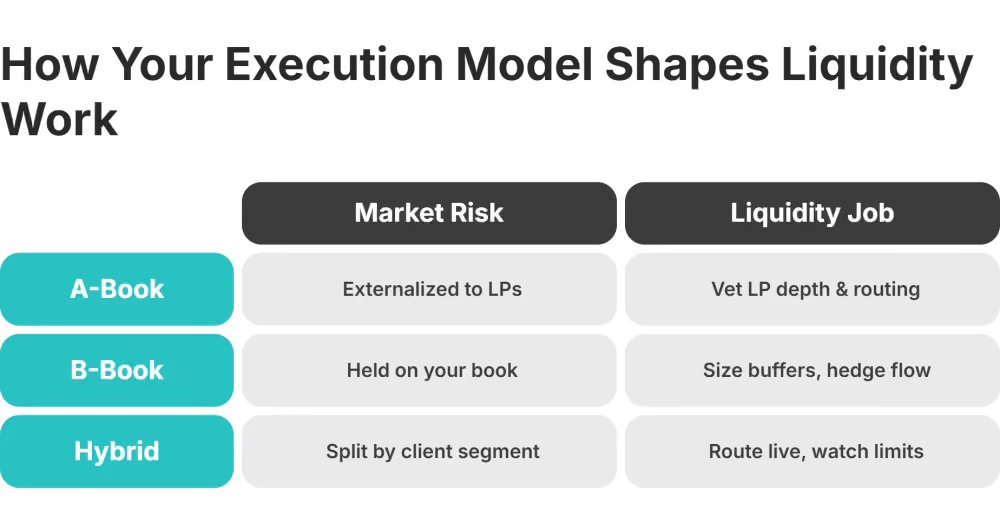
Your execution model fixes how often you hedge and how much capital you tie up. The technology follows from both.
A separate guide covers how agency, market-making, and hybrid models source and price liquidity . Each of the three puts a different daily load on an operations team.
A-Book: Full Externalization and LP Dependency
Full externalization lowers principal risk and moves performance risk onto your providers. Their reject rates and last-look policies now define your client experience, while the bridge adds latency on your side.
Evaluate a provider on production numbers, collected before you sign:
- Executable depth beyond top of book, per symbol and per session
- Fill ratio and reject behavior through news windows
- Quote stability during volatility spikes
- Median response time across the sessions you actually trade
A provider that streams a tight headline spread but rejects aggressively through a payrolls release costs more than its pricing saves.
B-Book: Internalization and Capital Buffer Requirements
Run a B-Book and the spread revenue arrives with market risk on your own balance sheet. You have to hold capital against it, because the buffers have to survive the day client flow turns one-sided.
A strong trend market lines up client wins on the same side of the book. Unhedged exposure grows just as winning clients start withdrawing. The buffer that looked comfortable at month-start now has to cover both at once.
Under the FCA's MiFIDPRU regime, the ICARA process expects a firm to size liquid assets against stress scenarios of exactly this kind.
Hybrid Models: Dynamic Routing and Infrastructure Demands
Hybrid routing splits flow between externalization and internalization. That flexibility depends on client segmentation and explicit routing rules under constant surveillance. Without them, the book takes on both models' risks and neither model's controls.
B2TRADER supplies those controls: dynamic leverage, position netting, and partial liquidation logic. The desk can act while a position is still open.
Core Liquidity Management Strategies for A-Book Operations
Sourcing, routing, and monitoring carry the liquidity work on an A-Book desk. When all three hold, execution quality survives a volatile session as well as a quiet one.
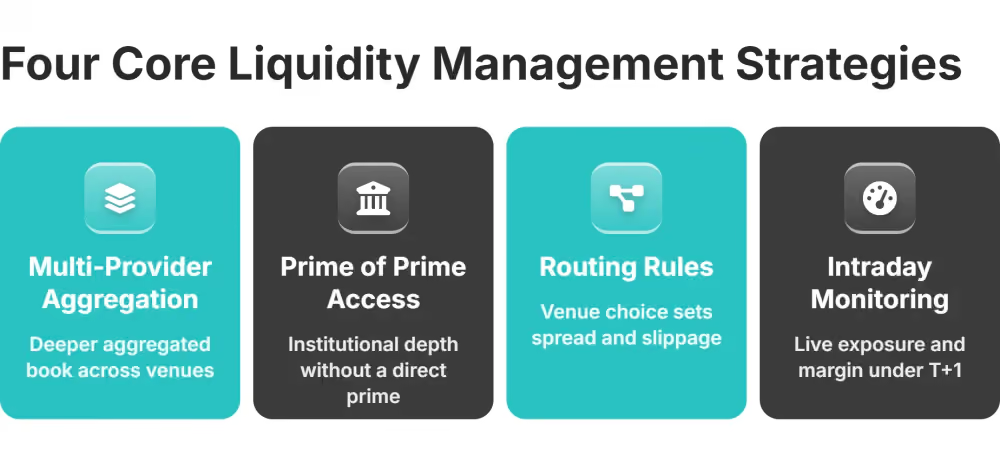
The four liquidity management strategies for brokers split across those three jobs, two of them on sourcing alone. Run them as a checklist against a provider or your own stack.
Multi-Provider Liquidity Aggregation
One provider, however good its pricing, is a dependency.
Multiple LP streams deepen the book and keep quotes competitive when a venue drops out. Compare feeds on how they behave during macro events.
Blended top-of-book pricing means little if depth beyond level one disappears when a decision on interest rates hits. Rejection statistics from those windows tell you more than any monthly average. A liquidity broker running a well-built aggregation layer normalizes those feeds into one book your router can trust.

Prime of Prime Access as an Institutional Liquidity Bridge
Direct prime brokerage often exceeds a mid-tier broker's credit capacity, because tier-1 primes set their thresholds at institutional scale. A Prime of Prime provider restores that reach by intermediating the credit relationship and passing institutional depth downstream.
B2BROKER's multi-asset liquidity works as that bridge. You price against an institutional book without opening a credit line at each venue.
How Routing Rules Set Your Fill Quality
Your aggregation layer picks which quote each order actually hits, and that choice sets your realized spread. The rules behind it also decide your slippage and how evenly you use each LP.
Tune them on the variables that move outcomes:
- LP ranking and symbol-level routing rules
- Time-in-force defaults per order type
- Toxicity filters on outbound flow
- Failover behavior when quotes gap or a venue degrades
Watch the per-provider statistics, because fill and reject numbers show which LP earned its ranking.
Intraday Liquidity Monitoring and Real-Time Position Controls
Settlement compression turned liquidity monitoring into an intraday job. T+1 settlement shortens funding windows on the securities side, and crypto sessions add volatility around the clock.
You need live views of exposure and margin utilization. Intraday cash flow forecasting and unsettled short-term obligations belong on the same screen.
The EBA's revised supervisory guidelines give intraday liquidity risk its own definition and expect the institutions they cover to evidence how they monitor it, with application from January 2027. Those views are cheaper to build now than to assemble during an examination.
Counterparty Risk and LP Diversification
Depth does not protect you if it all comes from one counterparty, however strong its financial health. Whatever hits that firm hits your entire book at once.
Spread the risk across dimensions. In counterparty risk management, a long provider list is not, by itself, diversification:
- Provider type, because banks and non-bank market makers thin out at different points in a stressed session
- Jurisdiction, so one regulator's action cannot freeze every credit line you have
- Asset class and settlement pathway, where an outage on one rail leaves the others live
When a few dominant providers pull their quotes at the same moment, downstream liquidity degrades fast , as it did in the 2015 Swiss franc break. Write a contingency plan for an LP outage before you need it, then extend it to spread blowouts and credit-line withdrawals.
Brokers sourcing crypto liquidity alongside FX and fixed income apply the same diversification test per asset class, because depth concentrates differently in each market.
The provider that looks deepest on a calm morning is often the first to pull its quotes when markets gap.
Regulatory Compliance as a Liquidity Management Driver
Supervisors review the liquidity mechanics your desk runs every day. Execution resilience, funding plans, and liquidity risk management are direct review topics, because they decide whether client money stays safe when something breaks.
Sooner or later one of them will ask how your setup works. The answer has to exist in records.
FINRA's oversight reports have already named the failure pattern for US broker-dealers. Those firms stress clearing-deposit requirements against month-end numbers and miss the intra-month swings that T+1 settlement makes sharper .
For UK and EU firms, the pressure comes from the FCA's ICARA process and ESMA's liquidity stress testing expectations. Each regime wants you to size buffers and keep evidence, in its own format. The records a supervisor asks for are the ones your desk already needs to run the book.
Build Your Liquidity Infrastructure Around the Right Partner
The partner you pick has to cover sourcing, routing, monitoring, and counterparty limits at once, because none of them holds up alone. Liquidity management strategies for brokers work best when the whole loop, from LP connectivity to the monitoring dashboard, runs as one system.
B2BROKER combines multi-asset liquidity, Prime of Prime access, and the surrounding trading and back-office technology. Your operations team manages one stack with one escalation path.
That choice rests on a partner's track record. B2BROKER has operated since 2014, serves 1,000+ corporate clients, and holds 10+ regulatory licenses. If you are building a liquidity operation from scratch, or rebuilding one that failed the last time markets moved fast, the team can map a configuration to your flow profile and jurisdiction.
Frequently Asked Questions about Liquidity Management
What is the difference between A-Book and B-Book liquidity management for brokers?
A-Book brokers pass client flow to external providers, so the work centers on depth, latency, fill consistency, and counterparty diversification. B-Book brokers keep the risk in-house, which moves the focus to exposure netting, hedge thresholds, and capital buffers.
How does liquidity aggregation improve execution quality for brokers?
Aggregation merges quotes from banks, non-bank market makers, and venues into one book, which tightens top-of-book pricing and deepens available liquidity. Paired with well-tuned routing rules, it improves fill rates and limits single-provider concentration risk.
How do brokers access institutional-grade liquidity without a prime brokerage relationship?
The credit line comes from a Prime of Prime provider that already holds tier-1 relationships. A hub such as [B2CONNECT](https://b2connect.b2broker.com/) packages that access with pricing and connectivity, so a broker skips qualifying for multiple direct prime relationships.
How should brokers manage liquidity risk during periods of high market volatility?
Watch exposure and provider behavior in real time, then rebalance routing before spreads widen materially. A rehearsed contingency funding plan matters more under T+1, because there is less time to improvise one.
What should brokers look for in a liquidity infrastructure partner?
Ask how many providers sit behind the pricing, whether you can inspect the routing logic, and who owns the problem when a feed degrades. An integrated stack, such as B2CONNECT with B2TRADER and [B2CORE](https://b2core.b2broker.com/), reduces vendor sprawl.
Recommended articles

Subscribe to our newsletter