Full-Service vs. Discount Broker: Which Model Can You Scale?

The choice between a full service broker vs discount broker is an engineering decision before it is a positioning one. Get it wrong, and the bill lands about eighteen months in, once the platform carries live clients and re-architecting means rebuilding the broker while it runs.
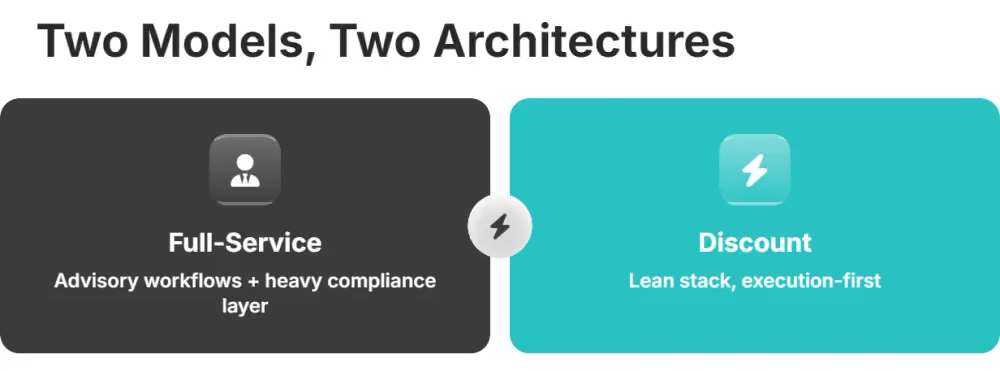
The two models pull in different directions from the first line of code. A full-service build carries advisory workflows and a heavy compliance layer; a discount build runs lean and rests on execution speed.
This article breaks down both types of brokerages from the operator's side and helps you decide which one fits the brokerage you want to launch.
Key Takeaways
- The choice between full-service and discount is an infrastructure commitment that locks in your technology spend for years.
- Full-service operators carry far heavier compliance overhead, since every piece of financial advice needs a suitability check and a documented supervisory trail.
- A discount model runs on a leaner, lower-cost modular stack, which speeds up deployment and cuts vendor dependencies at launch.
- STP and ECN route orders differently, producing different revenue and different best-execution duties.
- A hybrid setup puts self-directed trading at the base and adds advisory tiers on top, so you grow without re-platforming later.
Two Models, Two Operating Architectures
Full-service and discount brokerage are two different operating architectures. They run on different technology stacks and different liquidity models, each with its own compliance obligations.
A full-service brokerage runs on an advisory delivery system. The operator has to build:
- suitability workflows and a CRM deep enough for decades-long client relationships
- portfolio management, financial planning, and research from in-house analysts
- multi-asset liquidity across forex, crypto, equities, ETFs, mutual funds, indices, commodities, and metals
- the surveillance and supervisory layer regulated advice requires
The whole platform is large and tightly integrated, which makes it slow to change once it is live.
A discount brokerage runs on an execution delivery system instead. The core pieces are:
- a high-throughput matching engine
- automated KYC and onboarding
- payment processing built for volume
- a back office scoped to reconcile and report
This stack is leaner and quicker to change. Everything rests on software quality, because no advisor sits in the relationship to smooth over friction.
The Cost of Switching Models After Launch
Early decisions create inertia. A stack built for STP routing and spread-based revenue bakes in assumptions about how orders move and how profit and risk get booked.
Re-platforming to ECN order-book economics after launch means re-wiring the matching engine, the risk layer, and the surveillance and revenue systems at once. Operators who have done it describe it as rebuilding the broker while live clients keep trading. An ECN platform built around commission also cannot easily drop into high-volume retail discount.
What Full-Service Brokerage Demands from Operators
A full-service brokerage firm needs far more than a trading platform and a liquidity feed. Its range of services runs on advisory workflows, and the piece operators underestimate most is the compliance layer around all of it.
Advisory Compliance, Suitability, and Fiduciary Overhead
Every recommendation needs a suitability check and supervisor sign-off, and real-time surveillance watches advised trades as they happen. Each one leaves a paper trail regulators can pull under frameworks like the SEC's Regulation Best Interest , and each advisor's book goes through periodic supervisory review in line with FINRA Rule 3110 . Discount brokers build none of this, because they give no advice.
Multi-Asset Liquidity, CRM Depth, and Reporting Requirements
Full-service operators need liquidity well beyond equities, across FX, crypto, indices, commodities, and metals, because clients paying advisory fees expect premium execution. A capable CRM tracks each investment portfolio's drift and flags the life events that should trigger a rebalance, and reporting covers performance and tax planning. A thin CRM is the most common reason mid-market launches lose advisors to better-equipped rivals.
Advisory Licensing vs. Execution-Only Scope and Cost
The advisor works to a fiduciary standard and documents how each recommendation fits the client's financial goals, which turns into real headcount: a Chief Compliance Officer with advisory experience, principals to supervise each book, and surveillance staff for flagged trades. A discount operator runs a leaner team focused on transaction monitoring and AML, so its per-account compliance cost comes out far lower.
What Discount Brokerage Demands from Operators
From the outside, discount brokerage looks simpler, but the demands are just as heavy, only pointed elsewhere. The spend goes to matching throughput, automated onboarding, and platform quality.
With no advisory relationship to lock clients in, fast trade execution and built-in research tools are what keep them. A client who cannot trade in a couple of taps, or who hits a slow login at a volatile open, is one bad review away from leaving.
Matching Engine Throughput and Automated Onboarding
The matching engine sits at the center: how much load it carries and how fast it stays under it decide where the broker stands, and the pressure peaks during volatility spikes when every platform strains at once. Automated onboarding pulls account opening from days to minutes by folding identity and sanctions checks into one straight-through flow.
Cost-Efficient Processing and Back-Office Configuration
The back office is lean on purpose. One tightly scoped data model covers compliance and payments alongside partner management and reporting, with no advisory overlay or drift engine to maintain. Upgrading the payment processor never forces a regression test of an advisor's surveillance dashboard.
Execution Architecture: STP vs. ECN
Execution architecture is its own decision, and either business model can run STP or ECN . STP routes each order straight to a liquidity provider for a spread markup, which keeps complexity low. ECN pools orders into a competitive book that needs heavier infrastructure but delivers tighter spreads, commission revenue, and the execution institutional clients expect.
STP Routing, ECN Order Book Management
An STP broker stays effectively stateless: orders route to the best liquidity provider on price and credit, revenue comes from the markup, and the surveillance burden stays narrow. Running an ECN book adds priority queuing, manipulation detection, and a detailed audit trail of every match, so cost and engineering depth rise to match.
Liquidity Aggregation Requirements by Model
An ECN operator lives or dies on liquidity-pool depth; one that cannot fill institutional-sized orders at its advertised prices loses the clients it was built for. An STP operator gets by with fewer LP relationships, while an ECN operator must invest in aggregation and redundant connectivity and watch slippage and rejection rates across the panel.
The Hybrid Model: Tiered Service
Most operators land between a pure full-service and a pure discount build. The common path is a tiered model: low-cost, self-directed (DIY) trading at the base for beginners, with advisory tiers added as the client base matures.
A hybrid build is a staged decision. The operator opens quickly on a discount foundation, grows a client base on cheap unit economics, then promotes qualifying clients into wealth-management tiers. The same logic shows up in the crypto broker vs exchange business model choice between intermediated quoting and running a full order book.
Infrastructure Optionality and Staged Architecture
The execution engine routes the same way at every tier; what changes by account configuration are the workflows, surveillance rules, and reporting around it. The enabler is CRM configuration: the back office must hold advisory and self-directed accounts in one data model, with no compliance conflicts or duplicate records. Get that right at launch and you can promote a client inside one account history instead of reconciling two systems by spreadsheet.
Revenue Model and Unit Economics
The revenue implications run deeper than the headline fee difference. Each model carries its own unit economics and its own route to profitability, and that should shape how you buy infrastructure from the start.
A full-service brokerage account bundles retirement planning and broader wealth management under a licensed financial advisor, with advisory fees running 1% to 2% of assets under management and premium tiers reserved for high-net-worth individuals with seven-figure minimums. Discount operators sit at the other end, with near-zero account minimums and commission-free equity trades, which makes the choice between flat fee and volume fee pricing decisive for P&L.
Fee Structures, Spread Markup, and Path to Profitability
Full-service revenue rests on advisory fees, commissions on advised trades, and account-level service fees, so higher fees keep margin per client high while lifetime value compounds with tenure. Discount revenue comes from spread markup and commission, topped up by payment for order flow where the rules allow. Margin per trade is thin, so profitability depends on volume.
Scalability, Headcount, and Operational Leverage
Full-service brokerages scale through advisor capacity; discount brokerages scale on automation and throughput. Picture one hundred advisors serving fifteen thousand clients: taking on another fifteen thousand means hiring roughly sixty more advisors. A discount operator clearing two million orders a day can clear four million tomorrow on the same engineering team, if the architecture was built for it.
Advisor Ratios vs. Automation Leverage in Discount Models
Client-to-advisor ratios cap how much AUM one advisor serves before attention slips, putting a soft ceiling on margin. A discount model has no such ceiling, because every infrastructure upgrade multiplies throughput while headcount stays flat. That non-linear payoff is why a discount broker can grow into a nine-figure revenue business with an engineering team that still fits in one room.
Choosing Your Model: A Decision Framework
The model comes down to a few variables, and the fit between them decides whether your architecture can carry growth. Target market fixes the client segment and the AUM band. The budget sets the infrastructure you can buy and the compliance team you can sustain through the first three years. Expertise decides capability, since a team with no advisory depth cannot credibly stand up full-service asset management.
Market Fit, Operational Readiness, and Budget Constraints
Define the target client segment first, by its AUM band, jurisdiction, and appetite for advice, and then price the compliance setup and liquidity access it needs. An operator with advisory expertise and high-AUM clients should look hard at full-service, while one serving a high-volume, self-directed market should build a discount. If the trajectory is unclear, design for hybrid tiered service at launch, so there is nothing to retrofit later.
Get the Foundation of Your Infrastructure Right from Day One
The full service broker vs discount broker choice shapes your technology procurement, your compliance posture, and your scaling trajectory for years after launch. Treat it as architecture from the start, and the early work compounds instead of forcing a rebuild.
B2BROKER's role across both models is the same: one integrated stack spanning institutional liquidity, the B2TRADER matching engine,B2CORE CRM and back office, and B2BINPAY payments.
Get started with B2BROKER and talk to a team that has helped hundreds of operators build the right brokerage from the ground up.
Frequently Asked Questions about Full-Service and Discount Brokers
What infrastructure does a full-service broker need that a discount broker doesn't?
Full-service operators carry advisory and suitability machinery with full audit trails, plus a CRM deep enough to track decades-long relationships. A discount broker skips that layer and runs a leaner stack focused on matching throughput and automated onboarding.
How do full-service and discount brokerage models differ in their execution architecture?
Order execution is a separate decision from the business model. STP, common in high-volume retail, routes orders straight to liquidity providers for spread-markup revenue, while ECN, favored for institutional flow, pools them into a competitive book that costs more to run but returns tighter spreads and commission revenue.
Can a brokerage offer both discount trading and advisory services in a hybrid model?
A tiered architecture does exactly this, keeping self-directed execution at the base with advisory tiers on top. It works only when the back office holds both account types in one data model from launch, which avoids an expensive re-platforming job later.
How do full-service and discount brokers differ in their path to profitability?
Full-service revenue comes from AUM-based advisory fees of roughly 1 to 2 percent, which lifts client lifetime value but raises acquisition and compliance cost per account. Discount revenue rests on spread markup and commission volume, so margin grows mainly by scaling throughput, since no single account moves it much.
What compliance obligations separate a full-service broker from a discount broker?
Giving investment advice forces a full-service broker to document and supervise every recommendation under suitability rules, with dedicated compliance staff. An execution-only discount broker works to a narrower scope built around transaction monitoring and market-abuse surveillance, which keeps its per-account compliance cost much lower.
Recommended articles

Subscribe to our newsletter