Single Tenant vs Multi Tenant: Which Fits Your Brokerage?


Somewhere in every platform evaluation, a brokerage CTO has to answer one question for the board: if we run on shared infrastructure, can we prove that client data, execution performance, and jurisdictional controls stay isolated? Getting isolation wrong is expensive. IBM's 2026 report puts the average cost of a data breach in financial services at $6.29 million , second only to healthcare.
You answer that question by choosing between single tenant vs multi tenant apps. Tenancy sounds like an architecture detail, yet the model you pick decides how long deployment takes, how much your team maintains afterwards, and what you can hand an auditor.
This guide compares the two models on the criteria regulated brokers test in a live evaluation and closes with a decision framework you can take into an RFP.
Key Takeaways
- A single-tenant app dedicates a whole application stack to one brokerage, while a multi-tenant app serves many firms from shared resources and keeps each firm's records and settings apart.
- Single tenancy gives you the deepest customization and blast-radius control; multi-tenancy cuts maintenance, shortens deployment, and makes costs easier to predict.
- Multi-tenant security depends on isolation design, encryption, and the strength of the platform's identity controls.
- Test data residency, access boundaries, performance isolation, upgrade governance, and audit evidence before committing to either model.
- A hybrid model keeps the shared platform's efficiency while each brokerage sets its own risk, execution, and compliance rules.
Single Tenant vs Multi Tenant Apps: Defining the Architectural Divide
A single-tenant app runs a separate instance for each customer. Multi-tenancy puts several customers on one shared platform and enforces boundaries between them in data, configuration, and access.
Between those two extremes, cloud providers describe three isolation patterns. AWS's software-as-a-service guidance names them siloed, pooled, and bridge , and each one trades separation against the cost of running it.
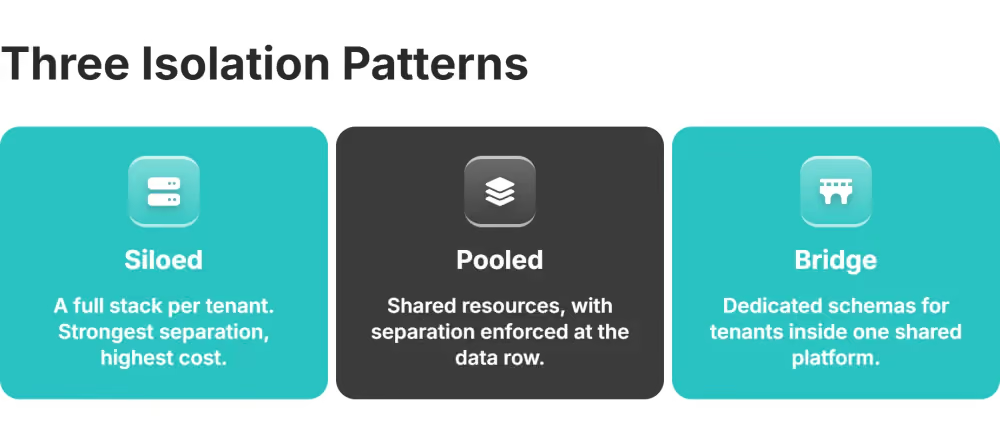
For a brokerage, the pattern decides where a failure stops. Order matching, liquidity routing, KYC queues, and the APIs your clients trade through all inherit the isolation of the layer they run on. The practical question is which pattern each workload needs.
What Single-Tenant Architecture Delivers
Single-tenant architecture gives each brokerage dedicated resources — its own application, database, and infrastructure, often inside a private cloud. Nothing you run competes with another firm for capacity. If another firm's deployment is breached or goes down, yours keeps trading.
That separation also makes deep customization possible. With no other tenant on the instance, the vendor can rework the platform for one client, from the user interface down to the code level.
You pay for that separation in operations. Every instance needs separate provisioning and its own patching schedule. Upgrades reach one deployment at a time, leaving some clients on older versions and waiting longer for fixes.
A dedicated instance is also not secure by itself. Without disciplined IAM and tested disaster recovery, it is no safer than a shared one, and your clients carry the consequences.
What Multi-Tenant Architecture Delivers
Multi-tenant architecture runs one platform for every client and isolates each tenant's data and configuration logically. An upgrade reaches all tenants in one release, the vendor scales the supporting infrastructure for everyone at once, and a new brokerage launches on a platform that is already live.
How secure multi-tenancy can be depends on the engineering behind it. Google Cloud's reference architecture for multi-tenant AI systems pairs per-tenant project isolation with principal access boundaries, so a compromised identity in one tenant cannot reach another tenant's data.
Because implementations still vary widely, a buyer has to inspect each one before trusting the label on it.
The Due-Diligence Criteria Brokerage CTOs Actually Weigh
Evaluate the controls and the evidence behind them, because the tenancy label predicts neither safety nor total cost. A SaaS vendor advertising single tenancy can still run weak access management, while a multi-tenant platform can surprise you on the invoice.
A brokerage platform delivered from the vendor's cloud is usually multi-tenant SaaS, so confirm the model for every product on your shortlist. Structure the evaluation as an RFP checklist and test every line in an architecture review or a proof of concept.
Data Isolation and Security Controls
Ask each vendor to demonstrate its data security controls on a live system; a slide that says "bank-grade security" proves nothing. Five demonstrations show how the vendor enforces tenant boundaries, from key management to recovery targets.
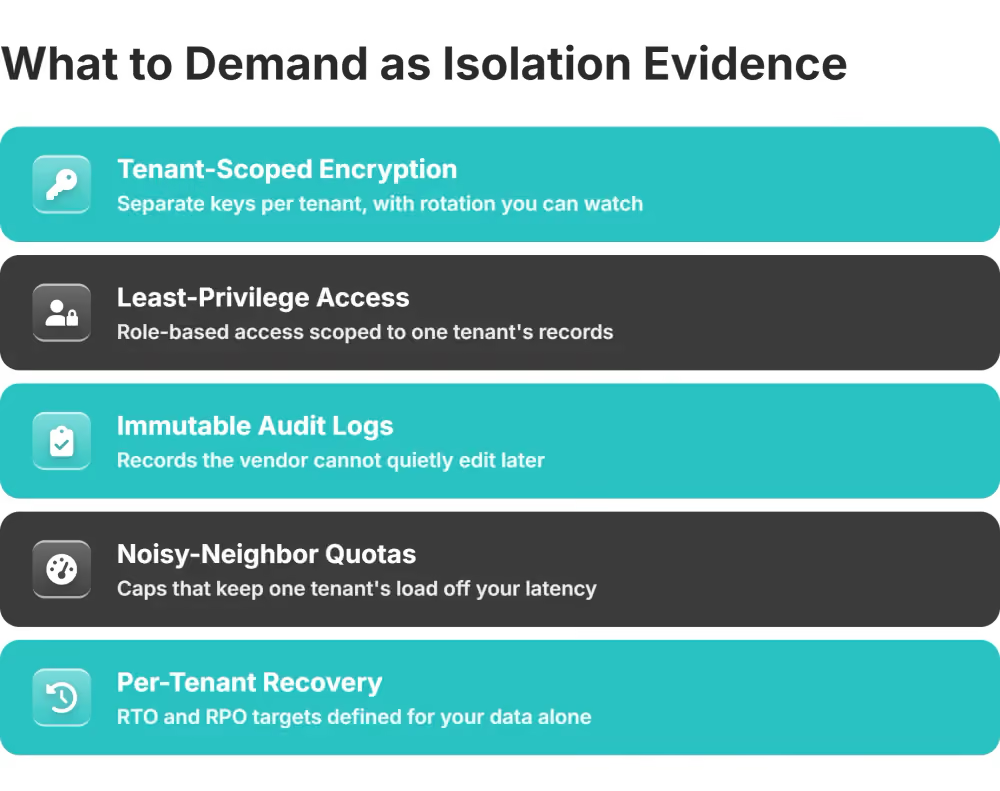
Vendors will offer a sandbox. Insist on production-scale load, because quotas and recovery times only show their limits under contention. Add the latest penetration-test report to the request. A vendor that cannot produce this evidence under NDA has answered your question.
Some vendors put the blunt version of the answer on the record, as B2BROKER does here.
Regulatory Compliance and Cross-Border Data Residency
Your licenses and client contracts define where data must live, how long you retain it, who may access it, and what you report. Obligations under MiFID II and the rules of the FCA or CySEC differ by license and data class, so no single residency rule covers every workload. Vendors selling across industries will point at their GDPR and HIPAA work, which is useful as far as it goes and covers none of your license-specific duties.
Write down your data protection duties before you shortlist vendors:
- every jurisdiction you are licensed in, and what client data each one covers
- every processor and subprocessor that touches client records
- the transfer mechanism and retention schedule behind each data class
- any right of access a regulator can exercise over that data
Check candidate architectures against that list early, because retrofitting residency after go-live is where deployment budgets break.
Cost Predictability and Deployment Speed
Price the models across the whole lifecycle rather than the license line. Dedicated instances concentrate cost in provisioning and per-environment maintenance. A shared platform puts it into engineering that the vendor spreads across every tenant, which is where the cost efficiency of multi-tenancy comes from.
A three-year total cost of ownership model with named deployment milestones makes proposals comparable, the same way a broker sizes any infrastructure build-versus-buy decision . Treat any universal "multi-tenancy saves X percent" figure as marketing, because the real number depends on your scale, jurisdictions, and customization depth.
Why 'Multi-Tenant Equals Less Secure' Is an Outdated Assumption
Shared infrastructure does not weaken security by itself. The instinct that it does dates to an earlier era of cloud computing. Isolation engineering and IAM discipline decide the outcome now, and a single-tenant stack fails just as fast when nobody reviews access.
In a threat model, the same path keeps recurring: an engineer misconfigures an access policy, an attacker uses the over-permissioned identity, and data crosses a tenant boundary. Every step on it has a named control. Automated policy review catches the misconfiguration, and least-privilege scoping limits what the stolen identity can reach.
In SecPod's 2025 survey of more than 400 cloud security leaders and practitioners, 73% named misconfiguration as their leading cause of cloud breaches , with overly permissive IAM roles and exposed storage buckets heading that list. The Cloud Security Alliance's IAM guidance treats identity as the primary perimeter , with least privilege as the control that holds it.
Inside B2BROKER's Hybrid-Tenancy Model for Regulated Brokerages
Hybrid tenancy settles isolation workload by workload. An analytics dashboard can run on the services every tenant shares. A client-money ledger usually cannot, so it gets a dedicated database and its own encryption keys.
Paying for full single tenancy across every workload buys isolation most of those workloads never use. A hybrid setup spends that budget where a regulator or a client contract actually demands separation.
B2BROKER documents each product in public, so every claim in this section comes with a page a buyer can open and check. Running trading, back office, and liquidity from one vendor also gives a broker a single escalation path when execution and reporting disagree, and no version gap between the trading platform and the CRM for the team to reconcile.
Dedicated Liquidity Pools and Configurable Compliance Rules
Liquidity reaches every brokerage through one channel, B2BROKER's multi-asset prime-of-prime aggregation , a single institutional connection covering FX, crypto, indices, commodities, and metals. What each brokerage configures for itself sits in the layer above.
That layer is B2TRADER , where margin policies, dynamic leverage, and partial liquidation rules are set per brokerage. Its cross-asset margin engine calculates requirements on the whole portfolio, so two brokerages can run different risk postures on the same platform.
On the operational side, B2CORE segregates onboarding, KYC, billing, roles, and reporting by brokerage and by jurisdiction. That is the bridge pattern in practice, a shared platform with tenant-scoped configuration that extends from segregated onboarding through security controls and white-label setup .
IAM Controls Aligned With CSA and NIST Frameworks
Whether a user in one tenant can read another tenant's records comes down to identity checks. Make each vendor say which of these it actually runs:
- tenant-scoped role-based access control and least privilege
- multi-factor authentication and privileged-access governance
- service identities with periodic access reviews and an audit log of every privileged action
Each control on that list carries a number in SP 800-53, the catalog inside the NIST SP 800 series , where least privilege is AC-6. Quote those numbers in your RFP, then ask for the configuration screenshots and log samples behind every answer before you accept the word "aligned" from anyone.
Single-Tenant vs Multi-Tenant at a Glance: A Decision Framework
No software architecture wins every row of the single tenant vs multi tenant apps comparison. Match each workload to an isolation pattern across the dimensions below, then apply the triggers that follow.
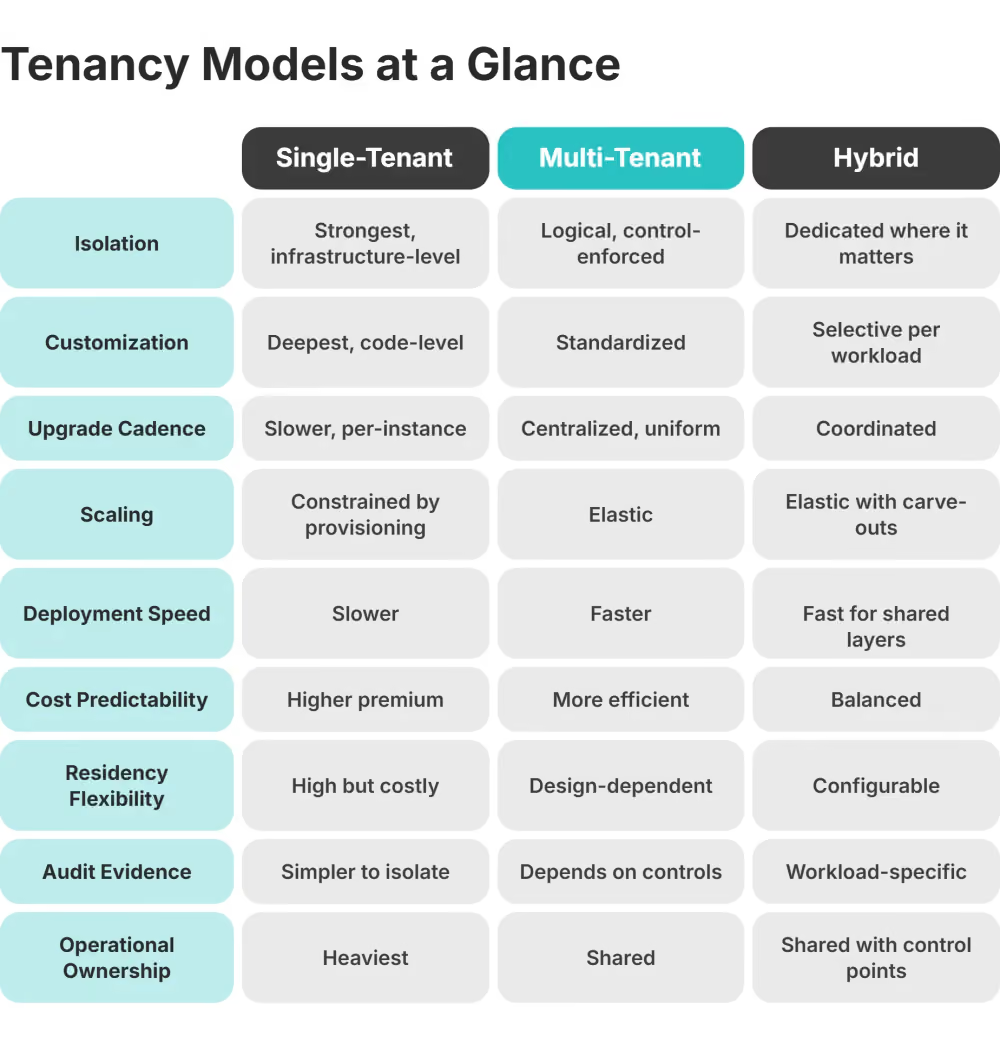
Favor a dedicated deployment when a physical-isolation mandate or a code-level customization requirement leaves no alternative. Favor multi-tenancy when standardization, cost-effectiveness, and vendor consolidation dominate your priorities. Most regulated brokers land on a hybrid, because their workloads carry different compliance requirements.
Building Your Brokerage on Infrastructure That Scales With You
Scale comes from giving each workload the isolation its data requires, and nothing heavier. Work through the single tenant vs multi tenant apps decision one workload at a time, and accept a vendor's answer only when it can show the control running.
Hold B2BROKER to that test as well. The company has been building brokerage infrastructure since 2014, it serves more than 1,000 corporate clients today, and it has helped launch over 500 brokers.
If you are mid-evaluation, ask each shortlisted vendor to show the isolation settings of a live brokerage on its platform. That one screen tells you where the tenant boundary actually sits, in the database or in the access policy.
Frequently Asked Questions about Single vs Multi Tenancy
What distinguishes single-tenant from multi-tenant apps?
A single-tenant app gives each customer its own software and infrastructure instance, which puts the boundary at the infrastructure layer. A multi-tenant app hosts many firms on shared infrastructure and separates them with logical controls at the data and application layers.
Which architecture better suits a regulated brokerage?
Firms with strict physical-isolation mandates or deep customization needs lean toward single tenancy, while brokers prioritizing deployment speed and predictable cost lean toward multi-tenancy. Many regulated brokers end up with a hybrid that dedicates only the sensitive layers.
Does multi-tenant architecture create greater security risk?
Risk follows the quality of isolation design, IAM enforcement, and monitoring, and sharing infrastructure by itself does not raise it. Validate access segregation, audit trails, and penetration-test results before trusting either model on its name.
How does database isolation differ between single-tenant and multi-tenant apps?
Single-tenant deployments usually give each broker separate databases, which simplifies separation but multiplies maintenance. Multi-tenant databases enforce separation logically through tenant-scoped schemas or rows, backed by separate encryption keys where the data class calls for it. Test authorization boundaries and backup segregation under production-scale load.
How should brokerage CTOs choose between single-tenant and multi-tenant apps?
Start from regulatory obligations, residency, customization depth, latency targets, and total cost of ownership, then give every workload the lightest isolation it can safely run on. A hybrid stack such as B2BROKER's shares one platform and still gives each broker its own margin rules, onboarding flow, and reporting.
Recommended articles
Subscribe to our newsletter