Build vs. Buy Brokerage Software: A Complete Decision Framework

Tackling the build vs buy brokerage software question is arguably the most consequential infrastructure choice your leadership team will make. This decision dictates exactly how fast your firm can transition from the planning phase to actually processing live client deposits.
Your chosen path also establishes your regulatory foundation, defining the exact architecture your firm will use to pass future compliance audits.
Modern brokerage technology combines the client trading experience with the internal engines that manage permissions. Your technical stack must maintain a stable execution path to liquidity while providing the tools to manage complex funding flows.
This guide offers a decision framework for brokerages, with concrete questions you can use in planning meetings. You’ll see where custom work pays off, how to check ownership costs, and cover hybrid approaches that combine reliable core infrastructure with your own proprietary software solutions.
Key Takeaways
- Custom development should be reserved for core differentiators like proprietary risk models, leaving standard operations like order routing to off-the-shelf solutions.
- Building an entire infrastructure from scratch typically demands massive upfront costs, delays market launch by 18 to 24 months, and generates permanent technical debt.
- Commercial WL platforms automatically push critical compliance updates, eliminating the need for internal developers to manually code evolving regulatory changes.
- A hybrid architecture maximizes operational efficiency by combining a purchased high-speed execution backend with a custom-built frontend client portal.
Discover the Tools That Power 500+ Brokerages
Explore our complete ecosystem — from liquidity to CRM to trading infrastructure.
Evaluate Brokerage Functions: Core vs. Commodity
A successful infrastructure strategy starts with identifying the technology that aligns with your specific business needs. Before building, firms usually separate their assets and systems into two buckets.
Core functions represent the specialized technology that gives your brokerage its unique market methodology and trading edge. That can be risk rules tied to your dealing model, or a client portal experience designed around your acquisition funnel.
Commodity functions include industry-standard capabilities where engineering a solution from scratch consumes thousands of developer hours without generating any strategic value. These standard systems typically cover basic retail order routing or tools to automate compliance reporting. Connectivity can also fall into this bucket when it depends on widely adopted industry protocols, such as the Financial Information eXchange (FIX) protocol.
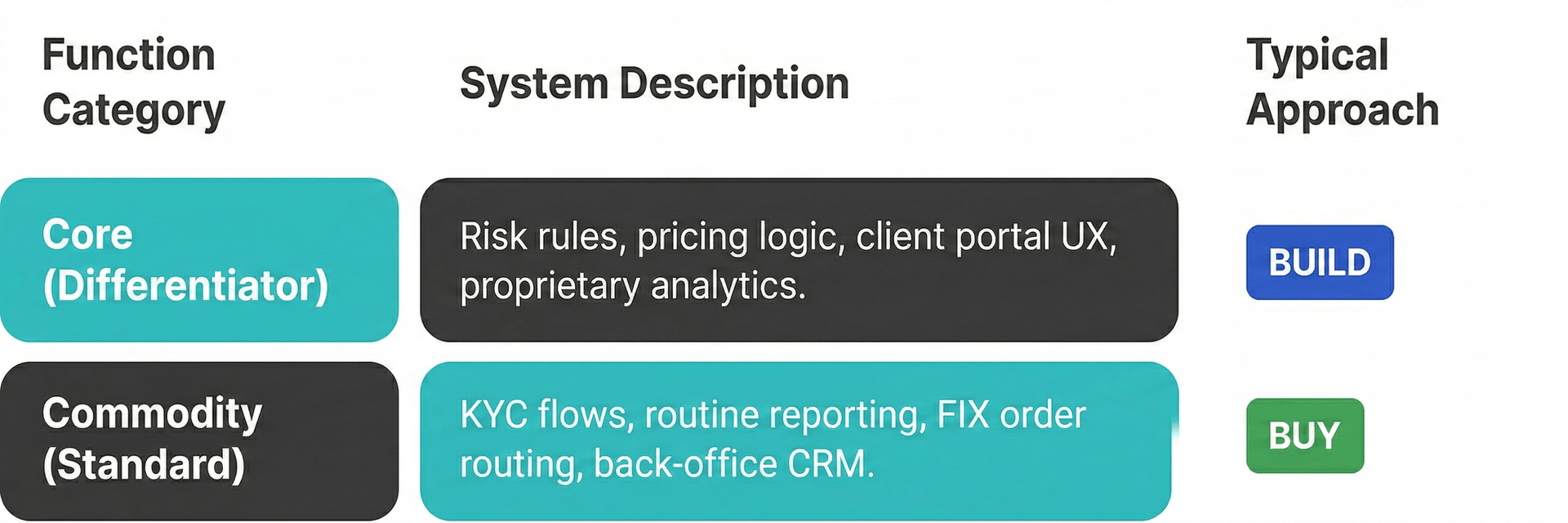
A straightforward litmus test helps categorize these requirements during your architecture planning sessions: if a new competitor can buy off-the-shelf software for a specific technical capability and reach operational parity overnight, that feature firmly belongs in the commodity category.
Mapping out these technical requirements early clarifies your budget and development timeline.
Build vs. Buy Software Pros and Cons for Brokerages
After requirements get sorted into core and commodity, the conversation shifts to operational trade-offs of building versus buying. Let's look at how both paths affect your budget and growth targets.
Control and Customization
A build route typically puts the codebase, roadmap, and IP under the brokerage’s full control. That matters when execution logic is intertwined with your core business processes, or when client-facing flows are tightly coupled to how the firm acquires and services accounts.
A buy route usually concentrates on configuration plus the vendor’s API surface. The practical question becomes how easily you can deploy new features for your institutional platform without breaking upgrade paths, and whether the workflow can live inside the platform’s operating model.
Building custom software makes sense if your firm relies on highly unusual execution models. Just make sure to define your absolute must-have features before writing any code to prevent massive scope creep during the development cycle.
Time to Market and Resource Allocation
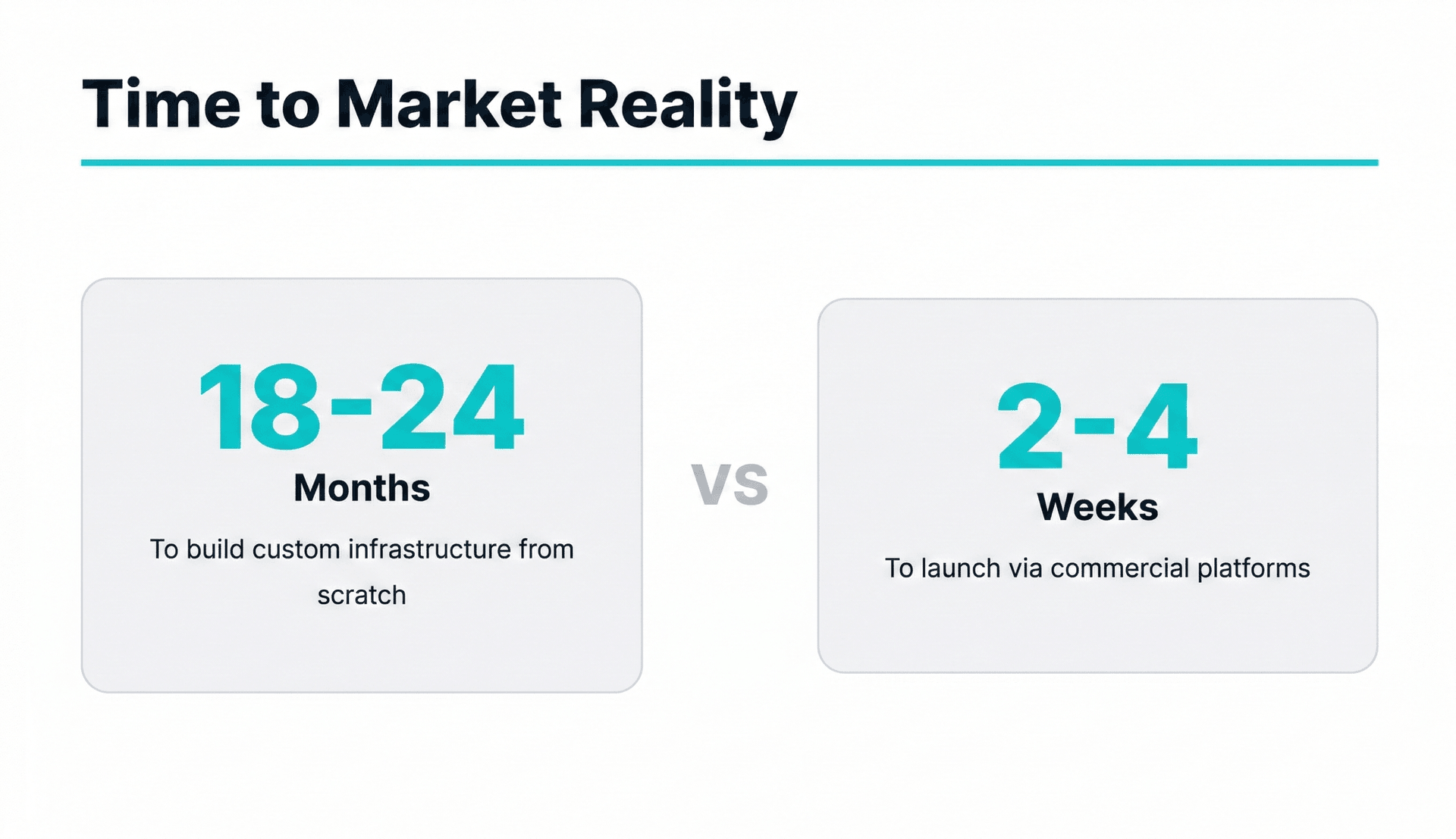
Deploying purchased software radically accelerates your timeline to start generating revenue. Most turnkey platforms and SaaS solutions launch within weeks, which gives you a massive advantage when trying to capture a narrow market window.
Building software from scratch is a massive undertaking. You will need a huge initial investment, a dedicated engineering team, and robust project management to deliver a custom platform to production-readiness, which usually takes 18 to 24 months.
Choosing vendor technology frees up your internal staff to focus heavily on acquiring new clients and improving your core services. A multi-year in-house build only pays off when the final product delivers a massive competitive edge that justifies the long wait.
Compliance Assurance and Maintenance Load
Compliance and audit readiness are continuous, daily requirements for brokerage software due to constant regulatory oversight. In Europe, MiFID II dictates expectations for record-keeping and communications recording, with ESMA guidance detailing retention standards. Similarly, in the UK, FCA supervision shapes both record-keeping practices and control frameworks.
Established software vendors typically include embedded compliance tools and push automatic updates whenever international financial rules change.
If you build a proprietary system, your internal developers carry the heavy burden of tracking these regulatory shifts and writing new code to satisfy them. Brokerages without a deep bench of compliance experts usually find that relying on vendor-maintained infrastructure significantly reduces their overall liability risk.
Key Factors in a Build vs. Buy Analysis
Most teams pressure-test their buy options and build strategies through a few practical lenses: Does the approach match where the brokerage is going? What does it cost to operate over time?
Strategic Fit with Growth Plan
Mapping out a detailed three-to-five-year operational roadmap highlights exactly which capabilities will generate your competitive edge. Projecting these future milestones helps leadership identify the specific technology required to support upcoming expansion phases.
Creating unique revenue drivers often involves writing custom code to keep your core market methodology completely private. Conversely, aggressive global expansion typically demands a highly scalable commercial infrastructure. Entering new regulatory jurisdictions requires proven systems that can handle sudden user growth without triggering massive engineering overhauls.
Documenting your exact differentiators early reveals whether internal development is actually necessary, as many firms achieve their desired architectural outcomes by augmenting purchased vendor solutions with customized API layers.
Total Cost of Ownership Modeling
Total Cost of Ownership (TCO) is the full cost of running the stack after go-live. TCO modeling captures the entire financial footprint, including any hidden costs, of your technology choices from day one through year five. A useful TCO worksheet usually separates costs into several buckets:
- Recurring vendor fees or hosting spend
- Ongoing engineering headcount for support
- Security work tied to audits and reviews
- One-time migration, integration effort, and the opportunity cost of a delayed launch
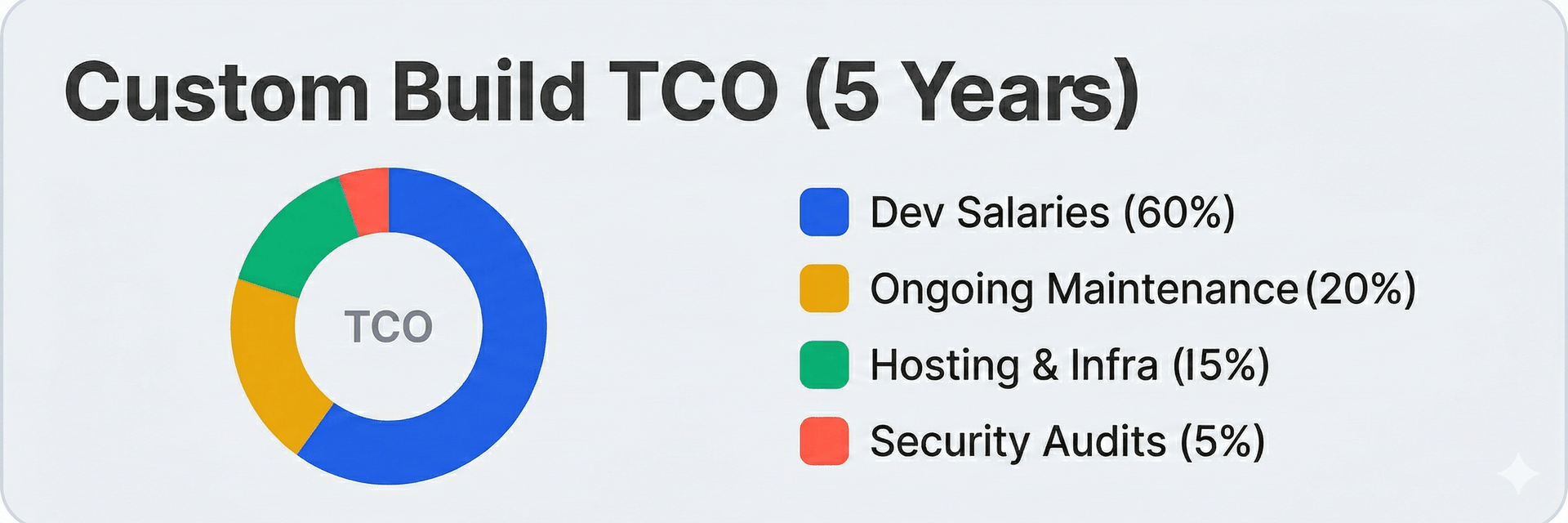
The true cost of building, heavily driven by development costs like developer salaries and technical debt remediation, rapidly inflates the final price tag for your own software. At the same time, white-label solutions offer highly predictable baseline fees, simplifying early financial planning. However, you should expect vendor expenses to increase organically as your active user base scales upward.
Constructing a comprehensive five-year TCO model that weighs anticipated maintenance costs against expected engineering payroll provides a realistic financial picture for your stakeholders.
Integration and Scalability Requirements
Modern financial operations demand seamless connectivity across your execution engines and client management portals. The trading layer has to talk to liquidity providers, while the business layer has to stay in sync with your existing systems, including CRM and back-office tools.
Purchasing the best brokerage technology solutions typically grants immediate access to robust API endpoints and pre-built FIX connections. These established communication pathways drastically streamline technical implementation.
Conversely, a custom solution can align closely with your environment, but every integration adds to your engineering surface area. Your development team must manually program the complex data flows moving between the core risk engine and the back-office administration panel, and that work increases with every external dependency.
Scalability should be tested against the roadmap using ranges rather than a single target number. Many teams model several multiples of current volume over a few years, then check whether the architecture and support model stay stable.
Build vs. Buy Decision Framework for Startup to Enterprise Brokerages
Moving from theory to a final infrastructure choice requires a structured approach applicable to any growth phase. Here’s a step-by-step evaluation framework that grounds your ultimate decision in operational reality.
Step 1: Define Differentiators and Roadmap
Start by listing the specific capabilities that directly acquire and retain your traders. Treat these highly unique features as your primary candidates for internal development. Grouping the rest of your technical requirements into the standard commodity bucket significantly accelerates your initial launch timeline.
Plotting these needs on a multi-year roadmap clarifies exactly what matters today for your unique business versus what becomes critical two years down the line. Aggressively validating whether a proposed custom feature actually creates a permanent competitive advantage prevents wasted engineering cycles on easily replicated tools.
Output from Step 1
- One-page list of differentiatorswith a success metric
- Roadmap split into launch phase and later phases
- Notes on what can be sourced via vendor modules or APIs
Step 2: Audit Internal Expertise and Capacity
Engineering core enterprise software requires deep domain knowledge of low-latency execution environments and complex regulatory constraints. Relying solely on general web development talent frequently leads to critical system failures during periods of high market volatility.
Thus, conduct an honest internal audit to reveal your actual capacity to build and maintain these demanding systems over the long term.
A massive expertise gap makes purchasing commercial software the most reliable path forward. Delegating heavy infrastructure maintenance to external partners frees your internal staff to concentrate entirely on revenue-generating client initiatives.
Output from Step 2
- A named owner for each system area, including on-call coverage
- A skills gap list tied to specific modules
- A hiring or vendor plan tied to those gaps
Skip the Developer Hiring Headache Entirely
Launch a fully branded, white-label software in weeks without writing a single line of code.
Step 3: Stress-Test Vendor or Prototype
Run a test that looks like production work. Test specific use cases with real workflows and real data shapes, then measure what breaks first, because that becomes the integration cost later.
For a vendor path, focus on evidence from the platform: demos, decision-grade inputs come from API behavior, integration effort, and audit artifacts that can be exported.
Firms leaning toward the custom development route need to build a tightly constrained prototype before authorizing the full project budget. Develop a focused proof of concept that exposes hidden technical complexities and validates your projected resource requirements early in the process.
Output from Step 3
- A scored test report with pass/fail criteria
- A list of integration blockers with effort estimates
- A compliance artifact sample, such as logs or reports
Hybrid Approach: Combining Built and Bought Components
Many leadership teams ultimately adopt a hybrid infrastructure model to balance strict budget constraints with ambitious business goals.
Purchasing the core operational software delivers immediate backend optimization alongside high-speed execution capabilities. Your internal engineering teams then focus entirely on developing specific proprietary layers to establish a permanent competitive edge in your target market.
Custom Client Experience Layer
Brokerages frequently purchase backend trading infrastructure while developing their user-facing interfaces entirely in-house. Building a bespoke web portal or a native mobile application delivers a premium user experience that solidifies your brand identity and directly improves long-term trader retention.
Relying on a purchased backend requires extensive API flexibility from your chosen technology vendor to make the architecture work. Your internal frontend developers need unrestricted access to core operational data via REST and WebSocket protocols to deliver a truly seamless client experience.
Before front-end build work starts, it helps to confirm support for:
- Account creation and role permissions
- KYC status updates and document states
- Balance and transaction history
- Order placement and order status updates
- Trade history exports
- Webhooks for key events
The B2BROKER ecosystem actively supports these hybrid models through deep API extensibility. We provide institutional-grade backend foundations designed specifically to integrate flawlessly with your custom-built applications.
Proprietary Risk or Pricing Modules
Another common hybrid scenario involves layering proprietary pricing algorithms over a purchased execution engine. You can run your own exposure logic or pricing rules as a separate service, then pass decisions into the order flow through a defined interface.
This approach keeps IP in logic that drives P&L decisions, without rebuilding execution components.
Yet, implementing this strategy requires clearly defined technical integration points between the separate systems to securely handle high-volume data flows. Weak architectural connections inevitably create a massive ongoing maintenance burden for your engineering staff and cause severe platform fragility during sudden market volatility.
Start your Forex Brokerage in Weeks, not Months
All Technology, Liquidity & Payment Integrations Included
White-Label cTrader/B2TRADER with Full Back Office Support
Compliance-Ready Setup with Ongoing Technical Support
Make the Right Infrastructure Decision for Your Next Stage
A clean build vs. buy decision starts with balancing tight launch deadlines against the financial reality of total ownership costs. Many growing firms find their ideal equilibrium through a hybrid approach that secures a proven vendor backend while keeping the client-facing experience entirely proprietary.
B2BROKER partners with financial firms to compress launch timelines and scale revenue effectively across market cycles. We have spent over a decade building an interconnected ecosystem that pairs deep multi-asset liquidity with complete wallet infrastructure.
Our advanced CRM & back-office solution, aggregated Tie-1 liquidity across 10 asset classes, and integrated trading platforms (cTrader, B2TRADER) provide maximum scalability for expanding businesses. A global team of over 500 professionals develops this ecosystem under 10 active regulatory licenses.
We deliver continuous 24/7 technical support to help our corporate and institutional clients maintain flawless daily operations. Connect with our technical specialists to get started and build your exact architectural foundation today.
Build Your Brokerage on Proven Infrastructure
Deploy our multi-asset white-label solutions and let our engineers handle your entire technical backend.
Frequently Asked Questions about Build vs Buy Brokerage Software
- What compliance hurdles arise when building brokerage software from scratch?
Building from scratch puts ongoing compliance delivery on your internal team, including record-keeping and audit evidence under regimes like MiFID II and FCA expectations. A vendor stack can cover many baseline controls, but the brokerage still owns policy, supervision, and governance.
- How can I avoid vendor lock-in if I choose an off-the-shelf brokerage stack?
Prioritize vendors offering robust API access, standard protocols like FIX, and explicit data portability provisions in contracts. Negotiate clear terms for data export and confirm how easily you could migrate critical functions to alternative providers if needed.
- Does a hybrid strategy complicate ongoing support?
Hybrid approaches require clear architectural boundaries and well-documented integration points between bought and built components. With proper planning, support complexity is manageable, but you should still allocate resources to maintain custom modules alongside vendor-supported infrastructure.