What Should a White Label Prop Firm Solution Include?

The global forex market trades roughly $9.6 trillion daily , and a growing share of that volume now runs through traders funded by prop firms. For a firm launching on white label infrastructure, the vendor decision goes well beyond trading technology. It sets the revenue model and defines how much regulatory exposure the trading business takes on. The same choice shapes how fast the firm can capture market share.
The questions that decide a launch come early, before the first challenge sells. Which revenue model does the infrastructure support? Which funding setup fits the rules in your jurisdiction? Where does a connected ecosystem cut risk, and where does a patchwork of vendors add it?
Working out how to launch a prop trading firm step by step starts with those answers.
Key Takeaways
- A white label forex prop firm solution can shrink the launch timeline from over a year to a matter of weeks, handing early movers a measurable advantage.
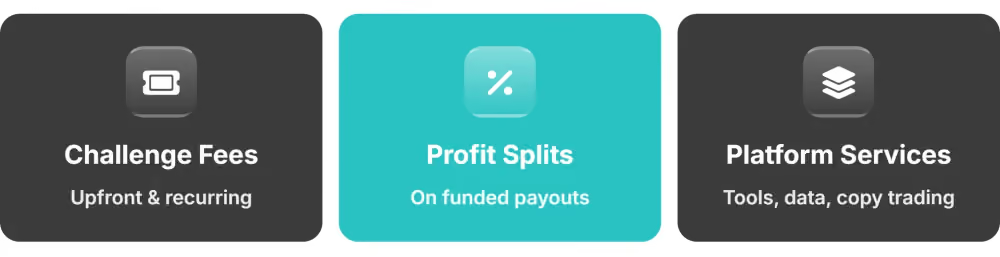
- Prop firm income comes from three sources that compound on a mostly fixed cost base: challenge fees, profit splits, and paid platform services.
- The execution model you pick (synthetic, real capital, or hybrid) drives both your regulatory exposure and how much capital you put up as the operator.
- Buying your trading platform, CRM, payments, and liquidity from different vendors raises integration risk and spreads support accountability thin when something breaks.
- Regulators are paying closer attention to prop firms, so compliance readiness now sits near the top of the vendor checklist.
The Prop Firm Revenue Model
Prop firm economics work because three revenue streams compound on top of a cost base that stays mostly fixed. Each stream depends on the infrastructure choices the operator makes early, before the first challenge ever goes on sale.
Challenge Fees as Recurring Revenue
A firm that sells 10,000 challenges a month at $150 each brings in $1.5 million in gross revenue before it pays out a cent. Challenge fees scale with marketing spend and conversion rates rather than with deployed capital, which makes this the lowest-risk layer in the model. The catch is operational. At that volume, onboarding and KYC run on automation, moving from signup to an active account without manual steps. The moment a person has to step in, support costs start eating into the margin.
Profit-Split Structures and Margin Dynamics
Industry data shows that only about 7% of challenge participants ever reach the funded withdrawal stage, since payouts depend on sustained trader performance. That ratio sets the operator's payout exposure and caps the revenue sharing the firm owes funded traders. Profit-split ratios also connect directly to the funding model. With synthetic execution, the firm sets the terms under which simulated profit turns into a real withdrawal, so it controls payouts more tightly than a real-capital model can.
Ancillary Revenue From Platform Services
Beyond fees and splits, operators charge for extra services on top of the core product. The common ones are:
- higher tiers of trading tools and analytics dashboards
- premium market data subscriptions
- access to copy trading and leaderboards
Adding asset classes like crypto, equities, CFDs, and commodities raises revenue per trader across financial markets while operating costs barely move, especially when the platform already supports those instruments natively.
Why White Label Beats Building
Most build-versus-buy decisions have little to do with whether a custom build is technically possible. The real issue is where your engineering team adds the most competitive value, and whether the firm can wait the months it takes for an in-house system to mature.
Development Cost and Five-Year TCO
Building a custom CRM for a brokerage runs to roughly $320,000 in five-year total cost of ownership. That figure mostly covers core engineering work, and in-house builds routinely overshoot their budget by two to three times. It leaves out the running costs that pile up afterward:
- patching security gaps
- tracking regulatory changes
- running platform upgrades
- retaining specialist fintech engineers in a tight job market
For most operators, these hidden costs pass the original build estimate by year three. White label forex brokerage startup costs come in well below those numbers and hand the maintenance load to the provider.
Getting to Market in Weeks
A firm that goes live in week eight, instead of month eighteen, collects around ten months of challenge fee revenue that slower competitors give up while their own build is still being finished. In a market growing around 11% a year , that head start compounds and gets hard to claw back. A white label platform trades the flexibility of a fully custom stack for the certainty of trading during a growth window.
Vendor Consolidation and Support Accountability
When the trading platform, CRM, payment gateway, and liquidity all come from different vendors, every connection between them becomes a point that can break, and support accountability gets split across companies. Picture a payout cycle that stalls because an API call misfires between the CRM and the payments provider. Each of the three vendors points at the other two.
With a single-vendor ecosystem, there is one company to call, so outages get fixed faster, and compliance gaps show up earlier. Scaling decisions also run through one accountable counterparty instead of a committee of suppliers.
Who Should Deploy This Model?
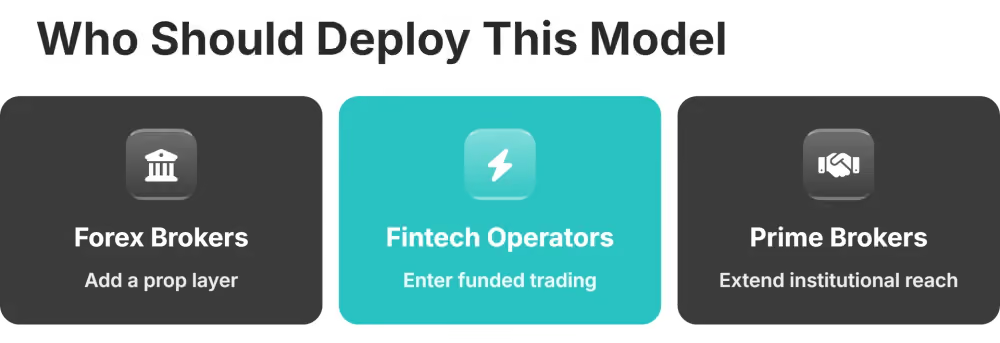
Three types of operators are well-positioned to launch a white label proprietary trading firm, and each one starts from a different base of trading infrastructure and relationships.
Forex Brokers Adding a Prop Revenue Layer
Existing forex brokers already run MT4 and MT5 and hold established LP relationships. They also own a client base that trusts their own brand. That starting point makes a prop firm faster to stand up than building from nothing, and the new revenue does not move in step with spread income. For a broker, it adds a revenue line that diversifies the business and improves profitability.
Fintech Operators Entering Funded Trading
Fintech platforms that already have payment rails and a track record in user acquisition can launch their own prop firm even with no brokerage background. The trade-off is that they usually lean on the white label provider for more of the stack, because they do not have the LP relationships or execution engine a broker already runs. For this group, the depth of the provider's ecosystem is the single most important selection criterion.
Prime Brokers Extending Institutional Reach
Prime brokers can use prop firm infrastructure to run funded trading programs for semi-institutional clients while skipping the cost of a separate licensed entity. Their existing liquidity relationships and partnership network put them in the best position for hybrid or STP-based setups, where deploying real capital is part of what they offer clients.
Core Infrastructure Every Solution Must Include
A white label prop firm runs on a handful of core components, and each one affects how the firm holds up under real order flow. The two that carry the most weight are the trading platform and the rules engine that governs every challenge.
Trading Platform Compatibility
Support for MT4, MT5, and cTrader is the baseline every provider has to meet. cTrader has pulled ahead for new launches because its prop firm features are built into the prop trading platform itself. Compatibility also feeds trader acquisition. cTrader has won a growing following among professional and semi-professional traders, so a strong trading experience on it helps a firm attract traders and improve retention. The platform stack is one of the more difficult decisions in choosing the right forex brokerage software for a prop operation.
Challenge and Evaluation Rules Engine
The rules engine is the operational core of a prop firm, and its functionality controls several things at once:
- account sizing and profit targets
- drawdown limits
- stage progression
- the move from evaluation to a funded account
At scale, rule execution has to be automated and deterministic. The moment approvals depend on manual steps, latency creeps in, and traders start complaining. Inconsistent enforcement across accounts then turns into regulatory friction.
Funding Model Architecture
There is no single best funding model. The right one depends on the infrastructure an operator already runs and the jurisdiction it works in, and each architecture has legitimate uses.
Synthetic Execution and Internal Risk Management
Synthetic models fill orders internally against a reference price feed, so there is no LP counterparty and no external capital at risk. The operator's profit comes from challenge fee volume and careful payout management rather than from trading gains. That keeps the capital requirement low, which is why most new entrants start here.
Real-Capital Deployment via External Liquidity
Real-capital models route funded trader orders to outside liquidity providers, which creates real market exposure the operator has to hedge as market conditions move. This puts a heavier load on the white label provider, which now has to deliver without exception on:
- production-grade connectivity to deep liquidity
- collateral management
- real-time hedging and risk management tools
The payoff is credibility with serious traders who steer clear of synthetic-only environments.
Compliance and Regulatory Readiness
Prop trading has shifted from what PropInformer's 2026 analysis called a "wild west" to a regulated reality . That shift has a hard consequence for anyone picking a provider. A compliance failure built into the infrastructure creates liability that no amount of clever legal structuring downstream can fully fix. Choosing a vendor is now a regulatory decision in its own right.
How Architecture Affects Regulatory Exposure
Synthetic execution draws little outside regulatory attention because orders never reach external venues or liquidity providers, so there is less for regulators to examine. Real capital and hybrid models raise the bar. They call for a heavier compliance infrastructure:
- transaction reporting
- capital adequacy planning
- market abuse monitoring
Operators in jurisdictions that already supervise prop firms should treat these as hard requirements. Whatever compliance posture you adopt has to line up with the wider white label forex broker compliance requirements in the markets where you operate.
Evaluating White Label Providers
Comparing white label providers comes down to four criteria. Judge each one against:
- platform reliability and scalability under realistic load
- depth of automated risk and challenge tooling
- compliance infrastructure matched to the jurisdictions you operate in
- support accountability, including SLA terms and escalation coverage
Since feature lists look much the same across providers, these operational factors are what actually separate them. A vendor that gives you one accountable relationship for the trading platform, CRM, payments, and liquidity comes out ahead on every criterion.
B2BROKER Prop Firm Infrastructure Stack
Running a white label prop trading operation through one vendor lowers operational risk and gets you live faster. B2BROKER delivers that through an all-in-one solution rather than a set of loosely connected products.
cTrader Prop Trading: Challenge Management Built In
cTrader Prop Trading is built for prop firm operators from the ground up, so the challenge tooling is part of the platform rather than bolted on later. The native key features cover:
- challenge configuration
- drawdown enforcement
- stage progression
- funded account transitions
That matters once you are in production. Native rule execution sidesteps the integration brittleness that hits operators who stack challenge logic on top of a plain retail platform.
B2CORE CRM: Onboarding, KYC, and Lifecycle Operations
B2CORE runs trader onboarding, KYC verification, back-office billing, and account management inside the same ecosystem as the trading platform. Because onboarding and KYC sit in one place, friction drops at the exact point in the funnel where conversion is highest.
The built-in analytics and trader dashboards cover lifecycle management too, so there is no need to stand up a separate BI stack. In practice, that means a shorter path from registration to a first challenge purchase, plus a clearer read on how trader cohorts behave over time.
Deployment Timeline and Onboarding Process
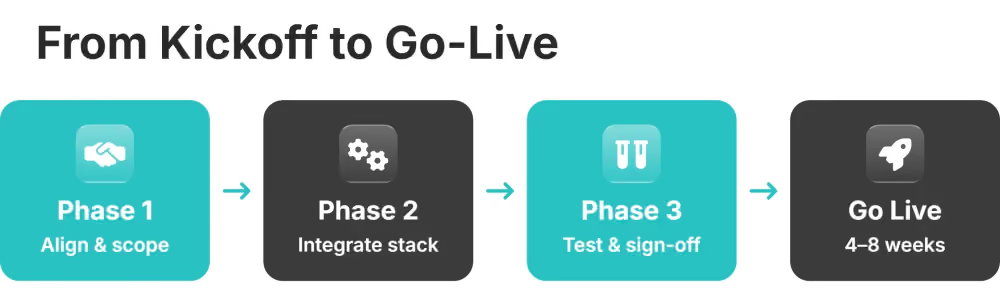
B2BROKER runs prop firm deployment as a set of defined phases:
- Phase one handles commercial alignment, scopes the target jurisdiction, and reviews technical requirements.
- Phase two provisions the backend environment, configures the platform, integrates payments, and sets up the KYC workflow.
- Phase three covers user acceptance testing, regulatory sign-off where it applies, and go-live preparation, including a stress test of the rules engine at realistic challenge volume.
Most operators get through all three phases in four to eight weeks. One dedicated implementation team owns the timeline from start to finish, so the cross-vendor coordination that drags out point-solution launches never enters the picture.
Build on Proven Infrastructure with B2BROKER
Operators who pick infrastructure on feature parity alone tend to underestimate how much operational risk a fragmented vendor stack creates once volume grows. The real differentiator is the combination working as one turnkey solution.
That integration shortens deployment timelines and lowers compliance exposure. It also frees internal teams to focus on trader acquisition rather than vendor coordination. Firms that launch this year will continue to compound that advantage as the market grows at double-digit rates.
Frequently Asked Questions about White Label Prop Firm Solutions
How fast can you launch a white label forex prop firm?
Deployment drops to roughly 4 to 8 weeks, against 12 to 24 months for a custom build, which brings challenge fee revenue in far sooner. An integrated provider like B2BROKER also avoids the cross-vendor delays that stretch timelines for firms assembling separate products.
What features should a white label prop firm solution include?
Trade execution, a deterministic challenge rules engine, real-time drawdown enforcement, and built-in CRM, KYC, and payments all have to work as one stack. Splitting them across separate modules multiplies integration complexity and spreads support accountability thin.
How do white label prop firms make money?
Revenue comes from three sources: upfront challenge fees, profit splits on funded traders, and ancillary services like premium tooling or data. Since only about 7% of participants reach the funded withdrawal stage, payout exposure stays contained and margins hold up.
What's the difference between building a prop firm in-house and using a white label solution?
A custom build runs to around $320,000 in five-year total cost of ownership and routinely overshoots that by two to three times once maintenance and engineering staff are counted. A white label solution shifts those costs to the provider, freeing your team to focus on trader acquisition and growth.
How should brokers evaluate a white label prop firm technology provider?
The factors that matter most are platform reliability under load, depth of automated risk tooling, compliance readiness, and support accountability with clear SLAs. Because feature lists look alike across vendors, these operational differences are what set B2BROKER's integrated ecosystem apart under one relationship.
Recommended articles

Subscribe to our newsletter