Key Features of Copy Trading Software for Brokers

Copy trading changes how clients behave. In an experiment cited by IOSCO, participants who could copy a high-performing trader placed 18% more trades than a control group. That lift is the commercial case. It also puts real pressure on the software underneath.
That pressure shows up late and costs real money. A platform that demos well can still miscalculate lot sizes at volume, or leave an auditor without the change log a license requires.
This guide walks through the key features of copy trading software that decide those outcomes at operating scale.
Key Takeaways
- PAMM, MAM, and direct replication solve different problems: pooled fund exposure, per-account manager flexibility, and scalable retail copying. A platform limited to one model limits the client segments you can serve.
- Server-side replication runs on provider infrastructure and keeps copying alive when a client terminal fails. Plugin-based deployment ties execution quality to terminal uptime.
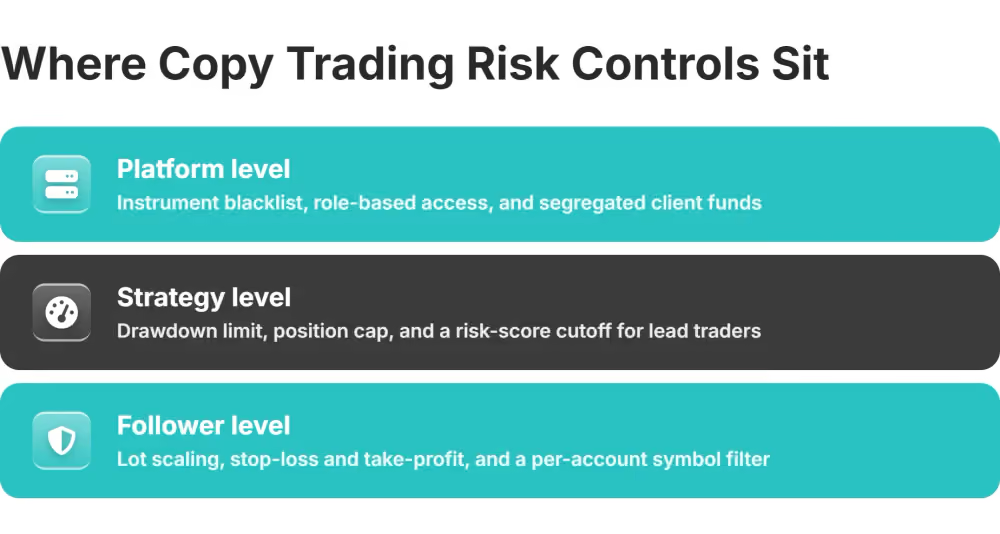
- Risk controls need to exist at three levels: platform, strategy, and follower. Drawdown limits, position caps, lot scaling rules, and symbol filters protect clients and cap the broker's own liability.
- Analytics carry real commercial value. Leaderboards drive strategy discovery for clients, while AUM and drawdown dashboards give the operator early warning before a strategy hurts followers.
- Integration with the rest of the broker's stack decides how much manual work the deployment creates as client volume grows.
Why Brokers Deploy Copy Trading
Copy trading earns its infrastructure budget through retention. A follower's engagement is tied to the strategy manager's performance rather than to their own appetite for placing trades. That keeps the account active for as long as the strategy delivers.
The demand is proven at consumer scale. eToro built a 40-million-user platform around social trading, where a Popular Investor program pays top traders to be copied. In 2025, the company brought copy trading to the US .
Revenue follows. Performance fees and subscription charges are billing layers a standard brokerage account never generates. Every master trade also multiplies into commission volume across follower accounts, while a manager who performs attracts deposits from their own network.
The evaluation question, then, is which platform architecture delivers these outcomes at scale while keeping operational overhead below the revenue it adds.
Allocation Models Every Platform Needs
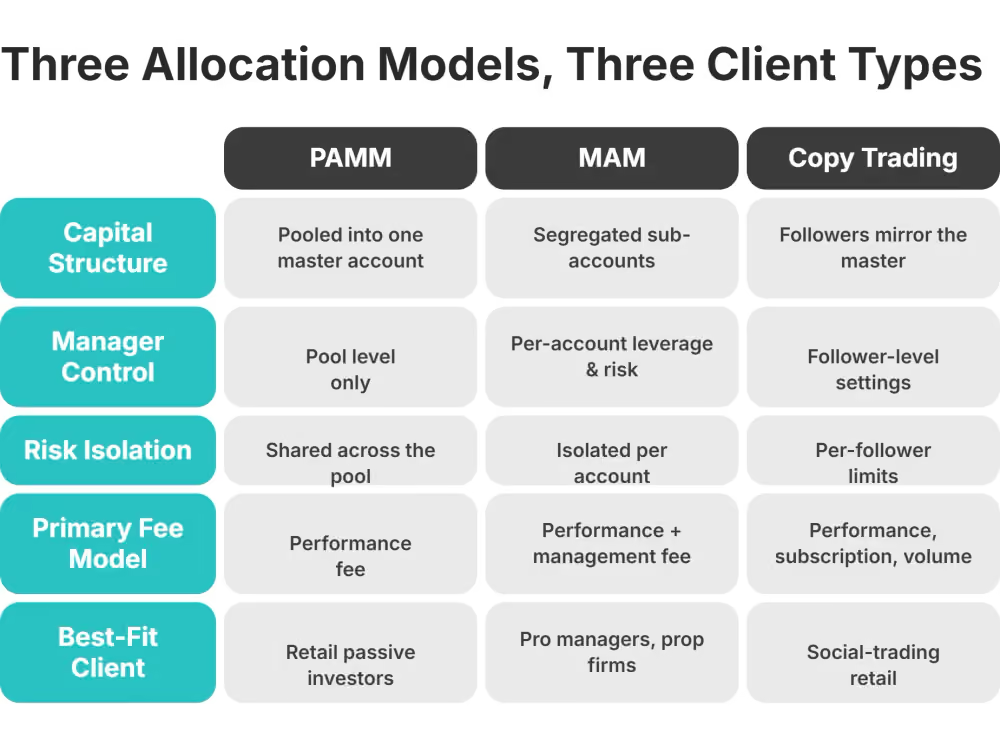
Allocation model support is where platforms differ most. The model has to match the client type you serve and the regulatory regime you operate under. Software locked to a single model quietly narrows the business you can build on it.
PAMM: Pooled Fund Management
PAMM pools investor capital into one master account and distributes profit and loss in proportion to each investor's share. The admin workload stays light, because the platform handles the allocation math and the manager trades a single account.
That profile suits high-AUM clients who want fund-style exposure without touching a terminal.
The regulatory weight is heavier than it looks. ESMA's 2023 supervisory briefing indicates that copy trading which executes without client intervention can amount to portfolio management under MiFID II. That classification brings suitability duties with it. Pooled structures can also trigger fund-management licensing in some jurisdictions.
MAM: Multi-Account Manager Structure
MAM keeps every sub-account structurally separate. Because each account tracks its own margin and positions, the manager can set different leverage or risk parameters per client. Pooled PAMM math cannot do that.
The separation also contains damage. A margin event on one sub-account stays on that sub-account. Brokers serving professional managers with mixed client books usually land on MAM for exactly this reason.
Copy Trading: Direct Order Replication
Direct replication, sometimes called mirror trading, copies a master account's orders into follower accounts in real time, with each follower's own risk settings applied at execution. It scales retail acquisition better than either managed model, because followers pick signal providers themselves from published performance statistics.
The technical differentiator between vendors is platform coverage. A brokerage running mixed MT4, MT5, and cTrader books needs multi-server, cross-platform replication without middleware. Vendors differ sharply on whether that works out of the box.
Execution Reliability and Architecture
Execution architecture shapes broker liability more than any feature on the list. A delayed or missed fill on the master account lands on every follower behind it, with the complaints arriving together.
Server-Side vs. Plugin-Based Deployment
A plugin-based trade copier runs replication logic on the trading terminal, which means copying lives and dies with terminal uptime. When the terminal crashes, replication stops for every account behind it, usually during the volatile stretch that caused the crash. A VPS keeps terminals online more of the time, but the dependency stays.
Server-side deployment moves replication onto the provider's infrastructure, where it runs regardless of terminal state and applies risk checks before an order executes.
The test here is concrete. Ask the vendor where replication logic physically runs, and what happens to open follower positions if a terminal or a single server dies mid-session.
B2COPY's multi-server update shows where the category is heading, with replication at the infrastructure level and pricing published openly.
Risk Management Controls
Among the key features of copy trading software, risk controls are the ones a regulator will ask about first. The risk management tools have to be configurable at the platform, strategy, and follower levels. A single stop-loss switch leaves both the follower and the firm exposed.
Drawdown Limits and Position Caps
Drawdown limits are thresholds the broker configures per strategy or per follower. When maximum drawdown crosses the line, the platform pauses or closes copying on its own, without waiting for someone on the risk desk to notice.
Position caps solve the concentration problem. A cap stops a strategy from loading followers into a single instrument beyond a set share. Like drawdown limits, caps can apply per strategy or per individual follower, tuned to that client's risk tolerance.
Lot Scaling and Allocation Logic
Lot scaling defines how a follower's trade size relates to the master's. Three methods cover the market:
- Fixed lot copies the same size to every follower regardless of equity. Simple to explain, but it stops fitting as accounts grow or shrink.
- Proportional scaling sizes trades by the follower's equity relative to the master's. This is the usual choice for PAMM and MAM structures.
- Multiplier lets the follower scale the master's size up or down by a set factor, for clients who want the same strategy at higher or lower intensity.
Follower-side stop-loss orders and take-profit overrides belong to the same layer. They close a copied position at the follower's own threshold even when the master keeps holding it.
Scaling logic is worth testing before signing anything. A sizing error lands on every follower account at once. Run the vendor's test environment with realistic account sizes and check the resulting fills by hand.
Symbol Filters and Blacklist Controls
Symbol filters restrict which instruments a strategy may replicate into follower accounts. Where a regulator limits certain products for retail clients, the filter becomes the compliance mechanism itself, enforced in the platform rather than by someone watching trades.
Filters also limit concentration at the follower level, keeping any single instrument or asset class from dominating an account's exposure.
Blacklist controls work one level up, excluding an instrument from all replication globally. Supervisors already flag this control layer as good practice. IOSCO's 2025 good practices report describes platforms that score lead traders algorithmically and disable copying above a risk threshold.
Fund Segregation and Capital Protection
Follower funds have to stay structurally separate from master account capital, at the account layer and at settlement. In many regulated jurisdictions this separation is a licensing or safeguarding requirement.
How a vendor enforces the separation is a due-diligence question to ask directly, with the account structure diagram on the table.
Audit Trails and Access Controls
Audit trails log every allocation change, parameter update, and account action with a timestamp and the user who made it.
When an examiner asks why a follower's risk limit changed in March, the answer has to come out of the platform log. Rebuilding that history after the fact rarely satisfies a supervisor.
Role-based access controls sit next to the trail, defining which team members may modify risk parameters, approve new strategies, or view follower data. Both belong in the platform natively. A vendor proposing a custom build for either is telling you the capability is missing.
Performance Analytics and Reporting
Reporting is where a copy trading deployment either grows the book or merely documents it. The output has to serve two different readers: the client choosing a strategy, and the operator watching risk and AUM across the whole business.
Three layers cover both:
- Strategy leaderboards rank strategy providers by return, drawdown, and consistency. Trader profiles with performance history behind each entry are the discovery engine that turns platform visitors into followers.
- Operator dashboards show total AUM, strategies approaching their drawdown thresholds, and accounts near position limits, giving the desk early warning before followers get hurt.
- Subscription analytics track follower growth and churn per strategy, which tells marketing which managers deserve promotion.
B2COPY 2.0's rebuilt interface illustrates the current bar, putting PAMM, MAM, and copy trading accounts on one screen with a leaderboard that surfaces masters across all three models.
Fee reporting belongs in the same evaluation. Copy trading generates three distinct billing structures; a platform that supports only one caps the commercial options from day one. When the performance metrics behind the leaderboard also feed billing, a follower's ROI and a manager's fee reconcile from one data set.
White-Label and Customization Capabilities
Running copy trading under your own brand takes more configurability than most spec sheets describe. Three dimensions decide it:
- Interface configuration: a custom domain and branding on the investor portal, control over which strategies the leaderboard surfaces and in what order, and editable notification templates.
- Fee configuration: independent settings per strategy, a broker-level commission on top of manager performance fees, and configurable caps and thresholds.
- Administrative controls: role-based permissions, API access for custom integrations, and per-jurisdiction configuration for firms running entities under different regulators.
Ask the vendor to demonstrate each dimension live before signing, in a sandbox with demo accounts that mirror your real client segments. If the settings cannot be shown working there, treat the claim as unverified.
Integration with Broker Infrastructure
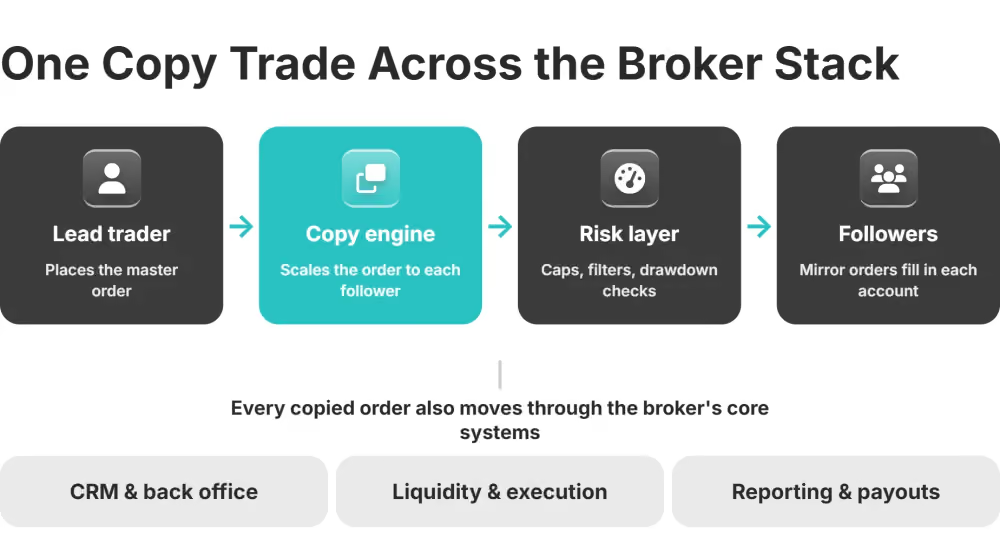
Integration quality sets the operating cost of the whole deployment. Copy trading touches the broker's CRM, back-office, liquidity layer, and matching engine. Every manual connection turns into recurring work that grows with client volume.
CRM and Back-Office Connectivity
CRM connectivity keeps one client record across copy and standard trading accounts, so onboarding, KYC, and billing run once per client. Separate flows mean two KYC processes and two billing systems for the same person. The duplication shows up as compliance exposure at the first audit.
B2CORE is the reference integration here. Copy trading accounts appear in the same back office as the rest of the operation.
Back-office connectivity covers reconciliation, reporting exports, and audit data flows. Confirm each one exists as a native integration, because a nightly CSV handoff will need engineering attention every time either system changes.
API Architecture and Bridge Compatibility
Order flow typically runs over FIX 4.4 or 5.0, while quote streams, reporting, and the RFQ lifecycle run over REST and WebSocket. Confirm the vendor supports the versions your stack speaks, because protocol mismatches appear late and cost integration weeks.
If your platforms expose TradingView charting or route orders through automated trading systems, those endpoints belong on the same compatibility checklist.
Bridge quality varies more than vendors admit. Native MT4/MT5 bridge support inside a server-side architecture removes the terminal dependency entirely. Cross-platform replication, where an MT5 master drives MT4 followers, still separates mature platforms from the rest of the market.
Liquidity and Matching Engine Alignment
Execution quality in copy trading is bounded by the liquidity underneath it. A thin book produces slippage at exactly the moments strategies trade most. That makes liquidity depth a copy trading feature, even though it lives in a different system.
Vendors advertising ultra-low latency without naming their liquidity sources are describing half of the execution path.
When replication, liquidity aggregation, and matching run on one vendor's infrastructure, fills stay more consistent because fewer hops between systems add latency or failure points.
SLA Commitments and Uptime Guarantees
SLA terms belong in the technical evaluation with the same weight as architecture. Downtime during a volatile session is the single worst operational event a copy trading business can have. Put uptime guarantees, incident response windows, and support coverage into the contract in writing.
If a vendor will not commit to uptime numbers in the contract, treat that as a maturity red flag.
Build Your Copy Trading Infrastructure Right
The key features of copy trading software are architectural. They emerge at scale rather than in a demo. A platform evaluated on that architecture, from allocation models down to integration seams, behaves predictably as the follower count climbs into the thousands.
Vendor consolidation is the shortest route to that predictability. B2COPY runs PAMM, MAM, and direct replication on server-side architecture across MT4, MT5, and cTrader.
It also connects natively to B2CORE for CRM and back-office operations, B2TRADER for trading, and B2BROKER's liquidity infrastructure. The seams where deployments usually leak, from CRM handoffs to bridge middleware to liquidity hops, are handled inside one stack.
If copy trading is on your roadmap, the evaluation stage is what decides whether it becomes a revenue channel or a support burden, long before any client copies a trade.
Frequently Asked Questions about Copy Trading Software
What features should brokers look for in copy trading software?
Allocation model support, server-side execution architecture, and configurable risk controls carry the most operational impact. CRM and back-office integration then determines whether the platform reduces administrative overhead or adds to it.
What is the difference between PAMM, MAM, and copy trading?
PAMM pools capital into one master account and splits results by each investor's share, while MAM keeps sub-accounts separate, letting managers set risk per account. Direct copy trading lets followers mirror the trades of a master account in real time, with follower-level risk settings applied at execution.
How does copy trading software manage risk for followers?
Drawdown limits pause or close copying when a strategy crosses a loss threshold, while position caps and lot scaling rules keep trade sizes proportionate to each account. Symbol filters restrict which instruments can be replicated. Segregated fund architecture keeps follower capital separate from the master account.
How important are execution speed and slippage control in a copy trading platform?
The impact of latency scales across a follower pool, making deployment architecture the main reliability variable. Server-side replication removes the terminal dependency that plugin-based setups carry. Fill consistency under peak load is still worth verifying before committing to a vendor.
Can copy trading software integrate with MT4, MT5, and broker CRM systems?
Mature platforms offer native MT4/MT5 bridges plus REST and WebSocket APIs for quotes and reporting, but support varies enough that it needs to be verified for each vendor. Ecosystem stacks such as B2BROKER's, where B2COPY connects directly to B2CORE and B2TRADER, reduce that integration risk.
Recommended articles

Subscribe to our newsletter