What is Liquidity Preference Theory?



Money rules investors’ and central banks’ decisions, and the ability to transform it from assets to banknotes motivates traders’ investment and saving decisions.
This is what we call liquidity , which is the backbone of the entire financial trading system and securities markets, whether stocks, bonds, commodities, Forex CFD pairs, or digital assets.
The question arises: Why does not everyone just stack cash money instead of holding securities? Here, banks emerge, offering profits as a price for transforming liquid cash into illiquid assets.
This is the liquidity preference theory in a nutshell. Let’s explore this premise in more detail and explain how it works in the financial markets.
Key Takeaways
- The liquidity preference suggests that people prefer keeping money as cash rather than illiquid assets.
- Economist John Keynes developed the liquidity preference theory in his 1936 book “The General Theory of Employment, Interest, and Money.”
- The hypothesis is that individuals prefer cash for transactional, precautionary and speculative purposes.
Understanding The Liquidity Preference Theory
The liquidity preference theory says people prefer holding money over investing in securities. This happens because cash is easily managed and can be directly used to make purchases and afford daily transactions.
Banknotes are the most liquid form of money, while stocks, bonds , and other assets are less liquid. As such, several steps must be taken to convert securities into cash, such as finding a counterparty to fulfil the transaction, matching their asking price, and finding a medium, whether an exchange platform or p2p payments.
Take into consideration that some investments and savings accounts lock up the user’s funds for a particular period and cannot be released from the account unless a penalty is imposed, causing one to realise a loss on their own money.
However, stacking cash does not yield any return. Here is where banks come into play. Banks are profitable organisations that offer financial services using public funds.
They offer cash holders interest rates in return for giving away their liquid money, allowing them to earn from their money. This is also described as the prize investors receive for exchanging their most liquid asset for less liquid ones.
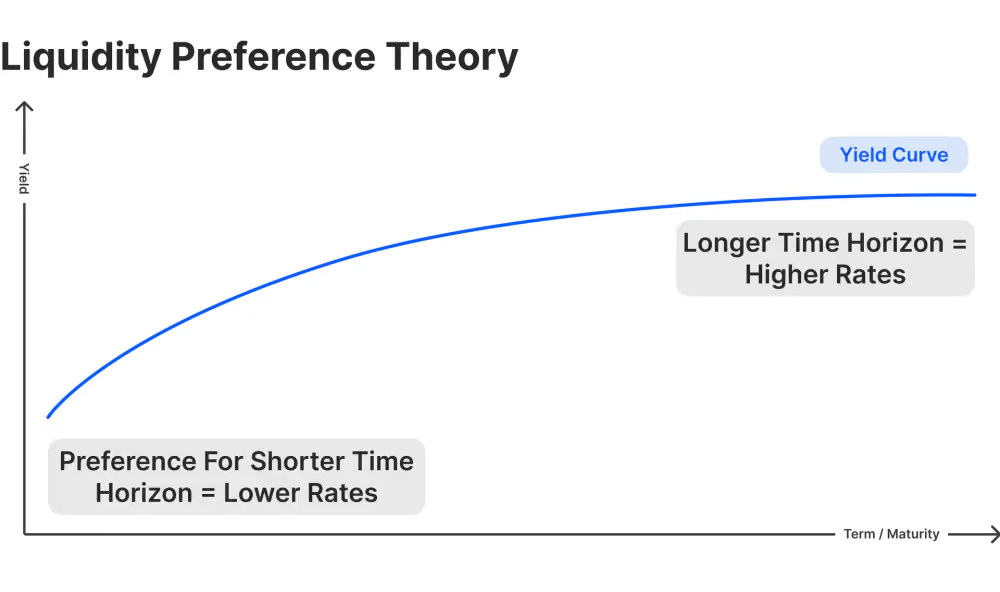
The price of giving away liquidity depends on the period during which the investor forgoes cash money. This is why long-term bonds and savings have higher yields than short-term investments.
Development of the Liquidity Preference Hypothesis
The historical economist John Keynes developed the Liquidity preference theory, which explained how interest rates and investors’ decisions work.
Naturally, people opt to hold liquid assets that can be converted into cash quickly at low costs. This allows them to conduct daily transactions immediately without extra payments or procedures.
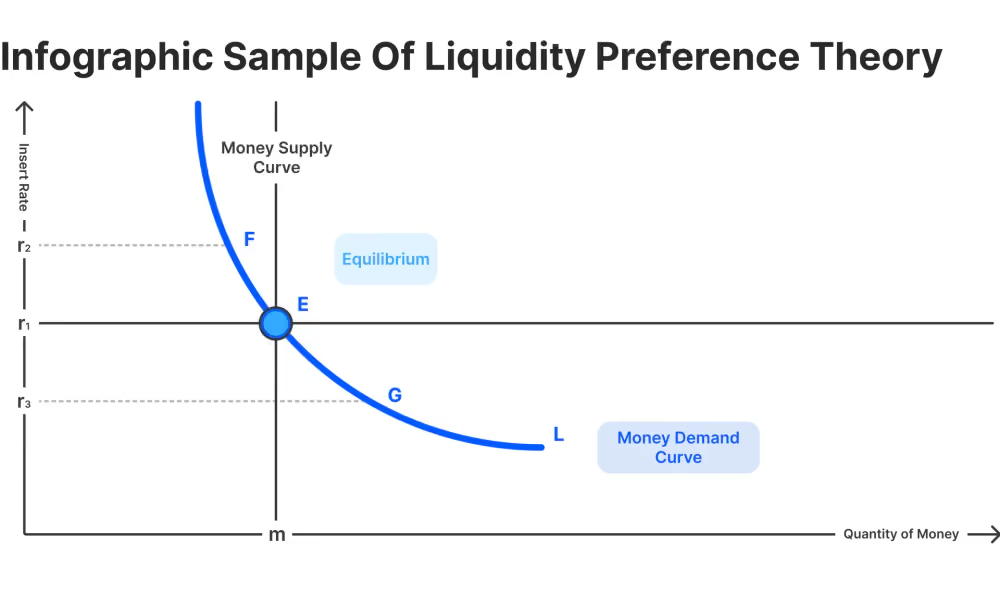
On the other hand, interest incentivises people to let go of their liquid holdings and convert them into less liquid assets , like bonds and stocks. The theory proposes that the more illiquid the asset, the higher the reward and the interest rate.
Therefore, during economic meltdowns or high inflation, the demand for cash increases, and the interest rate increases because the price of forgoing liquid assets becomes higher.
How The Liquidity Preferences Affect Investors’ Decisions
The Keynesian liquidity preference theory suggests that most trading markets and financial policies are derived from the liquidity demand, which varies based on economic conditions. The trade-off between liquid and non-liquid assets leads to three main decision-making points.
Liquidity Preference and the Yield Curve
In natural market status, the yield curve moves upwards across time, stating that long-term bonds and investments yield more earnings than short-term securities because high risks bring higher returns.
However, during an economic recession, when uncertainty drives people to hold their cash money or demand more short-term investments, the liquidity preference curve tends to flatten, giving more weight to bonds that mature faster.
Liquidity Preference and Interest Rates
Central banks and policymakers make decisions on interest rates and borrowing based on liquidity demands. When inflation rates are high, money loses its value, and investments become worthless because interest does not bring sufficient returns.
Therefore, banks increase interest rates to stimulate economic growth and motivate people to expand their investments.
Liquidity Preference and Investing
Investors decide whether to invest based on economic factors. During stability and economic growth, less liquid assets are more secure, and long-term gains become valuable.
However, during recessions and uncertainty, people opt for safer assets, such as cash and short-term bonds, which can be easily converted and used for payments.
Theory of Liquidity Preference Motives
The liquidity preference framework relies on three main factors that drive people’s decisions when allocating their capital between liquid and non-liquid assets.

Conducting Transactions
Money is the medium of exchange and transaction. Therefore, people require liquid assets to buy daily goods and services regardless of interest rates and bank incentives. The degree of liquidity demand depends on household income and expenses.
The transactional motive explains that people demand cash to run errands and make transactions. As such, individuals with high incomes spend more and require more liquid money, which makes them seek high-yield investments.
Guarantee During Uncertainty
When a recession hits the economy, banks lose their ability to provide valuable returns or even return the money to investors . Therefore, people keep their capital in cash assets rather than investments.
Moreover, households tend to seek relocation or have more unexpected emergencies. Therefore, they demand liquid assets to pay for these needs.
Speculating and Earning
The speculative motive entails investors’ and institutions’ tendency to increase or decrease their capital investments according to future market projections.
As such, if market recovery is predicted, speculators trade their cash for long-term bonds and stocks to benefit from potentially high interest rates.
However, individuals and corporations tend to hold more cash when uncertainty prevails, even if this money does not generate income.

Arguments Against the Liquidity Preference Model
Despite being rightfully justified, many criticise this model because it neglects other factors and considers them, especially the liquidity preference model of the interest rate, which entails that banks adjust their rates according to people’s demand and not the other way around.
Critics say that many economic drivers, such as inflation rates, money supply, credit risks, investment opportunities, and default risks, affect bank borrowing and investment returns, which in turn affect the need for liquid capital.
Additionally, many suggest that the theory is obsolete in today’s realty, where globalisation facilitate money free flow between economies where interest rates are higher to pursue better returns.
Conclusion
The liquidity preference theory was developed by the economist John Maynard Keynes, who suggested that household and institutional money demand shapes how interest rates rise.
He indicated that people require easily convertible assets, like cash money, to conduct daily transactions, safeguard during uncertainties, and speculate on trading markets.
The notion of this theory revolves around the fact that long-term bonds are more rewarding than short-term investments because they require users to forgo their liquid assets for less liquid securities. As such, bond prices act as rewards to incentivise people to let go of their cash.
Subscribe to our newsletter