When to Launch Your Brokerage

When to launch your brokerage is settled the day your license, capital, named compliance owners, and tested systems are all in place. In one year, the Financial Conduct Authority (FCA) determined 310 asset-management applications, and nearly one in five was withdrawn or rejected .
The FCA names two recurring reasons: senior managers not yet recruited and capital not yet in place. Rejection costs an application fee and nothing else. A brokerage that clears authorization with those two gaps still open loses far more. Its fixed costs start on day one, and its first clients arrive expecting a finished operation.
This guide works through all four kinds of readiness across jurisdictions and asset classes, then ends with a checklist for testing the date you have in mind.
Key Takeaways
- The launch date follows regulatory, capital, operational, and technology readiness. Market timing and investor pressure decide nothing on their own.
- A premature launch turns into financial strain when fixed costs, license commitments, and liquidity obligations arrive on schedule while revenue arrives late.
- Regulatory readiness now means sustaining capital thresholds, governance controls, ICT resilience, and third-party oversight every month after go-live.
- Turnkey infrastructure cuts time-to-market while the brokerage keeps ownership of compliance, risk, and client onboarding.
- Launching one jurisdiction, asset class, or client segment at a time caps the exposure of each step and produces real demand data before the full launch.
Why Every Open Problem Costs More After Launch
Treat the launch date as the day every unsolved problem starts costing more. A control gap that costs a workshop to close before go-live costs a remediation program after it, with live clients on the platform the whole time.
Before launch, only your team knows about that gap. After launch, your clients run into it when they withdraw or complain. Nothing in the obligations your regulator holds you to pauses while you fix it. The FCA canceled the authorization of 1,456 firms in 2024/25 for failing its minimum threshold conditions, including permissions that sat unused and returns that never arrived. The authorization itself is one of the things you can lose after launch.
For a CTO or COO, deciding when to launch your brokerage comes down to which of three moves the readiness evidence supports. Proceed with the full launch, open only the slice you can support today, or delay until a named condition is met.
The Financial Strain Pattern Behind Premature Brokerage Launches
A premature launch usually fails slowly. Startup costs begin with the license, revenue ramps over two or three quarters, and the firm burns its capital in the gap between them.
Regulators size minimum capital for the time it takes to close a firm. The EU's fixed overheads requirement assumes an investment firm needs its own funds for a three-month orderly wind-down . Supervisory data on 57 firms that actually wound down puts the median at four months. A brokerage launched at the regulatory minimum is capitalized for about one orderly wind-down, the outcome that number was designed to buy.
B2BROKER has seen the same sequence in the brokerages that leave its client base within a year. The brokerage launched on minimum capital, the first slow quarter forced a cut, and the cut landed on the part of the operation clients feel first.
Follow one such cut to its end. The firm trims support coverage to cut the salary bill. Withdrawal requests start waiting a day longer. A client posts about the delay, next month's deposits drop, and revenue falls below the plan the cut was meant to protect. The next cut is bigger.
Regulatory Readiness Across Jurisdictions and Asset Classes
Regulatory readiness means you can meet the obligations of your authorization month after month, for each asset class you offer, on a clock the regulator sets.
That clock starts with the application. The FCA has a statutory deadline of six months for a complete application and twelve for an incomplete one , a standard it met for 98% of applications in 2025/26. A launch date set before the determination is a guess with a six-month error bar. Which of the two deadlines applies depends on how complete your file was on the day you sent it.
Each market names that clock differently. A US broker-dealer applies to the Financial Industry Regulatory Authority, which reviews its business structure, supervisory system, and funding. FINRA then has 180 days to decide on a New Member Application . The NMA clock starts only once the file is substantially complete.
After authorization, the tracks split. A forex or CFD broker in the EU answers to MiFID II conduct rules and the IFR/IFD prudential regime, while a crypto brokerage falls under MiCA and, since January 2025, DORA.
MiFID II and IFR/IFD Capital Thresholds for Forex and CFD Brokers
A forex or CFD broker should launch only when its own funds clear the highest of three tests under IFR/IFD, and keep clearing it as costs and volumes grow.
In force since June 2021, IFR/IFD sets the prudential rules for EU investment firms through three tests you calculate in parallel:
- a permanent minimum capital of €75,000, €150,000, or €750,000 , depending on the activities you are authorized for, with the top tier for firms that deal on own account
- the fixed overheads requirement, one quarter of the previous year's fixed overheads
- for Class 2 firms, a K-factor requirement that scales with client money held, assets safeguarded, and trading activity
The permissions behind the business model decide which tier applies. Routing every order to a liquidity provider keeps an a-book broker below the top tier. Internalizing that flow counts as dealing on own account. A firm with no trading history has no previous year's overheads to measure, leaving the regulator to size the overheads test from the business plan you file.
Two of the three grow with you. Every hire raises the fixed overheads requirement. So do the client assets you hold or safeguard, through the K-factors. The own-funds requirement is a budget line that moves every quarter. With early trading losses coming out of the same pool, the capital you launch with has to sit well above the tests you pass on authorization day.
MiCA Authorization and DORA Resilience for Crypto Brokerages
A crypto brokerage serving EU clients needs its MiCA authorization in hand before the first trade and its ICT risk framework under DORA working on the same day.
The MiCA side no longer has a transition window. The transitional period expired across the EU on 1 July 2026 . A pending application permits nothing. Service to EU clients may start only on the day the license is granted. Authorization carries a prudential floor of €50,000, €125,000, or €150,000 by service class, or one quarter of fixed overheads if that is higher. A first-year firm calculates that quarter from the projected overheads in its own application. The budget you file becomes the capital you must hold.
DORA is the second gate. Since 17 January 2025, it requires a register of information covering every contract with an ICT third-party provider , submitted to your regulator every year. Your platform vendor and your cloud host go in that register before launch. Both support critical functions, and each needs a documented exit plan on file.
Whether you take client orders as a broker or match them as an exchange decides which service classes you apply for, and with them the capital tier and the custody duties.
Capital Adequacy: Modeling Runway Against Early-Stage Losses
Launch capital has to cover the regulatory minimum you must hold at all times and the monthly operating burn at the same time, through a revenue ramp that runs slower than the plan.
The regulator already puts a liquidity floor under that runway. An FCA investment firm must hold core liquid assets of at least one third of its fixed overheads requirement at all times. In practice, that is one month of fixed costs parked in core liquid assets, outside anything your model can count as runway.
Build the runway model in three scenarios. The base case takes the plan as written. In the downside case, authorization slips by a quarter and first-year volumes come in at half the forecast. The stressed case adds the two lines that usually get left out — a rolling reserve held back by the payment provider, and support hiring pulled forward to the month clients arrive.
All three scenarios carry the same brokerage startup budget checklist of license fees, platform subscriptions, compliance salaries, and support coverage. Those four lines are the cost of starting a forex brokerage. How much licensing and capital rules add to it depends on the jurisdiction you pick.
The readiness test is the stressed case. If the firm still clears its regulatory minima at the bottom of that scenario, the capital is ready. A plan that only balances on first-quarter volumes puts a red line on your financial readiness checklist. That launch is early.
Operational and Compliance Ownership You Cannot Outsource
You can outsource the systems that run AML checks, trade surveillance, and regulatory reporting. You cannot outsource the accountability for what those systems decide.
UK regulators have written that boundary down. The critical third parties regime took effect on 1 January 2025. The Treasury named its first four designations in July 2026, including AWS and Microsoft. Even where the provider is designated and supervised, the firm using it keeps its own responsibility for risk assessments, due diligence, and contingency planning.
Before launch, each of these controls needs a named person inside the firm who decides, escalates, and signs:
- the AML/KYC policy, including which clients the firm will refuse
- escalation rules for suspicious activity, with the person who files the report
- complaints handling and the deadlines the regulator expects
- trade surveillance thresholds and who reviews the alerts
- daily reconciliations of client money and positions against the platform
- regulatory reporting, from transaction reports to the DORA register
A quick test settles whether ownership is real. Ask who freezes a client account at two in the morning when the surveillance system flags it, and how long that person takes to answer. If the answer is "the vendor", the control is not yours yet.
Technology Readiness: Turnkey Infrastructure vs In-House Build
Turnkey infrastructure shortens time-to-market only when the integration, governance, and support around it are finished before go-live. Building in-house as an independent brokerage moves all three onto your own engineers before the first client logs in.
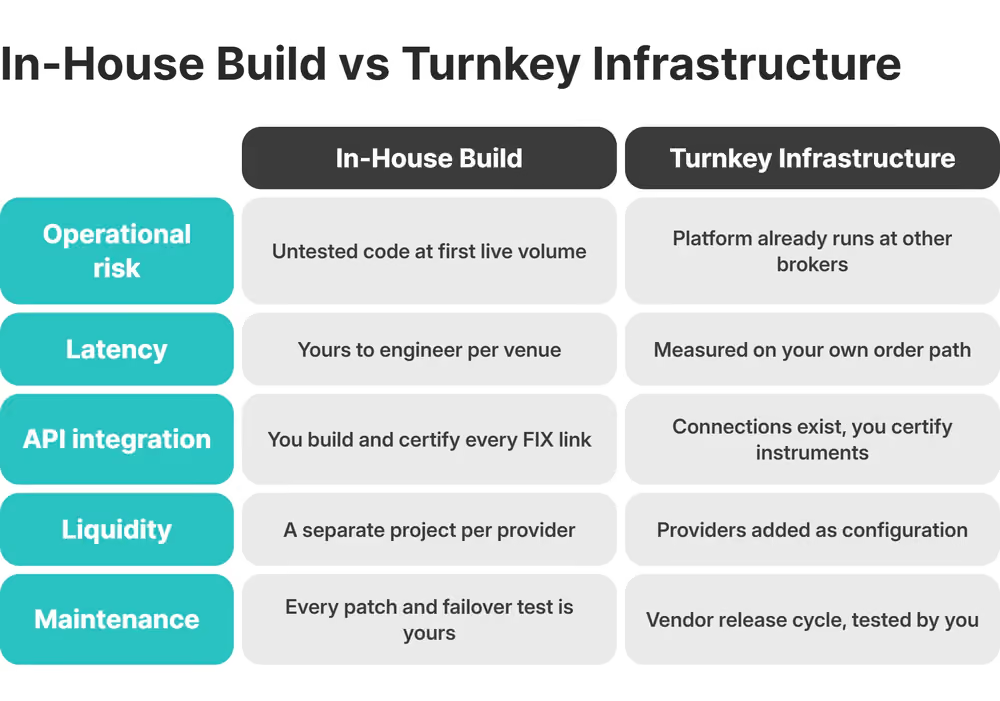
A turnkey stack supplies the components without taking the governance. A trading platform such as B2TRADER goes live within a single sprint with FIX and REST APIs. B2CORE covers the CRM and back office with more than 150 ready integrations across trading platforms, payment providers, and KYC vendors. Crypto payments run through B2BROKER's partner B2BINPAY , integrated with B2CORE, under a separate agreement with that company.
The vendor never sets your risk parameters or decides which clients you accept. Those stay with the people from the previous section. The same split runs through every step of starting your own brokerage , from the license application to the first live client.
A Phased Launch Strategy to De-Risk Market Entry Timing
A phased launch caps what each step can cost you. The first slice is one jurisdiction, one asset class, or one target market. Nothing else opens until volume, incidents, and support load all sit inside the gates you set.
Robinhood held FCA authorization from August 2019 and a waitlist of about 250,000 people, and still postponed the launch indefinitely in 2020 to focus on its core business. When it returned in November 2023, it opened the app to the waitlist in stages and reached general availability in March 2024 , starting with US stocks while UK equities stayed on the roadmap.
Each gate should be a number you already collect: daily volume against the liquidity provider's tested capacity, incidents per week against your runbook, and support tickets per hundred active clients against the coverage you have hired. A phase advances when all three sit inside their limits for a full month.
Sequencing depends on infrastructure that grows by configuration. An API-first platform adds a liquidity provider as one more session and an instrument group as one more setting. A MiCA authorization passport across the EEA turns the second jurisdiction into a notification to your regulator plus the local conduct and language work.
Readiness Signals vs Red Flags: A Diagnostic Checklist
Your brokerage is ready to launch when the signals below cluster across all seven dimensions at once. A red flag that persists in any one of them marks where the first incident will land.
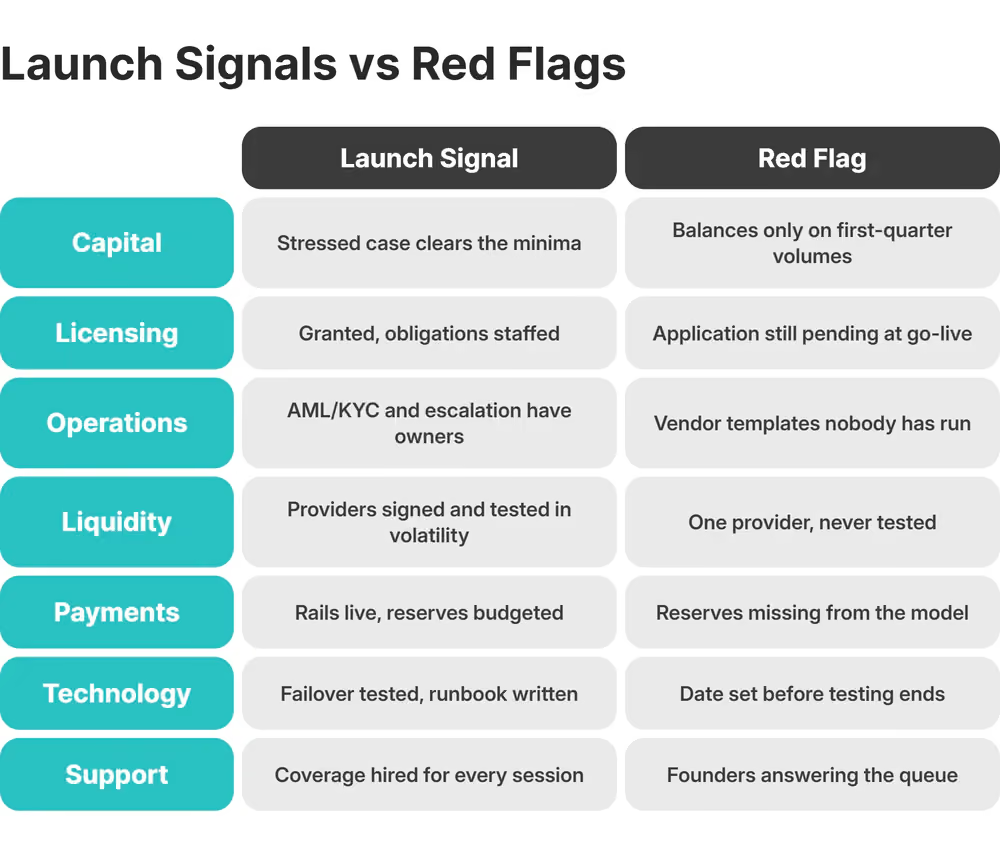
The signs your brokerage is financially ready to launch sit in the capital row. The signs of overextension sit one row lower, in payments and support, where unbudgeted reserves and founders working the support queue appear well before the capital row turns red.
The FCA applies a version of this table at its own gateway. The regulator expects an applicant to be ready, willing, and organized on the day it applies. Firms that fall short are asked to withdraw and come back later.
Launch When Readiness Converges, Not When Pressure Mounts
Launch on the day the last of the five conditions is met, and let the readiness plan set that date. If the question on your desk is when to launch your brokerage, the readiness plan sets the date, not whatever the investor deck says.
An integrated infrastructure partner shortens the path to two of the five conditions. Platform deployment and the integration work behind it move from months to a sprint when the platform and its connections come from one stack that is already in production elsewhere. Licensing, capital, and ownership stay on your side of the table, where the regulator expects them.
B2BROKER has been building that stack since 2014 and has helped launch more than 500 brokers. More than 1,000 corporate clients run on it today, with the deployment volume behind that single-sprint timeline.
If your readiness plan has the broker's license and the capital in sight, map the technology and integration steps against it now. B2BROKER's team can walk through the stack, the integrations your model depends on, and the phase you can support first.
Frequently Asked Questions about Launching Your Brokerage
When should you launch your brokerage?
Launch when the authorization is granted, the capital clears the stressed runway scenario, each compliance control has an owner inside the firm, and the trading infrastructure has run under production-like load. Demand decides which phase opens first. The date itself comes from internal readiness.
How do you know if your brokerage is financially ready to launch?
Model the runway in base, downside, and stressed scenarios, with authorization delays, liquidity costs, payment reserves, and support hiring in each. Capital is ready when the stressed scenario leaves the regulatory minima untouched.
When is it too early to launch your own brokerage?
It is too early when the firm runs on vendor infrastructure without internal owners for risk, AML/KYC, and governance decisions. Regulators expect accountable control over clients, data, incidents, and third-party dependencies. A turnkey system shortens the build without taking on any of that accountability.
How does regulation affect when to launch your brokerage?
Authorization, prudential capital, conduct controls, and operational resilience all have to be in place before market entry. MiFID II, IFR/IFD, MiCA, and DORA each add a gate of their own. Build the regulator's statutory review periods into the launch plan, and a licensing track running alongside the build stops being the thing that slips the date.
Can turnkey technology help you launch your brokerage sooner?
Yes, by delivering the platform, back office, and connectivity as one deployment, which shortens the technology work. Licensing, capital, and governance readiness still set the launch date.
Recommended articles


Subscribe to our newsletter