When Brokers Should Add cTrader Alongside MT5: A Decision Guide

MT5 remains the default trading platform for many multi-asset retail brokers. If it supports your current operation well, there is no reason to replace it. The more useful question is when a broker should add cTrader next to MT5 to cover client segments that the existing setup no longer serves efficiently.
The trigger is business friction. Scalpers complain about execution , sales calls keep returning to Level II Depth of Market , and a growing share of forex-focused clients choose brokers specifically because cTrader is available. These are measurable signs that the platform mix has a gap, and adding cTrader can close it without dismantling the stack that already works.
This guide gives brokerage operators a practical decision framework: which business signals justify the move, which client segments cTrader can unlock, what architecture needs attention, and how to roll out the new platform with clear ROI metrics.
Key Takeaways
- Brokers should consider adding cTrader when MT5's execution variability causes measurable scalper churn or when client feedback consistently requests Level II Depth of Market transparency.
- cTrader unlocks ECN-centric day traders and C#-based algorithmic developers who actively select brokers based on platform availability.
- A unified liquidity bridge setup ensures both platforms draw from the same pool, eliminating pricing fragmentation and simplifying risk management.
- Phased deployment, starting with 10–20% of forex-focused scalpers, lets you validate retention improvements and execution metrics before full rollout.
- Tracking retention shifts, acquisition costs, and support load against platform fees provides the ROI clarity needed to justify dual-platform infrastructure investment.
Business Triggers That Show MT5 Alone Is Insufficient
MT5 is enough for many brokers until it isn't. The platform's multi-asset depth and broad third-party ecosystem handle most retail and institutional scenarios well. But specific operational signals indicate when MT5's architecture no longer covers your client base's demands efficiently.
The goal here is a diagnostic checklist: measurable, actionable triggers. That review should include compatibility risks in the existing user base, especially for teams still supporting MetaTrader 5, MetaTrader 4, MetaQuotes tooling, MQL4 scripts, and expert advisors.
Escalating Demands for Level II Market Depth
cTrader's DOM includes standard, price, and VWAP views that let traders evaluate available liquidity at different price levels. MT5 can support market depth, but cTrader's native interface is more directly aligned with ECN trading workflows. That distinction matters for traders who decide whether to enter, scale, or avoid a position based on visible liquidity. It also concentrates advanced charting tools, timeframes, built-in and custom indicators in one execution-first screen.
Track DoM-related requests over a rolling 90-day window. If support tickets and sales calls increasingly mention order book transparency, liquidity visualization, or VWAP depth, treat the pattern as a retention signal rather than a feature request. High-value clients who trade on execution quality tend to migrate toward platforms that make that quality visible.
Persistent Slippage Reports From High-Frequency Traders
cTrader's execution architecture is managed by Spotware on cloud infrastructure, targeting sub-millisecond order processing. MT5's execution speed depends heavily on how each broker has optimized their server infrastructure. The same MT5 setup can produce very different execution outcomes across brokers, which means slippage complaints often reflect broker-side performance factors rather than MT5's core design. The evaluation should test real-time price updates, low latency routing, and order execution behavior under load.
For scalpers and high-frequency traders, repeated slippage is not an inconvenience. It's a reason to leave. A scalper targeting 5 pips takes a proportionally severe hit from even minor execution delays. Retention risk from this segment tends to build silently in support ticket data before it shows up in churn numbers.
A practical threshold: if more than 15% of your support complaints originate from scalpers citing execution quality, treat cTrader's managed execution environment as a quantified mitigation path.
Client Segments Unlocked by Adding cTrader
cTrader is not only a retention tool for current clients. It is also an acquisition lever, because some traders filter brokers by platform availability before they ever evaluate spreads or licensing. MT5-only brokers are invisible to that search behavior.
ECN-Centric Day Traders
ECN-centric traders prioritize direct market access, transparent execution, and no dealing desk intervention. cTrader was built around STP/ECN execution, which makes the platform easier to position for clients who already compare brokers through that lens.
This matters for acquisition because cTrader appears consistently on "best ECN broker" and "best scalping platform" comparison lists. Brokers that offer cTrader appear in those searches; MT5-only brokers do not. A broker with more than 70% forex volume and more than 20% scalper clients in their active base is leaving comparison-site traffic and high-intent inbound leads on the table by not offering cTrader.
Multiple major retail brokers now highlight cTrader tooling as a product differentiator. cTrader now serves over 300 brokers and prop firms globally , and the platform earned Best Trading Platform for Brokers recognition from Finance Magnates.
C# Algorithmic Developers
cTrader Algo lets developers build cBots, indicators, and plugins with C# or Python. Developers already working in .NET can build trading automation for cTrader without learning a domain-specific language. MT5's MQL5 ecosystem has a deeper marketplace and larger historical volume, but it requires developers to adopt a proprietary environment, which slows onboarding and reduces appeal for fintech-adjacent firms standardized on modern development stacks.
For brokers, the commercial value is account activity. Automated strategies usually require active capital deployment, platform stability, and fast data access. cTrader Open API also gives developers a cleaner path to build trading apps, reporting tools, and integrations connected to the cTrader backend. Some white-label cTrader deployments report faster ROI payback compared to MT5-only launches, specifically because developer adoption accelerates client activation rates.
Architecture Differences Brokers Must Address
Adding cTrader introduces real infrastructure complexity, and setting that expectation early prevents integration friction from derailing an otherwise sound business decision. The two domains that require the most attention are execution and routing models, and API and plugin ecosystems.
Execution and Routing Models
MT5 supports both netting and hedging execution models and allows broker-managed execution patterns that include A-book, B-book, and hybrid configurations. cTrader is designed as STP/ECN by default, with a fully managed execution environment and no broker-side virtual dealer plugin in its default configuration. Spotware manages the servers, and the dealing desk functionality is an opt-in add-on that most brokers do not enable.
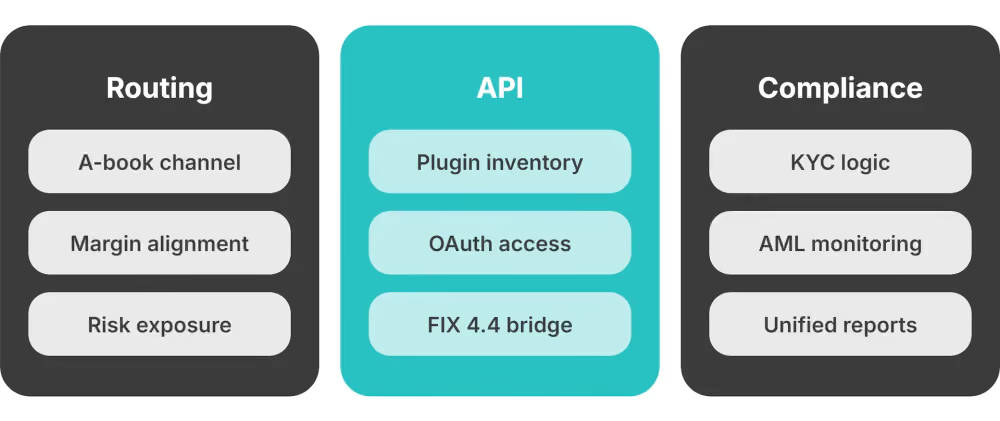
This means brokers running hybrid A-book/B-book on MT5 need to architect cTrader as a pure A-book channel. That requires deliberate routing decisions: which clients or order types go to cTrader, how margin calculations align across both platforms, and how risk exposure is reported when trades originate from two separate execution models.
Before integration begins, map your current execution workflows against cTrader's STP-only model. Identify routing conflicts, review margin calculation alignment, and confirm that your reporting infrastructure can aggregate trade data from both platforms without manual reconciliation gaps.
API and Plugin Ecosystems
MT5's EA, indicator, and plugin marketplace is mature and large. If your brokerage relies on specific MT5 plugins (social trading integrations, CRM connectors, risk management tools), you need to validate whether direct cTrader equivalents exist or whether custom development is required.
cTrader's Open API supports TCP and WebSocket connections with OAuth-based authentication and .NET and Python SDKs. The API is more flexible for third-party integrations than MT5's proprietary connectivity model, particularly for custom CRM systems, reporting pipelines, and social trading platforms that need direct data access. cTrader also supports the FIX 4.4 protocol , which aligns directly with institutional liquidity bridge infrastructure.
The practical step here is an API audit before you commit to a timeline: inventory your current MT5 plugins and integrations, identify the cTrader equivalent or custom development path for each, and assign maintenance ownership. This prevents the discovery of blocking dependencies after the integration is already underway.
Integration Essentials for a Dual-Platform Stack
Dual-platform success depends entirely on unified infrastructure. Fragmented liquidity and siloed compliance don't just increase operational overhead. They create arbitrage gaps between platforms, complicate regulatory reporting, and ultimately erode the ROI that justified adding cTrader in the first place.
Unified Liquidity Bridge Setup
MT5 and cTrader should connect to the same liquidity aggregation layer. A unified bridge keeps spreads consistent across both platforms, prevents pricing fragmentation where arbitrage gaps can form between feeds, and simplifies risk management by centralizing exposure visibility. It also gives operations a single view of liquidity providers instead of separate provider mappings for each platform.
B2BROKER's deep liquidity pools support multi-platform connectivity via the FIX protocol. This means both MT5 and cTrader can draw from the same aggregated pool rather than maintaining separate feeds, a critical operational requirement that many brokers overlook until post-launch reconciliation problems surface. This matters when the same bridge prices CFDs, indices, and crypto alongside the core FX book.
The technical steps to validate before go-live: test bridge latency under normal and elevated market conditions, run failover scenarios for each platform independently, and confirm that execution parity between MT5 and cTrader holds under load. Discovering latency discrepancies in production creates client-facing issues that are harder to contain than pre-launch testing gaps.
Back-Office and Compliance Alignment
Dual-platform operations require consolidated KYC/AML workflows, margin rules, and transaction reporting rather than two parallel compliance processes. Every additional manual step in reconciliation is an audit risk and operational overhead.
B2CORE CRM supports multi-platform client management across MT5, cTrader, B2TRADER, DXTrade, and additional platforms from a single dashboard. Clients can manage accounts across platforms without separate onboarding workflows. Regulatory reporting aggregates trade data from both platforms into unified outputs automatically, rather than requiring manual consolidation.
Map compliance touchpoints before integration starts: client onboarding logic, transaction monitoring rules, margin calculation alignment, and regulatory filing requirements. Building dual-platform compliance logic from day one is significantly easier than retrofitting it after launch.
Phased Deployment Framework
A phased launch gives the team a clean way to validate execution quality, support load, and retention impact before exposing the full client base to another platform.
Pilot Group Selection, Success Metrics, and Wallet Readiness
Start with 10-20% of forex-focused scalpers or ECN traders. This group produces the clearest signal because it is most likely to benefit from cTrader and most likely to leave when execution quality disappoints.
Define the success metrics before launch: execution speed, slippage against the MT5 baseline, retention improvement for the pilot segment, support tickets by platform, deposit behavior, and qualitative feedback on DoM and cBot workflows.
Wallet readiness should be treated as a pre-launch requirement. Clients using both platforms need reliable fund movement between MT5 and cTrader accounts, including edge cases such as partial withdrawals, margin calls, and balance disputes.
Metrics to Track Dual-Platform ROI
ROI measurement for a platform addition must focus on business outcomes, not adoption counts. The number of clients who activated cTrader accounts is a vanity metric. What matters is whether those clients stayed longer, cost less to acquire, and generated incremental revenue that exceeds the infrastructure investment.
Retention, Acquisition, and Support Cost Impact
Compare churn rates for cTrader users versus MT5-only users over a 6–12 month window, segmented by trading style. Scalpers, swing traders, and algo developers should be analyzed separately. The retention impact of cTrader will be strongest in the scalper and ECN trader segment, and that's where you should expect to see the clearest signal.
Track acquisition sources monthly to confirm whether cTrader's availability generates inbound leads from comparison sites, developer communities, and social trading channels that didn't exist before the addition. If cTrader-attributed acquisition costs are lower than MT5-attributed costs, that's a compounding ROI argument: not just retention improvement, but cheaper growth.
Calculate total cost of ownership against incremental revenue: cTrader licensing fees, integration build costs, ongoing infrastructure support, and training overhead, measured against revenue from cTrader-attributed client segments. Run this calculation quarterly, controlling for market volatility and promotional effects, so the platform's contribution is isolated.
Monitor support tickets by platform. If cTrader reduces slippage and execution complaints from the scalper segment, that's a measurable cost reduction in your support operations. If cTrader introduces new friction (documentation gaps, cBot questions, DoM interface confusion), that signals where training or tooling investment is needed before scaling.

Accelerate Your Dual-Platform Strategy with B2BROKER
The decision logic is clear: when Level II DoM demand, slippage complaints, or scalper churn reveal gaps that MT5 alone isn't addressing efficiently, adding cTrader becomes a rational strategic move. The operating model for success requires unified liquidity, consolidated back-office and compliance, and a phased rollout tied to measurable KPIs.
B2BROKER provides the infrastructure layer that makes dual-platform operations coherent rather than complex. Multi-asset liquidity aggregation connects MT5 and cTrader to a single pool via the FIX protocol. B2CORE CRM unifies client management, KYC/AML, and regulatory reporting across platforms without duplicating compliance workflows. cTrader white-label setup, technical support, and dealing training reduce integration risk and shorten time to production.
For brokers evaluating whether to add cTrader alongside MT5, the right partner isn't one who manages two separate stacks. It's one who connects both to a single liquidity, back-office, and payments ecosystem that reduces vendor sprawl and keeps operations coherent as you scale.
Frequently Asked Questions About cTrader and MT5
Can I share one liquidity pool across both platforms?
Yes. Connecting MT5 and cTrader to a unified liquidity bridge, typically via the FIX protocol, keeps spreads consistent across both platforms and prevents pricing fragmentation. B2BROKER's liquidity infrastructure supports multi-platform connectivity this way, so both platforms draw from the same aggregated pool rather than maintaining separate feeds.
Will traders need separate logins for cTrader and MT5?
At the platform level, yes. cTrader and MT5 use separate native credentials. However, a unified back-office solution like B2CORE can link accounts across platforms so clients manage everything from a single client portal. The platform credentials differ, but the client relationship remains unified.
How do compliance reports consolidate trades from two platforms?
A back-office reporting layer should aggregate transaction data from both MT5 and cTrader into unified regulatory outputs automatically. B2CORE handles this consolidation, so reconciliation is automated and audit risk is minimized. Manual trade reconciliation across two platforms is the primary compliance risk in dual-platform operations, and building automated consolidation in from day one eliminates it.
Recommended articles

Subscribe to our newsletter