How to Scale a Forex Brokerage Across FX and Crypto


Most search results for “how to scale a forex brokerage” answer a different question than the one operators are asking. They explain trade sizing for retail clients. This guide is written for the other reader — the CEO, COO, or CTO trying to turn a functional brokerage into an institutional-grade, multi-market business.
Scale, at this level, is not a marketing problem. Global OTC FX turnover reached $9.6 trillion per day in April 2025 [BIS 2025], and the brokers capturing that flow are competing on infrastructure economics, not ad spend. The decisions that determine your ceiling sit inside four categories: infrastructure, liquidity architecture, capital structure, and operating model. Each one creates a different scaling inflection point, and each one fails differently when operators postpone the decision.
The framework below walks through the scaling questions that actually matter — the ones that define whether your next growth cycle multiplies your margin or quietly collapses it.
Key Takeaways
- Scaling a forex brokerage means separating transaction-volume constraints, which are technical, from client-growth constraints, which usually sit in compliance, onboarding, and operations.
- Your earliest build, buy, or outsource decisions on matching, liquidity, and back-office layers often define your scaling ceiling and switching risk years later.
- At scale, liquidity architecture matters as much as spread — concentration risk, heterogeneous latency, and provider credit terms can all constrain execution quality.
- Capital planning cannot stop at regulatory minimums. Client fund segregation and LP collateral become a hidden drag on P&L as notional exposure grows.
- Multi-asset expansion and a true 24/7 operating model create growth leverage, but only when support, risk, and settlement infrastructure scale alongside.
Two Distinct Scaling Problems Operators Conflate
Most scaling plans break because they treat growth as a single problem. It is not. The brokerages that compound steadily learn to diagnose which constraint is actually binding before they spend capital. Throughput pressure and client-base pressure stress entirely different systems. Treating them as one problem usually produces expensive upgrades to layers that were not the bottleneck.
Scaling Transaction Volume: A Technology and Latency Problem
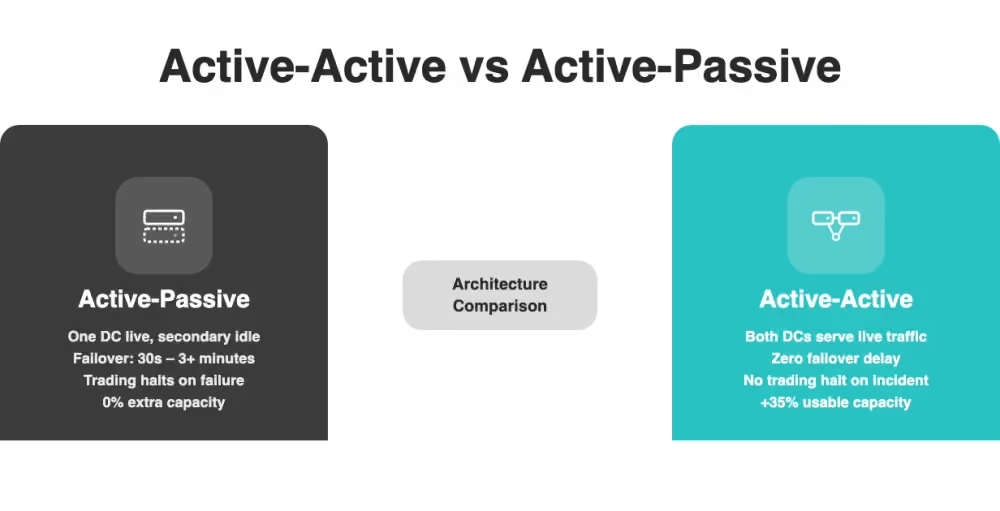
When volume is the constraint, the pressure lands on execution infrastructure: matching engine throughput, liquidity aggregation, smart order routing, failover design, and FIX connectivity standards (FIX Trading Community). Unit economics may improve with volume, but latency outliers, rejection rates, and routing weaknesses become visible in ways they were not at lower flow. Solving volume without solving routing only moves the failure downstream.
Scaling the Client Base: A Compliance and Operational Problem
When client count is the constraint, the binding factor is rarely marketing. It is onboarding throughput, ongoing KYC refreshes, transaction monitoring, case management, and trade reconstruction capability. FATF mutual-evaluation frameworks and ESMA's MiFID II regime make clear that compliance cost scales weakly with volume. Doubling clients rarely halves your compliance cost per client. Building compliance architecture like an afterthought is how growth stalls at the 50,000-client mark.
The Infrastructure Decision That Defines Your Scaling Ceiling
Early architecture decisions do not just determine your current capabilities. They determine what expansions remain possible and how expensive it becomes to change course. Operators often evaluate brokerage infrastructure vendor-by-vendor when the right unit of analysis is layer-by-layer: matching, liquidity, back office, compliance, payments, and support each have their own optimal sourcing strategy.
Build vs. Buy vs. Outsource: Decision Criteria by Layer
Compare each layer against four criteria: time-to-market, customization depth, operating leverage, and compliance accountability. Matching and liquidity usually reward buy or outsource decisions — the engineering talent, certifications, and LP relationships are difficult to replicate internally.
Compliance tooling, back-office reconciliation, and client portals often justify partial customization because they touch unique workflows. B2TRADER's matching engine, for instance, processes 3,000 requests per second and removes the need to engineer in-house throughput at that tier.
Technology Lock-In Risk and the Cost of Switching Late
Switching infrastructure late in the growth curve is not a technology migration. It is a cross-functional project that spans APIs, reporting schemas, client portals, reconciliation logic, and LP connectivity. Late re-platforming usually collides with the exact growth moment you were trying to enable — creating dual-run complexity, client disruption risk, and delayed jurisdictional expansion. The cost of deferring the decision rarely shows up on a vendor invoice; it shows up in 18 months of slowed expansion.
Liquidity Architecture at Scale
Liquidity is where retail-grade brokerages and institutional operations separate most visibly. Execution quality shapes retention, hedging efficiency, and margin stability far more than the headline spread does.
At today's turnover levels, concentration, credit, and collateral mechanics usually cap growth before quote availability does. Brokers that treat liquidity aggregation as a procurement line item rather than an architectural decision tend to learn this lesson during stress events.
Managing Concentration Risk Across Liquidity Providers
Relying on one or two providers looks efficient until volatility exposes the fragility. Diversified aggregation plus formal failover testing is table stakes for brokers operating at scale. Evaluate provider mix, last-look policies, fill rates, credit exposure, and contingency routing — not just spread averages. The right question is not which LP is cheapest on a quiet day; it is which mix maintains execution quality at 3x normal volume on the next rate-decision morning.
Credit Line Collateral Requirements as a Hidden P&L Drag
LP credit lines typically require collateral, and that collateral compresses returns as notional exposure grows. Most operators underestimate this drag until it becomes a treasury conversation rather than a trading one. Collateral should be modeled explicitly inside your capital plan — alongside client-fund segregation pressure, hedging capacity, and working-capital needs. Treated as an afterthought, it quietly caps your growth long before regulation does.
Capital Constraints That Operators Routinely Underestimate
Growth velocity depends on capital structure as much as on client acquisition. Four distinct funding drains operate in parallel: regulatory capital, segregated client money, LP collateral, and working capital. Each scales on its own curve. Most brokerages that hit a profitability cliff did not fail at acquisition — they failed because they ran the P&L as if only trading infrastructure scaled with revenue. Compliance, operations, and treasury rarely offer the same operating leverage, and pretending otherwise is how a profitable brokerage becomes an undercapitalized one inside two quarters.
Regulatory Expansion: New Entity vs. Extended License
Jurisdictional growth is a strategic allocation decision, not a compliance checkbox. Extend under existing permissions when the rules, product mix, and client geography align. Launch a new entity when safeguarding, local residency, or product-scope rules create operational requirements your current license cannot support without material workarounds. FATF and ESMA frameworks remain the anchors here, and the EBA's capital guidance continues to raise minimum expectations as AUM grows ( EBA ). The entity decision dictates cost, timeline, governance, and reporting overhead for years — build the model before the lawyer drafts anything.
Multi-Asset Expansion as a Scaling Lever
Multi-asset expansion increases wallet share and retention, but only if FX, crypto, CFDs, commodities, and indices share risk controls, reporting, and client-lifecycle infrastructure.
Adding crypto alongside an FX business pulls in distinct liquidity, margin models, settlement workflows, and compliance treatment. Brokers that launch multi-asset as a catalog expansion rather than an architectural one spend the next year patching reconciliation gaps. Integrated infrastructure — B2TRADER, B2CORE, and B2CONNECT on one margin account — reduces the integration surface and shortens the time between a product decision and live revenue.
The 24/7 Operational Model Most Scaling Plans Ignore
FX and crypto expansion require a follow-the-sun operating model across support, treasury, risk, and incident response. Business-hours operations were acceptable when volume was regional and crypto was not on the balance sheet. Neither condition holds anymore.
The minimum disciplines are on-call escalation, documented RTO and RPO targets, monitoring, runbooks, and disaster-recovery rehearsals. Outages during volatile sessions generate execution losses, client complaints, and regulatory scrutiny in quick succession. Operational resilience is a scaling lever — underinvest, and growth becomes a liability rather than an asset.
Build Your Scaling Roadmap on Infrastructure That Won't Constrain You
Scaling a forex brokerage is a sequence of architectural decisions, not a marketing campaign. The operators who succeed do it by separating transaction scaling from client scaling, sizing liquidity for stress not averages, and treating capital, compliance, and operations as co-equal inputs to the growth equation.
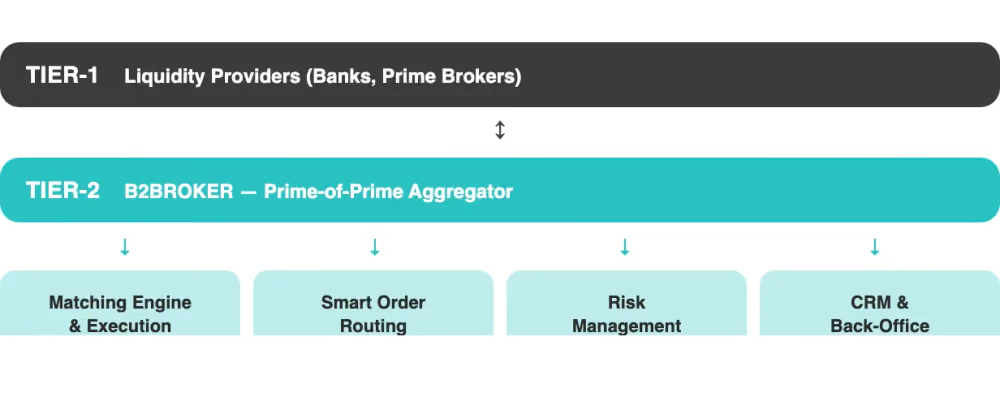
B2BROKER's integrated stack — B2TRADER, B2CORE, B2BinPay, institutional liquidity, and APIs — is built to remove the scaling bottlenecks that fragmented vendor stacks usually create. If your next growth cycle depends on infrastructure decisions you have not yet made, now is the moment to have the conversation.
Frequently Asked Questions About Scaling a Forex Brokerage
What infrastructure components are required to scale a forex brokerage beyond 100,000 active clients?
At that threshold, the binding constraint shifts from front-end growth to institutional plumbing. Matching, aggregation, risk, reconciliation, KYC, surveillance, payments, and 24/7 support all need to operate as a single system rather than discrete modules. With global OTC FX turnover above $9.6 trillion per day in April 2025, scaling safely requires resilient liquidity and connectivity architecture capable of handling stress-event spikes without cascading failure.
What technology stack decisions create the biggest scaling constraints?
Early choices around matching engine architecture, FIX connectivity, co-location, and back-office integration define your latency envelope, audit-trail quality, and switching cost for years afterward. When smart order routing sits above fragmented venues, you also need defensible best-execution logic and auditability under MiFID II. The right questions at initial vendor selection concern throughput headroom, API extensibility, and the exit cost — not the launch price.
How do forex brokerages manage liquidity provider concentration risk at scale?
Operators typically reduce concentration risk by aggregating multiple bank and non-bank liquidity providers, then monitoring fill quality, rejection rates, credit usage, and failover behavior continuously. Concentration becomes a solvency issue during stress events, when spreads widen sharply and single-provider dependency can amplify margin pressure. Formal failover testing — not just redundancy on paper — is what separates a resilient setup from a fragile one.
When should a forex brokerage establish a new regulated entity versus extend an existing license?
Establish a new entity when client geography, product scope, or safeguarding rules create operational requirements your current license cannot support without material workarounds. As client funds and AUM grow, minimum capital expectations also rise, which often makes jurisdiction-specific structuring more practical than stretching a single license. Make the decision with cost-of-capital, reporting overhead, and governance complexity modeled over a three-year horizon, not twelve months.
How can multi-asset infrastructure help scale a forex brokerage?
Multi-asset expansion improves wallet share and distribution efficiency, but only if FX, crypto, and CFDs share risk controls, reporting, and client-lifecycle infrastructure. An integrated stack such as B2TRADER, B2CORE, and B2CONNECT scales faster by reducing vendor sprawl and the late-stage re-platforming risk that derails many brokers during their second growth cycle. The question is less "which assets to add" and more "which assets can our infrastructure support without a rebuild."
Recommended articles


Subscribe to our newsletter