MT5 White Label Costs Guide for Brokers: Hidden Fees and ROI Tips

MT5 white label solutions usually start with a one-time setup fee between $5,000 and $30,000, plus a monthly fee of $1,000 to $10,000. The exact figure moves with your provider and the level of customization you ask for, and it climbs further as trading volume grows. For a first launch, those numbers look manageable. The add-ons are what change the math.
This guide is written for startup founders and finance teams who already understand brokerage economics and want a full-stack view of what MT5 white label licensing actually costs. The point is to see the line items most vendors keep out of a first proposal before you commit to one.
One thing to factor in from the start: MetaQuotes raised its MT5 licensing minimums under the 2025 pricing policy, and the increase was steep. Vendor selection and contract terms carry more weight now than they did even two years ago, so cost transparency matters before you sign anything.
Key Takeaways
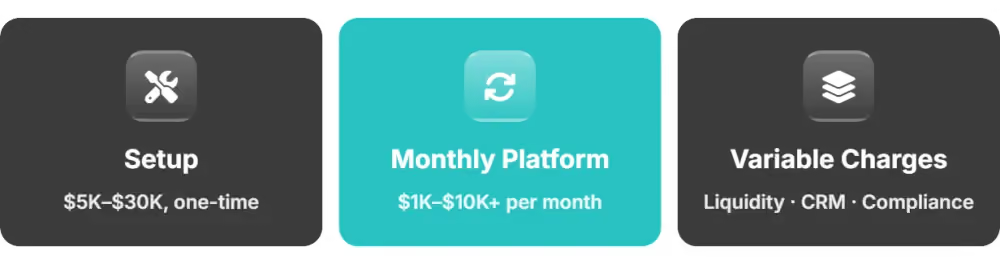
- MT5 white label pricing has three buckets: a setup fee of $5,000 to $30,000, a monthly platform fee of $1,000 to $10,000 or more, and variable charges for liquidity, CRM, and compliance. Budget for only the first two and overruns of 20–60% are common.
- The 2025 MetaQuotes policy lifted MT5 licensing minimums and tightened compliance requirements, which makes vendor choice and contract negotiation weigh more than in past years.
- Hidden fees from data feeds, payment gateway holdbacks, and volume-based surcharges erode margins fast, so ask for itemized cost breakdowns before you sign.
- Model ROI by linking each cost bucket to a revenue driver such as spread capture, commission income, and client lifetime value, instead of trusting a vendor's payback projection.
- Moving from white label to a full MT5 server license pays off only when volume and client counts justify the infrastructure, usually past 5,000 active accounts or $50B in monthly volume.
Understanding MT5 White Label Ownership
A MetaTrader 5 white label is a licensing arrangement. The provider hosts and maintains the MetaTrader 5 server infrastructure, and you run your white label platform on top of it under your own brand, shaping the trading environment with your own pricing and interface choices.
Ownership here is partial. You control the right to operate under your own brand and the settings that define your offering, from spreads to leverage. You also keep access to your client data. The underlying server license stays with the provider, and the direct contractual relationship with MetaQuotes stays there too, so you work through the vendor for both.
One detail decides who you can sign with. MetaQuotes stopped issuing new MT5 white label licenses in late 2022 and now nudges brokers to go direct instead. A fresh white label runs through a licensed main label holder who sub-licenses access to you, so confirm the provider holds a valid MetaQuotes license before any pricing talk.
A full server license works differently. You sign directly with MetaQuotes and take over the infrastructure yourself, which puts maintenance and compliance on your plate. The payoff is complete control. The cost shows up as a larger budget and heavier technical overhead, with a path to market measured in months.
The white label trade-off is easy to state. Operational complexity moves to the provider, and your time to market drops to two to four weeks. In return, you depend on the vendor. Their uptime and execution quality reach your clients directly, and their pricing stability sets the ceiling on your margins. Their scalability decides how far you can grow before the arrangement strains. That dependency is where the cost conversation should start.
Core Cost Components Brokers Should Budget For
Every legitimate MT5 white label proposal includes the cost categories described here. What changes between white label providers is the size of each number and how much sits inside the base package. Knowing these categories before you talk price gives you room to negotiate.
Setup and Configuration
A basic setup runs $5,000 to $15,000 upfront. That covers MT5 server provisioning and the branding work that puts your logos and color scheme on the trading terminal and mobile apps, down to the email templates. The first bridge configuration is included too.
Advanced setups push the figure to $10,000 to $30,000 or higher. The extra cost pays for multi-language support and custom reporting dashboards, plus integration with the back-office systems you already run.
Ask for itemized setup quotes that separate platform configuration from integration work. A bundled number hides the cost drivers and makes renegotiation harder once requirements shift.
Ongoing Platform, Support, and Hosting Fees
Monthly fees start around $1,000 to $3,000 for a basic package and reach $10,000 or more for full-service arrangements. At a minimum, that license fee should cover hosting and platform maintenance, plus regular software updates. Baseline technical support with a defined escalation path should be part of it too.
The gap between a low quote and a working setup hides in the exclusions. The items most often left out of a cheap monthly fee:
- bridge maintenance
- regulatory reporting modules
- premium support tiers
- extra server capacity
- failover and disaster-recovery environments
- additional data center locations
Server location drives both latency and cost, so ask each vendor where their data centers sit and how failover and redundancy are designed before you assume any of it is bundled in.
Liquidity Connectivity, Bridge Costs, and Compliance Tooling
The liquidity bridge is the software that links your MT5 server to liquidity providers. It handles order routing and price aggregation, and it gives you a live view of exposure for risk management.
Bridge pricing is usually tied to volume. Connectivity alone runs $500 to $2,000 per month, and some providers add a per-million charge on STP volume on top of that. The models differ enough that you should get the exact structure in writing.
Compliance cost depends on your jurisdiction. Reporting modules and transaction surveillance run heavier under FCA, CySEC, or ASIC than under lighter-touch regimes, and the audit-trail infrastructure behind them adds to the bill. A useful budgeting rule is to set aside 10% to 15% of total platform spend for compliance and reporting, then expect that share to climb as regulations tighten.
Hidden Fees That Distort Total Cost
First-time buyers and new brokers underestimate this layer the most, and it can add 20% to 60% on top of the headline price. Most stay out of the first proposal for a practical reason: a vendor can only price them after mapping your actual requirements. Ask early and they surface before you commit.
Data Feeds and Quote Packs
Real-time pricing for anything past the core FX pairs carries its own licensing cost, usually $300 to $1,500 per month for coverage of indices, commodities, and cryptocurrency CFDs. A base package may include simple feeds, then add a premium for low-latency delivery or extra and aggregated sources.
The risk is operational. Add an asset class after launch and the renegotiation rarely goes in your favor, so map your planned instrument list against vendor feed pricing before you sign.
Back-Office, CRM, and Integration Charges
Connecting a forex CRM and back-office account management usually costs $500 to $1,500 per month. The figure depends on how complex your setup is and whether you run the vendor's native CRM systems or wire in a third-party tool. Either way, it should run client onboarding and KYC, with IB tracking for your partners. Integration is rarely a one-time job, and API updates and workflow changes keep generating maintenance charges that the opening quote tends to leave out.
If multi-vendor coordination is the problem, an integrated white-label CRM for brokers can fold back-office functions into the same stack as the trading platform. A broker with an existing stack still pays migration costs, though a smaller integration surface usually makes the switch worthwhile.
Payments, Treasury Holdbacks, and Growth-Linked Surcharges
Payment gateways come with a setup fee of $500 to $2,000, plus a per-transaction cost that typically runs 1% to 3% of deposit and withdrawal volume. The cost that gets less attention is the treasury holdback. Processors often hold 5% to 10% of volume for 30 to 180 days as a chargeback reserve, which drags on cash flow exactly when a young brokerage needs it most.
Growth-linked surcharges are the ones that catch brokers off guard. The first is a per-active-client charge above a base tier, usually $5 to $20 per active client. The second is a volume surcharge that kicks in once your forex trading volume passes the contracted limit.
The wording around these matters as much as the rates. Pin down how the contract defines an active client and a unit of trading volume, and fix the measurement window in writing. Negotiate caps before signing, and line up the holdback release schedule with your liquidity plan.
MT5 White Label vs. MT5 Server License vs. MT4 White Label
MT5 white label sits in the middle of these three options. It launches faster and stays simpler to run than a full server license, and it brings more infrastructure and a deeper algorithmic trading ecosystem than a MetaTrader 4 (MT4) white label, where platform limitations and shrinking development support are growing constraints.
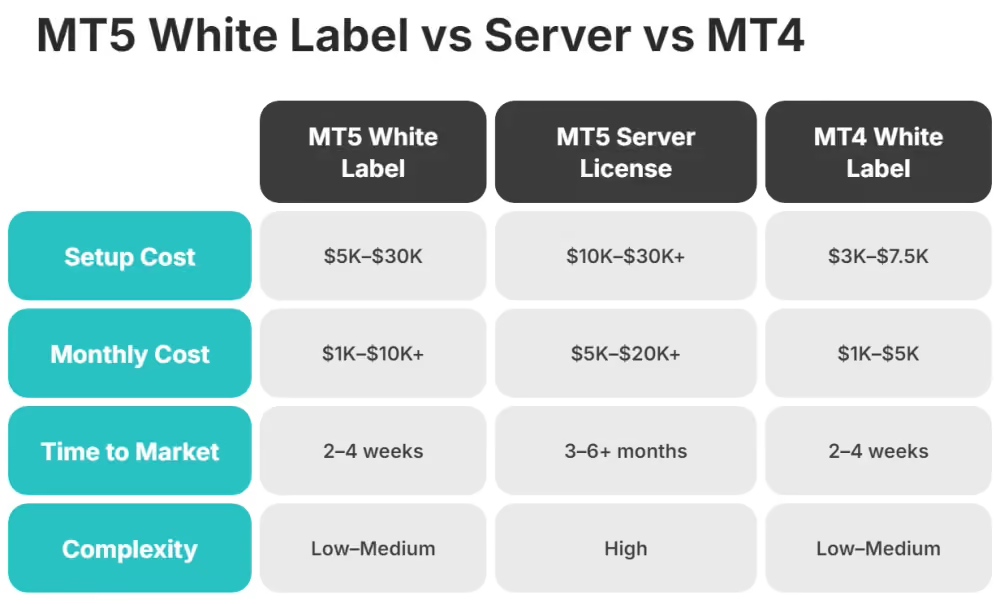
A full server license gives you more. You manage the relationship with MetaQuotes directly and control the server infrastructure outright, and it opens the door to issuing your own sub-licenses. That control comes with dedicated technical staff and full maintenance responsibility. The threshold where it pays off is high, and most brokers never reach it, so a careful look at your forex brokerage software options is worth the time before you commit to any structure.
There is no universal answer here. The right choice matches your operational capacity and growth trajectory to the trading technology and cost structure that fit them.
Framework for Forecasting ROI Without Guessing Numbers
A vendor's ROI projection assumes the good case. Clients arrive on schedule, churn stays low, and volume climbs in a straight line. Your own model pressure-tests those assumptions and shows what must hold for the investment to make sense.
Link Cost Buckets to Revenue Drivers
Tie each cost category to the revenue it touches. Platform access is what lets you capture spread and earn commission income. Liquidity quality shapes execution and slippage, and that feeds directly into client retention. The CRM affects how many prospects convert and how often dormant clients come back.
From there, build a unit-economics model that puts cost-per-client-acquired against lifetime client value, with sensitivity analysis around your spread and commission structure and your churn rate. The aim is to find your biggest levers rather than to reach accounting-grade precision. The BIS Triennial Survey is a useful benchmark for forex market volumes when you calibrate how much trading activity to expect per client.
Model Growth Scenarios and Stress-Test Assumptions
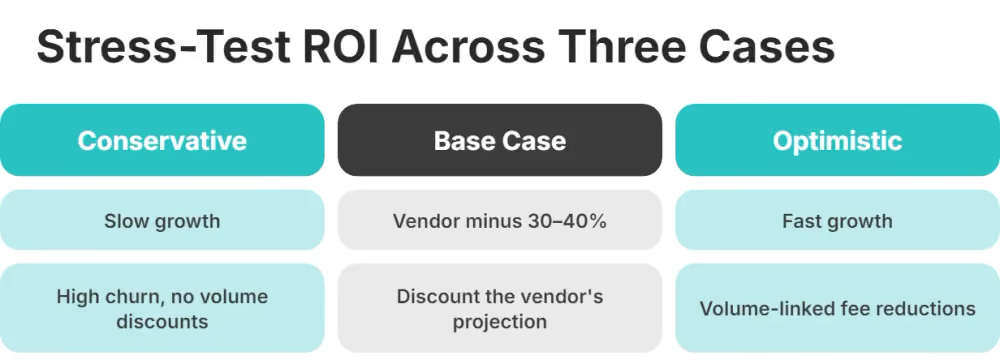
Run the numbers three ways. The conservative case assumes slow acquisition and high churn with no volume discounts. The base case takes the vendor's projection and discounts it by 30% to 40%. The optimistic case assumes fast growth with volume-linked fee reductions.
The variables worth the most attention are the ones you control least. Watch your client acquisition cost and the average volume each client generates, and pay equal attention to how fast regulatory and tooling costs climb. Use the three cases to set a breakeven threshold: the client count and trading volume you need to stay cash-flow positive under conservative assumptions. That figure becomes your operational target.
Negotiating Vendor Pricing and SLAs
Negotiation is standard procurement practice, and vendors expect it. The better outcomes come from clear requirements and realistic volume projections.
Get Transparent Tiering and Enforceable Performance Remedies
A few specific asks cut ambiguity and cap your downside:
- written pricing schedules that show how costs move by volume tier, plus a cap on maximum surcharge exposure
- price-review clauses tied to volume milestones, or most-favored-nation pricing where you can get it
- SLA uptime minimums of 99.9% or better, with service credits or fee reductions when the vendor misses them
- latency and execution benchmarks you can verify independently, separate from vendor-reported figures
Contract length cuts both ways. A longer commitment can win you a discount while deepening lock-in, so make every performance obligation explicit and measurable before you extend the term.
Your SLA terms also depend on the rules you operate under. White label forex broker regulations differ by jurisdiction, and a vendor's standard SLA may not cover what your regulator demands. The IOSCO Principles for Financial Market Infrastructures give you a solid framework for judging which operational-resilience commitments are reasonable to ask for.

When to Transition From White Label to Full Server
This question belongs at specific operational thresholds rather than on a general wish list. It becomes real once monthly trading volume runs above roughly $50B, or once you pass 5,000 active clients. It also comes up when your customization or control needs outgrow what the provider's constraints allow.
Going direct means hiring dedicated technical staff and taking on full infrastructure responsibility under a direct MetaQuotes relationship. The platform question also reopens here, since some brokers weighing MT5 vs. cTrader find that spreading across both serves their clients better than pouring more into MT5 alone.
Plenty of successful brokers stay on white label for good. The right call is a business model decision, set by whether you weight control and cost or speed and operational simplicity higher.
Run Your MT5 Brokerage With B2BROKER
Baseline fees only mark the start, and the hidden fees carry the real budget risk. Your unit-economics model matters more than a vendor's projection.
B2BROKER supports brokers who already run MetaTrader 5, handling setup and ongoing maintenance with 24/7 technical support. It also supplies liquidity aggregation , B2CORE CRM , and B2BINPAY payments . For brokers who need a new platform, cTrader white label and B2TRADER bring multi-asset trading without MetaQuotes licensing constraints, fitting brokers and prop firms alike.
B2BROKER has been operating since 2014 and serves more than 1,000 clients, backed by 10 regulatory licenses. After that long in the market, we know what brokers need to launch and scale.
Frequently Asked Questions about MT5 White Label Costs
What questions should I ask a vendor to uncover hidden MT5 white label fees?
Request itemized pricing on data feeds, CRM and integrations, payments, and volume-based surcharges, with definitions and tier thresholds in writing. A vendor who won't commit line items on paper usually has extra fees waiting after you sign.
How can I estimate ROI without disclosing trading volume?
Build internal scenarios from benchmarks for spread and commission capture, conversion, and lifetime value, then apply conservative churn and acquisition costs. That yields a defensible range without exposing proprietary figures.
How much does a white label broker cost in total?
First-year costs usually run $30,000 to $150,000, depending on setup complexity, monthly fees, and add-ons. Once data, payments, integrations, and volume-linked charges are counted, many brokers land 20% to 60% above the headline price.
What is an MT5 white label?
A provider hosts and maintains the MetaTrader 5 infrastructure while you operate under your own brand. You control pricing conditions like spreads and leverage without owning the server license or holding a direct MetaQuotes relationship.
Recommended articles

Subscribe to our newsletter