MT5 White Label Compliance: What Every Broker Must Know

Running an MT5 white label operation has never meant running free of regulatory scrutiny. When MetaQuotes suspended new white label licenses in October 2022, the shift to full server licenses put compliance responsibility squarely on the broker — no umbrella arrangement, no shared liability with a sub-licensor. You hold the license; you own the compliance stack.
For brokers already operating on MT5 or planning to launch, this matters more than platform specs or pricing. Regulators in the UK, Cyprus, Australia, and beyond have made clear that technology procurement is not a defense against enforcement. A broker that outsources its MT5 infrastructure to a managed service provider cannot outsource its KYC obligations , its AML policies, or its client money segregation requirements. Those stay with you.
This guide covers what MT5 white label compliance actually means in practice: the regulatory frameworks that apply, the obligations you cannot delegate, the technology controls regulators expect to see, and a step-by-step compliance checklist for launch.
Key Takeaways
- Regulatory accountability for KYC, AML, and client fund protection stays with the operating broker, not the white label provider.
- MetaQuotes stopped issuing new white label licenses in October 2022; most MT5 operators now hold full server licenses with direct compliance obligations.
- KYC and transaction monitoring cannot be outsourced; brokers must own the policies, exception handling, and audit trails.
- DORA (effective 2025) adds IT resilience and third-party oversight obligations on top of existing AML/KYC requirements.
- Record retention requirements span 5–7 years across major jurisdictions. Audit-ready logging is non-negotiable.
- A compliant white label provider should offer built-in KYC workflows, segregated account architecture, and audit-ready reporting, not just a trading platform.
What MT5 White Label Compliance Actually Means
MT5 white label compliance is the full set of legal, regulatory, and operational obligations that apply to a brokerage operating under the MetaTrader 5 platform, whether running a full server license or accessing the platform through the broader forex white label solutions market.
The distinction matters. MetaQuotes stopped issuing new white label licenses in part because of proliferating offshore operators that bypassed compliance obligations. Today, any firm running MT5 must demonstrate it meets the regulatory standards of its chosen jurisdiction: licensing, capital adequacy, KYC/AML procedures, client fund handling, and data protection.
Compliance responsibility does not transfer with the technology. When a broker deploys an MT5-based solution, the brokerage entity retains full accountability for everything from onboarding verification to suspicious activity reporting. The white label provider supplies the platform, servers, and often liquidity. The regulatory record is the broker's alone.
This is true whether the broker is comparing a legacy MT4 white label, a MetaTrader 4 setup, or a modern MT5 white label solution; the white label trading platform may change, but the compliance owner does not.
This principle shapes every compliance decision: jurisdiction selection, staff hiring, technology procurement, and vendor evaluation. Understanding it upfront prevents costly assumptions that the technology partner handles regulatory risk.
Licensing Requirements: Choosing the Right Jurisdiction
Jurisdiction selection is the first and most consequential compliance decision an MT5 white label operator makes. It determines capital requirements, client reach, timeline to market, and the regulatory credibility clients and banking partners will assign to your firm.
Top-Tier Regulators: FCA, CySEC, ASIC, CFTC/NFA
Top-tier jurisdictions offer the highest client trust and the widest market access, but each comes at a cost.
Beyond capital rules, brokers should budget for licensing fees, legal support, compliance staffing, and the operational cost of adapting the forex brokerage to local rules.
FCA (UK): Permanent minimum capital requirements under the UK IFPR are generally £75,000, £150,000, or £750,000 depending on activities and permissions. FCA authorization for a forex license requires detailed business plans, fit-and-proper assessments, and demonstrated compliance procedures. Leverage caps for retail clients sit at 30:1 for major currency pairs. Fines can exceed £1 million. Client money is protected under CASS rules with £85,000 FSCS coverage per eligible claimant.
CySEC (Cyprus): EU framework with MiFID II passporting rights across European markets. Minimum capital generally falls into €75,000, €150,000, or €750,000 categories depending on license type and activities. Application and related fees vary by permission scope. Client protection through the ICF reaches €20,000 per client. From 2025, CySEC's prudential oversight also reflects updated EBA group capital test guidance for investment firm groups. Non-compliance penalties exceed €350,000.
ASIC (Australia): Requires AUD 1 million in adjusted net assets for retail services. Strong retail protections and an active enforcement stance. Australian firms must hold client funds in Australian authorized institutions.
CFTC/NFA (US): High capital thresholds and restrictive leverage rules (50:1 for major pairs, 20:1 for non-majors). The most demanding jurisdiction to enter, but provides access to a deep retail market.
Mid-Tier Jurisdictions
Mauritius (FSC), Labuan (LFSA), and BVI offer a middle ground: more credibility than pure offshore, with capital deposits of $25,000–$250,000 and faster application timelines. Mid-tier licenses are increasingly acceptable to institutional banking partners and payment processors, making them a practical choice for operators building toward a top-tier license.
Offshore Jurisdictions
SVG, Seychelles (FSA, $50,000 minimum capital), Belize, and Vanuatu (VFSC, $45,000–$50,000) offer the fastest and cheapest entry. SVG setup costs run approximately $10,000. The tradeoff is significant: offshore-registered brokers face friction with EU, UK, US, and Australian clients, and banks and PSPs frequently decline offshore FX operators or impose higher fees. FATF gray-list risk adds reputational exposure.
Offshore may be appropriate for prop trading firms not holding client funds. Even then, advertising restrictions, data protection laws, and AML obligations still apply.
That includes a prop firm that does not custody client deposits but still markets forex trading products, connects to liquidity providers, or serves clients in a restricted forex market.
KYC & AML Obligations for White Label Brokers
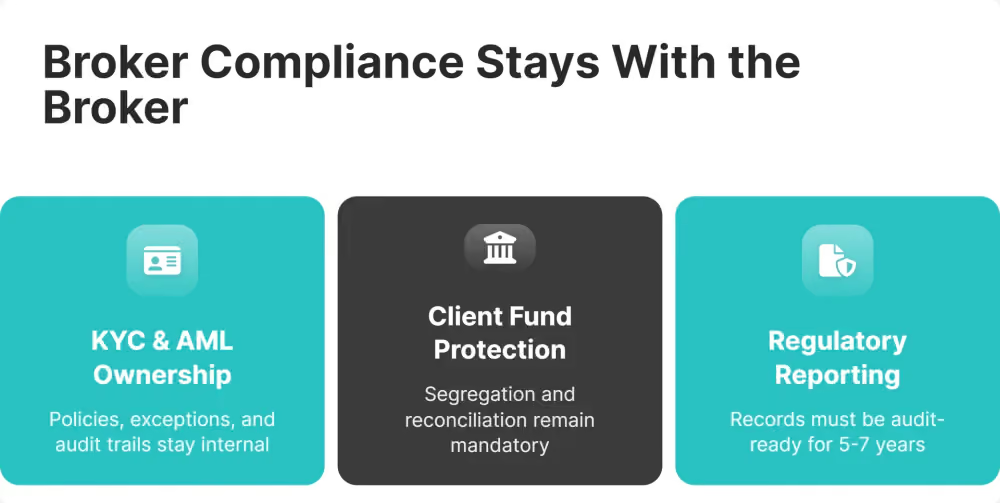
White label forex broker regulations put KYC and AML at the operational core of broker compliance. They cannot be outsourced. The broker must own the policies, control the exception handling, and maintain every audit trail.
Identity Verification and Customer Due Diligence
Brokers must verify client identities before allowing trading or transactions. This covers:
- Standard CDD: Full name, address, date of birth, government-issued ID, and beneficial ownership for corporate accounts.
- Enhanced Due Diligence (EDD): Applied to high-risk clients: politically exposed persons (PEPs), clients from high-risk jurisdictions, or those with unusual transaction patterns. EDD requires deeper source-of-funds verification and more frequent review.
- Client segmentation: Clients must be segmented by geography, risk profile, and activity type, with monitoring intensity scaled accordingly.
In practice, regulated brokers often connect screening vendors through an API, combine them with CRM systems or a forex CRM, and route deposits through approved payment gateways so compliance decisions are captured inside the client record.
Automated KYC tools can reduce verification time by approximately 60% while maintaining compliance standards. At roughly $10,000 annually for robust platforms, automation is cost-effective relative to manual processing errors and regulatory risk.
Transaction Monitoring
Ongoing transaction monitoring is not optional after onboarding. Brokers must run systems that detect unusual patterns: large single transactions, structuring behavior, rapid account turnover, or trading activity inconsistent with client profile. These systems must generate Suspicious Activity Reports (SARs) within the timeframes required by the applicable regulator.
MT5's built-in reporting capabilities support trade surveillance, but the broker must layer dedicated AML monitoring software on top, particularly for accounts involving crypto CFDs.
Accounts involving cryptocurrencies, copy strategies, or high-turnover trading systems need tighter monitoring because source-of-funds checks and suspicious activity patterns can differ from traditional FX flows.
PEP and Sanctions Screening
Every client must be screened against PEP lists and sanctions databases at onboarding and on an ongoing basis. Non-compliance with sanctions screening has produced some of the largest regulatory fines in the sector. Staff training on PEP identification is required under most regulatory frameworks.
Record Retention
Records of all KYC documentation, transaction monitoring decisions, and client communications must be retained for 5–7 years depending on jurisdiction. Records must be tamper-evident and retrievable for regulatory audit on demand. This requirement extends to terminated client relationships.
Client Fund Segregation Rules
Client fund segregation is a non-negotiable requirement in every top-tier and most mid-tier jurisdiction. Brokers must maintain client deposits in accounts completely separate from operational funds, and demonstrate this separation through regular reconciliation.
- FCA (UK): Daily reconciliations required. Client money protected up to £85,000 under FSCS.
- CySEC (Cyprus): Full segregation mandated under MiFID II. Compensation up to €20,000 per client through the Investor Compensation Fund.
- ASIC (Australia): Funds must be held in Australian authorized deposit-taking institutions. Regular reconciliation against client liability records is required.
- Offshore jurisdictions: Segregation is often voluntary but functions as a baseline trust signal for clients and banking partners. Offshore operators who skip segregation face disproportionate difficulty opening and maintaining banking relationships.
The operational implication: brokers need accounting infrastructure that tracks client liabilities in real time and produces reconciliation reports on demand. This is not a manual spreadsheet task. It requires purpose-built back-office tooling integrated with the trading platform.
The same infrastructure should connect transaction records, data feeds, and account balances so finance teams can reconcile funds across the full trading environment.
Leverage Controls and Reporting Requirements by Region
Leverage caps are set by regulators, not by the platform, and white label operators must configure MT5 to enforce jurisdiction-specific limits for retail and professional clients:
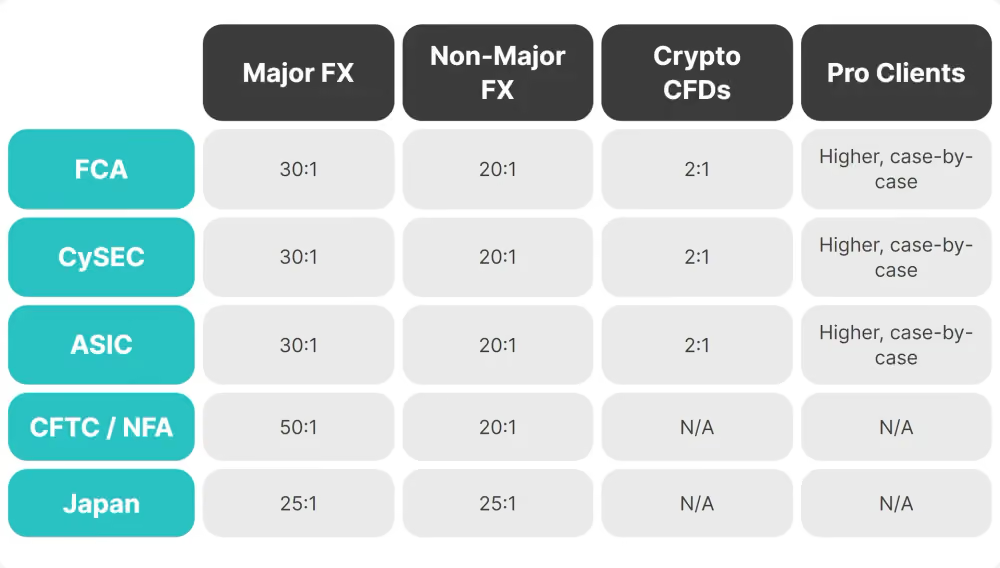
Brokers serving multiple jurisdictions must configure per-account or per-group leverage settings accordingly. MT5's group management system supports this, but requires deliberate configuration and ongoing audits to confirm no retail account is operating above its applicable cap.
Where a broker controls its own MT5 server, these settings should be reviewed before each new jurisdiction, product group, or client classification goes live.
These controls should sit alongside risk management tools for exposure limits, margin alerts, B-book routing policies, and algorithmic trading activity that may change risk faster than manual review can catch.
Reporting obligations run parallel: monthly or quarterly financial statements, trade activity logs, client fund reconciliation, and real-time risk dashboards are standard requirements across FCA, CySEC, and ASIC frameworks.
Data Privacy: GDPR and DORA Compliance
Compliance for MT5 white label operators extends beyond financial regulation. GDPR can apply to firms processing personal data of people in the EU, while DORA applies to defined EU financial entities and creates ICT third-party risk obligations that can affect their technology providers.
GDPR
GDPR applies to any firm processing EU user data, regardless of where the firm is incorporated. Core obligations include:
- Data minimization: Collect only what is necessary for the stated purpose.
- Purpose limitation: Use data only for what clients consented to.
- Transparency: Clear privacy notices explaining what data is collected and why.
- Right to erasure: Clients can request deletion of personal data, subject to AML record retention requirements.
- Data breach notification: Regulators must be notified within 72 hours of a confirmed breach.
The tension between GDPR's right to erasure and AML's 5–7 year retention requirement is one of the main operational challenges brokers face. The resolution: data required for AML compliance cannot be deleted under legitimate GDPR exemptions, but must still be handled with encryption and access controls.
DORA (Digital Operational Resilience Act)
DORA became applicable in January 2025. It requires financial entities, including brokers, to build IT risk management, incident response, and third-party oversight into their operations.
Practical implications for MT5 operators:
- IT risk management framework: Documented policies for identifying and managing technology risks.
- Incident classification and reporting: ICT-related incidents must be classified, logged, and reported to competent authorities within prescribed timelines.
- Third-party oversight: Contracts with technology providers (including white label platform vendors) must include specific provisions around data access, audit rights, and exit strategies.
- Operational resilience testing: Regular testing of continuity plans, including simulated outages and cyber incident scenarios.
Those reviews should cover uptime, planned upgrades, technical support response times, low-latency connectivity, and resilience for client portals or mobile apps.
Partnering with a technology provider that holds ISO 27001 certification can support vendor due diligence under DORA, but it does not replace the broker's own ICT risk management, incident reporting, testing, or third-party oversight obligations.
What Compliance Features to Look for in an MT5 White Label Provider
Technology cannot replace regulatory accountability, but the right provider can significantly reduce the operational burden of compliance. When evaluating an MT5 white label or setup service, assess these capabilities:
KYC/AML integration: Does the platform connect to automated identity verification tools? Can it trigger enhanced due diligence workflows automatically based on risk signals?
Audit-ready reporting: Are trade logs tamper-evident? Can the system generate regulatory reports (transaction reports, client fund reconciliation, suspicious activity summaries) on demand or on a scheduled basis?
Segregated account architecture: Does the back-office system track client liabilities separately from firm funds in real time?
Leverage configuration per group: Can the system enforce jurisdiction-specific leverage caps at the account or group level without manual intervention?
Data residency controls: For EU client data, can the system enforce storage in EU data centers? Does the provider hold or inherit certifications (ISO 27001, SOC 2) that support third-party due diligence under DORA?
DORA contract provisions: Does the provider offer contracts that include data access rights, audit rights, and exit assistance? All three are required under DORA for third-party technology contracts.
Platform extensibility: Can the provider support a plugin model, third-party integrations, and trading software extensions without weakening audit trails or permission controls?
Providers that treat compliance as an afterthought create long-term risk. The right partner builds it into the infrastructure from the start.

How B2BROKER Supports Broker Compliance Operations
B2BROKER does not provide MT5 white label services. Instead, it supports brokers with the surrounding operational stack that compliance depends on: CRM, client onboarding, back-office controls, liquidity connectivity, reporting workflows, and turnkey brokerage infrastructure.
For fintech startups and established brokers, that surrounding stack can be a scalable, user-friendly, all-in-one operating layer rather than a replacement for the broker's own platform license or regulatory permissions.
For the operational compliance layer (KYC workflows, client fund tracking, audit trails, and reporting), B2CORE CRM can support brokers already operating with MT5 or other trading platforms. B2CORE provides:
- Automated KYC document collection and verification workflows
- Client segmentation by risk profile and geography
- Compliance audit logs with tamper-evident record management
- Client fund reconciliation reporting
- Role-based access controls for compliance teams
For brokers seeking MT5 white label alternatives while maintaining regulatory-grade tooling, B2TRADER (B2BROKER's proprietary multi-asset platform) includes built-in regulatory reporting, KYC/AML support, and audit logs natively, without the third-party configuration requirements of MT5.
B2BROKER's Forex Broker Turnkey bundles platform, liquidity, back office, and compliance-supporting infrastructure into a single deployment, designed for operators who need to go live in a regulated environment without assembling the stack from multiple vendors.
For teams evaluating trading solutions, a turnkey solution can reduce integration work across CRM, liquidity, reporting, and back-office operations while leaving the broker responsible for license scope, governance, and platform-specific controls.
Frequently Asked Questions about MT5 White Label Compliance
Is compliance the responsibility of the MT5 white label provider or the broker?
Compliance remains with the broker, including KYC, AML, client fund protection, and leverage controls. A white label agreement does not transfer regulatory liability to the platform or infrastructure provider.
Which jurisdiction is best for launching an MT5 white label broker?
There is no single best jurisdiction; the right choice depends on target markets, capital, timeline, and banking access. FCA and CySEC offer stronger credibility with higher capital requirements, while mid-tier and offshore jurisdictions can be faster but carry greater market-access limits.
What KYC documents does an MT5 white label broker need to collect?
Brokers usually need government-issued ID, recent proof of address, and beneficial ownership documents for corporate clients. High-risk clients require enhanced due diligence, including source-of-funds checks and more frequent review.
Does GDPR apply to offshore MT5 white label brokers?
GDPR can apply when an offshore broker offers services to people in the EU or processes their personal data. Brokers targeting EU retail clients need compliant privacy notices, data handling, and breach reporting procedures.
What is DORA and does it apply to forex brokers?
DORA is the EU Digital Operational Resilience Act, applicable from January 2025 to defined EU financial entities. Covered brokers must implement ICT risk management, incident reporting, resilience testing, and third-party oversight for technology vendors.
How long must an MT5 white label broker retain compliance records?
Most major regulators require 5–7 years of retention for KYC documents, transaction records, and client communications. These records must remain tamper-evident and retrievable for audits, even after the client relationship ends.
What happens if an MT5 white label broker fails a compliance audit?
Minor failures may lead to warnings and remediation orders, while systemic failures can trigger fines, license suspension, or revocation. Inadequate AML controls, missing segregation, and weak KYC are among the highest-risk findings.
Recommended articles

Subscribe to our newsletter