What Must Banking as a Service Infrastructure Include?

Banks that sponsor fintech programs make up roughly 3% of all US banks, yet in 2023 they drew 13.5% of the severe enforcement actions federal regulators issued. Some of those orders barred those sponsors from onboarding new fintech partners. Every launch waiting in that pipeline stopped.
That is the risk inside banking as a service infrastructure: the stack you build on decides how fast you ship and what a regulator can freeze.
The sections below work through how to evaluate that stack, from the three-layer architecture to the build-versus-buy call. B2BROKER's fintech infrastructure page maps the same ground onto specific components.
Key Takeaways
- BaaS stacks split into three layers: a licensed entity answering to regulators, API middleware exposing its systems, and the branded product a client sees.
- Capital markets fintechs need more than accounts and cards; execution quality, liquidity, and post-trade controls decide revenue and risk.
- Regulation shapes the stack from day one, because the license, KYC and AML duties, and DORA-grade resilience obligations all arrive with the infrastructure partner.
- Institutional middleware speaks FIX, REST, and WebSocket, so trading, payments, CRM, and reporting systems integrate without custom engineering per provider.
- An integrated white-label stack cuts vendor count and shortens time-to-market compared with assembling point solutions.
What Banking as a Service Infrastructure Actually Means
Banking as a service infrastructure is the licensed BaaS platform a regulated provider runs so other businesses can offer financial products without holding a banking license of their own. It gives non-bank companies accounts, payments, and compliance controls through application programming interfaces (APIs) they can build on.
Embedded finance is the part the end customer sees, such as paying inside an app or taking a loan at checkout. The infrastructure is the machinery underneath that keeps the experience legal and running.
That machinery keeps standardizing, and regulators are now building open banking rails themselves. In 2026 the BIS Innovation Hub's Project Aperta connected the domestic open finance networks of five jurisdictions , from the UK to India, through a neutral API interoperability layer.
Once those rails are in place, API access stops being a differentiator, and the lasting advantage moves to the infrastructure underneath.
The Three-Layer Architecture Every BaaS Stack Requires
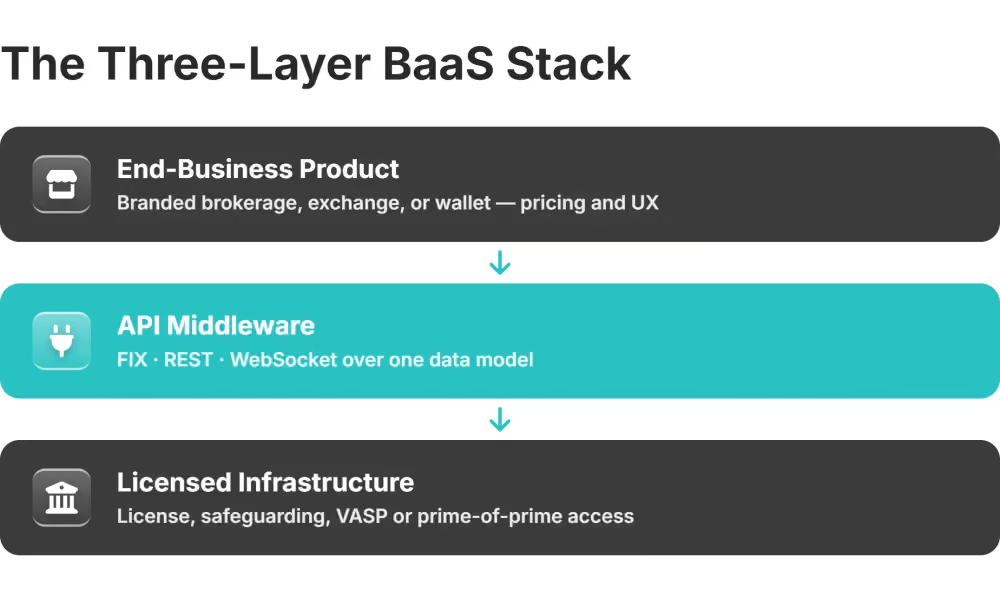
The stack is three layers, each depending on the one below: a licensed entity carries the license and answers to regulators, API middleware exposes its systems to engineers, and the end business packages both into a branded product.
For a capital markets fintech, the licensed layer means regulated liquidity and custody access; the product layer is a brokerage or exchange front end.
1. The Licensed Infrastructure Layer
The bottom layer supplies the license, the safeguarding of client money, and the accountability a regulator can act on. In consumer BaaS, licensed banks and e-money institutions usually fill this role, while a capital markets fintech more often builds on a VASP or a regulated prime-of-prime partner for market access.
Three properties predict how this layer behaves under stress:
- Jurisdiction coverage. Which markets the authorization actually reaches, and which will need a second entity.
- Counterparty structure. Who holds client balances at each step, and what happens to them if the partner fails.
- Regulatory record. An enforcement history like the sponsor-bank wave of 2023 freezes onboarding for every business built on that partner.
2. The API Middleware Layer
API middleware translates the licensed entity's core banking infrastructure into interfaces a product team can use. In capital markets that means FIX for order flow, REST for account management, and WebSocket for streaming data, well beyond the card-issuing endpoints consumer platforms expose.
The real test of this layer is how it handles many providers at once. Strong middleware hides their differences behind one schema. An integrated stack running on one data model goes further and closes most reconciliation gaps between systems by design.
3. The End-Business Product Layer
At the top sits the product clients see, whether that is a brokerage, an exchange, a digital wallet, a marketplace, or an embedded investment feature with its own pricing and UX. Differentiation lives in this layer, and so does the temptation to spend the entire budget on it.
Resilience still comes from below. A polished front end on fragile middleware fails at the first volume spike, and the client blames the brand on the screen.
Where Capital Markets Infrastructure Diverges From Consumer BaaS
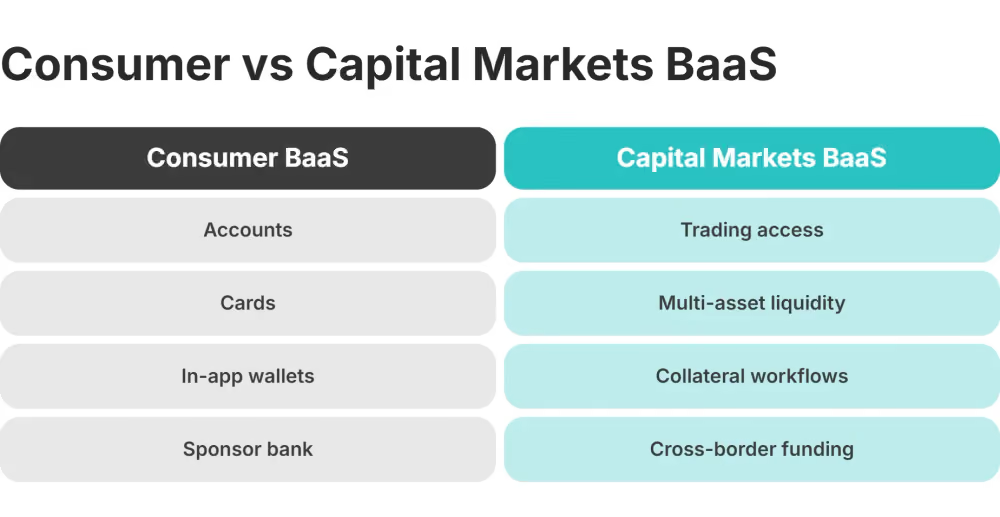
Consumer BaaS and capital markets BaaS solve different problems with the same vocabulary.
A consumer stack turns payment services into accounts, card issuance, and in-app wallets on top of a sponsor bank. An institutional stack outputs trading access, aggregated liquidity, collateral workflows, and cross-border funding rails.
Most published BaaS guides cover the consumer market and barely mention matching engines or white-label brokerage infrastructure. Those are exactly the components a capital markets operator has to evaluate. The next section takes them one by one.
Core Technical Components of Institutional-Grade BaaS Infrastructure
Evaluate the institutional stack along the chain an order travels, from execution and the liquidity behind it to client operations and the funding that settles everything. A failure anywhere on that chain reaches the client.
Matching Engine and Order Execution Architecture
When a client account goes underwater during a data release, either the engine liquidates positions partially and in deterministic order, or the desk carries the loss while support explains a full close-out. That margin logic is the piece of execution architecture that decides a firm's survival.
Throughput belongs in the contract too. Sustained load capacity is measurable, so ask for it in writing.
White-label platforms cover this layer without a multi-year build. B2TRADER , B2BROKER's multi-asset trading platform, ships with configurable margin and netting modes and handles high-volume order flow.
Multi-Asset Liquidity Aggregation
Liquidity aggregation keeps pricing continuous when any single venue thins out. One aggregation layer pools quotes across FX, crypto, metals, commodities, and indices and routes each order to the source pricing it best at that moment.
The advertised spread says little on its own. What matters is the failure case:
- Source diversity. How many independent providers feed each book, and how correlated they are under stress.
- Fill quality at size. Where orders actually execute once they exceed the top-of-book quote.
- Failover depth. How fast routing shifts when a provider stops streaming.
Back-Office and Client Lifecycle Management
Client lifecycle operations belong in the core stack because the cost of keeping them separate is concrete.
When KYC status and authentication live in one tool while trading permissions live in another, the systems disagree for minutes at a time, and a client can fund and trade before checks complete. In a regulatory examination, that gap becomes a finding.
B2CORE is the unified version of this layer, running the client lifecycle, finance, and support workflows in one back office so the audit trail stays in a single system.
Crypto and Cross-Border Payment Processing
Funding is infrastructure too. A globally distributed operation moves client money across currencies daily.
Stablecoin and crypto rails increasingly carry the cross-border legs that correspondent banking settles slowly. B2BINPAY covers that layer with crypto payment processing and treasury flows that settle alongside the trading stack.
Scrutiny of those rails is rising. In June 2026 the NYDFS and the European Banking Authority announced a supervisory cooperation agreement on stablecoin activities , with quarterly information exchange and crisis coordination.
Choose a funding layer with compliance tooling built for that level of oversight.
Regulatory Infrastructure as a Vendor Selection Criterion
Your choice of vendor is now part of your regulatory compliance record, a link EU law makes explicit. DORA, applicable since January 2025, obliges financial entities to keep a register of every ICT provider , report major incidents on fixed timelines, and test recovery against third-party failure.
The FSB points supervisors in the same direction. Its third-party risk management toolkit tells them to monitor concentration on critical service providers across the financial system, which puts your infrastructure partner in your regulatory filings.
Know your customer (KYC) and anti-money laundering (AML) checks remain necessary, but the diligence scope has widened. Your vendor now has to help you prove operational resilience through auditability, recovery testing, and dependency mapping. Transaction monitoring alone cannot show how the stack recovers when a critical provider fails.
Build vs. Buy vs. White-Label: The Decision Framework for Fintech CTOs
The decision comes down to time against control. An in-house build gives maximum control over every component; it also means your team carries the full licensing and support load while the market moves.
Buying point solutions trades build time for integration debt. Each vendor adds an integration to maintain and one more register entry to oversee. The gaps between those vendors' records are where audits find problems.
A white-label stack from a single partner collapses both problems into one relationship. The infrastructure arrives already integrated, while a provider that absorbs post-trade automation and embedded compliance work removes whole categories of internal engineering.
For most teams the deciding question is which model turns banking as a service infrastructure from a multi-year program into a deployment.
B2BROKER packages the institutional version of that regulated infrastructure as one ecosystem:
- B2TRADER for execution
- B2CORE for the client lifecycle
- B2BINPAY for funding
- Multi-asset liquidity underneath
Together the components cover the technical chain this article walked through, from execution to funding.
If your business case depends on a launch window, the fastest way to test the fit is a conversation about your own stack with the people who deploy this daily.
Frequently Asked Questions about Banking as a Service Infrastructure
What is banking as a service infrastructure and how does it work?
A regulated provider exposes its accounts, payments, and compliance systems through APIs, and other businesses build financial products on top. The licensed entity carries the regulatory duties, middleware supplies the interfaces, and the client-facing business assembles both into its product.
What does the three-layer model of banking as a service infrastructure include?
The model includes a licensed entity that holds funds and carries KYC, AML, and safeguarding duties; an API middleware layer that exposes those capabilities to developers; and the end business that packages them into a branded financial product.
How does banking as a service infrastructure differ for capital markets fintechs?
Execution quality, multi-asset liquidity, margin logic, and post-trade controls join the requirements list, because they drive revenue and risk directly for brokers and exchanges. Consumer stacks built for cards and accounts carry none of that.
What should fintechs look for in institutional-grade banking as a service infrastructure?
Priorities are regulatory coverage, operational resilience, vendor concentration risk, and integration depth across the systems that have to reconcile daily; in Europe, DORA-aligned incident handling and third-party oversight have become practical selection criteria. Integrated components such as B2TRADER, B2CONNECT, and B2CORE cut the number of vendors the compliance team must oversee.
Should a fintech build, buy, or white-label banking as a service infrastructure?
Building maximizes control and stretches time-to-market, with every compliance and support obligation carried in-house. White-labeling from a single provider is usually the faster path when launch speed and a smaller vendor surface matter more than owning every component.
Recommended articles

Subscribe to our newsletter