Embedded Finance Infrastructure for Crypto Exchanges

The phrase "embedded finance" usually arrives wrapped in retail examples: embedded payments at checkout, buy now, pay later (BNPL) plans, and digital wallets — a market Bain sizes at more than $7 trillion in US transaction value in 2026 . Almost none of that coverage says anything useful about running a crypto exchange.
The problems on an exchange operator's desk look different. The liquidity contract sits with one vendor and the compliance tooling with another. The launch date slips in the integration gap between them.
This guide defines embedded finance infrastructure at the scale of a regulated, high-volume exchange: what the stack includes, how to evaluate each layer, and why one integrated platform tends to beat an API-only approach.
Key Takeaways
- For a crypto exchange, embedded finance infrastructure means the full operating stack behind the venue, from liquidity access to post-trade control, and APIs are only its surface.
- An institutional deployment needs five coordinated layers; every extra vendor boundary between them adds reconciliation work and slows incident response.
- Compliance lives inside the architecture. Anti-money laundering (AML), know your customer (KYC), auditability, and resilience controls decide how the platform runs, so they belong in vendor selection, before any contract is signed.
- Build versus buy comes down to whether proprietary technology justifies the longer integration, governance, and maintenance timelines it drags in.
- Owning the core stack compounds: control over liquidity access, client experience, and operating standards travels with you into every new jurisdiction.
What Embedded Finance Infrastructure Actually Means for Crypto Exchanges
For a crypto exchange, embedded finance infrastructure is the operational stack beneath the venue. It is the machinery that carries a client from onboarding to settled trade inside one controlled environment. None of it is visible in the trading interface.
That is not what most coverage means by the term. Explainers usually frame embedded financial services as a payment button or an embedded lending offer that non-financial platforms and marketplaces add to a retail checkout. The rails behind them come from fintech providers, sold as banking-as-a-service (BaaS) and open banking.
Those models are real building blocks, letting a non-bank offer banking products or read account data on a licensed partner's rails. For an exchange, they are still only the inputs. A venue needs a matching engine, institutional liquidity, and post-trade operations. No API model supplies them.
The Five Layers of an Institutional-Grade Embedded Finance Stack
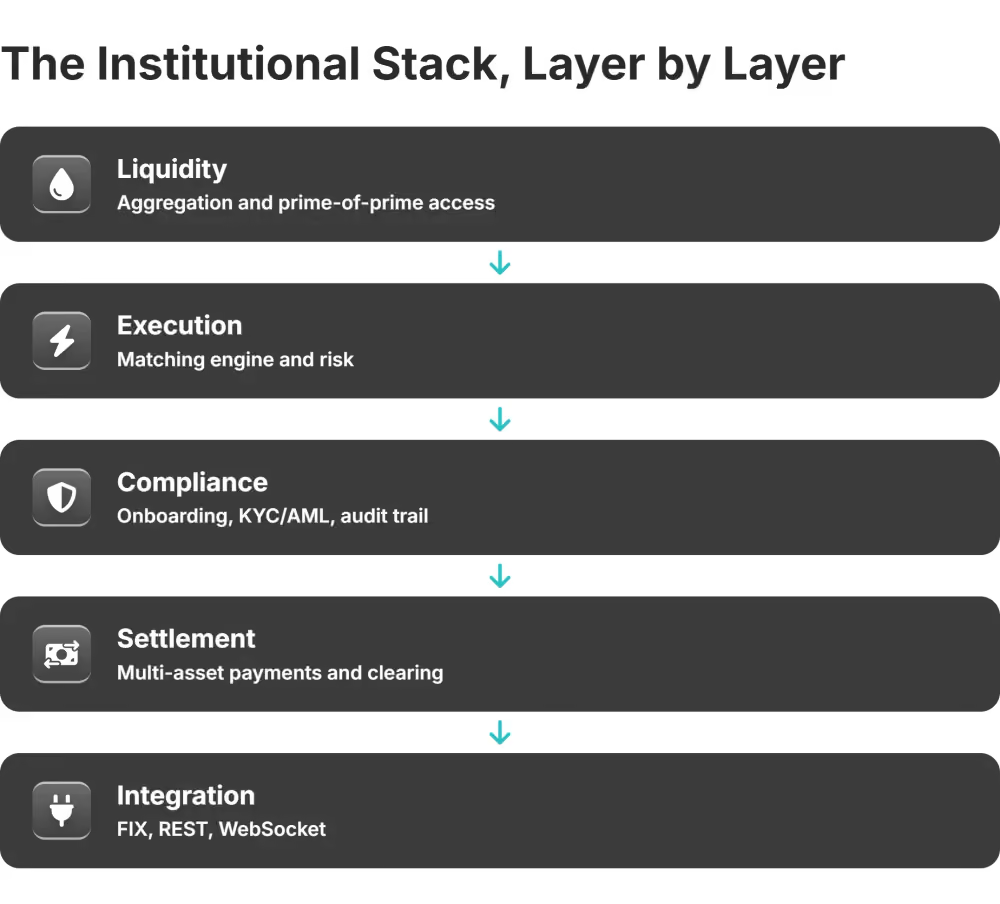
The stack reads in its operational sequence: liquidity, execution, compliance, settlement, and integration. Each layer feeds the next, which is why a unified architecture outperforms a collection of point solutions .
What connects the layers is a shared data model. Once that model fragments across five vendors, a settlement discrepancy turns into a hunt for which system holds the correct number. By the time someone owns the problem, it has aged into a client complaint.
1. Liquidity Aggregation and Prime-of-Prime Access
Generic embedded finance content never mentions liquidity, yet nothing else in the stack works without it. Aggregation pulls depth from multiple sources into one book. Prime-of-prime access then adds institutional pricing the venue could not reach on its own balance sheet.
Evaluate the layer on measurable behavior: fill rates at your typical order size, spread stability through volatile sessions, and depth in the pairs your clients actually trade.
2. Order Matching and Execution Infrastructure
When order flow spikes, everything downstream waits on the matching engine. Its throughput ceiling decides how the venue holds up under that load. The same engine carries the risk mechanics, from netting and margin logic to partial liquidation.
Execution quality is a revenue function too. Poor fills push traders to competitor venues one disappointing order at a time. A liquidation engine that mishandles a gap turns client losses into the exchange's own.
3. Back-Office Compliance and Client Management
Behind the trading screen, the stack has to run the whole client lifecycle, from KYC screening at onboarding through transaction monitoring to the audit trail. This is the layer where a COO's workload either compounds or compresses.
Fragmented back-office tooling forces the compounding path. Client data spread across three systems means every audit starts with manual reconciliation. KYC gets rechecked for the same reason: no system trusts the other's record.
A unified data model keeps every desk reading from one source.
4. Crypto Payment Processing and Multi-Asset Settlement
Client money never stops moving during a session, which is what puts payment and settlement in the core stack: deposits, withdrawals, and internal transfers all need to clear across fiat and digital assets without a separate provider for each corridor.
Each processor bolted on for a new currency adds its own settlement timing and its own gaps in fraud prevention. Corridors multiply as the business grows. A layer that opens new ones by configuration keeps that growth from adding vendors.
5. API Connectivity and Integration Architecture
APIs expose the stack. Institutional connectivity means FIX 4.4/5.0 for order flow, with REST and WebSocket interfaces and webhooks keeping downstream systems synchronized.
The trap in an API-only strategy is accountability. When exception handling and compliance ownership are split across systems that only talk through endpoints, failures land in the seams that no single vendor owns.
How Regulatory Compliance Shapes the Infrastructure Choice
Compliance determines architecture from day one. A regulated exchange cannot bolt AML and resilience controls onto live infrastructure without rebuilding it. Fund segregation, incident response, and business continuity are system requirements that belong in vendor selection alongside throughput and pricing.
The UK's Financial Conduct Authority shows where the bar sits. Under its operational resilience rules, firms identify important business services, set impact tolerances , and prove through testing that they can recover within them.
The transition period closed in March 2025, turning a project deadline into the running standard. Uptime and recovery have become board-level questions.
The same logic scales across borders. As institutional capital moves into digital assets , every new market brings its own supervisor. Readiness for that scrutiny has to be in the stack before the first license application.
Standards bodies are already building for this. In May 2026, the BIS and GLEIF tested Legal Entity Identifiers in a cross-border open-finance prototype spanning five jurisdictions, a step toward KYB and identity checks that travel between markets instead of restarting in each one.
Build vs. Buy: A Decision Framework for CTOs and COOs
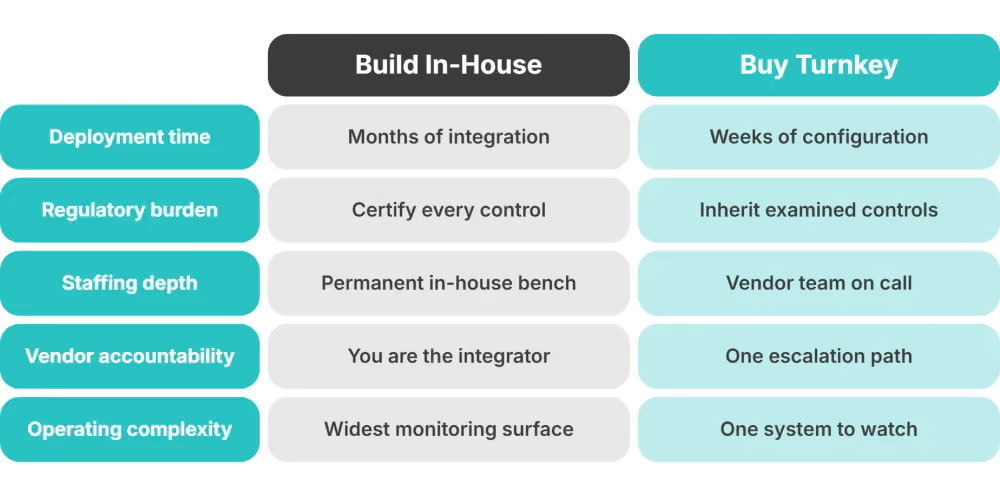
The honest decision lens has five variables:
- Deployment time. Months of integration and certification for a build; weeks of configuration for a turnkey stack.
- Regulatory burden. Every control in a proprietary build has to be documented and certified by your own team before a supervisor sees it.
- Staffing depth. An in-house stack needs engineers who know matching, custody, and compliance tooling on payroll permanently.
- Vendor accountability. One integrated provider gives one escalation path; a self-assembled stack leaves your team as the integrator of record.
- Operating complexity. Each additional system widens the reconciliation and monitoring surface the operation carries every day.
Building in-house is the right call when the venue's edge is proprietary market structure. The precondition is an engineering bench that can certify every control across execution and post-trade flows.
That path buys ownership and bills for it in calendar time and permanent maintenance headcount.
Buying compresses the timeline where it hurts most: compliance setup and post-launch change management. Comparing turnkey digital asset exchange platforms against your requirements list usually settles the question faster than a build feasibility study.
How B2BROKER Delivers Embedded Finance Infrastructure as a Turnkey Ecosystem
B2BROKER maps each layer of the stack to a component engineered to run with the others:
- Liquidity: multi-asset liquidity with prime-of-prime access across crypto, FX, and other asset classes.
- Execution: B2TRADER , the multi-asset trading platform at the core of the venue.
- Back office: B2CORE for onboarding, KYC/AML workflows, client management, and reporting.
- Settlement: B2BINPAY for crypto payment processing and settlement across digital assets and fiat.
- Connectivity: FIX 4.4/5.0, REST, and WebSocket interfaces tying the stack to external systems.
The list matters less than the property behind it. The layers share one data model and one escalation path, so a risk flag, a settlement record, and a client report never disagree.
B2BROKER's multi-license footprint is part of the same argument. When a supervisor in one market has already examined the infrastructure, the next license application starts from evidence instead of a blank page.
Infrastructure Ownership Is the Competitive Moat That Scales With You
Exchanges that control their core financial infrastructure iterate faster and hold up better under stress than competitors renting every layer through interfaces. The advantage grows with each new market, because the stack arrives with its operating standards already enforced.
That is the practical case for treating embedded finance infrastructure as an operating decision owned by the CTO and COO. Get the stack right early. Growth then stays a matter of adding volume and jurisdictions instead of re-platforming with clients live on the book.
If you are weighing that decision now, B2BROKER's team can walk through the stack against your specific requirements before you commit.
Frequently Asked Questions about Embedded Finance Infrastructure
What is embedded finance infrastructure for a crypto exchange?
It is the operating stack that lets an exchange deliver trading, funding, settlement, and compliance inside one controlled environment. APIs expose those services, and the infrastructure behind them covers everything from liquidity access and order matching to wallet rails and reconciliation.
What are the core components of an embedded finance infrastructure stack?
Five layers: liquidity aggregation, order matching, back-office and compliance, payment settlement, and connectivity. Weakness in any one of them shows up as wider spreads, slower reconciliation, or elevated operational risk during volatile sessions.
How does embedded finance infrastructure differ from open banking and banking-as-a-service?
Open banking lets applications read bank account data with the customer's consent, and banking-as-a-service lets a company offer banking products, from embedded banking to card issuance, through a licensed partner. Neither provides execution, liquidity, or post-trade operations, so a crypto venue's infrastructure sits above both and orchestrates them into a working trading operation.
What regulatory requirements matter most for embedded finance infrastructure providers?
Operational resilience, AML and KYC controls, auditability, client asset segregation, and outsourcing governance lead the list. A provider serving regulated financial services firms should support impact tolerances, incident response, disaster recovery, and clear accountability across internal teams and third parties.
How should CTOs and COOs evaluate build versus buy for embedded finance infrastructure?
Build when the firm's edge depends on proprietary market structure and the engineering capacity exists to certify every control in-house. Buy when speed, resilience, and a single accountable vendor matter more; a turnkey stack such as B2BROKER's, spanning B2TRADER, B2CONNECT, B2CORE, and B2BINPAY, compresses launch timelines without giving up infrastructure depth.
Recommended articles

Subscribe to our newsletter