How Should CTOs Consolidate a Brokerage Tech Stack?

Trading, client management, and money movement usually arrive from different vendors, each keeping its own record of the same client. CTOs consolidate brokerage tech stacks by moving those functions onto one governed architecture, where every module reads the same client, order, and balance record and one team answers for the whole path.
If your trading platform, CRM, and payment gateway come from three vendors, your regulator already treats each of them as part of your operation. Since March 2025, UK firms in scope have had to map the third parties behind each important business service . When one of them fails to recover in time, the failure counts as the firm's own.
This guide works through what fragmentation costs, the three ways to consolidate, and a migration path that keeps live trading up while the stack changes underneath it.
Key Takeaways
- A consolidated stack runs trading, client management, risk, and payments on one shared data record, retiring redundant tools and keeping a client or an order in one place.
- Fragmented systems add manual reconciliation, split audit trails, and make operational resilience mapping harder for you and your compliance team.
- A turnkey ecosystem shortens launch timelines while the institutional controls over execution and client onboarding stay in place.
- Build, buy, and turnkey differ most on time-to-market and on who owns the data afterward.
- A low-risk migration phases connectivity, parallel testing, data reconciliation, and cutover governance before live trading moves.
What Does It Mean to Consolidate a Brokerage Tech Stack?
Tech stack consolidation puts the workflows that move a client's orders and money onto one architecture. Overlapping tools retire, and your desk keeps control of risk parameters and client data.
The scope is specific to a brokerage. It covers:
- liquidity and execution, including the matching or bridging layer
- CRM and onboarding, with KYC inside it
- payments and transaction management, from deposit to withdrawal
- back office, risk limits, and settlement
- business intelligence and regulatory reporting
Rationalizing generic software tools or an ERP suite is a different exercise. The systems above pass one client and order record between them. Every boundary that record crosses is a place where two copies can disagree.
The count of boundaries grows faster than the vendor list. Seven standalone systems can need up to 21 point-to-point links, each retested whenever either side ships a release.
A consolidated stack still connects outward. Liquidity providers, external venues, and payment processors stay connected over FIX, REST, or WebSocket, through integration points the platform owns and monitors. A change on the provider's side lands in one place, and the modules behind it never have to know.
Why Fragmented Systems Create Operational and Regulatory Risk
Each system in a fragmented stack keeps its own copy of the client and order record. The gaps between those copies surface as reconciliation breaks, duplicated controls, and dependencies that no single contract covers end-to-end.
Vendor sprawl also slows incident response. When fills degrade, the platform vendor points at the bridge and the bridge vendor points at the liquidity provider, each behind its own SLA and ticket queue. Your desk spends the first hour of the incident working out whom to call.
A compliance officer lowers a client's leverage in the CRM after a risk review. The trading platform, sitting with another vendor, picks the change up in a nightly data synchronization. For the rest of the session, the client opens positions at the old limit, reconciliation finds the mismatch the next morning, and the two audit trails now disagree about when the limit changed.
The Cost of Disconnected Liquidity, CRM, and Back-Office Tools
Disconnected systems cost you staff hours first. Each boundary the data crosses adds manual data entry and a reconciliation somebody runs by hand, taking hours from onboarding, execution support, and month-end reporting.
The manual layer does not shrink on its own. In a survey of 500 senior finance managers in the US and UK, spreadsheets were still integral to operations at 90% of firms . Global transaction volumes rose 32% over the two years before that survey, multiplying the rows to match while the team matching them stays the same size.
Mortgage and real estate brokerages meet the same pattern, with vendors that build one strong module and bolt on third parties for the rest.
For a trading brokerage, the bolt-on is the payment processor whose settlement file gets matched against client deposits in a spreadsheet, one deposit at a time, before a balance reaches the trading account. From the client's side of that queue, the user experience is watching funds sit somewhere between their bank and their trading account.
How Vendor Sprawl Complicates FCA and IOSCO Compliance Mapping
With dependencies, controls, and data lineage in one architecture, every service on the compliance map has one owner. Spread that service across several contracts and the accountability for it splits with them.
The FCA's operational resilience rules are the clearest test. A UK firm has to prove it can recover each important business service within a set tolerance in a severe but plausible scenario. Take the service "a client can withdraw funds." In a fragmented stack where it crosses four vendors, the map for that one service carries four contracts, four recovery times, and a scenario test that needs all four vendors in the room.
Firms are not there yet. Reviewing the first year of self-assessments under the rules, the FCA found firms still centering the exercise on IT, where incomplete mapping of third-party dependencies stops a firm from finding the vulnerabilities it is supposed to fix.
IOSCO's work on AI in capital markets reaches the same layer. Its 2025 report placed concentration, outsourcing, and third-party dependency among the four most-cited risk areas. The May 2026 supervisory toolkit that followed asks supervisors whether a firm keeps a register of third-party contracts and usage for its AI providers and whether those contracts carry performance indicators and remedies for poor performance.
Consolidation shortens the vendor list a register like that has to cover, without emptying it. The remaining ecosystem vendor is itself a concentration risk, one that puts data ownership and exit terms into the evaluation that follows.
Comparison at a Glance: Fragmented Stack vs Turnkey Ecosystem
A fragmented stack optimizes for local flexibility, where each desk picks the tool it likes best. A turnkey ecosystem optimizes for control, operational efficiency, and auditability across the whole operation.
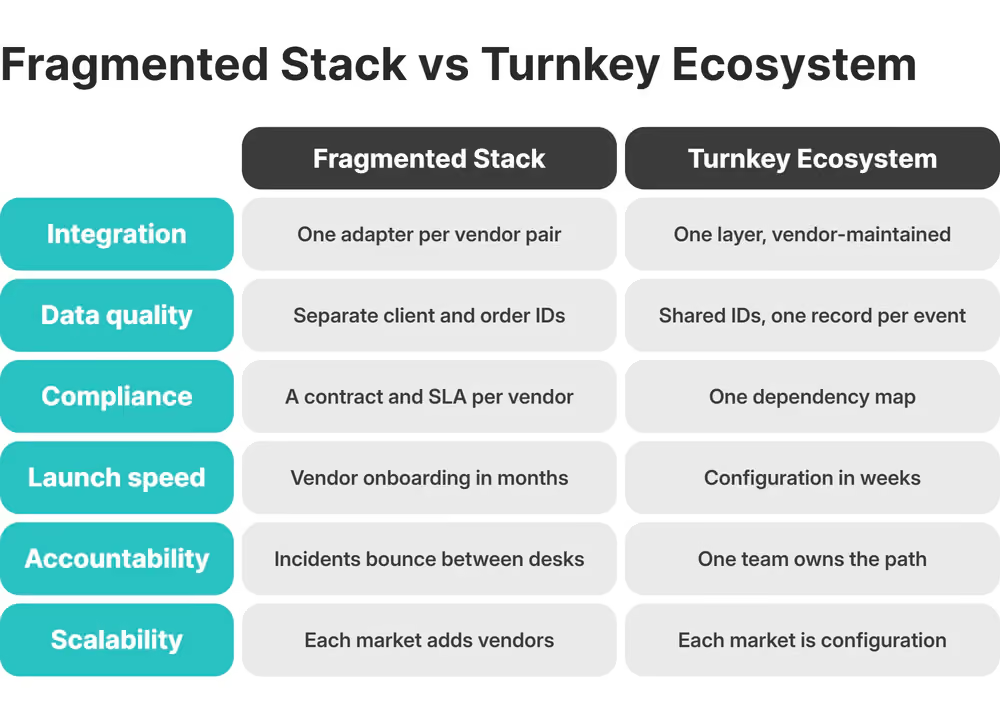
Local flexibility pays off when each function has its own specialist team behind it. One operations team running all six rows can only operate the ecosystem column.
How Should CTOs Evaluate Build vs Buy vs Turnkey Models?
Build maximizes control, buy adds point solutions one gap at a time, and turnkey compresses deployment risk. Which one fits depends on where your bottleneck sits: engineering capacity, a single weak component, or time-to-market.
Score the three routes CTOs use to consolidate brokerage tech stacks on the same six criteria:
- Time-to-market. A build is measured in quarters and a turnkey deployment in weeks. Count the months of revenue in between.
- Total cost of ownership. The license fee is the visible part. Add the engineers who maintain integrations and handle data management for as long as the stack runs.
- Regulatory credibility. Ask what the vendor already runs for regulated clients and what evidence of its security posture it can hand you for a resilience self-assessment.
- Integration complexity. Count the systems that must exchange the client record, and name who owns each adapter when a release breaks it.
- Asset coverage. Check that FX, CFDs, and crypto sit on one margin engine, or you will run two stacks under one brand.
- Support depth. Look for one escalation path with 24/7 coverage across every component, the only arrangement that puts the owner of a failing module on the call during a live incident.
Buying is the route large institutions take too. In July 2023, Amundi Intermédiation, which executes around €5 trillion in assets for some 60 clients, committed all of its asset classes to a single execution platform for more than 60 dealers in Paris, Dublin, Singapore, and Tokyo. Equities and derivatives went live first, with fixed income scheduled to follow the same year.
The same logic applies one layer down. A build, buy, or consolidate choice for the back office follows the same criteria, and data ownership weighs heaviest there, in the system where the client record lives.
What Does a Consolidated Brokerage Architecture Look Like?
A consolidated architecture runs execution, client data, risk, and settlement as one unified system. Each event is written once and never copied downstream.
Liquidity and the trading platform sit at the center of it. Reporting queries the data warehouse every module writes to, over APIs the platform itself governs. Exports from that warehouse feed the accounting software your finance team closes the month in.
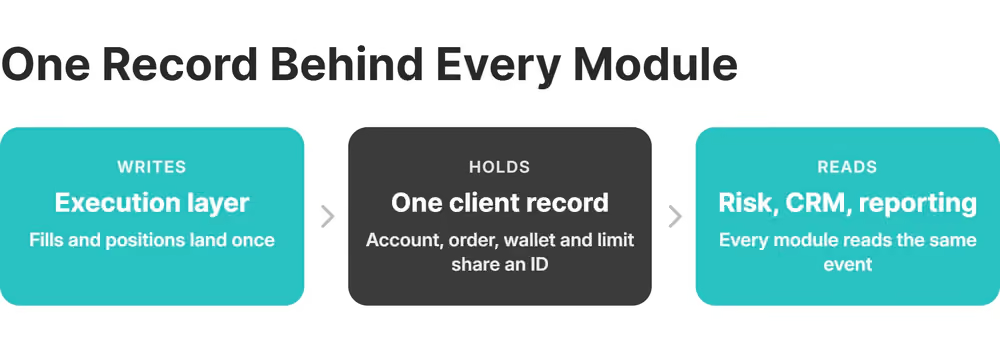
That arrangement removes the sync job. Nobody exports positions at midnight so the CRM can agree with the platform by morning, and no desk has to decide which of two balances is the real one.
Vendors selling brokerage as a service get judged against exactly this model, where trading infrastructure, liquidity, back office, and compliance are assessed as one governed stack.
In B2BROKER's ecosystem, the layers look like this:
- B2TRADER executes CFD, spot, and perpetual futures trades on one multi-asset platform, with cross-margin collateral and FIX and REST APIs.
- Multi-asset liquidity feeds that platform across FX, metals, indices, energies, and crypto.
- B2CORE runs CRM, onboarding, and the back office, with 150-plus ready integrations to payment, KYC, and helpdesk providers.
- B2BROKER's partner B2BINPAY , integrated with B2CORE, handles crypto payments and settlement.
For any vendor, the test is whether one client record serves all three: the CRM that holds it, the risk engine that limits it, and the payment layer that credits it.
Unifying Liquidity, CRM, and Risk Through a Single Data Layer
A single source of truth leaves nothing to reconcile between two copies. With the account, order, wallet, position, and limit sharing one set of identifiers, a change to any of them is a single event that every module sees at once.
When a KYC status changes, the trading limit changes in the same event, with no export and re-import between the two systems. The customer journey from onboarding to first trade leaves one trail across every system. An exception arrives the same way, as one queue item carrying the shared identifier.
The same layer shows the risk desk exposure by client and by instrument as it happens, and hands compliance a single timestamped record when a regulator asks how a limit was set. A liquidity broker that consolidates provider relationships does the same for the execution side, with one counterparty to map and one set of reports to file.
Bridging TradFi and Digital Asset Operations Under One Roof
Every separate stack duplicates the credit, margin, booking, and reporting controls you already run. One operating model covers all of it, from FX and CFDs through to crypto custody and settlement.
The largest institutions are building toward that model. On July 1, 2026, Standard Chartered and LMAX Group executed the first live digital asset prime brokerage trades , with spot Bitcoin and Ether settling T+1 through the bank's UK branch. Standard Chartered acted as credit intermediary on LMAX's venue. The same controls ran inside the bank's established risk and compliance frameworks.
For a broker offering both traditional and digital assets, the question is whether a crypto position and a EUR/USD position count toward the same margin and appear on the same statement. Run them on two stacks and the answer is no, with someone doing a daily reconciliation between them.
How to Migrate from Fragmented Vendors to a Consolidated Platform Without Downtime
Migrate in phases with the old stack still running, and move live trading last. A single cutover stakes execution continuity on one night. A bank has already shown what that bet costs when it fails.
In April 2018, TSB moved its customer data onto a new platform in one event. The data arrived intact, the platform failed at go-live, and customers lost access to branch, phone, online, and mobile banking, with some services down for weeks. The FCA and PRA fined the bank £48.65 million in December 2022 for failures in planning, testing, risk management, and management of the outsourcing behind the migration.
Under that outsourcing sat a chain the bank had never assessed. Its principal IT supplier had itself relied on 85 other suppliers to deliver and run the platform. TSB, the regulators found, had never established how that chain was being managed.

A brokerage migration avoids that shape by running seven steps in order and by leaving a way back at each of them:
- Audit. Inventory every system, contract, data flow, and owner, including the shadow IT and spreadsheets that bridge them today.
- Dependency map. For each important business service, write down which vendor it stands on. This is the same map the FCA asks for, built once and reused here.
- Sandbox integration. Connect liquidity, platform, CRM, and payments in a non-production environment and replay recorded order flow through it, measuring quote latency and API throughput at peak session volume.
- Parallel run. Process the same live flow on both stacks and compare fills, balances, and reports each day until the differences reach zero.
- Phased cutover. Move reporting and CRM first, then payments and KYC, and live trading last, each behind its own go/no-go decision from the stakeholders who own that workflow.
- Reconciliation. Before a phase closes, positions, balances, and client records must match on both sides. Count KYC files after the data migration and fund a test wallet end to end.
- Post-migration monitoring. Hold the old stack for an agreed window and compare fill rates, reject rates, and support tickets against the pre-migration baseline. Track user adoption of the new back office desk by desk. A team still working in the old screens is a phase that has not closed.
The rollback is part of the plan, executed once in the sandbox before the first phase opens. TSB's migration was irreversible by design, leaving no way back when the platform failed.
Why Consolidation Is Now a Competitive Necessity for Brokerage CTOs
Consolidation now decides how fast you can add a market, how you get through a vendor outage, and what you can show a regulator afterward. Those three outcomes put the stack on the same agenda as capital and licensing.
The regulatory clock keeps that decision open. UK firms reassess their important business services and impact tolerances every year or after a material change to the business . Put a new vendor behind a service, and its map reopens.
Once CTOs consolidate brokerage tech stacks, adding a market becomes a configuration job inside a stack you already operate, with one team accountable for the result. A consolidation plan is a growth plan at that point.
B2BROKER has been building brokerage technology infrastructure since 2014 and has helped launch more than 500 brokers on it. Over 1,000 corporate clients run on the same integrated ecosystem today.
If your dependency map has more vendors than owners, start with the two systems that share the most data and reconcile the worst. B2BROKER's team can walk through your current stack, show where each layer maps onto the ecosystem, and scope the first migration phase.
Frequently Asked Questions about Consolidating a Brokerage Tech Stack
What does it mean to consolidate a brokerage tech stack?
It means moving the tools behind trading and payments onto one governed architecture where client, order, and balance data exist once. The result is straight-through processing and one core vendor relationship to map across FX, CFDs, crypto, and other asset classes.
Why do fragmented brokerage systems create operational risk?
Execution, client, exposure, and settlement data sit in separate control environments, leaving every handoff to a reconciliation and every incident to a hunt for the owner. Real-time risk visibility and third-party dependency mapping both degrade with each vendor added.
How should CTOs evaluate build, buy, or turnkey brokerage platforms?
Score them on latency, asset coverage, integration depth, regulatory mapping, and total cost of ownership over the life of the stack. Building buys control at the price of longer delivery and permanent maintenance. A turnkey ecosystem wins where institutional reliability, 24/7 support, and multi-asset scale matter more than bespoke ownership.
How can brokers migrate to a consolidated platform without downtime?
Run the old and new stacks in parallel, reconcile positions and balances daily, and cut over in phases that start with reporting and end with live trading. Each phase needs a tested rollback before it opens.
When should a brokerage choose B2BROKER's integrated ecosystem?
Choose it when vendor sprawl is what limits your speed to market, data quality, or ability to add an asset class. B2BROKER connects liquidity, B2TRADER, B2CORE, and partner payments in one infrastructure model, with execution, reporting, and support escalating through one accountable team.
Recommended articles
Subscribe to our newsletter