How to Evaluate a Brokerage as a Service Provider

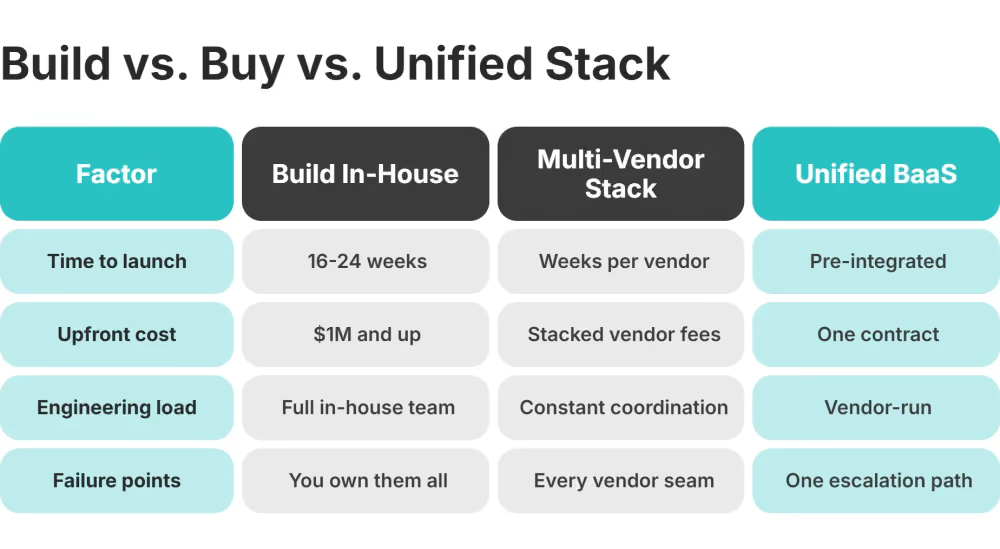
Brokerage as a service is an infrastructure decision. Most firms consider it after pricing a full in-house build: custom software can cost mid-six figures, or more than $1 million once maintenance is included , and a custom CRM layer alone often takes 16–24 weeks to build.
A BaaS contract buys you someone else's engineering instead. The real question is whether that engineering keeps working when trading volume jumps past your forecasts, or when a liquidity feed goes down in the middle of a session.
The criteria below follow that logic. Judge a provider by how its stack behaves under stress; a feature list only shows what the vendor wants to sell. A full BaaS stack should cover the same ground as the trading platforms, CRM, risk management, and compliance tools in a complete brokerage technology map .
Key Takeaways
- A BaaS decision sets your regulatory posture and time-to-market from day one, so evaluate it with architecture-level care.
- A unified stack cuts the integration handoffs and support finger-pointing that multi-vendor setups create.
- Score providers on how execution held through the last volatile news window; feature matrices hide that answer.
- Native integration shortens onboarding because you configure the business on a stack that already talks to itself.
- Forex and crypto operators weight the same checklist differently, so match the stack to how you actually run risk and custody.
What Brokerage as a Service Means
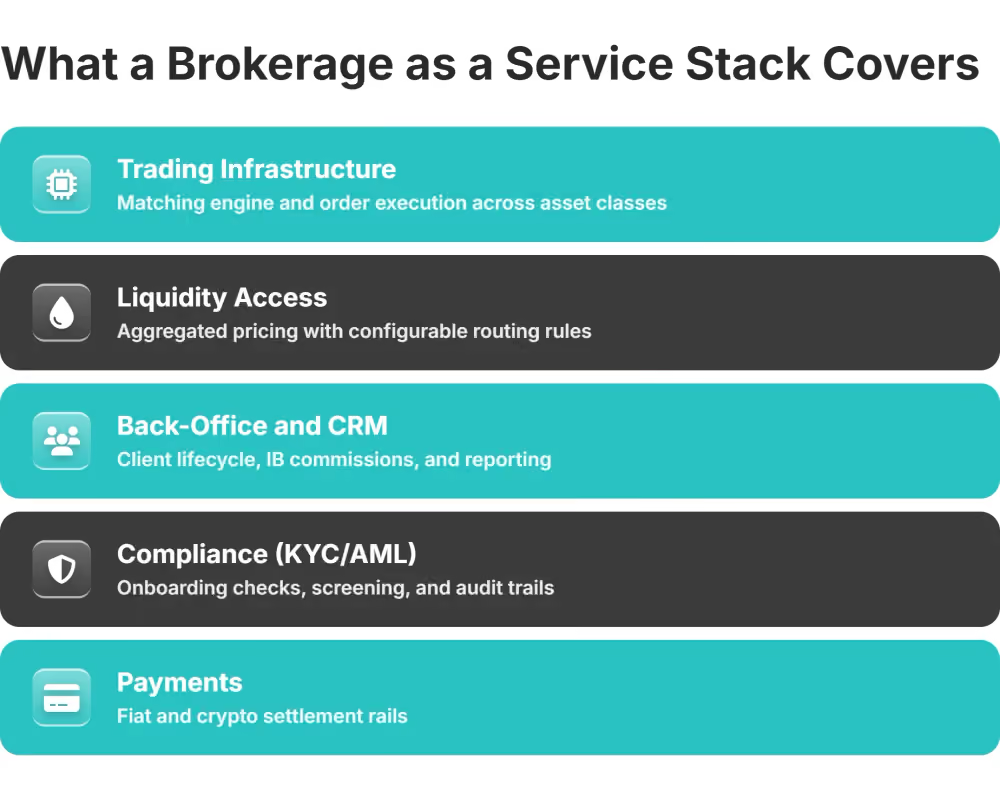
Brokerage as a service means renting the operating core of a brokerage, the fintech systems that connect clients to financial markets, as one managed, API-accessible platform. A typical stack covers:
- trading infrastructure and the matching engine
- liquidity access
- back-office and CRM tooling
- compliance workflows (KYC/AML) with real-time screening
- payment processing
The useful distinction is operational consistency. Configuration and compliance updates land across the stack through one relationship, and when something breaks there is a single escalation path. A brochure that lists the same components does not create that shared data layer.
Build vs. Buy: The Core Strategic Trade-off
Building in-house maximizes control, and it also converts a brokerage problem into a fintech software company, where every protocol change and every incident needs your engineers, permanently. The build cost from the intro is only the entry ticket; the permanent engineering payroll sits on top of it.
Assembling point solutions, or wrapping a white-label front end around a third-party backend, sits in the middle and often underperforms the spreadsheet. Each vendor boundary is a failure surface. When a bug sits between two systems, both sides can blame the other, and a compliance update has to wait for vendors who do not share a roadmap. Operators who rejected a unified stack on sticker price sometimes pay the difference back in calendar time.
The B2BROKER Integrated Ecosystem
A strong BaaS offering ties its components together with native integration, so risk and account data never wait for a nightly reconciliation between suppliers. B2BROKER's brokerage-as-a-service solution is built that way: when a client's risk tier changes, the spread controls and deposit limits tied to that tier update from the same back-office layer in the same session. That shared data layer is the commercial case for a unified stack.
Trading Infrastructure and Matching Engine
B2TRADER is the multi-asset trading platform in this stack, and its published figures set the baseline you then verify:
- Up to 3,000 requests per second under load
- 1,000+ financial instruments across asset classes, from FX and cryptocurrency to equities, ETFs, and CFDs
- FIX 4.4/5.0 connectivity for institutional flow, with REST and WebSocket for client-facing apps
Spec sheets are the opening bid. In a live evaluation, ask how fill rates held through the last high-impact news window, whether partial liquidation behaves predictably when markets gap, and make sure order-type support matches what your clients will actually send.
Liquidity Access and Execution Model Flexibility
Liquidity access is useful only when you can inspect the aggregation behind it. B2BROKER's liquidity provision model uses prime-of-prime aggregation with named institutional LPs, and routing stays configurable: A-Book, B-Book, or a hybrid, mapped at account or group level to your own risk rules without a platform rewrite.
The institutional test is simple: if a provider cannot name its LPs or explain how prices are composed, treat "deep liquidity" as marketing language.
Back-Office, Compliance, and Risk Tooling
B2CORE is the CRM and back-office layer, and the place where the unified-stack argument turns into daily operations. The heaviest example is compliance: KYC/AML workflows with sanctions and PEP screening run inside the same system that holds each client's brokerage account and payments, which keeps the audit trail in one place when an examiner asks for it.
A bolted-on third-party KYC path adds a separate contract and a sync job between systems, and every sync job is a place that audit trail can break. The same layer also carries the IB commission engine, account management, and real-time margin-breach monitoring, so partner payouts and risk actions read from one client record.
Evaluating a BaaS Provider: Key Criteria
Selecting a BaaS provider is a governance decision, and the gap between stacks built for institutional load and thinner commodity bundles usually shows in how a vendor answers questions it did not script for the demo.
Execution Quality and API Standards
Take these questions into the vendor session:
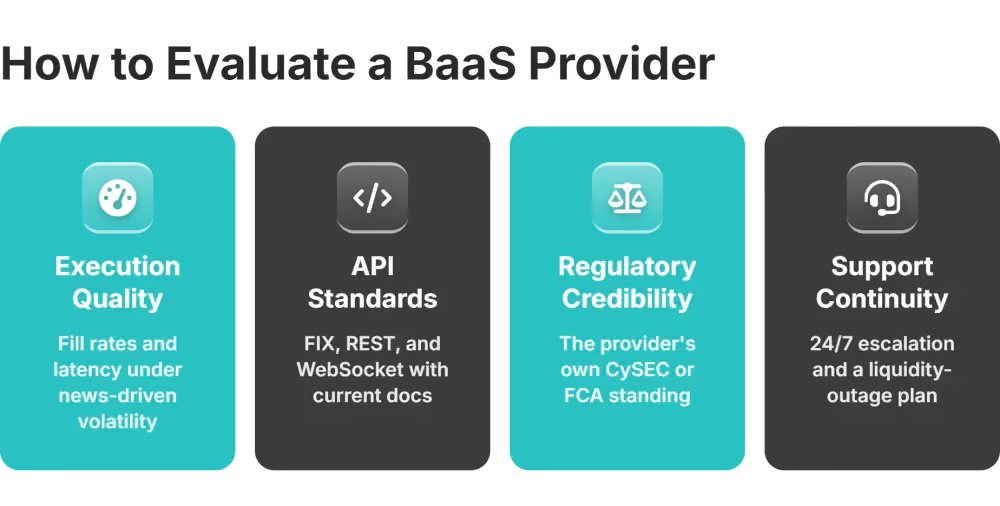
- What measured order capacity and latency do you see at peak load, including P99 and P99.9? Averages hide the spikes that hurt clients.
- What were fill rates in the last major news window, an NFP or FOMC release for example, and can you show the method behind those numbers?
- Do you support FIX 4.4/5.0 for institutional flow alongside REST and WebSocket for client apps, and is the API documentation current?
- What uptime SLA do you contract? 99.9% still allows roughly 8.7 hours of downtime a year, while 99.99% compresses that toward about 52 minutes. Ask what the SLA actually covers and how the vendor verifies its historical uptime.
Incomplete or stale API docs often travel with incomplete operational runbooks, so treat documentation currency as a proxy for engineering discipline.
Regulatory Coverage and Support Model
A provider's own regulatory standing is evidence that its compliance tooling has survived a real examination against regulatory requirements. A financial services license under CySEC or the FCA is a stronger qualification signal than a marketing claim that workflows are "aligned" to a rulebook, because a regulator has already reviewed how that firm operates in practice.
Support design decides whether an outage stays a ticket or becomes a client-facing incident. Before signature, confirm the escalation path you actually get: a named account contact who knows your setup, plus a documented playbook for the moment a liquidity provider goes offline. Those answers are cheaper to collect now than during a live break.
Deployment, Onboarding, and Time-to-Market
Implementation time is often the first line item a CTO tracks, and a unified stack shortens the calendar because you inherit one technical relationship covering the whole path to launch.
How a Unified Stack Accelerates Launch Timelines
Multi-vendor launches stretch because each step waits on the previous vendor: back-office wiring cannot start until trading infrastructure is live, payments wait on the back-office, and integration testing waits on everyone. No single component needs to be exotic for the calendar to slip from weeks into months.
Native links across the trading, back-office, and payments layers remove that dependency map, because the components were built to interoperate. Onboarding effort then shifts to configuring the business you plan to run: the spread tiers and IB structures. Operators planning a multi-asset launch can follow the same sequencing questions covered in how firms bring FX, crypto, and CFD books live on one stack .
Scalability and Long-Term Infrastructure Fit
Capacity that works at launch rarely survives growth without architectural headroom, so evaluate the failover design before you commit, and ask how a new asset class or legal entity lands without a rebuild.
Multi-Asset and Multi-Jurisdiction Expansion
Adding a regulated entity in a new jurisdiction should require only modular compliance configuration, and a vendor whose answer involves a platform migration is showing you the stack's ceiling. Prefer providers with live operational experience in your target markets: "compliant with" on a slide is weaker evidence than staff who have already passed an examination there.
Multi-asset growth should stay additive. Onboarding a new instrument set is a pricing and risk-parameter exercise on a well-built stack, and you want that confirmed before signature, so the first request for an unlisted product stays a configuration task.
EU Digital Operational Resilience Act rules push financial institutions toward defined recovery objectives and tested continuity arrangements; for trading venues, the related ICT continuity standards expect trading to resume within or close to two hours of a disruptive incident , with near-zero data-loss limits. Ask vendors for RTO/RPO specs, recent failover evidence, and a contractual SLA that matches the deck.
BaaS by Operator Segment
Operator type changes which checklist items dominate: crypto venues weight matching speed and custody controls hardest, while forex brokers usually put routing flexibility first.
Forex Brokers: Execution Control and Instrument Depth
Forex operators usually put execution-model flexibility first. Being able to route account types to A-Book or B-Book and adjust that logic without a platform change is how desks handle risk management across client segments and books of trading activity.
Instrument depth decides what you can sell without sending clients to a rival online brokerage, and it shapes the trader's user experience as much as the interface does. Group-level spread and markup controls become standard the moment you run regional brands or tiers on one infrastructure. Teams still mapping licensing, liquidity, and platform choices can start from the foundational requirements for launching a forex broker .
Crypto Exchanges: Speed, Custody, and Compliance
Crypto exchange operators add a second layer to the same checklist: regulated custody and settlement expectations, plus KYC/AML workflows that can support FATF travel-rule obligations for VASPs and local VASP registration where those rules apply.
B2BINPAY covers the crypto payment leg with multi-chain support and KYC-linked flows that operators in regulated markets run alongside their trading infrastructure. In jurisdictions that require VASP registration for fiat gateways, treating compliance as bolt-on middleware usually stops the project at the licensing stage.
B2BROKER's Turnkey Brokerage Solutions
A turnkey solution collapses the whole stack into one vendor relationship, replacing a web of separate partnerships. The gain is fewer integration surfaces for tickets to fall through, and no sequential dependency chain stretching the launch calendar.
Forex Broker Turnkey
Forex Broker Turnkey deploys the trading platform, the back-office, and liquidity connectivity as one path. Risk parameters set in B2CORE reach the trading layer without a separate reconciliation pass. For how each layer of that stack fits together, see the brokerage technology components operators evaluate before buying .
Build Your Brokerage on Infrastructure That Scales
The infrastructure choice at launch sets the ceiling you live with for years, because each extra vendor adds an integration surface and a separate calendar to coordinate when rules or the wider financial industry shift. A unified brokerage as a service stack removes that compounding overhead, because the operational layers stay aligned as you grow.
Use the criteria above as the filter for demos and RFPs; ask for stress evidence before you compare pricing sheets.
B2BROKER pairs fintech engineering with a decade of financial services experience, so operators get one technical relationship and 24/7 support behind the full stack. Map your requirements with the team before you lock in a multi-year vendor bet.
Frequently Asked Questions about Brokerage as a Service
What is brokerage as a service and how does it differ from building in-house?
It delivers the full brokerage operating stack as a managed, API-accessible platform. Building in-house means owning every layer yourself, so BaaS consolidates that burden under one provider and usually compresses time-to-market.
Is a unified brokerage stack better than integrating multiple point solutions?
A unified stack removes the sync failures and support gaps that appear when separate vendors own different layers. Point solutions can win on a single module, but each extra vendor boundary adds integration risk as the client base grows.
How do you evaluate a brokerage as a service provider for execution quality and compliance?
Check matching throughput and fill rates in volatile windows, and confirm the API coverage your flow needs. For compliance, weigh the provider's own regulatory standing and whether KYC/AML runs natively inside the platform, so the audit trail stays in one system.
How long does it take to launch a brokerage with a BaaS provider?
Timelines depend on whether you inherit a unified stack or must integrate several vendors. Native links between the layers remove sequential dependency mapping, so one integrated provider typically reaches readiness faster.
Who is responsible for regulatory compliance in a brokerage as a service model?
Responsibility is shared: the provider supplies tooling aligned to frameworks such as MiFID II or CySEC requirements, while your firm keeps licensing and client-facing disclosure duties. Treat jurisdictional coverage as a primary qualification criterion in regulated markets.
Recommended articles
Subscribe to our newsletter