What is Liquidity Distribution? FOREX Liquidity Distribution

Liquidity distribution is a key factor when planning your brokerage firm. While most content on Forex liquidity distribution explains what it is, we will highlight liquidity distribution as a system design problem and explain the full engineering stack that brokers actually need.
Building an ideal FX liquidity connectivity involves evaluating the broker’s technology stack, execution quality governance, routing policy design, and resilience architecture. If you are making real infrastructure decisions about how your brokerage sources, prices, routes, and risk-manages order flow, this guide is for you.
Key Takeaways
- Execution quality is determined by how the broker designs the full distribution stack, not by any single LP relationship.
- Fill rate, rejection rate, slippage distribution, and time-to-fill are key variables that directly affect client retention and dealing P&L.
- A-book/B-book routing is a policy framework with defined inputs and governance requirements, not a binary model switch.
- Multi-LP failover logic, circuit breakers, and connectivity playbooks are operational requirements, not optional enhancements.
What Forex Liquidity Distribution Actually Means
At its most basic level, Forex liquidity refers to the ability to buy and sell a currency pair without significantly impacting its exchange rate. When a pair is liquid, it can be traded easily with substantial activity on both sides of the book.
Market liquidity shapes everything from bid-ask spreads to execution speed to how quickly a broker can open and close positions.
Operationally, liquidity distribution is an infrastructure decision with measurable consequences for spread quality, fill rates, and dealing risk. It is the system a broker builds to source prices from multiple venues, aggregate them into a unified book, route orders to that pool, and manage the resulting exposure in real time.
The distinction that matters most is between visible depth and executable depth. During calm sessions, a displayed order book may show substantial volume at quoted levels, but during volatility, much of that depth evaporates.
Therefore, what you really need to measure is not just what the book displays, but how much volume can be reliably traded at quoted levels when orders actually hit the market.
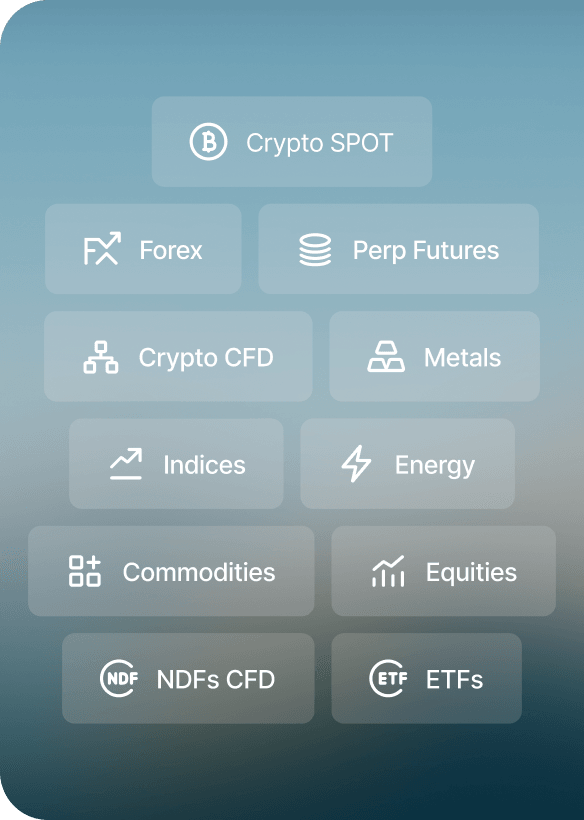
Deep, Reliable Liquidity Across 10 Major Asset Classes
FX, Crypto, Commodities, Indices & More from One Single Margin Account
Tight Spreads and Ultra-Low Latency Execution
Seamless API Integration with Your Trading Platform
The Participant Hierarchy: Who Does What in the Distribution Chain
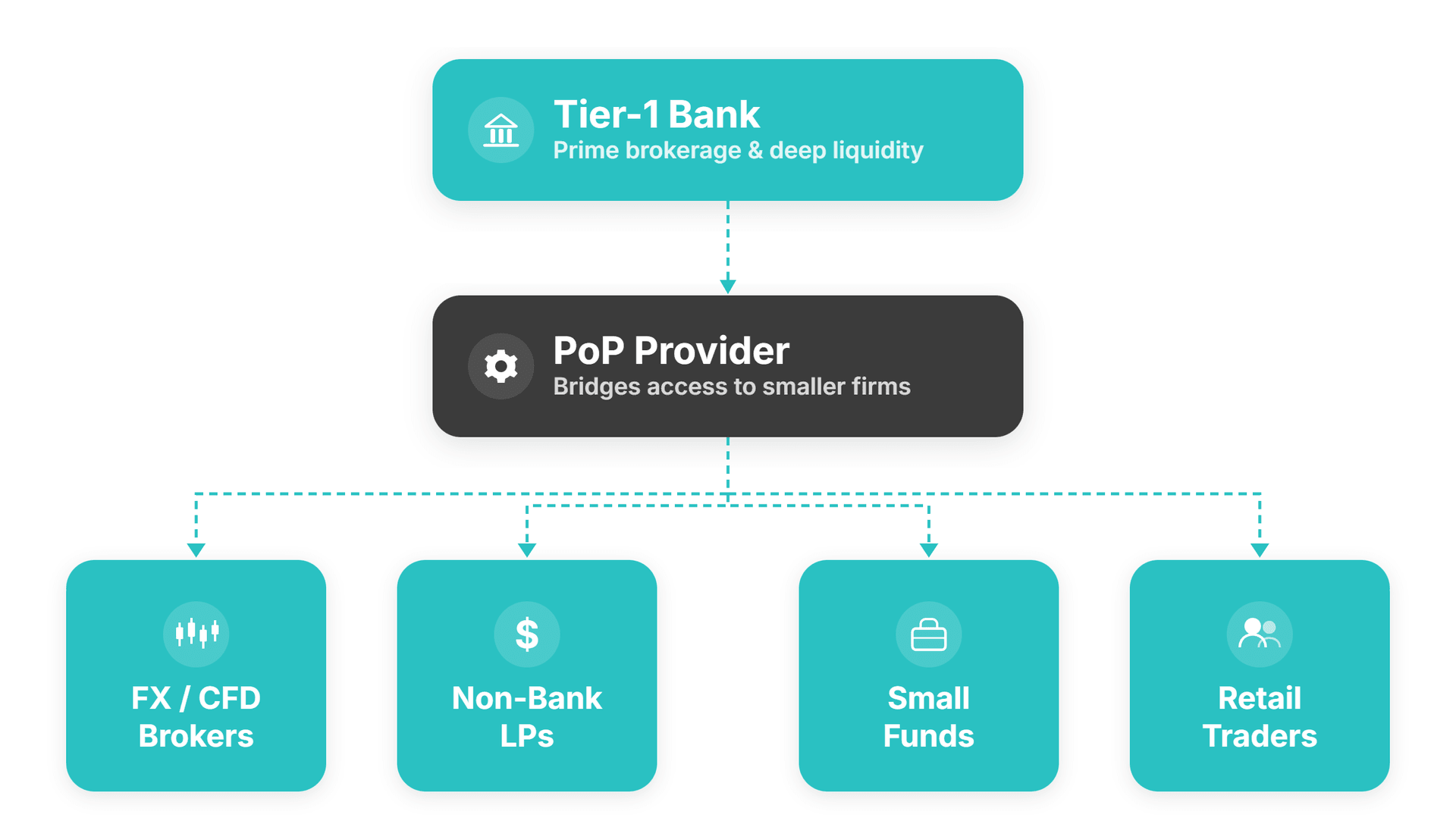
The Forex liquidity chain has a well-defined structure. At the top sit Tier-1 banks and financial institutions like Deutsche Bank, Barclays Capital, and UBS, which set interbank pricing and provide the deepest pools of liquidity. These banks accept large-volume orders and establish the reference rates around which the rest of the market trades.
Then, below them come non-bank market makers, ECNs, and hedge funds, which contribute additional depth and compete on pricing.
Finally, retail brokers sit at the distribution end of this chain, sourcing liquidity upstream and streaming prices to their clients.
However, individual brokers cannot access Tier-1 banks directly. The capital commitments, credit relationships, and minimum volume thresholds required by prime brokers make direct interbank access quite challenging for most retail and mid-sized firms.
This is where prime-of-prime providers come into play. A PoP intermediates the Tier-1 relationship: it holds the prime broker credit line and extends institutional-grade liquidity to brokers at a more accessible scale.
The Broker’s Dual Role as Consumer and Distributor
Brokers play a unique role in the distribution chain because they operate on both sides of the market.
Upstream, a broker is a liquidity consumer: it connects with multiple liquidity providers to obtain better dealing rates and competitive spreads, sourcing the best available prices across its LP network.
Downstream, the broker is a liquidity distributor: it aggregates those upstream prices, applies its own markup and risk logic, and streams executable quotes to retail traders.
This dual role becomes most complex in hybrid model brokerages that internalize some client flow while routing excess exposure to external LPs.
A hybrid broker must run dynamic routing logic that decides in real time whether a given order is internalized against the broker’s own book or sent to an LP for external execution. That decision depends on client tiering, instrument volatility, position size, and the broker’s current net exposure.
Therefore, real-time exposure monitoring is crucial for the broker to know when internalized risk is approaching limits that require hedging or external routing.
The End-to-End Technology Stack
The technology stack that connects a prime-of-prime feed to a client’s executed trade is the operational core of any brokerage, and managers must prioritize it when building their trading platform.
B2BROKER’s distribution infrastructure, which includes systems such as OneZero, PrimeXM, AMTS, and B2BX, along with FIX API, Bridge MT4, and Gateway MT5, illustrates what an aggregation and distribution platform looks like in practice.
The full flow moves from the PoP’s pricing feed through the aggregation layer, across the bridge, into the trading platform, and back through post-trade reporting and CRM touchpoints. Let’s get into more detail.
The Aggregation Layer
The aggregation layer is the broker’s central pricing engine. It consolidates streaming quotes from multiple LPs, applies smart order routing logic, and presents a unified order book to the trade execution layer.
Aggregating across multiple sources accomplishes two things: it improves the best-bid-best-offer pricing the broker can stream to clients, and builds execution resilience by eliminating dependence on a single provider’s depth or uptime. As such, when one LP’s feed degrades, the aggregation engine continues to construct a viable book from the remaining sources.
The Bridge
The bridge is the integration point between the aggregation engine and the trading platform. It translates execution instructions from the platform into the format required by the aggregation layer, enforces routing rules, and passes trade confirmations back to the platform and CRM.
Bridge configuration is where the A-book and B-book routing policy is operationalized; the rules that determine whether a specific order is internalized or sent to an LP are defined and enforced at this layer.
Is Your Tech Stack Market-Ready?
Get a platform assessment with our experts and integrate cutting-edge brokerage solutions to compete from day one.
Connectivity Protocols and Where They Fit
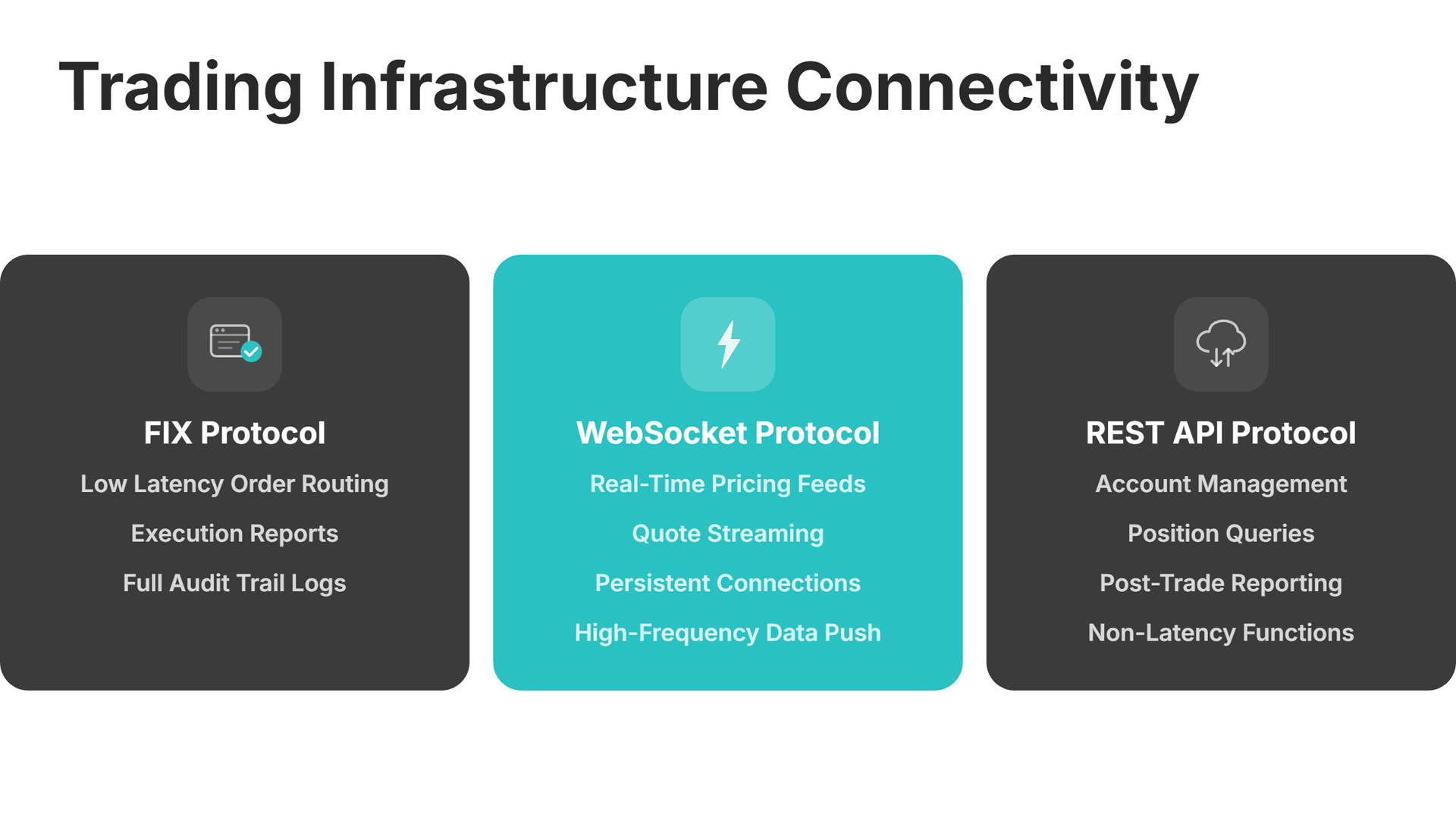
The B2BROKER infrastructure integrates seamlessly with FIX protocol, MT4/MT5 bridge connections, and WebSocket API as connectivity methods. In practice, protocol selection is a functional decision rather than a preference. Each protocol serves a specific role in the distribution stack.
FIX
FIX (Financial Information eXchange) handles order submission and execution reports at the routing layer between the broker’s aggregation engine and the liquidity provider.
It is the institutional standard for low-latency, reliable message delivery with full audit trails. Any broker running a multi-LP setup will rely on FIX for the execution pathway.
WebSocket
WebSocket handles real-time pricing feeds and quote streaming from LPs into the aggregation layer. It maintains persistent connections that push updates without the overhead of repeated HTTP requests, making it the correct choice for high-frequency price data ingestion.
REST
REST (Representational State Transfer) handles non-latency-sensitive functions, including account management, position queries, and post-trade reporting.
However, using REST for execution routing introduces unnecessary round-trip latency. Mismatching protocols to functions creates integration risk across the stack, so brokers must be deliberate about which protocol handles each layer.
Execution Quality: The Metrics That Govern Performance
Slippage and spreads are frequently mentioned in discussions of liquidity distribution, but rarely with the precision required to manage them. High liquidity reduces the risk of slippage (the difference between the requested and achieved execution price), but the real governance framework requires tracking four core KPIs.
- Fill rate measures the percentage of orders executed at the quoted price.
- Rejection rate tracks orders refused by the LP, a critical stress indicator during high-impact events like Non-Farm Payrolls releases.
- Slippage distribution captures the spread between requested and achieved price across order size buckets, with tail behavior mattering for large-order slippage events that erode dealing P&L.
- Time-to-fill measures latency from order submission to execution confirmation at the bridge layer.
Each metric from the above connects directly to broker business outcomes. High rejection rates during market stress events translate into client complaints, support tickets, and churn. Slippage tails on institutional-size orders erode trust and profitability.
These metrics must be governed through continuous monitoring with threshold-based alerts, not measured once and for all during onboarding.
A-Book and B-Book Routing: Policy Design, Not a Binary Switch
Most brokers do not run a pure A-book or a pure B-book. Hybrid routing is standard practice among established firms and is operationally superior to running either model in isolation.
The question is not which model to choose, but how to design the routing policy that governs when orders are internalized and when they are externalized.
The routing inputs that determine the order path include client tiering, where profitable and low-risk segments can be internalized while high-value or sophisticated traders are routed externally.
Here are some examples that determine A/B book routing:
- Symbol-level volatility thresholds trigger external routing when market conditions make internalization riskier.
- Position size limits cap the exposure that can be held on the broker’s book for any single instrument.
- Toxic flow signals, particularly elevated markout—which measures price movement immediately after execution in the client’s favor—flag segments that consistently generate adverse selection.
Additionally, automated hedging must trigger without manual intervention when internalized exposure reaches defined limits, and routing rules must be documented, version-controlled, and auditable.
Routing decisions directly affect client outcomes and fall under regulatory scrutiny, so treating routing as a policy engineering problem rather than a discretionary judgment call is both operationally and legally essential.
Risk Controls Embedded in the Distribution Layer
Risk management in a liquidity distribution system is not a separate function bolted on after the technology stack is built. It is an embedded infrastructure that automatically monitors credit limits, performs pre-trade checks, and enforces exposure caps at execution speed. Let’s discuss:
Counterparty and Concentration Risk
Counterparty credit limits and concentration caps must be monitored in real time, with automatic routing adjustments triggered when thresholds are approached.
Over-reliance on a small number of LPs creates fragility: if one source weakens, widens, or goes offline, the broker’s execution quality degrades across the board. Therefore, you must diversify LP relationships and set concentration limits that prevent any single provider from carrying more than a defined share of total volume.
Pre-Trade Checks
Pre-trade checks are the first line of defense. Margin sufficiency, position limit enforcement, and instrument-level restrictions must all execute before an order reaches the LP.
KYC and AML flags from the CRM must feed into the routing engine, so non-compliant orders are blocked pre-trade, not caught in post-trade reconciliation where the damage is already done.
Detecting and Responding to Toxic Flow
Toxic flow refers to client segments or symbols generating consistent adverse selection, identified through markout analysis that measures price movement immediately after execution.
The correct response sequence is to adjust routing so the affected flow is sent to the A-book, widen spreads for the affected segment, or restrict trading activity on the relevant instruments.
On the other hand, the wrong response is to absorb the flow indefinitely and hope it reverts.
Relying on manual review means the problem compounds before it is identified. Therefore, automated surveillance tooling is the operational detection mechanism that flags elevated markout ratios.
Resilience Architecture: Failover, Circuit Breakers, and Runbooks
LP outages, venue degradation, and depth evaporation are not edge cases. They are predictable operational events that occur during peak market conditions when clients are most active and execution quality matters most. Therefore, the distribution layer must be optimized from day one.
Multi-LP Failover Logic
When a primary LP stream disconnects or degrades below defined quality thresholds, smart routing must redirect order flow to secondary LPs automatically, without manual intervention.
This requires pre-configured failover sequences and continuous quality monitoring at the aggregation layer. The failover should be seamless enough that client-facing execution quality does not visibly degrade during the switch.
Circuit Breakers and Kill Switches
Circuit breakers are automatic halts on specific instruments when slippage exceeds safety limits or pricing uncertainty makes execution unreliable.
These are standard operational controls, not emergency measures. Every instrument traded through the distribution stack should have defined circuit breaker thresholds that trigger automatically.
Connectivity Degradation Runbooks
Brokers should maintain documented response sequences for LP outage scenarios. For example, which secondary LPs activate, how client-facing spreads adjust, what communication protocols trigger for the dealing desk, and how the situation is escalated.
The absence of a runbook means the first outage is improvised under pressure, which ultimately leads to costly mistakes.
Total Cost of Execution: Why Headline Spread Misleads
Pricing and fees matter when evaluating liquidity providers. Different providers carry different fee structures, including flat fees, commissions, and spread-based costs, and comparing them is necessary.
While most platforms highlight spread, the true cost of executing through a liquidity distribution setup is a composite of LP fees, reject rates, slippage tails, infrastructure investment, and relationship management overhead.
For example, a provider quoting tighter spreads but carrying higher rejection rates during news events may deliver worse total cost than one with slightly wider spreads and near-zero rejects.
Moreover, slippage complaints and execution inconsistency during high-volatility periods are leading indicators of client churn. Clients are most active when markets move, and that is precisely when shallow liquidity providers fail.
Ultimately, connecting execution cost to broker growth economics means understanding that the cheapest-looking LP on a spreadsheet may be the most expensive one in practice.
Optimize Your Liquidity Architecture
See how our pre-integrated ecosystem and powerful execution engine boost your trading volume and financial bottom line.
How to Evaluate an LP on Stress-Test Data
Before selecting your liquidity provider, you must request reproducible execution data under stress conditions. That means asking for rejection rate data during NFP and other Tier-1 news events, slippage distribution by order size, and depth behavior at defined price levels during fast markets.
Translate those results into projected execution cost under realistic trading conditions, not average-day conditions. A provider’s performance during short-lived, highly active sessions that drive the majority of market participants is far more important than its performance during quiet periods.
Providers who resist structured testing or cannot supply granular stress-test data are raising red flags that their performance under pressure does not match their marketing claims.
What to Ask a Liquidity Distribution Partner Before You Sign
Technology, regulatory compliance, trading instruments, reputation, pricing, and customer support are all critical factors in selecting a liquidity provider. But turning those categories into an actionable evaluation requires operational planning.
Connectivity and Latency
Ask the provider to specify protocols supported for pricing ingestion and execution routing, co-location options, and documented latency SLAs from order submission to execution confirmation. Vague answers on latency and connectivity are a red flag because a provider that cannot quantify its own execution performance cannot guarantee yours.
Risk Control Transparency
Ask how credit limits are set and monitored, whether pre-trade checks are configurable at the instrument and client level, and what the provider’s process is for notifying brokers of LP-side credit events that could affect execution capacity.
Support Model
Customer support across multiple channels is a baseline requirement. But a support model operating only during business hours in one time zone is a structural risk for a broker serving global sessions. FX trades around the clock, and an LP outage at 3 AM in the broker's time zone requires a rapid response.
Therefore, evaluate the provider’s support coverage against your actual trading session map, not against a generic 24/7 claim.
Multi-Asset Distribution: FX, CFDs, and Crypto
Multi-asset liquidity across FX spot, crypto assets, equities, and commodities is today’s standard. The control-plane logic, aggregation, routing, risk controls, and post-trade reporting are consistent across asset classes, but the underlying venue structure differs materially, and brokers who ignore those differences build invisible risk into their distribution layer.
Spot FX
Spot FX draws from a structured interbank network with predictable depth behavior during major sessions. London and New York overlap produces the deepest liquidity; Asian session depth is thinner but well-understood.
These factors make the Forex market the most mature and standardized venue, with an outstanding average daily trading volume that reached $9.6 trillion in April 2025.
CFDs
CFD liquidity comes from synthetic providers who construct pricing from the underlying instrument. This introduces pricing model risk that brokers must account for in spread configuration and hedging logic.
The CFD provider’s pricing model becomes a key factor in execution quality, adding a layer of dependency that does not exist in spot foreign exchange markets.
Crypto
Crypto liquidity is the most complex: highly fragmented across centralized exchanges, OTC desks, and decentralized venues. It operates around the clock with erratic volume cycles and introduces custody considerations that have no analog in traditional Forex trading.
Therefore, multi-asset brokers must normalize these disparate data streams into a unified risk framework to prevent the buildup of invisible leverage across markets.
Build Your Liquidity Distribution Infrastructure with B2BROKER
B2BROKER operates as a combined prime-of-prime liquidity and technology provider, which means brokers access the full distribution stack, from LP aggregation to bridge connectivity and trading platform integration, as a unified ecosystem.
With access to over 1,500 trading instruments across 10 asset classes and distribution through cutting-edge bridge systems, you can build your brokerage and go live in a few days, rather than months or years.
With 500+ global brokers and brands leveraging our market access and 10+ years of experience, B2BROKER is your reliable partner to build, test, and operate your infrastructure so that you can focus on growth rather than engineering.
Ready to Operate in Multiple Assets and Markets?
Integrate with the widest range of 10+ asset classes and 1,500 instruments — all from one margin account.
Frequently Asked Questions about Forex Liquidity Distribution
- What's the difference between a prime broker and a prime-of-prime provider?
Prime brokers offer direct Tier-1 interbank liquidity but demand massive capital and strict credit relationships. Prime-of-prime (PoP) providers bridge this gap by holding the Tier-1 relationship themselves and redistributing institutional liquidity to retail and mid-sized brokers.
- How do I know if my liquidity provider has good execution quality?
Execution quality is measured by fill rate, rejection rate, and slippage distribution. Brokers should continuously monitor these metrics through their bridge or aggregator and set alerts for abnormal rejection or slippage patterns. Providers that cannot supply transparent execution data are a potential risk.
- Can brokers use A-book and B-book at the same time?
Yes, most established brokers operate a hybrid model, automatically routing trades between A-book and B-book based on predefined rules. This dynamic routing relies on parameters like client tiering, volatility thresholds, position sizes, and the detection of toxic flow.
- What happens to client orders if a liquidity provider goes offline?
If a primary provider degrades or goes offline, automated failover logic in the aggregation layer instantly reroutes orders to secondary providers. If pricing becomes entirely unreliable, automated circuit breakers will halt trading on those specific instruments to protect the broker and clients.
- How is liquidity distribution different for CFDs and crypto vs. spot FX?
Spot FX relies on a structured, predictable interbank network, while CFD liquidity is synthetically derived from underlying markets. Crypto liquidity is the most complex, being highly fragmented across several exchanges, requiring brokers to normalize these disparate streams into a unified risk framework.