How to Integrate a Liquidity API into Your Crypto Exchange Platform?

Crypto trading has transcended its wild west era—now it's an accelerating, dynamic ecosystem where speed, depth, and execution matter most. As the market continues down its path, building an influential, competitive crypto exchange isn't about user experience alone or token offerings.
It's about liquidity, plain and simple—the base upon which that liquidity is founded is your API connection.
Here are step-by-step guidelines on how exactly you can integrate an API that will maintain your exchange stable, scalable, and up-to-date.
Key Takeaways
- Selecting a reputable LP becomes the key to effective execution as well as core market access.
- Security is non-negotiable—two-factor authentication and periodical auditing secure your liquidity infrastructure.
- Always test integrations in a staging environment to avoid performance issues post-launch.
What Is a Liquidity API?
A liquidity API is an expert interface enabling your crypto exchange to directly connect with liquidity providers like institutional brokers, market makers, or liquidity aggregators to access deep, trustworthy reserves of tradable assets.
In other words, it serves as the link between your trading platform through swaps and the whole financial world, making it possible to instantly buy/sell cryptocurrencies (sometimes Forex or CFD) with minimal slippage and favourable prices.
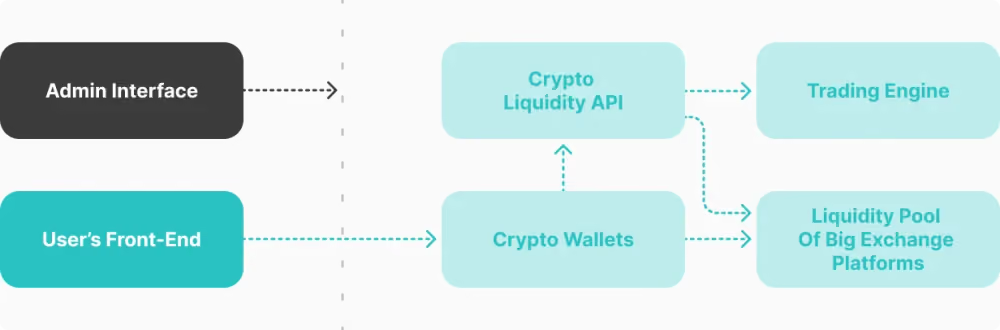
Unlike general-purpose APIs , a liquidity API is purpose-built to handle high-speed trading demands, offering access to live price feeds, executable quotes, order book data, and trade settlement—all in milliseconds.
It's the lifeblood of any professional-grade trading system because it ensures your users can open and close positions instantly without delays, gaps in pricing, or liquidity shortages during volatile market conditions.
How is it Unique Among Other APIs?
While a Market Data API provides real-time or historical prices for analysis or display, it usually doesn't offer executable pricing. You get to see the prices, but you cannot trade them. In contrast, a Trading API places orders onto an exchange, but it presumes the liquidity already exists.
Your exchange's liquidity API fills that gap—that's the system that injects your exchange with the tradeable assets with which users actually trade. It doesn't just show prices, process orders, etc.—it connects your exchange with other, external sources of liquidity where your orders are actually filled.
In essence, if Market Data APIs tell you what's happening, and Trading APIs let you act on it, then liquidity APIs make sure there's something to trade in the first place.
Major Characteristics of a Liquidity API
A well-crafted liquidity API offers something beyond raw data. It's an essential building block within any serious crypto trading platform or exchange, acting as the engine propelling price execution, market depth, and trade stability.
Following are the key characteristics that make an elite-level liquidity API and why they are important in an actual trading scenario.
Aggregated Order Book
One of the most critical features of a liquidity API is order aggregation. Instead of relying on a single liquidity provider, an advanced API can pull quotes and order book data from multiple sources—exchanges, brokers, market makers —and merge them into a single, unified view.
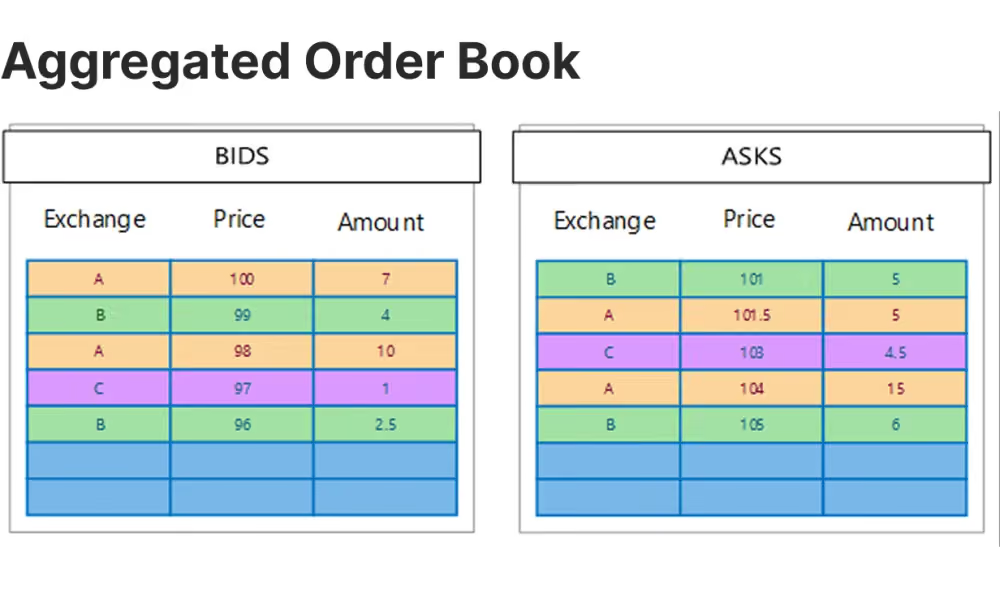
This allows your platform to offer the best available bid and ask prices across the market, giving your traders tighter spreads and deeper liquidity.
For instance, if one exchange has a slightly better buy price, but another has higher sell volume, the API will mix them together to make a better order book. The combination reduces slippage while making it efficient to fill orders regardless of size.
Real-Time, Executable Spreads
While market data feeds are merely transmitting price action, an API provides real-time executable spreads, thus your traders are trading at prices, not examining quotes. The spreads are continuously improved with real-time conditions such as volatility, trading, and provider latency.
This kind of dynamic pricing ensures your users always see the latest and marketable rates, something you particularly want in fast-moving markets where prices could be changing in milliseconds. It also instills greater trust, in that your platform will never display stale or misleading prices.
Depth of Market (DOM)
Depth of Market, or Level 2 data, shows not just the top of the book but also multiple layers of bid and ask prices with their respective volumes. A good liquidity API will provide a full snapshot of the order book at different price levels. This is incredibly useful for advanced traders who want to understand how much market liquidity is available at each level and plan large trades without moving the market too much.
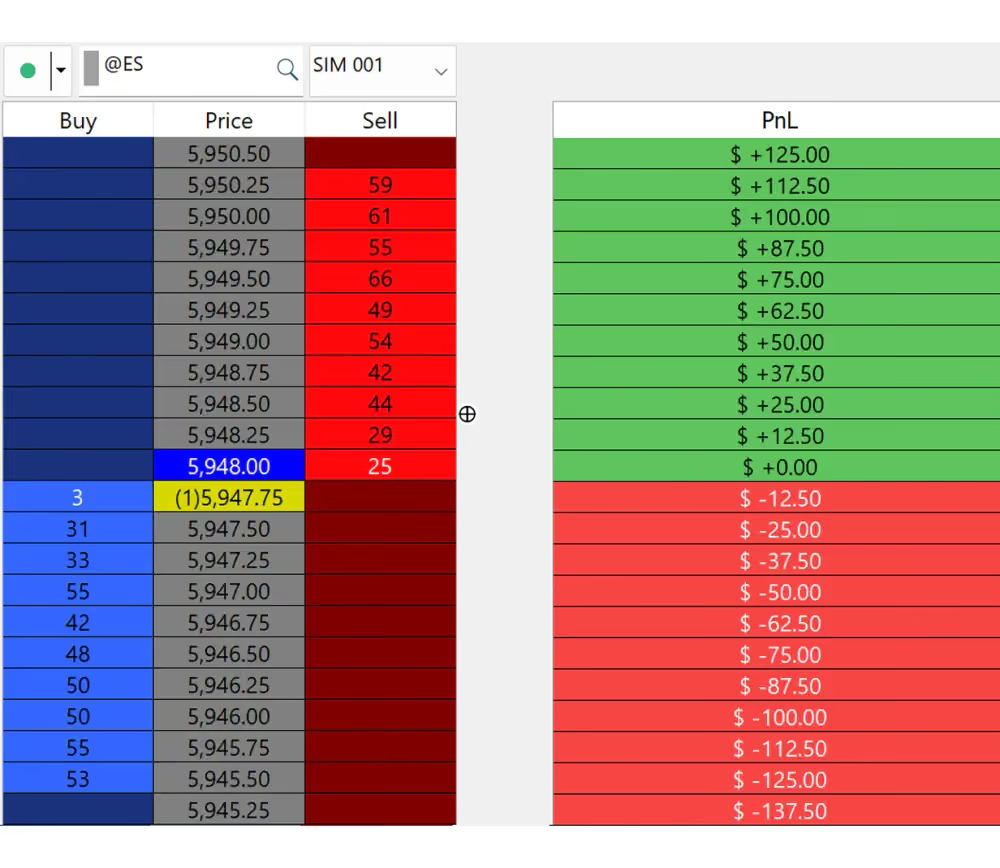
By providing comprehensive DOM through your liquidity API, you give users better information to make informed decisions, and you increase the clarity of your trading platform.
Low Latency Execution
Speed matters when it comes to trading. An ultra-low latency, high-quality liquidity API is designed with real-time routing and execution of orders. No matter whether you process dozens per second or thousands, the API should keep pace without failures, lags, or pauses.
It's true especially around volatility spikes or events that move markets, where opportunities foregone, or nonoptimal trade execution will be caused by several milliseconds' worth of latency. A good liquidity API operates with this in consideration, with streamlined functionality that never sacrifices performance.
Smart Order Routing (SOR)
Certain liquidity APIs take it one step further with the addition of smart order routing. In this scenario, the API has the ability, upon analysing accessible liquidity over multiple venues, to intelligently direct an order for the best execution.
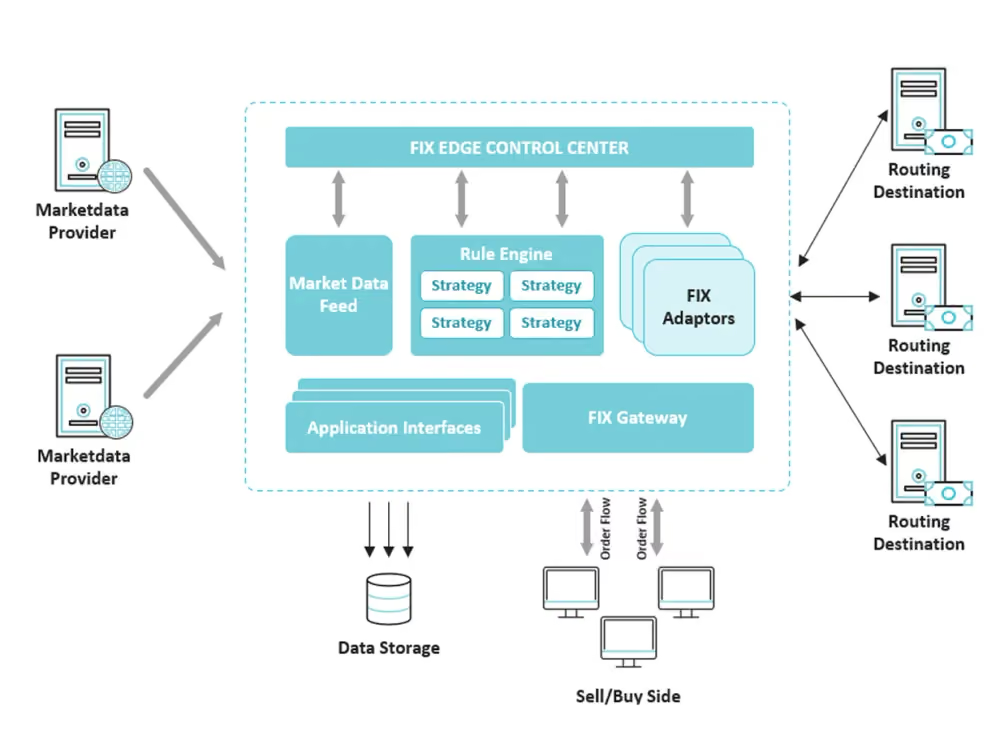
For instance, if an order is too large for a single source, the API can break it up and send parts to different providers, all while keeping execution time low and slippage to a minimum. This is a significant plus for institutional platforms or exchanges handling high volumes.
Failover and Redundancy Systems
Speed is equally crucial as reliability. A pro-level liquidity API supports failover mechanisms and redundant endpoints. If one server or provider becomes unavailable, the API will immediately shift the route to an alternate path without disrupting the trading process. It keeps your exchange online and responsive, even when you encounter infrastructural snags or provider downtime.
Multi-Asset Support
Best-of-breed liquidity APIs are not about Bitcoin alone, or Bitcoin plus Ethereum. They often support dozens, sometimes hundreds, of crypto assets, as well as non-crypto instruments, such as forex, indices, or commodities.
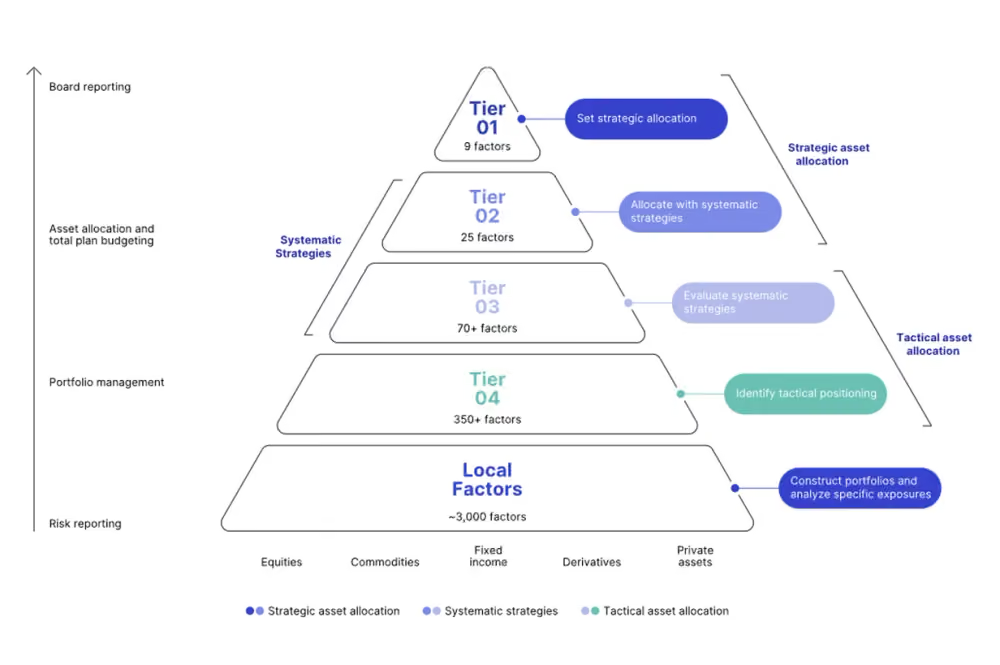
That multi-asset functionality is important if you're crafting an exchange with several assets, or if you expect you'll be branching into non-crypto assets.
It also enables your platform to accommodate a larger variety of trader profiles, ranging from crypto enthusiasts to professional forex traders who desire a larger suite of products under one roof.
A Practical Guide to Integrating a Liquidity API into Your Crypto Exchange
Incorporating a liquidity API into your crypto exchange is a strategic step—but it's far from plug-and-play. While this mighty tool is vital to keep your exchange competitive with prices, deep order books, and real-time execution, the process of actually integrating it involves multiple crucial steps.
Let's lay out how to go about the process in such a way that you get long-term performance, safety, and dependability.
Step 1: Choosing a Reliable LP
It begins with selecting a liquidity provider you can trust—the decision that will determine the effectiveness and reputation of your trading platform. The correct LP bolsters your exchange with consistent market depth, stable spreads, and minimal disruption during times of higher volatility.
In evaluating, go beyond surface-level. Look at your provider's technology stack, liquidity coverage, uptime assurances, and supported trading instruments. Compatibility counts—make sure the liquidity API plays well with your existing crypto exchange infrastructure.
You should also compare your levels, because some carriers impose higher-than-normal fees that might not be worth it with your level of maturity.
Don't skip due diligence. Look into the LP's regulatory status, customer feedback, and history of operations. The correct provider will not only facilitate your launch—they'll grow with you. Finalize that the LP has adequate capital reserves to avoid risking service disruption because of liquidity gaps.
Step 2: Establish Effective Security Arrangements
Because liquidity APIs handle high-frequency trading data and access to significant fund pools, they're a prime target for cybercriminals. That's why setting up multiple layers of defense is non-negotiable.
Begin with two-factor authentication for internal admin access, along with external API calls. That, along with sophisticated encryption protocols, will encrypt the API endpoints. You might want to consider incorporating IP whitelisting, access control management, and intrusion detection systems as complements to your security suite.
To ensure your organization remains robust in the long run, you should conduct systematic architecture audits . Such proactive tests help you discover vulnerabilities within your liquidity connections before your attackers do. Good cybersecurity keeps your platform secure, but it also keeps your users' trust.
Step 3: Test the Integration Thoroughly
Even the smoothest API documentation cannot ensure perfect performance when connecting. That's why it's important to test the whole integration in a test environment before going live.
Set up a dedicated staging or sandbox environment to simulate real trading conditions. This allows you to validate everything—from order execution logic to real-time pricing accuracy and latency thresholds. Testing also helps uncover edge cases like partial order fills, unexpected downtime, or inconsistencies between your order book and the LPs.
Skipping this step could result in unstable performance, customer complaints, or worse—funding errors. Think of testing not as an option, but as a foundational part of responsible development.
Step 4: Monitor and Optimise System Performance
Once your liquidity API becomes active, the task doesn't stop here. Performance monitoring in real time becomes necessary to maintain high performance and address emerging issues.
Over time, even the best APIs may suffer from degraded execution speeds or inconsistent pricing. Bottlenecks in order routing can slow down trade fulfilment, while a sudden dip in liquidity quality may impact spreads. To stay ahead, continuously analyse order flow, error logs, and transaction latency.
And keep an eye on your liquidity provider's performance. Once they begin underperforming—due to shrinking fund pools, latencies, or unresponsive customer support—don't be afraid to reconsider your options. Giving good liquidity isn't a one-time setup, but a continuous process.
Final Remarks
In this ultra-competitive trading environment, your crypto exchange cannot fall behind in speed of execution or depth of liquidity. An effective liquidity API holds the key to earning trust, attracting serious traders, and scaling without disruption. From selecting a reliable LP to testing, monitoring, and performance, the integration process serves as your key to success over the long haul.
Looking to take your communication to institutional-grade liquidity? Explore B2BROKER’s Liquidity Solution — offering ultra-depth liquidity in crypto, forex, and beyond, backed with ultra-low latency, 24/7 support, and multi-asset flexibility. Start integrating smarter today.
FAQ
What does an API provide when it's working with liquidity?
A Liquidity API connects your exchange with external sources of liquidity, allowing real-time, tradable trading with thick order books.
Is it hard to implement a Liquidity API?
It's complicated, but with adequate planning, testing, and a reliable LP, it's manageable as well as scalable.
How do I compare the performance of two different Liquidity Providers?
Keep an eye on trade execution speeds, quote accuracies, and order book depths frequently. Any deterioration might mean you should consider changing providers.
추천 기사
뉴스레터 구독하기