How to Start a Prop Firm: From Capital Setup to First Trade

Demand for prop trading has surged. Google Trends data shows search interest in "prop trading" climbed over 3,000% between 2022 and 2026, and futures prop firm queries grew even faster. Industry estimates now place the global prop trading industry above $20 billion, with 2,000+ firms operating worldwide.
For brokerage leaders watching those numbers, the question has shifted from "is this worth exploring?" to "how fast can we launch a prop trading business?"
Knowing how to start a prop firm means making a sequence of operational decisions that directly affect your time-to-market. Which regulatory path fits your jurisdiction and risk appetite? How much capital do you need to segregate before a single funded trade goes live? What does the integrated tech stack actually look like?
This guide covers each of those decisions in the order they belong in your business plan. It is written for fintech entrepreneurs and operations directors ready to move from market research to execution.
Key Takeaways
- Starting a prop firm requires $25,000–$250,000 in capital, depending on structure and jurisdiction, with regulated entities facing higher capital thresholds.
- Unregulated funding models get you to market faster. However, 80–100 prop firms shut down in 2024 alone, mostly unregulated operations with thin margins and no capital adequacy buffers.
- Keep operational capital and trading reserves in separate accounts from day one, with at least three months of runway set aside before you fund a single trader.
- Aggregated liquidity feeds deliver tighter spreads and built-in redundancy compared to single-dealer access, and traders notice the difference in fill quality within their first week.
- A realistic launch timeline is 8–16 weeks across four phases: entity registration, tech and liquidity integration, pilot challenges, and live trading.
What Is a Proprietary Trading Firm?
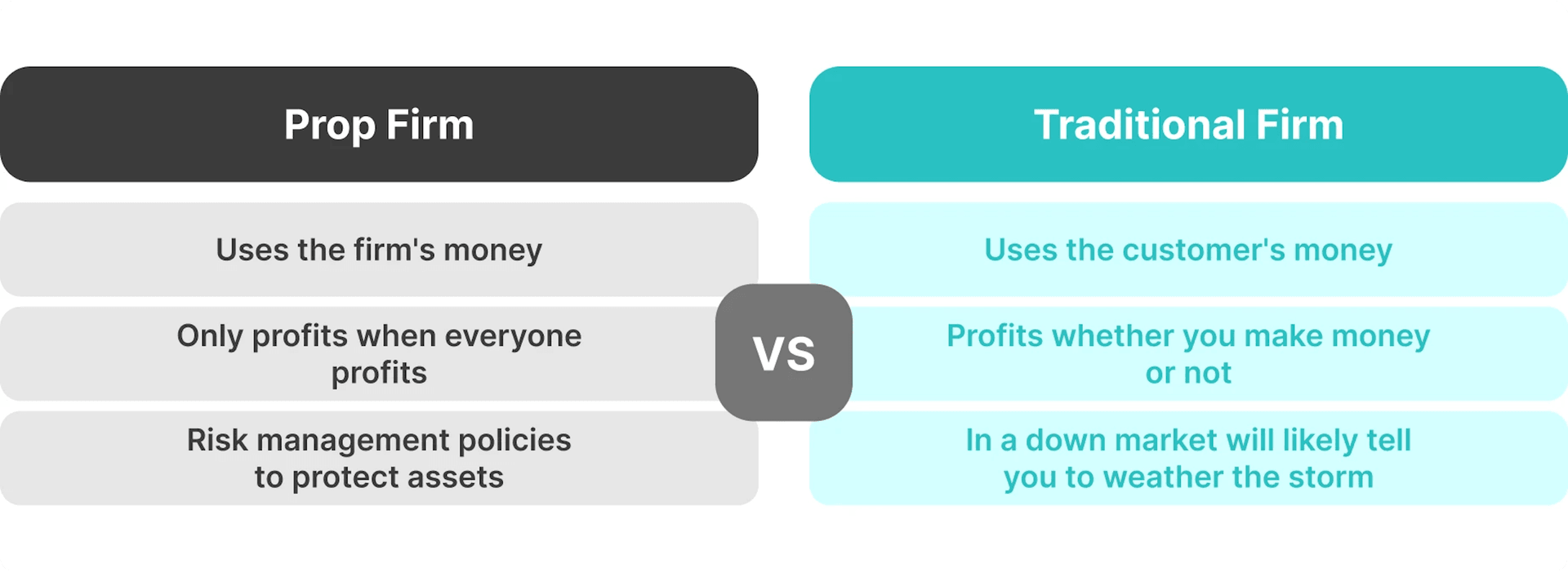
A proprietary trading firm, or prop firm, puts up its own money and lets traders execute strategies across forex, indices, commodities, crypto, and CFD instruments. In return, the firm takes a cut of the profit the trader generates.
How does this differ from running a brokerage? A prop firm does not hold client deposits or provide investment advice. Revenue comes entirely from trader performance. If the traders on your platform don't make money, the firm doesn't either.
Most modern prop firms follow a challenge-based business model. Aspiring traders pay an evaluation fee to attempt to hit a profit target within strict drawdown limits over a set period. Pass rates across the industry sit around 5–15%, which makes evaluation fees a significant revenue stream on their own.
Traders who pass receive access to a funded account with profit splits typically ranging from 70% to 90% in the trader's favor. Beyond evaluation fees and profit splits, many firms earn through spread markups on execution.
Planning to include crypto in your asset lineup? The infrastructure behind a crypto broker differs from an exchange in ways that affect your liquidity setup and cost structure, so it's worth sorting that out early.
Legal and Regulatory Paths for Prop Firms
Your legal structure is the first decision to lock down. It sets your capital requirements, compliance burden, and realistic timeline to first trade.
Most retail prop firms run without a broker-dealer license. Some pursue full licensing because their jurisdiction requires it or because they want a regulated status for institutional credibility. If your firm starts providing investment advice or holding third-party funds, authorities like the SEC or ESMA can reclassify your operation and require registration.
Unregulated Funding Model
Challenge-based prop firms typically avoid broker-dealer registration because they allocate the firm's own capital to traders. No client funds change hands, so custody requirements don't apply.
That said, 'unregulated' is not a synonym for 'informal.' You still need written agreements that spell out trader obligations and payout mechanics. You also need documented risk controls. A trader who loses money and claims your rules were unclear will look for any gap in your paperwork.
The downside of this model is the lack of a regulatory safety net. If the firm hits a rough patch, there is no compensation scheme to protect your traders. Finance Magnates Intelligence estimated that 80–100 prop firms shut down or exited the market in 2024, the majority of them unregulated operations with thin margins and heavy reliance on evaluation fees. Regulated entities with capital adequacy requirements weathered the same period far better.
Licensed Proprietary Trading Entity
Some founders go the licensing route because outside capital or institutional services are part of the longer-term plan. If you've looked into launching a forex brokerage, you'll recognize many of the same regulatory checkpoints.
In the EU, firms providing MiFID investment services need authorization under the IFR/IFD prudential regime, which has been in effect since June 2021. Capital minimums depend on what you do:
- €750,000 for firms dealing on their own account or underwriting
- €150,000 for MTF/OTF operators
- €75,000 for firms that don't hold client money or securities
Smaller firms classified as 'Class 3' face a lighter compliance load, while larger 'Class 2' firms must calculate capital using the K-factor system based on risk exposure.
In the U.S., SEC Rule 15c3-1 sets specific net capital minimums for broker-dealers:
- $50,000 for introducing accounts
- $250,000 minimum for firms carrying customer accounts
- $1,500,000 for prime brokers
These thresholds apply once your prop firm structure involves executing client trades or holding outside funds. Crossing into advisory territory can also trigger the Investment Advisers Act, which brings fiduciary obligations and fund segregation rules on top of standard registration requirements.
Licensing costs more upfront and adds ongoing compliance work. The payoff is that institutional liquidity providers and banking partners take you seriously from the first conversation. If outside capital is anywhere in your five-year plan, starting licensed avoids a painful restructuring later.
The regulatory bar is rising: in December 2024, the SEC tightened Rule 15c3-3, requiring large broker-dealers to compute reserve requirements daily instead of weekly.
Capital Planning and Risk Limits
Starting a prop firm typically requires between $25,000 and $250,000, depending on your legal structure and jurisdiction. That range covers technology fees, legal setup costs, initial trading reserves, and sufficient runway to absorb early-stage losses before revenue stabilizes.
The way you allocate money between operations and trading directly affects whether you can pay out profitable traders on time and survive a rough month in the markets.
Segregating Operational and Trading Reserves
Keep operational capital and trading reserves in separate accounts from day one. Operational capital covers salaries and platform fees. Trading reserves cover trader allocations and payout obligations. Mixing the two is how firms end up unable to honor payouts after a bad week.
A practical rule: maintain at least three months of operational runway before you start scaling trader allocations. If your monthly burn is $15,000, that means $45,000 sitting in the operational account untouched before you fund a single trader.
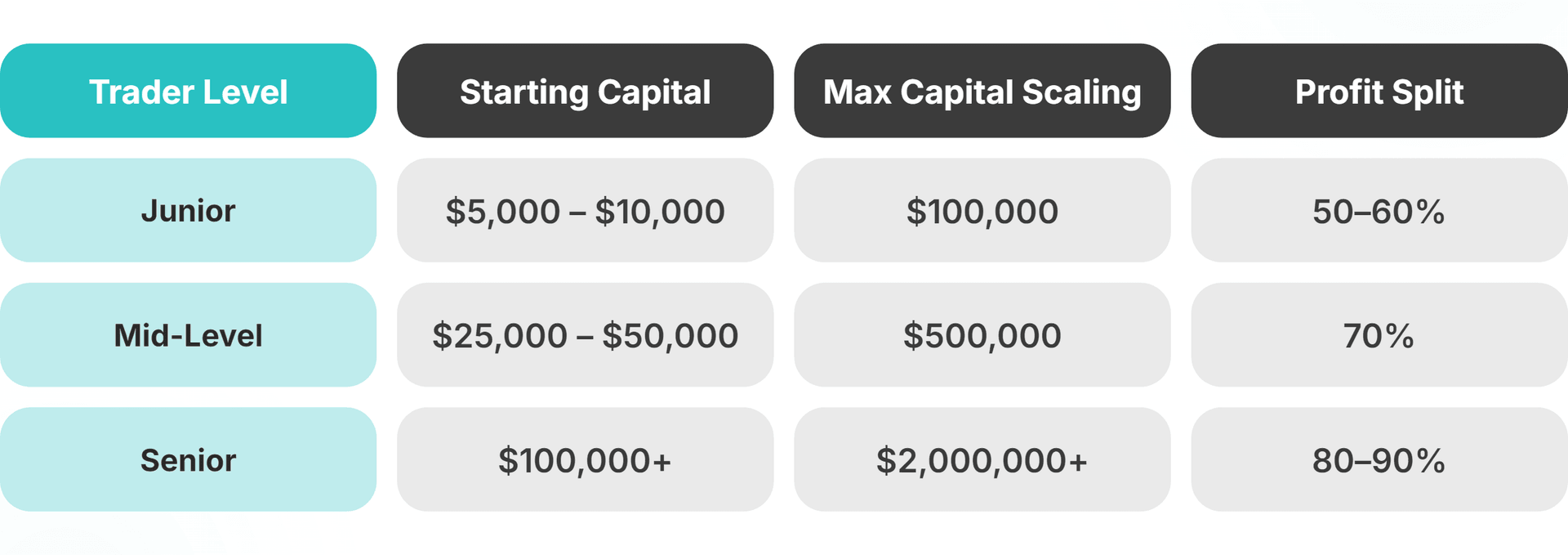
Capital allocation should scale with trader experience. Here's a typical structure:
Prop firms handle fewer payment flows than retail brokerages, but you still need to reconcile payouts across multiple accounts and maintain enough liquidity in the payout pool to cover withdrawals without dipping into trading reserves.
Setting Drawdown and Leverage Rules
Your drawdown and leverage framework needs to be locked in before you onboard your first trader. These risk management rules protect firm capital and set clear expectations for every participant.
Standard drawdown limits across the industry:
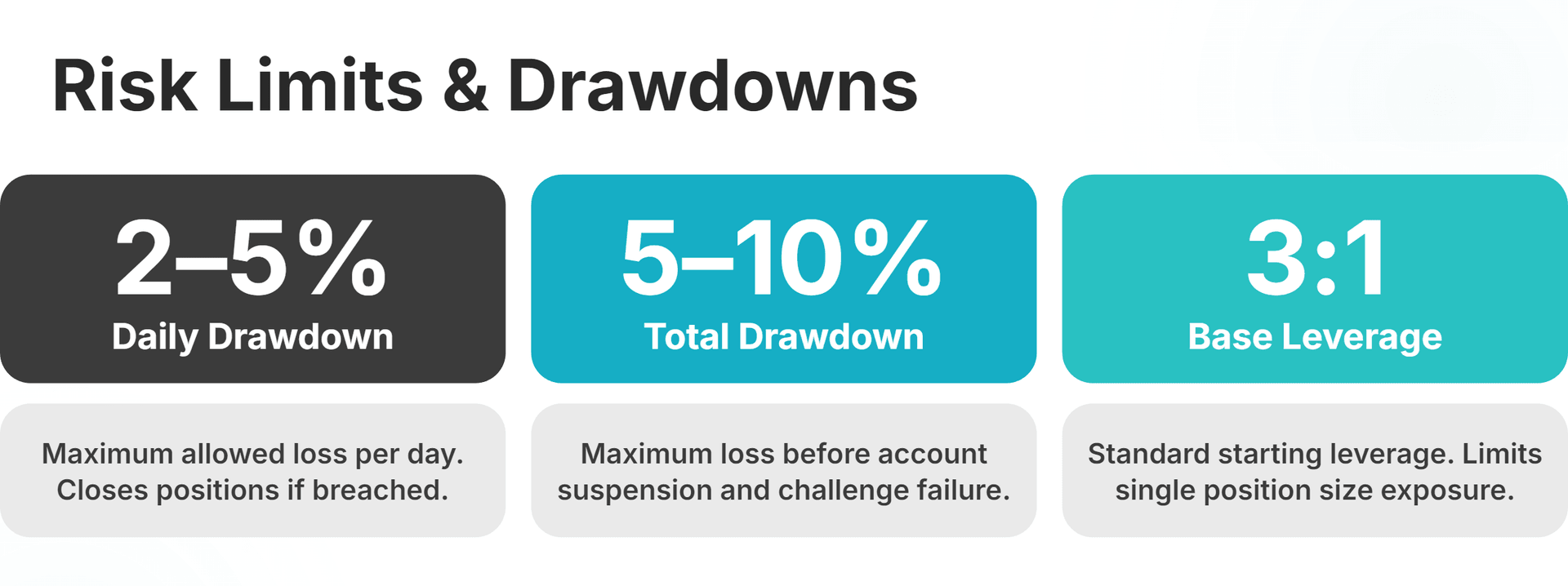
- Daily drawdown: 2–5% of allocated capital
- Maximum total drawdown: 5–10% before account suspension
Most firms start traders at roughly 3:1 leverage, then adjust upward based on performance or market conditions. Position sizing caps typically limit a single position to 10–15% of allocated capital. Track these metrics consistently across all funded accounts.
Firms also set absolute daily loss limits ranging from $500 to $5,000, depending on account size. Once a trader hits that number, the system flattens all open positions and locks the account until the next session.
That enforcement has to be automated. You can't monitor trading activity across dozens of funded accounts with a spreadsheet. If high-frequency trading strategies are part of your prop offering, the latency requirements for these controls get significantly tighter.
Core Technology Stack to Start a Prop Trading Firm
Every system in your stack needs to work with the others. When they don't, your team patches gaps manually, and that manual work compounds as you add traders.
Many firms accelerate this process by starting with a white-label solution that comes pre-integrated and built for scalability.
Platform, Bridge, and Market Data
The trading platform is what your traders see and use every day. MT4 and MT5 are the most common choices in the retail prop space. Some firms use cTrader or build proprietary solutions.
The liquidity bridge is middleware that connects the platform to your liquidity providers. It routes orders, manages positions, and passes execution data back to the platform. When choosing a bridge, check uptime guarantees and whether it supports every asset class you plan to offer.
Market data feeds supply the pricing that drives everything else. If your data lags by even a few hundred milliseconds, traders get requotes and your risk calculations fall behind. For a broader view of how these components connect, see this guide to brokerage trading technology solutions.
CRM, KYC, and Payment Flow
The CRM tracks each trader's evaluation progress, communication history, and payout records. Without it connected to the rest of the stack, your operations team runs manual workflows to copy data between systems.
KYC runs before any trader receives capital. Identity verification, AML checks, and sanctions screening must be completed before funding. If this process is handled in a separate tool, onboarding slows down, and compliance gaps appear at scale.
Payment processing handles deposits and withdrawals. Traders expect fast payouts, and your system needs to reconcile every withdrawal against the trader's balance and profit split in real-time. A mismatch between the CRM and the payment system is the fastest way to lose a funded trader's trust.
One Back Office for Everything
B2CORE handles trader management, KYC, payouts, and reporting in a single integrated dashboard.
How to Integrate Institutional-Grade Liquidity
Liquidity connects your technology stack to the global markets your traders access. The quality of that connection directly affects spreads and fill rates. Traders who consistently receive poor execution will leave, regardless of how good the rest of your platform looks.
Institutional-grade liquidity means aggregated pricing from multiple tier-1 banks and non-bank market makers, streamed into your platform as a single feed.
Aggregated Feeds Versus Single-Dealer Access
Aggregated feeds combine pricing from several counterparties. Your execution engine picks the best price automatically, and if one provider widens or goes offline, the others fill the gap. For most prop firms, this is the standard setup. Running it through an institutional trading platform with proper aggregation logic gives traders execution quality they notice on every fill.
Single-dealer access is simpler to integrate. You connect to one source, route all flow there, and launch faster. The trade-off: your traders see only one liquidity provider's pricing, and counterparty risk concentrates in one place.
How to choose? If you're starting small on a tight budget, a single-dealer gets you to market sooner. Once trader retention becomes the priority, migrating to aggregated feeds is worth the effort.
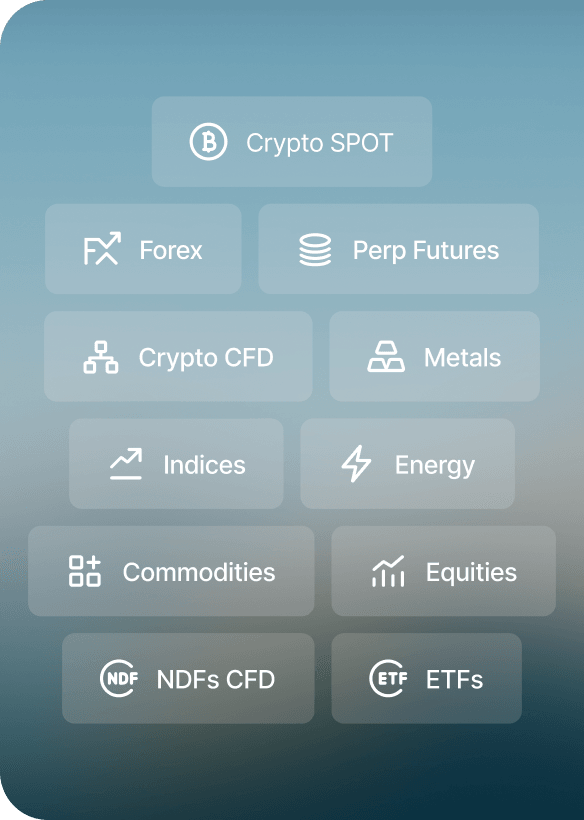
Deep, Reliable Liquidity Across 10 Major Asset Classes
FX, Crypto, Commodities, Indices & More from One Single Margin Account
Tight Spreads and Ultra-Low Latency Execution
Seamless API Integration with Your Trading Platform
Structuring Trader Evaluation and Funding Models
Your evaluation model determines how you filter for skilled traders and how you drive profitability. With industry pass rates around 5–15%, evaluation fees become a major income source before any funded trader generates a profit split.
Evaluation Challenges and Instant Funding
The standard challenge asks traders to hit a profit target of 8–10% within drawdown limits over 30–60 days. Most firms run two phases: Phase 1 tests skill with a higher target, and Phase 2 verifies consistency with a lower one.
How does instant funding differ? Instant funding skips the evaluation entirely. Traders pay a higher upfront fee and receive live accounts with capital immediately. The firm takes on more risk, but the higher fee partially offsets that exposure.
Revenue across both models comes from the access fee, the firm's profit-sharing cut (usually 10–20%), and spread markups on execution. Documenting how each revenue stream works reduces confusion and builds the kind of transparency that keeps traders coming back for larger accounts.
Launch Timeline to First Live Trade
A realistic launch takes 8–16 weeks. Rushing any phase creates compliance gaps or operational problems that are harder to fix once traders are live.
Step 1: Register the entity and open accounts (2–4 weeks). Incorporate your legal entity, open banking and trading accounts, and finalize agreements with your legal counsel.
Step 2: Connect tech and liquidity (3–6 weeks). Integrate your platform, bridge, CRM, and payment system. Connect to your liquidity provider. Test order routing and confirm that execution data flows correctly between all systems.
Step 3: Run pilot challenges and risk checks (2–4 weeks). Launch a small batch of evaluation challenges with internal or beta traders. Monitor slippage during volatile sessions, validate payout processing accuracy, and stress-test your drawdown enforcement logic.
Step 4: Go live and scale capital (ongoing). Open challenges to the public, monitor early cohort performance, and increase trader allocations as your data confirms that risk controls hold up under real conditions.
Mistakes That Can Derail New Prop Firms
Shortcuts taken at launch compound as you scale. Here are the most common ones and how to avoid them:
- Undercapitalization. Running out of payout money after a few successful traders is the fastest way to kill your reputation. Keep three months of operational runway separate from trading reserves, as covered earlier.
- Weak risk controls. If your drawdown enforcement relies on manual checks, a single rogue session can blow through your limits before anyone notices. Automate position closures on breach from day one.
- Poor liquidity selection. Traders feel bad execution immediately. If your single-dealer setup widens spreads during news events, funded traders leave, and social media reviews go negative. Test execution quality under stress before going live.
- Manual processes where automation should exist. Copying payout data between your CRM and payment system by hand works with five traders. At fifty, errors pile up and disputes follow. Integrate your systems before you need to.
- Unclear evaluation rules. Vague language around profit targets or drawdown calculations generates support tickets and refund demands. Write your challenge terms as if a lawyer on the trader's side will read them, because eventually one will.
Accelerate Launch With B2BROKER Turnkey Solutions
Each section of this guide covers a decision that takes time: legal structure, capital segregation, tech integration, liquidity setup, and evaluation design. Building each piece from scratch can take months and require coordination across multiple service providers.
B2BROKER's cTrader Prop Trading package bundles these components into a single pre-integrated ecosystem. The package includes a challenge management module, cTrader as the prop trading platform, B2CORE for CRM and back-office, B2BINPAY for payment processing, and multi-asset liquidity across 10 asset classes. REST and FIX APIs connect everything to your internal systems or third-party tools.
We have operated since 2014, with over 500 professionals supporting clients worldwide and a track record across hundreds of broker and institutional deployments. Whether you're among the startups entering the space or an established broker adding a prop desk, the 24/7 support team works alongside your operations during setup and after launch.
If your regulatory path, capital plan, and evaluation model are ready, a white-label solution like this can compress your timeline from months to weeks.
Launch Your Prop Firm in Weeks
Pre-integrated stack with liquidity, platform, CRM, and payouts ready out of the box.
Frequently Asked Questions about Starting a Prop Firm
- How much does it cost to start a prop firm?
Expect to spend between $25,000 and $250,000, depending on your legal structure, jurisdiction, and growth plans. Regulated entities face higher thresholds due to net capital requirements.
- Is owning a prop firm profitable?
It can be. Revenue comes from evaluation fees, profit splits, and spread markups. Profitability depends on keeping acquisition costs low and payout discipline tight.
- What technology do I need to start a prop trading firm?
At minimum, you need a trading platform (MT4/MT5 or cTrader), a bridge to your liquidity provider, a CRM for managing traders, KYC verification, and payment processing. Integration between these systems is what makes the stack work at scale.
- Do I need a license to start a prop firm?
Most retail prop firms operate without one by allocating firm capital rather than managing client funds. If your structure involves investment advice or the holding of third-party money, licensing may be required in your jurisdiction.
- How long does it take to launch a prop firm?
A realistic timeline is 8–16 weeks across entity setup, tech integration, pilot testing, and go-live. Turnkey solutions can compress that timeline significantly.
Recommended articles