How to Navigate Multi-Jurisdiction Liquidity Compliance Requirements Globally

Multi-jurisdictional liquidity compliance means meeting different liquidity adequacy rules in every country where your brokerage operates, even when your funding model is centralized. If you’re adding licenses or serving clients cross-border, you need robust contingency plans that hold up in audits and in real market stress.
When your liquidity story does not reconcile at the entity level, consequences arrive quickly: a supervisor can limit activity until your controls are clear, while your partner bank can reprice credit terms as it waits for stronger reporting.
This guide is written for operators who know liquidity basics and now need clarity on multi-region execution. It breaks down the major frameworks you will run into, highlights where teams lose visibility, and lays out an operating plan for rule mapping, stress design, reporting, and governance.
Key Takeaways
- Liquidity compliance frameworks like Basel LCR, US RLAP/RLEN, and EU backstop plans impose different liquidity adequacy thresholds and stress testing mandates.
- Map divergent liquidity thresholds across every active jurisdiction to prevent regulatory blind spots.
- Pre-position liquid assets at the subsidiary level to satisfy local ring-fencing mandates.
- Harmonize stress testing scenarios to create a unified risk view for group-wide governance.
- Automate real-time gap analysis to detect intraday funding shortfalls before they breach limits.
Why Multi-Jurisdiction Liquidity Compliance Matters for Brokers
Operating across borders puts your brokerage under the microscope of multiple regulators at once. Each authority enforces its own liquidity adequacy thresholds and reporting timelines, so you must satisfy both for every single entity to avoid supervisory intervention.
Failing to meet local standards triggers severe consequences beyond monetary fines. Regulators typically take specific actions against non-compliant firms:
- License Suspension: Authorities can pause your ability to accept new clients immediately upon detecting a funding gap.
- Forced Capital Repatriation: Local regulators can mandate that you repatriate funds into their jurisdiction to protect local traders.
- Service Blackouts: Regulators can block your ability to service clients in key markets until you resolve the underlying liquidity shortfall.
How does this affect institutional partnerships? Institutional clients, liquidity providers, and other stakeholders verify your financial health before signing agreements. Demonstrating a robust liquidity framework makes your firm a reliable partner. It proves you can handle financial market volatility without endangering client funds.
Consider a broker licensed in both the UK and Cyprus. The FCA might demand daily reporting while CySEC focuses on different stress tests. Many brokers end up running parallel routines until one operating model connects local reporting with cross-border liquidity management.
Turn Compliance Into A Competitive Advantage
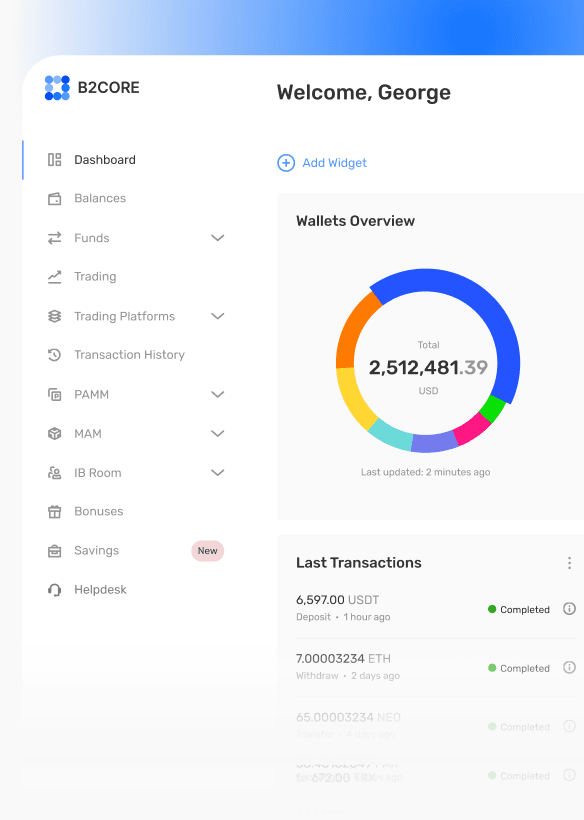
B2CORE consolidates your entire client administration and reporting into one interface, simplifying oversight across every jurisdiction.
Core Regulatory Frameworks Across Key Regions
Global expansion exposes your firm to distinct regulatory architectures regarding capital management. Each framework sets its own buffer logic and reporting expectations, so it helps to learn their structure first.
Basel Liquidity Rules (LCR and NSFR)
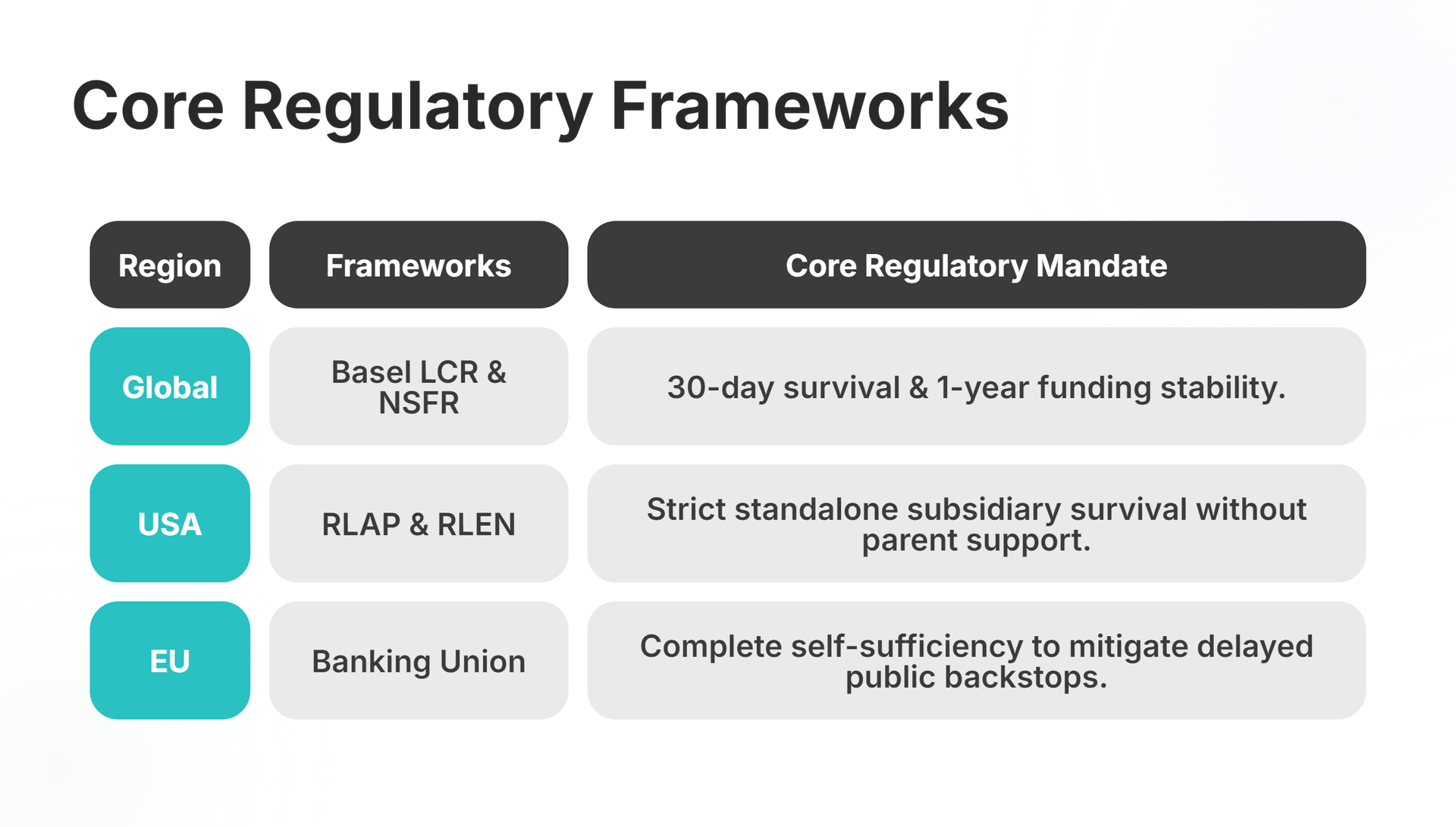
The Basel Committee standards function as the universal foundation for liquidity risk management. Most national regulators adopt these two primary metrics:
The Liquidity Coverage Ratio (LCR) acts as your primary short-term survival metric. It mandates holding enough High-Quality Liquid Assets (HQLA) to match net cash outflows during a hypothetical 30-day stress window. This ensures you remain solvent during a sudden credit shock.
The Net Stable Funding Ratio (NSFR) extends the horizon to one year and assesses whether your funding profile remains stable relative to your assets and off-balance-sheet activity. This prevents over-reliance on short-term borrowing to finance long-term activities.
Local authorities frequently transpose Basel guidelines with stricter definitions or specific reporting calendars. You must treat these ratios as a baseline foundation before layering on local requirements.
US RLAP and RLEN Requirements
United States regulations, heavily influenced by Federal Reserve guidelines, focus heavily on ensuring subsidiaries can survive independently during stress events.
The Resolution Liquidity Adequacy and Positioning (RLAP) rule requires you to pre-position assets directly at material subsidiaries. Your local entity must hold sufficient HQLA to cover strict 30-day or longer deficits without relying on parent company support.
Resolution Liquidity Execution Need (RLEN) focuses on liquidity needs after the parent enters bankruptcy, with the goal of keeping surviving material entities operating while the resolution strategy executes. Supervisors often treat the detailed RLEN work as sensitive, so teams usually manage it through controlled internal materials.
Brokers with significant US operations often face Regulation YY mandates. Regulation YY sets expectations for liquidity stress-testing controls and oversight for covered firms, including governance of methodologies and assumptions. The rule text sits in 12 CFR 252.35.
EU Banking Union Backstop Plans
In the EU, you deal with Banking Union supervision and resolution funding structures that shape how authorities assess liquidity preparedness under stress.
Within the euro area Banking Union, the European Central Bank (ECB) and national authorities supervise significant banks through the Single Supervisory Mechanism, which shapes how liquidity risk supervision works in practice. The central bank describes that structure in its Banking Supervision overview.
For resolution funding, the Single Resolution Fund supports the resolution process, and the European Stability Mechanism can provide a common backstop through a revolving credit line when needed.
The European framework lacks the full integration seen in US models. The planned public backstop for resolution liquidity remains operationally incomplete in terms of deployment speed. This leaves a gap in the speed with which fiscal authorities can intervene during a sudden crisis.
Why are private buffers critical in the EU?
Liquidity in resolution still depends on practical constraints, including collateral terms and timing, so firms typically plan for private liquidity buffers even when public support exists in the framework. Expanding into EU markets, therefore, demands self-sufficiency, given the risk of delayed government support.
Common Compliance Gaps in Cross-Border Liquidity Structures
Even well-capitalized brokerages frequently encounter significant structural blind spots when managing liquidity across multiple jurisdictions. These gaps usually stem from outdated legacy infrastructure or siloed operational teams working in isolation. Solving these friction points requires a cohesive technology strategy.
Fragmented Funding and Collateral Pools
Brokers often maintain separate funding pools for each entity, without visibility into their aggregate liquidity position. This isolation creates severe inefficiencies, with collateral or repo capacity trapped in one jurisdiction or idle in money market funds despite urgent needs elsewhere. You end up over-capitalized in stable regions while facing dangerous mismatches that leave other entities effectively illiquid.
Understanding the underlying mechanics of liquidity provision reveals why this isolation creates such operational drag. Most teams start fixing this with shared visibility that still respects local segregation. A central dashboard provides a consistent position view and keeps transfers under control through documented approvals.
Inconsistent Stress Testing Methodologies
Stress testing becomes inconsistent because local teams use different assumptions and because templates evolve in parallel. Over time, the same “30-day stress” label can mean different outflow rates or different collateral haircuts across entities.
So, what do regulators look for? Supervisors increasingly compare stress test outputs across borders to find discrepancies in your modeling. Inconsistent methodologies immediately raise specific supervisory concerns:
- Regulators view mismatched scenarios as a sign of weak global oversight.
- Contradictory assumptions often mask deep liquidity holes and potential contagion risks during market crashes.
- Authorities suspect firms of tweaking models to lower capital requirements in specific regions.
You must harmonize your scenario definitions to create a unified standard for the entire group. You should then allow for jurisdiction-specific calibration regarding outflow rates or collateral haircuts. This approach satisfies local nuances while providing a coherent global risk picture.
Automate Your Entire Brokerage Back-Office
Launch faster with a SaaS CRM and back-office solution that handles complex verification workflows and reporting without manual intervention.
Five Steps to Build a Globally Compliant Liquidity Program
Moving from ad hoc compliance to a systemic program requires a deliberate roadmap. Whether you are a startup or an enterprise, you need a structured approach to manage multi-jurisdiction complexity.
1. Map Jurisdiction-Specific Rules
Start with a footprint list that covers every licensed entity and every client-servicing location aligned with your financial services business needs. You must document three specific data points for each region to establish a baseline:
- Liquidity Thresholds: The minimum capital required to remain solvent locally.
- Reporting Frequencies: How often you must submit data to the regulator.
- Stress Testing Mandates: The specific risk scenarios required by local law.
Create a visual matrix that explicitly flags overlaps and conflicts between different regulatory bodies. It prevents you from accidentally violating a local rule while satisfying a group-level policy. Since regulations change frequently, you must refresh this mapping on a strict quarterly cadence to capture evolving supervisory expectations.
2. Harmonize Stress Testing Scenarios
Develop a core set of stress scenarios aligned with your most stringent regulator’s expectations. These should cover adverse market conditions and idiosyncratic shocks affecting your specific firm.
You can then layer jurisdiction-specific variables on top of this foundation without duplicating your entire modeling effort.
How does this improve reporting? This approach creates a consistent data set for your board and senior management. It enables consolidated reporting that accurately reflects group-wide risk while still meeting local examiners' requirements. Harmonization prevents confusion caused by contradictory answers to the same risk question across different entities.
3. Pre-Position High-Quality Liquid Assets Locally
Are central treasury models failing? Regulators globally are adopting US-style expectations for pre-positioning assets at the subsidiary level. Relying on a central treasury to bail out international entities is no longer a defensible strategy during an audit. You should analyze each subsidiary’s projected 30-day stress outflows to determine their standalone needs.
Maintain local buffers that exceed these minimum thresholds by a prudent safety margin. Be careful to align your asset composition with local definitions of HQLA. An asset considered "liquid" in London might not meet the strict eligibility rules enforced by regulators in Singapore.
4. Deploy Cross-Border Funding Dashboards
Real-time dashboards serve as your essential infrastructure for monitoring liquidity positions across multiple foreign exchange lines and time zones. You cannot effectively manage risks across diverse payment systems if you cannot see them until the end-of-day report finally arrives. Unified visibility across your multi-asset operations drastically shortens your response time during market stress.
Build a single dashboard that uses one data model for cash and collateral by entity, then connect it to your treasury source of record. Add exception handling so the team can trace breaks, assign owners, and close issues in a consistent way.
5. Document Governance and Escalation Paths
Formalize your liquidity governance by establishing clear escalation triggers and decision rights. Your team needs to know exactly who has the authority to move capital or approve debt issuance when indicators flash red. Regulators now request detailed documentation as a standard compliance requirement.
What specific protocols are required? Your governance framework must include several components to pass an audit:
- Actionable Playbooks: Pre-approved steps for handling intraday liquidity deterioration.
- Severity Levels: Distinct protocols for managing mild stress versus existential crises.
- Communication Chains: Defined reporting lines for informing the board and local regulators.
All-In-One CRM & Back Office for Brokers and Exchanges
Fully Customisable Trader’s Room with Modular Features
Built-In IB Module, KYC, Payment Integrations, and Reporting Tools
Intuitive Interface that Boosts Client Engagement
Technology Capabilities That Streamline Multi-Jurisdiction Reporting
Multi-jurisdiction reporting becomes hard when your team builds every report by hand and then checks the same numbers in different formats. As you add entities, that workflow grows faster than headcount, so technology becomes part of the compliance plan.
Investing in modern infrastructure is a practical necessity if you aim to manage global complexity efficiently.
Automated Liquidity Analytics
Liquidity gap analysis is the process of comparing your asset maturities against liability maturities across specific time buckets. You map cash inflows against obligations to identify funding needs and shortfalls before they materialize.
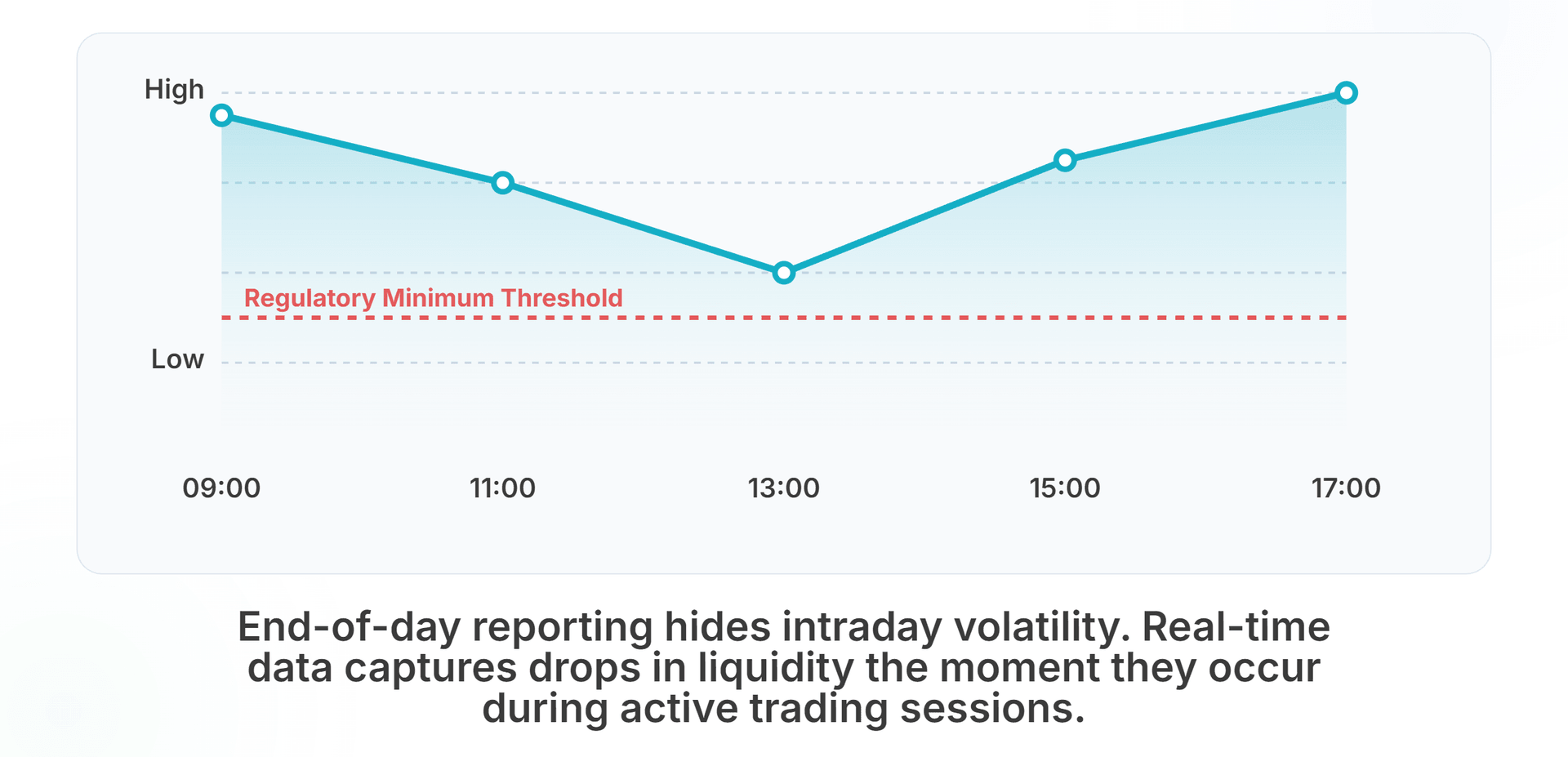
Running this analysis only at the end of the day leaves you vulnerable to sudden intraday volatility. Real-time monitoring solves this by capturing risks the moment they occur during active trading sessions.
Automated gap analytics support data-driven decision-making and feed live market data directly into your stress testing models without human input, reducing manual intervention and preventing dangerous control breaks during regulatory submissions.
Standardized Reporting Modules
Standardized reporting modules act as reusable frameworks that enforce strict data consistency across every jurisdiction. This approach prevents the common error of calculating the same metric differently for two separate regulators. You establish a single "source of truth" for your data that satisfies multiple reporting formats.
Using template-based reporting drastically improves operational efficiency and reduces the engineering cost associated with custom development. You can enter new markets faster by leveraging existing data structures instead of building new reports from scratch.
For a broader map of brokerage technology components, check our guide.
Selecting a Liquidity Partner with Multi-Region Licensing
Your liquidity partner affects more than pricing and depth. When you operate across jurisdictions, the partner also shapes how much compliance work sits in your team’s day-to-day, because each new counterparty relationship adds onboarding, reviews, and ongoing monitoring.
Start with licensing coverage and tie it to your legal entities. Ask where the provider can face your regulated entity as a counterparty, then confirm that coverage in public registers and in contract terms before you design funding flows around it.
A single partner with broad licensing can streamline business processes and simplify operations. Your team maintains fewer counterparty files, and treasury spends less time splitting margin across multiple relationships. That structure also helps when regulators ask how you manage liquidity across entities.
Technology matters as much as licenses. Look for a stack that connects liquidity to compliance-adjacent workflows such as KYC and AML, then verify reporting outputs that match how you file locally. Transaction monitoring needs clean data feeds, so integration quality matters.
Finally, check how the provider handles regulatory change. A strong partner shows an update process, keeps documentation current, and communicates changes early enough for you to adjust controls.
Use a short checklist during evaluation:
- Show the license footprint for each region you operate in
- Share onboarding requirements for your entity type
- Document APIs and reporting outputs you can export
- Explain how regulatory updates reach clients
For a broader market view and comparison angles, see our comparison of the top 10 liquidity providers in the industry.
Accelerate Compliance with B2BROKER's Liquidity Stack
Fragmented compliance processes and manual reporting requirements create a massive bottleneck for expanding brokerages. Navigating jurisdiction-specific complexity without the right tools drains your internal resources.
B2BROKER resolves these friction points by deploying an institutional liquidity provider stack that acts as a unified infrastructure layer.
Our technology consolidates deep liquidity aggregation across 10 asset classes alongside a powerful back-office solution to centralize your data. This integration automates complex reporting tasks to satisfy local requirements across forex and crypto markets.
Since 2014, we have helped hundreds of business clients navigate the shifting landscape of global financial regulations. Your firm benefits from a partner holding over 10 international licenses, ensuring broad regulatory alignment.
We designed our infrastructure for continuous evolution to keep you ahead of supervisory changes. Scaling into new markets becomes a seamless process backed by our dedicated 24/7 operational coverage.
Scale Globally Without Regulatory Friction
Consolidate funding pools and automate complex reporting across jurisdictions with our unified institutional stack.
Frequently Asked Questions about Multi-Jurisdiction Liquidity Compliance
- How do you decide where to pre-position liquid assets?
Start with each entity’s 30-day stressed net outflows using the local regulator’s assumptions, then place HQLA in that same entity to cover the shortfall plus a management buffer.
- Which data feeds support real-time liquidity dashboards?
Most dashboards pull from your treasury or cash ledger as the source of record, then add international bank connectivity feeds for balances and collateral valuations. Trading platform APIs typically fill in margin usage and settlement drivers.
- How often should brokers update cross-border stress scenarios?
A quarterly review cadence keeps scenarios aligned with supervision cycles and internal governance. Update sooner when a regulator issues new guidance or your business model changes in a way that shifts cash flow behavior.