How to Build a Trading Platform for Multi-Asset Flow

A capable engineering team can put a trading front end into production in a few weeks. Keeping the venue in business is the hard part. Of 845 cryptocurrency exchanges in one study, 366 had defaulted since 2014, and the warning signs, elevated withdrawal fees and thin instrument coverage, sat far from the trading screen.
Answering how to build a trading platform therefore means designing everything beneath the screen: the execution core, the liquidity network, and the compliance machinery that make a front end commercially viable.
This guide works through those layers in the order an operator evaluates them, then puts numbers on the service levels and on the total cost of each sourcing route.
Key Takeaways
- Institutional viability comes from ecosystem design; the platform's weakest layer, whichever one it is, sets the ceiling for the whole business.
- A front end cannot hold institutional flow without a coordinated matching engine, OMS, liquidity connectivity, and margin controls behind it.
- Latency, throughput, failover, and uptime SLAs are product requirements that buyers compare in numbers, so quantify them before committing to an architecture.
- Build versus buy is rarely binary for a regulated broker; a hybrid that licenses the core and customizes the client layer cuts time-to-market without surrendering control.
- Development is the smallest slice of total cost. Running and changing the platform after launch compounds year over year.
Why Institutional Platform Design Starts With Ecosystem Thinking
It is tempting to treat the platform as a software project where you choose a tech stack, hire developers, and ship an app. Institutional platforms fail that framing, because the components that decide commercial viability sit outside the codebase.
The most common failure starts with a firm that builds an excellent matching engine, then patches in a third-party back office to satisfy its regulator. The two systems keep separate records of the same trades, so every mismatch becomes a manual investigation.
When the regulator requests a complete audit trail, assembling it takes weeks, because nobody designed the two data models to line up.
Ecosystem thinking runs the sequence in reverse. You map the full set of dependencies first and decide which components to own and which to source. Those decisions then shape the architecture before you commit capital or headcount.
The Core Architectural Layers Every Institutional Platform Requires
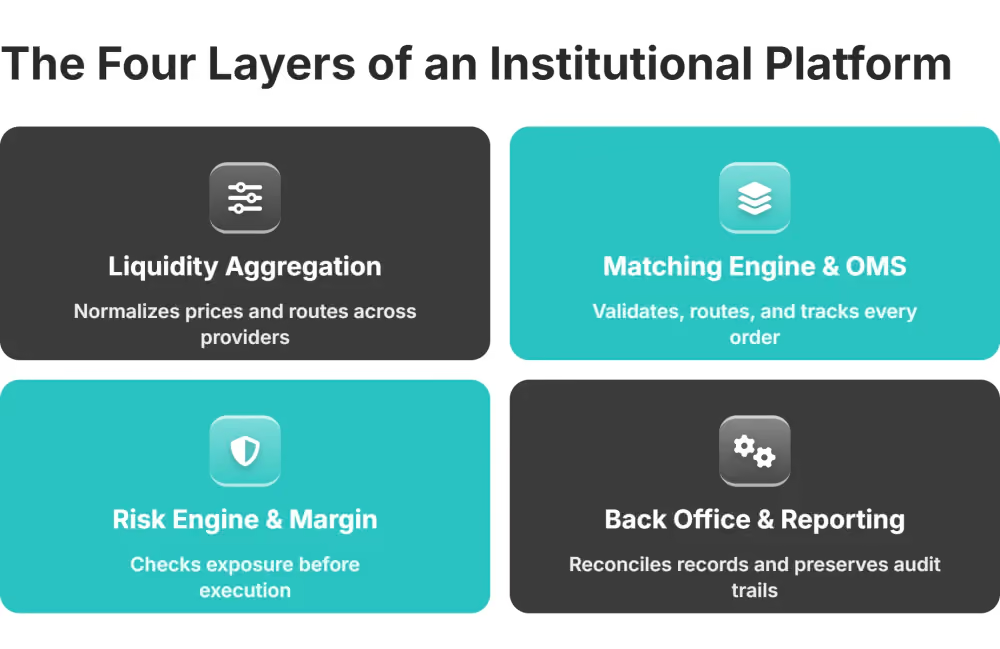
Four layers make up the platform core, and they degrade together. A weak back office undermines a fast matching engine as surely as thin liquidity undermines tight spreads.
Integration quality therefore counts for more than any single best-in-class component. The first thing to inspect is how the matching engine, OMS (Order Management System), and connectivity layer interact under production load.
Matching Engine and Order Management System
The matching engine is the most latency-sensitive part of the platform. The OMS is its memory, tracking every order's state through the full lifecycle. On a multi-asset venue, OMS complexity grows with every instrument type you add.
Evaluate both against a concrete checklist:
- Deterministic latency, with acknowledgment times that hold under load and on quiet days alike
- A full order-type set: market, limit, stop, iceberg, OCO, fill-or-kill, immediate-or-cancel
- Margin-aware pre-trade checks inside the execution path
- Drop-copy feeds for real-time position monitoring
- Clean API access over FIX 4.4/5.0, REST, and WebSocket
Algorithmic trading adds another test. The venue must run backtesting against production-like market data before trading algorithms reach live flow.
Liquidity Aggregation and Provider Connectivity
The spreads and fill rates a client experiences depend on the liquidity providers behind the platform. That makes aggregation a core dependency, not an add-on. The aggregation layer has four jobs:
- Price normalization across provider feed formats and symbol conventions
- Order routing that works the full depth of the book instead of top-of-book only
- Automated failover when a primary provider widens or stops quoting
- Protocol coverage for FIX alongside the REST and WebSocket APIs crypto venues use
Prime-of-prime credit belongs in the same risk management design, because an exhausted credit line rejects orders no matter how well the engine performs.
Risk Engine and Margin Controls
A risk engine that reviews trades after execution protects nothing. Institutional-grade risk sits in the execution path, where every order passes position, size, and exposure checks before the matching engine accepts it. Daily loss thresholds then cap what a single account can lose.
Margin architecture determines how efficiently the platform uses capital. Dynamic leverage that adjusts by client group lets a desk run tighter controls on VIP flow, and configurable liquidation logic keeps forced closes orderly during volatility spikes.
Test all of it at production-scale volume before launch — staging traffic proves nothing about behavior at real size.
Back-Office, Settlement, and Regulatory Reporting
Regulatory readiness lives in the back office. KYC workflows, daily reconciliation, and audit trails decide whether the platform can operate under a license at all. That puts this layer in the platform core from the first design session.
Reporting obligations shape the data architecture directly. MiFID II requires records sufficient for the regulator to reconstitute each key stage of every transaction , so client records, order histories, and permission logs need consistent identifiers from day one. A US-facing venue answers to regulators such as FINRA and the SEC instead, each with its own record formats.
Multi-factor authentication protects privileged access, while immutable audit records let the compliance team trace secure transactions without stitching data together manually.
Retrofitting that structure into a live trading database is one of the most expensive corrections a platform team can face.
Non-Functional Requirements That Define Institutional Viability
Service levels are board-level decisions, because downtime bills the whole company at once. High-impact outages cost financial services firms an average of $1.8 million per hour , and for a trading venue the same hour also produces compliance exposure and client attrition.
Latency and Throughput Benchmarks
A vendor conversation about latency only becomes useful when it happens in numbers. Realistic institutional benchmarks, by function:
- Quote feed ingestion: under 5 ms
- Order acknowledgment: under 10 ms
- Matching latency: under 1 ms at the 99th percentile for co-located flow
- Peak throughput: 50,000+ messages per second
- REST and WebSocket round-trips: under 20 ms
Throughput targets follow the asset mix. Cryptocurrency trading runs around the clock — FX concentrates at the London open and the London–New York overlap. A platform carrying both has to size for both patterns. An internalization model changes the math again, because internalized flow never leaves the venue.
Uptime SLAs for 24/7 Crypto and 24/5 FX Operations
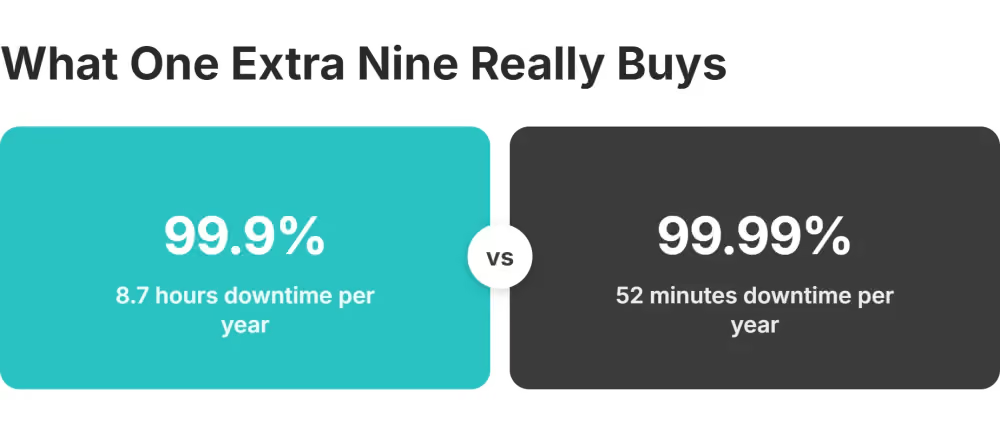
The arithmetic of availability is unforgiving. A 99.9% commitment allows 8.7 hours of downtime a year; 99.99% allows 52 minutes.
Reaching four nines takes geographically distributed infrastructure on a cloud platform such as AWS, with automated failover and fault tolerance built into every critical service. A tested disaster recovery plan and a network operations center, backed by artificial intelligence for anomaly detection, support the SLA commitment.
Scalability needs its own load test. Doubling order traffic should not push acknowledgment times outside the promised envelope.
Build vs. Buy vs. White-Label: A Decision Framework for Regulated Brokers
For a regulated broker, how to build a trading platform is first a capital allocation question. Where does spending buy differentiation, and where does it buy a commodity another firm already runs at scale?
A custom trading platform makes sense only when the firm has an execution requirement no existing product covers, a multi-year runway, and an engineering budget in the eight figures. An MVP can validate UI/UX design and the user interface, but it cannot prove production resilience.
For everyone else, the 12–24 months a build takes means launching late, into a market that moved, on infrastructure no client has ever tested.
A white-label platform inverts the trade. Time-to-market compresses to weeks. The engineering burden drops to configuration and light frontend development, while deep customization stays limited by what the vendor exposes.
The hybrid path fits most regulated brokers. License the proven core, customize the client experience on top, and reserve bespoke development for what genuinely differentiates execution or the user experience.
Layering licensed platforms is usually more capital-efficient than a single bespoke build, because each platform serves the segment it was built for.
The True Cost of Building a Trading Platform
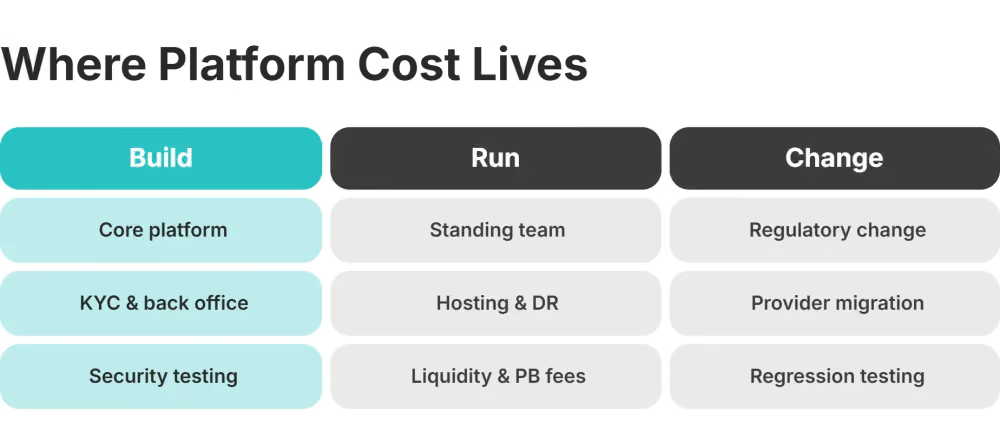
Headline development estimates capture the cheapest phase. Platform cost splits into three categories, and only the first one ends.
The run category is where custom builds surprise their owners. A live platform needs a standing team of 10–20 engineers, and regulatory change alone can absorb a fifth of that capacity in a year.
The change category is the one estimates miss entirely. A single liquidity provider swap costs weeks of integration and regression work; multiplied across amendments and upgrades, change becomes a permanent budget line.
The largest hidden item is time itself. Revenue the platform would have earned during a 12–24-month build never arrives, and for many business plans that foregone revenue exceeds the entire development budget.
From Infrastructure to Launch: How B2BROKER Compresses Time-to-Market
For a team that has done the math above, the answer to how to build a trading platform is usually to build less of it. An integrated stack delivers the layers this article covered as one coordinated system, with a single vendor relationship in place of many.
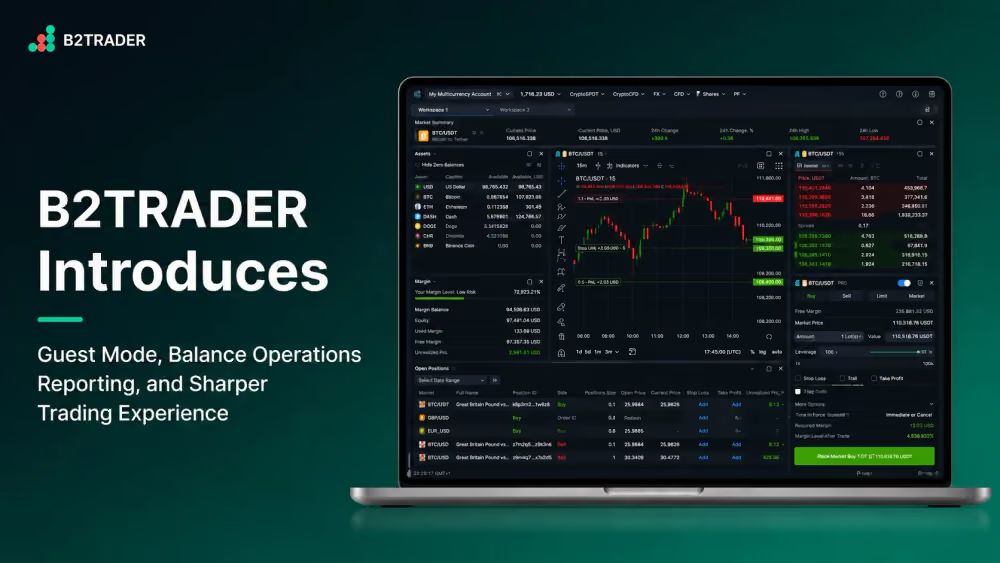
- B2TRADER is the multi-asset trading platform in that stack, carrying the OMS, margin logic, and FIX, REST, and WebSocket APIs described above.
- B2CORE covers the back office: CRM, KYC and AML workflows, reconciliation, client dashboards with built-in data visualization, and the client portal.
- B2BINPAY handles crypto payments and treasury.
- Multi-asset liquidity across FX, crypto, indices, metals, and commodities runs as an integrated layer.
Because the components share data natively, the reconciliation gaps that open between separate vendors' systems never appear.
Deployment on this model typically takes weeks, against the 12–24 months of a comparable custom build.
The layers, benchmarks, and cost categories above give you a workable evaluation checklist whichever route you choose. If the hybrid path fits your plans, the fastest way to test it is against your own requirements.
Frequently Asked Questions About Building a Trading Platform
Can you create your own trading platform?
Yes, and firms do, but the result has to work as an ecosystem of interdependent layers under production load. The most common failure is building strong execution and discovering the other layers were never designed.
What is the difference between building from scratch and using a white-label solution?
A custom build maximizes control and takes 12–24 months with a standing engineering team; a white label launches in weeks on infrastructure other brokers already run in production. Most regulated firms end up between the two, licensing the core and customizing the edges.
What technology stack is used to build an institutional trading platform?
Execution cores typically run on low-latency languages such as C++, Java, or Go, with Python for analytics tooling. A database such as PostgreSQL sits behind resilient messaging and API gateways. Architecture matters more than language choice. How the OMS, matching engine, risk layer, and back office exchange data determines where failures happen.
How do you ensure regulatory compliance when building a trading platform?
Compliance has to shape the architecture from the start, because onboarding, AML controls, margin rules, and reporting all impose data requirements. Firms that bolt compliance on after launch often find their systems never captured the data the regulator wants.
What is the fastest way to launch a multi-asset trading platform?
A turnkey or white-label stack with selective customization is the fastest route, since the core infrastructure already exists and has a production track record. An integrated ecosystem such as B2BROKER's, combining B2TRADER, B2CORE, and aggregated liquidity, compresses launch to weeks.
Recommended articles

Subscribe to our newsletter