MT5 White Label Compliance Checklist: Pass Every Regulatory Audit

MT5 white label compliance decides whether your brokerage reaches the market. It controls whether your launch on the MetaTrader 5 trading platform clears the MetaQuotes approval process and holds up under the first regulator review. Banking onboarding sits at the end of that chain, and most brokers underestimate it until it stalls everything else.
Failures cost money at every stage. A rejected MetaQuotes application adds four to eight weeks per resubmission cycle. A failed regulatory audit does far more damage, since it can trigger fines and force a license suspension, and at worst, it makes your banking partners walk away.
This checklist covers every layer in the order you will face it, from the MetaQuotes submission to the vendor questions that separate real infrastructure from compliance theater.
Key Takeaways
- Most first-time MetaQuotes applications fail on incomplete bank verification or missing director paperwork. Certify every document within 90 days of your submission date.
- Your licensing jurisdiction sets how heavy your compliance load will be and which banks will work with you. Offshore licenses launch fast, while tier-one regulators give you institutional credibility.
- Your AML/KYC setup inside MT5 needs automated sanctions screening and PEP checks, plus documented enhanced due diligence triggers for high-risk accounts.
- Audit readiness depends on tamper-evident trade logs and client-money segregation reports, with data retention of five to seven years matched to your regulator's rules.
- Before signing any white label agreement, confirm that the vendor gives you raw data access and enforceable leverage controls, along with a clear upgrade path to a full server license.
MetaQuotes Application Essentials
MetaQuotes approval is the first compliance gate for an MT5 white label solution, and the one brokers underestimate most often. The documentation requirements have grown stricter since 2023, and every incomplete or outdated submission triggers another resubmission cycle. Every document has to be current and certified, and formatted in the exact way MetaQuotes expects, which can differ from your technology provider's standard version.
Entity, Director, and Banking Verification Documents
The core document set for a MetaQuotes white label application depends on how long your company has existed:
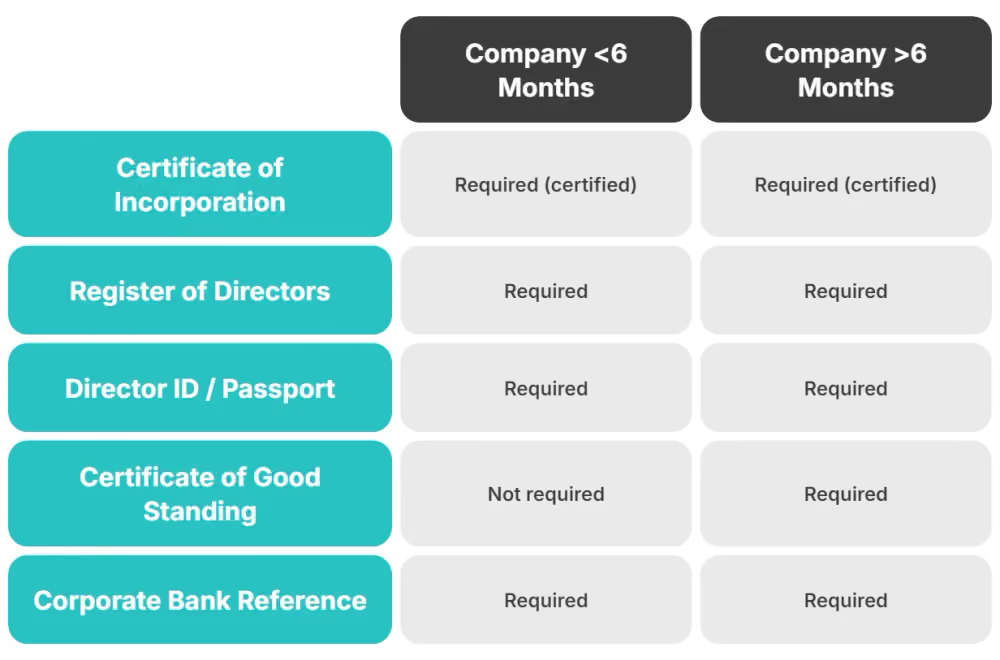
A few specifics matter more than the table. Documents older than 90 days are a common cause of rejection, so time your certification around the target submission date rather than the formation date. The bank reference is the single most frequent failure point, since many banks delay the letter or refuse to issue it in the format MetaQuotes accepts, so request the exact wording from your provider early.
EMI and PSP accounts do not meet the corporate bank account requirement. You need a traditional corporate banking relationship, with a letter confirming an active account and stating your company registration number and registered address. Your registered business activities should also name forex trading or financial services directly, because a generic description raises questions about the real business purpose and can trigger extra scrutiny.
Branding and Server-Name Assets
MetaQuotes asks for technical branding assets alongside the legal documents, and you should prepare both sets at the same time so branding work does not extend your timeline. You submit logos in BMP and ICO formats at the dimensions MetaQuotes specifies, plus your white label name, server name, website, and contact details.
Your legal company name must stay visible in the trading terminal no matter how you customize the branding, and MetaQuotes treats this as non-negotiable. Set your demo group configuration now too, including currency options and leverage defaults, because changes after submission can force rework that delays deployment.
Choosing the Right Licensing Jurisdiction
Your choice of jurisdiction is an architecture decision with consequences that last for years. It sets how heavy your compliance load will be, which banking partners agree to work with you, which client geographies you can legally serve, and how scalable the brokerage will be later.
Offshore licensing is faster and cheaper upfront. Tier-one licensing costs more and takes longer, and it builds the foundation for institutional relationships and lasting market access. The white label provider supplies the technology, but regulatory accountability stays with the broker.
Offshore and Mid-Tier Regulator Options
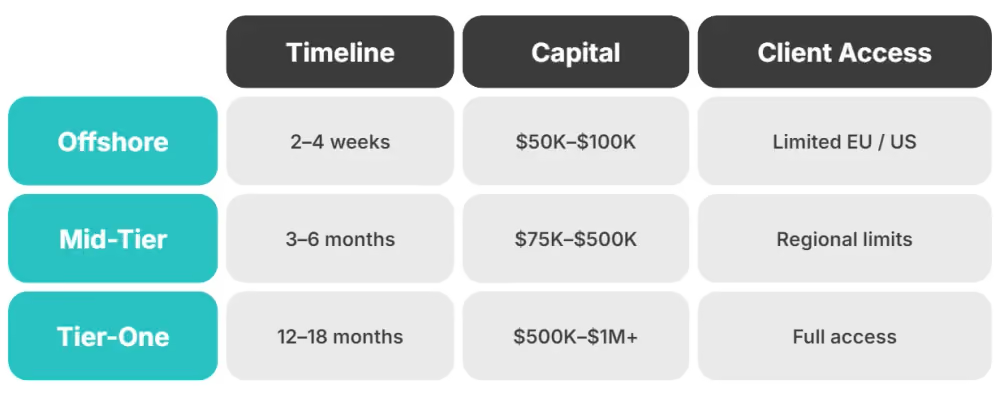
Offshore jurisdictions give new brokers and startups a fast launch and low capital requirements, but the cost shows up later. Banking access keeps tightening for offshore-licensed brokers, and the client geographies you can serve stay limited. Some institutional counterparties will not engage with an offshore license at all.
Mid-tier jurisdictions such as CySEC, FSCA, and Labuan sit in the middle. They demand more compliance rigor than offshore setups, yet they approve faster and carry lower licensing fees than tier-one routes, and they satisfy a wider range of banking partners. How white label forex broker regulations apply across these tiers shapes your compliance burden and banking access from day one.
Tier-One Broker-Dealer Path
Tier-one licensing under the FCA, ASIC, or MAS suits brokers that target institutional clients and prime brokerage relationships, or that plan to build a credible brand and business model over the long run. The FCA authorization process is one of the most rigorous routes open to a retail forex broker, and that rigor is what builds credibility.
The requirements are demanding. Capital reserves run from $500K to well above $1M, and you submit a detailed business plan. Every director and significant shareholder goes through fit-and-proper checks, and you keep ongoing compliance infrastructure running after launch. The full process takes twelve to eighteen months.
The payoff is a real competitive moat. A tier-one license opens banking relationships and institutional counterparty access, and it lets you market in major retail forex markets that offshore and mid-tier structures cannot reach. Bring in specialized regulatory consultants early, because revision cycles without expert guidance stretch the timeline.
AML and KYC Configuration Inside MT5
AML and KYC make up the operational layer regulators audit most often, and the layer where mistakes carry the highest penalties. Your provider may supply the tooling, but the broker still owns each KYC decision and the audit trail behind it, down to how every exception gets resolved.
Retention rules vary by jurisdiction and usually run five to seven years. Design your data storage and access controls from day one, with audit-trail integrity built into the same architecture, because compliant record-keeping is far easier to build correctly than to retrofit. The FATF Recommendations set the baseline that most jurisdictions fold into their own AML frameworks.
Sanctions and PEP Screening Rules
Sanctions screening has to run at onboarding and continuously after that. At a minimum, screen against OFAC in the US, the EU consolidated list, and the UN Security Council lists. Which lists apply depends on your jurisdiction and client base, so confirm the set with your compliance function before you lock in a configuration.
PEP screening follows the FATF definitions, which cover the individual along with immediate family members and close associates. That scope is wider than many first-time brokers expect, and your screening logic and case management workflow both have to reflect it.
Connect third-party screening APIs directly into your CRM systems and back-office flows, since manual gap-filling does not hold up at audit time. Every hit and every false positive needs documented escalation and a recorded decision, with a SAR or STR filing where the rules require it. An integrated white label CRM for brokers with built-in AML/KYC workflows narrows the gap between your MT5 trading environment and the compliance infrastructure behind it.
Enhanced Due Diligence Triggers
Enhanced Due Diligence (EDD) is the extra verification you apply to higher-risk clients and activity. Regulators check the written policy and then check whether you follow it, and any gap between your documented triggers and your real behavior becomes an audit finding.
A trigger usually fires on deposits or withdrawals above set thresholds, on clients tied to high-risk jurisdictions, on complex ownership structures, on unusual trading patterns, or on large single deposits with no documented source of funds. When one fires, EDD calls for source-of-funds and source-of-wealth evidence, plus extra identity verification and senior sign-off before you activate the account. Record every decision and every exception. Automate these triggers inside your forex CRM workflows rather than relying on manual review, because an automated rule behaves consistently and a regulator can verify it.
Trade Surveillance and Audit-Ready Reporting
Reporting and surveillance form the evidence layer that proves your compliance during an audit. Missing logs will fail you, and so will logs that an examiner cannot open and verify against each other, even when your operations are clean. Regulators focus on whether you can prove best execution and detect market abuse across your trading systems, and on how you handle client money. Each of those needs structured data and controlled access, with retention periods that outlast the audit itself.
Execution Logs and Client-Money Evidence Pack
MetaTrader 5 generates order and execution logs on its own, but you still have to set the export frequency and retention period and decide who can access them. Pulling logs on demand during an audit will not replace automated daily exports to secure, immutable storage. Regulators usually expect these data points in the logs:
- order timestamps for both submission and execution
- execution price and requested price
- slippage metrics
- rejection reason codes
- order modification history
- execution venue
FIX protocol connectivity standardizes the log format and simplifies reporting across multiple jurisdictions. For logs meant as regulatory evidence, use write-once storage or hash-based integrity verification, so an examiner can trust that the records have not changed.
Client funds must sit separately from your operational capital, backed by daily reconciliation reports and bank confirmations that hold up in an audit. Regulators run unannounced spot checks, so keep real-time segregation monitoring and set automated alerts on any discrepancy.
Hosting Location and Data Residency Rules
Hosting and data residency requirements depend on your jurisdiction, and they matter more every year. A server in the wrong geography, or a data transfer set up without the proper legal mechanism, can block your licensing approval or produce ongoing compliance findings. Local data residency rules keep spreading, so the architecture you choose at launch determines how easily you adapt as requirements change.
Server Strategy and Cross-Border Data Transfers
Place your primary servers in a recognized low-latency financial data center that matches your target market: LD4 in London for FCA-regulated entities, NY4 in New York for US-adjacent operations, TY3 in Tokyo for APAC clients, and FR2 in Frankfurt for the EU. The right choice comes down to where your clients sit and what your regulator expects.
Your disaster recovery setup protects uptime with a backup site in a separate geography and scheduled failover tests with documented results, and your regulator will scrutinize your RTO and RPO targets. For regulated entities, the typical benchmarks are an RTO under four hours and an RPO under one hour.
For transfers out of the EU under GDPR and similar regimes, Standard Contractual Clauses (SCCs) became the primary tool after the Schrems II ruling. The EU data protection framework defines what "adequacy" means in practice. Document your data-flow architecture and the legal basis for each transfer, because regulators expect that documentation to be produced on the spot.
Governance Framework for Continuous Compliance
Governance keeps your compliance intact after launch. Regulators look at your ongoing controls, well beyond the initial setup, and they are skilled at telling paper compliance apart from operational reality. At tier-one jurisdictions, board-level accountability is non-negotiable, and ownership has to be clear across the compliance and risk functions and the operations team. Mid-tier regulators increasingly expect the same. Treat compliance as a permanent function that runs for the life of the brokerage.
Compliance Policy Set and Audit Simulation
Regulators expect a defined set of core policies, covering AML and KYC, best execution, conflicts of interest, complaints handling, business continuity, and whistleblowing. Each one needs board approval and version control, plus a review cycle that runs at least once a year. Examiners frequently ask for training records too, meaning attestations that show who completed each training and when, along with the result, so build this record-keeping into your compliance function from the first day.
Run an audit simulation every year, internally or through a third party, to find gaps before your regulator does. Work through your own audit book and produce the evidence you would need for each potential finding, then fix the problems before you submit.
Vendor Due Diligence Checklist Before Signing
Vendor due diligence is the last checkpoint, because a provider's limitations turn into compliance gaps that are expensive to fix after launch. A proper forex brokerage software evaluation of any white label trading platform goes past the list of trading features. It asks what data you can actually access and what controls you can enforce yourself, and what happens on the day you decide to leave.
Data Access, Risk Controls, and Upgrade Path
You need direct access to your raw trade data and client records, and to the audit logs behind them, rather than filtered summaries, because you have to export and verify your own data independently to satisfy a regulatory examination. Retail leverage caps and other risk management tools must be enforceable at the trading platform and group level, and ESMA's 1:30 cap on major FX pairs is the obvious one to test. Confirm the cap is configurable inside a test environment before you sign, since a spec sheet is not enough.
That same test environment lets you validate your data export formats and permission hierarchies, then confirm liquidity connectivity and risk-control configurations before go-live, where a gap costs far less to find than during an audit. Confirm the vendor supports migration and guarantees data portability, and ask for a realistic timeline for moving to a full MT5 server license — a vendor that cannot describe a clear path is a structural dependency risk. Flag any lock-in clauses and restrictive data-ownership terms, and negotiate data portability and migration support into the first agreement, since your leverage is higher before you sign than after.
Accelerate Compliance With B2BROKER's Turnkey Ecosystem
MT5 white label compliance spans seven connected layers: MetaQuotes documentation, jurisdiction selection, AML and KYC operations, audit-ready reporting, hosting and data residency, governance, and vendor due diligence. A gap in any one of them creates risk across the rest.
The cost of failure grows at each stage. A resubmission delay is measured in weeks, and a regulatory finding in months. A banking complication can mean lost business that is hard to win back.
B2BROKER supplies a turnkey solution that supports compliance across the whole multi-asset brokerage operation. It maintains full MT5 server management and aggregates liquidity from multiple liquidity providers.
B2CORE is an all-in-one CRM that brings integrated KYC/AML workflows and screening connectivity, and B2BINPAY handles compliant crypto payments and payment gateways.
Multiple international regulatory licenses and a team of more than 500 fintech professionals stand behind the stack, with 24/7 technical support, so your compliance infrastructure runs from day one instead of being retrofitted under examination pressure.
Frequently Asked Questions about MT5 White Label Compliance
Why do MetaQuotes applications get rejected the first time?
Usually, it's incomplete bank verification or director certifications dated more than 90 days before submission. Preparing documents in the exact format MetaQuotes requires and confirming the bank letter wording in advance lowers the risk.
How often should client KYC files be refreshed?
Most regulators expect a cycle of one to three years by risk tier, with high-risk clients reviewed annually. Automated reminders and workflow triggers keep records current before deadlines rather than at examination time.
Can I add crypto CFDs without re-applying for a new license?
Usually, you must at least notify your regulator, and some jurisdictions treat crypto derivatives as a license variation needing extra approvals. Confirm the instrument scope that your current permission covers before launching cryptocurrencies or any new asset class.
What happens if my server is hosted outside my regulator's jurisdiction?
You may need cross-border transfer mechanisms such as Standard Contractual Clauses, and some regulators require local data residency outright. Misalignment can delay approval or surface as compliance findings in audits.
Recommended articles
Subscribe to our newsletter