How Brokers Manage Volatility When Liquidity Thins Out

A volatile session opens, and the spread is the first thing to move. It widens across correlated pairs because a top liquidity provider has stopped streaming quotes, and the thinner pricing tips client positions into a margin call faster than the desk can react. Within minutes, the desk is fighting its own platform as much as the market.
A brokerage's infrastructure, built long before that session, mostly decides how well it holds up. For an institutional operator, volatility is an engineering problem. Retail investment advice and trader psychology barely enter into it.
This guide gives the technology and risk leaders who run a brokerage a practical way to approach volatility management across four areas: liquidity resilience, matching engine integrity, leverage control, and risk governance.
Key Takeaways
- Treat volatility as an infrastructure problem. Your liquidity and margin systems decide the outcome as much as the market does.
- The real danger is the margin call cascade: widening spreads force liquidations, and those liquidations widen spreads again. Real-time controls have to break that loop early.
- Relying on one or two liquidity providers is a weak point because when markets seize up, they can widen pricing and pull credit at once.
- Your matching engine sets execution quality when volume surges. Rejection rates and latency climb the moment it cannot keep up.
- Mechanical leverage and margin rules let a broker cut risk automatically in volatile markets, before anyone has time to decide by hand.
Why Volatility Is an Infrastructure Problem
Volatility becomes dangerous when one failure starts feeding the next. A flood of orders backs up the risk checks, so the broker's own prices drift away from the market, and by the time operations notices, it has already lost a live view of client exposure. Each weakness makes the others worse, until the whole firm is exposed.
This is why the best brokers treat volatility as engineering. How a firm routes orders and prices credit and how fast it fails over to backups decide whether it absorbs the shock or passes it to clients and its own balance sheet.
The data already shows it. In 2026, 34% of brokerages named risk management their top operational challenge, ahead of scaling and even compliance. A Tools for Brokers report from the same year puts liquidity bridges at 20% of tech budgets and AI at 28%, as operators rebuild the plumbing before the next event.
The Margin Call Cascade: How Volatility Becomes a Systemic Threat
Volatility sets off a feedback loop that takes a broker down step by step. A short-term spike raises margin pressure, which triggers calls across the client book. Forced liquidations follow. The selling pushes prices and spreads wider, and those wider spreads pull the next accounts into breach, so each turn of the loop worsens the next.
The headline volatility figure is only the trigger. The real danger lives in the feedback between client books and the liquidity providers and collateral desks behind them. Managing that loop is the job, because watching the headline number does nothing to slow it.
Regulators expect a broker to keep functioning through this. Under FINRA Regulatory Notice 21-12 , a member firm's order-handling and margin duties tighten in stressed markets, along with liquidity-management obligations, and Rule 5310 means a broker-dealer cannot blame volatility for a slow fill. The SEC's Net Capital Rule (15c3-1) and Customer Protection Rule (15c3-3) still require enough capital and segregated client funds, however bad the order book gets. So a cascade is a regulatory problem as much as a credit one.
How Spread Widening Amplifies Forced Liquidation
When spreads widen during sharp market movements, every forced liquidation costs more and returns less equity to the account. A position closed at a 10-pip spread recovers far more than the same trade closed at 40 pips, even though the underlying market price is identical.
Liquidations also rarely happen one at a time. Correlated accounts hit their margin limits together, and each forced exit drains liquidity and widens the spread further, so those price fluctuations raise the cost of the next one. Without a real-time, account-level margin engine, a broker can only watch this run through the book before anyone steps in.
Why Liquidity Concentration Risk Is the Breaking Point
A broker that routes most of its flow through one liquidity provider has built a single point of failure. Under stress, that single source can widen its quotes or pull them entirely, and it can cut the broker's credit line at the same moment. Diversifying that flow across several venues, and managing CFD liquidity across them, keeps pricing and fills steadier when one of them drops out.
A backup stream only counts once it has carried real trading flow. A failover that exists only on paper is an assumption, and assumptions break in a crisis. Resilient brokers prove it in production, routing live client orders to standby venues during planned windows, so they know the route holds before they have to rely on it.
Matching Engine Performance Under High-Volume Stress
Volatility tests a matching engine harder than any benchmark can. When order volume spikes and clients flood the book with cancellations and resends, the queue lengthens, and any weak spot in the routing logic turns that pressure into outright platform failure. The engine that clocked low latency in a quiet demo is often the first to buckle here.
Slow or failed executions turn into client disputes, and those cost trust and retention while weakening the firm's regulatory standing. So a CTO should judge an engine by how it behaves when the market turns. A vendor's brochure latency, measured in a calm market, says nothing about that.
Order Rejection Rates and Execution Integrity During Volatility Spikes
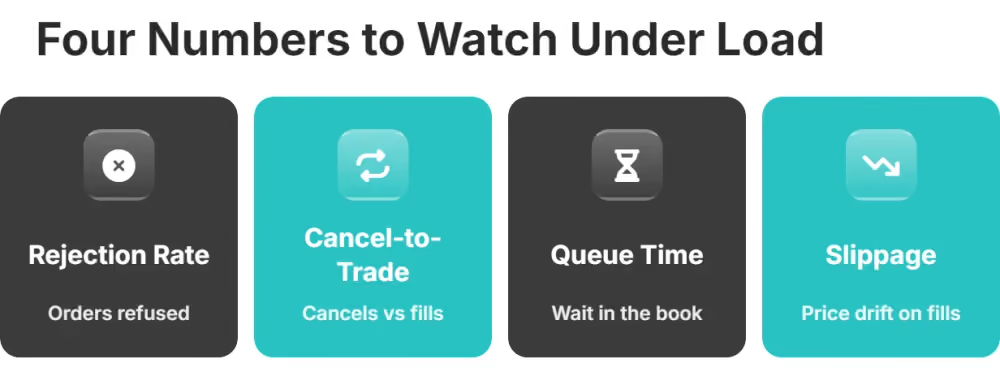
Four numbers tell you how the engine is really coping in a fast market:
- rejection rate
- cancel-to-trade ratio
- queue time
- slippage on aggressive orders
Together, they show whether orders are matching cleanly or starting to back up.
Watch the rejection rate most closely. If it climbs while market volume stays flat, the limit sits inside your own engine, and clients feel that as failed trades. The same pressure shows up as slippage , which brokers keep down with tighter tolerance settings and faster routing.
Latency at the worst moments is what counts. A median of 200 microseconds means nothing if the slowest 1% of orders blow out to 200 milliseconds during the minutes that matter. Only live production data shows whether the engine holds there.
The Architecture Decisions That Determine Fill Quality Under Load
A few design choices decide whether an engine survives when load triples in 60 seconds:
- in-memory order books, so matching never waits on disk
- deterministic matching, so the same inputs always produce the same result
- horizontal scaling that splits the load by symbol
- risk checks inside the execution path, rather than bolted on at the perimeter
- isolated failure domains, so a surge in one symbol cannot freeze the whole engine
The basics are table stakes: price-time priority and atomic, deterministic order handling. What sets a strong engine apart is how it behaves above that baseline. One that runs every symbol through a single shared risk gate jams under load, while one that checks risk per symbol or per client keeps a local problem local.
Dynamic Leverage Controls and Real-Time Margin Management
A leverage setting that suits a calm market turns dangerous when volatility spikes. A 1:100 ratio that looked prudent at 9:00 AM can be reckless by 14:32, after a surprise move in interest rates. So strong desks cut leverage and exposure automatically as market conditions change, instead of waiting for a risk committee to convene.
Regulators are moving the same way. ESMA's February 2026 Supervisory Briefing on Algorithmic Trading tells EU supervisors to expect controls that are automated and documented, and proven through testing, instead of hands-on intervention. Automated controls only help if the broker can actually shed risk on demand through hedging, and that depends on how it provides liquidity : an agency book offloads risk differently than a market-making one, so most desks run a hybrid.
Volatility-Scaled Position Sizing Across Client Books
Volatility-scaled position sizing ties each client's allocation to current volatility instead of a fixed limit. As that volatility climbs, the allowed exposure shrinks on its own, so the broker avoids carrying oversized positions into the most dangerous part of the session.
This matters most when many clients converge on one investment strategy. As that correlation rises, a wave of accounts reacts to one signal within the same minute, and the broker ends up holding the one-sided risk on its own book. Scaling size to volatility caps the build-up before it becomes a single, synchronized liquidation.
Hard Drawdown Thresholds and Mechanically Enforced Derisking
Multi-manager hedge funds run a habit worth borrowing: drawdown limits that act on their own. You set bands at the firm level, then at the desk and strategy level below it, and each band triggers a preset response with no meeting needed. A small drawdown cuts leverage, while a deeper one forces a partial derisk or suspends trading outright.
The point is that the rule fires on its own, with no committee in the loop. In a fast market, a risk meeting produces slow and uneven decisions. A preset threshold removes the hesitation and leaves a clear record of how the firm acted in the moment.
Build the Infrastructure Before the Next Volatility Event Tests It
Every volatility event is a stress test of decisions made months earlier. The brokers that come through have usually stopped running their core systems as separate vendors and connected them into one view. That integration is the point of the B2BROKER stack: the B2TRADER platform matches orders under load, B2BROKER's multi-asset liquidity , from FX to fixed income, removes the single-provider risk that breaks pricing, and the B2CORE back office keeps client exposure and funding in one workflow, so no one is reconciling separate tools by hand during the worst hour of the quarter.
The gaps that surface during a volatility event stay invisible in a calm market. The only way to find them is to build and harden the stack before the next event does it for you.
Frequently Asked Questions about Managing Brokerage Volatility
How do Forex brokers ensure platform stability during high volatility?
Low-latency matching and pre-trade risk checks keep order flow moving as spreads widen, while live failover testing in production proves the backup venues hold before a crisis. A platform like B2TRADER protects execution integrity by keeping rejection rates and queue congestion under control.
How do margin requirements change during periods of high market volatility?
When intraday loss potential outruns existing buffers, brokerages raise house margin and cut leverage, tightening collateral rules to slow the margin call cascade. Real-time margining and partial-liquidation workflows let them derisk early, before a maintenance breach becomes a balance-sheet problem.
Why isn't higher volatility always good for brokers?
Higher activity lifts volumes, but it also raises slippage, rejection risk, client losses, funding pressure, and execution disputes. Volatility only pays off when the firm's infrastructure and risk rules hold steady under stress; otherwise thinning liquidity and rising margins erode retention and invite negative-balance events.
What tools do institutional brokers use to monitor and respond to volatility spikes?
They watch realized volatility and a volatility index like the VIX, margin utilization, fill quality, and counterparty credit usage by symbol and client segment, then pair those dashboards with automated throttles, dynamic leverage controls, and mechanically enforced drawdown thresholds. An integrated back office like B2CORE speeds response by putting exposure and client equity next to funding data in one workflow.
How can brokers reduce liquidity concentration risk during stressed markets?
They diversify across bank and non-bank providers, watch credit consumption continuously, and validate failover with live traffic before a crisis, since paper backups vanish when spreads gap and counterparties reprice at once. B2BROKER's integrated liquidity and trading stack cuts vendor sprawl for tighter control during a dislocation.
Recommended articles


Subscribe to our newsletter