How to Choose the Best Liquidity Provider for Multi-Asset Brokers


Liquidity shapes the outcomes your brokerage delivers every trading day. It affects the prices clients pay, the likelihood of a high-quality fill across various financial instruments, and the audit evidence your team must produce when questions arise.
This guide targets heads of dealing, risk, and operations who compare partners across multiple asset classes. It explains how to select the best liquidity provider for multi-asset brokers using execution data that holds up in real sessions.
Key Takeaways
- The best liquidity provider for multi-asset brokers delivers consistent execution quality across financial markets, not just competitive spreads.
- Brokers should benchmark fills, latency, and slippage behavior to assess true liquidity depth and reliability.
- Aggregation across multiple liquidity sources reduces dependency risk and improves execution resilience.
- Total liquidity cost includes technology, data, and operational overhead, not just trading spreads.
- Choosing a scalable, multi-asset liquidity partner is critical for sustaining growth as trading volume and product scope expand.
Have a Question About Your Brokerage Setup?
Our team is here to guide you — whether you're starting out or expanding.
Why Liquidity Partner Choice Matters More in a Multi-Asset Setup
Multi-asset trading creates one execution standard across different asset classes in the client’s mind. When one product line shows wide slippage or frequent rejects, support tickets spike across the board, and the brand takes the hit. Clients remember outcomes, not venue names.
Operationally, fragmented liquidity splits pricing and risk data across trading systems. Latency differences between feeds attract latency-sensitive flow and increase adverse selection. Dealing teams then spend time managing exceptions instead of improving actual execution.
A liquidity partner also sets the practical limit on expansion. Adding a new asset class should reuse the same connectivity and trading infrastructure. If each rollout needs custom gateways and new reporting logic, time-to-market slows and operational cost grows.
Common vulnerabilities in fragmented setups include:
- Latency gaps that attract arbitrage and raise execution disputes.
- Collateral fragmentation that forces larger buffers across multiple counterparties.
- Inconsistent execution logs that complicate best-execution and regulatory reporting.
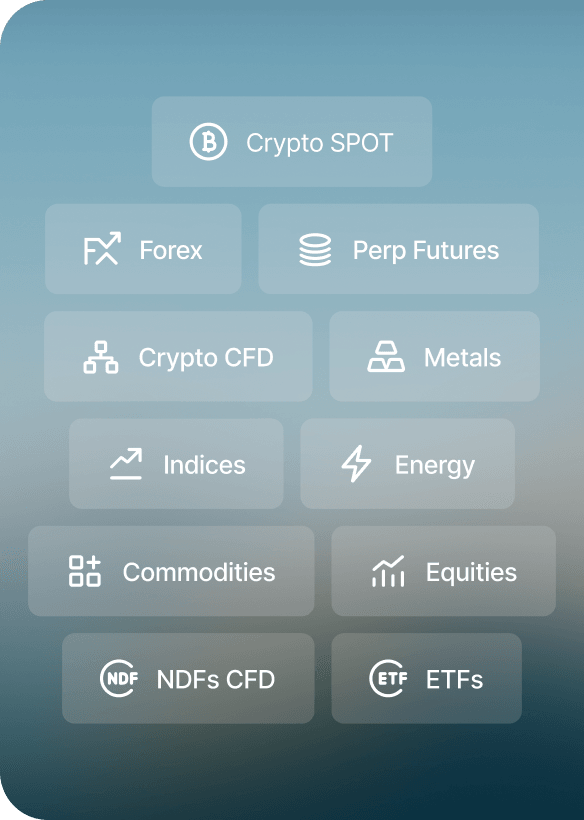
Deep, Reliable Liquidity Across 10 Major Asset Classes
FX, Crypto, Commodities, Indices & More from One Single Margin Account
Tight Spreads and Ultra-Low Latency Execution
Seamless API Integration with Your Trading Platform
What “Best” Means for Multi-Asset Liquidity Providers
In multi-asset brokerage, “best” starts with outcomes you can measure. A long instrument list or a tight top-of-book spread says little if quotes fade during volatility, or if fills degrade when institutional clients trade size.
Multi-asset coverage brings uneven market hours and stress patterns. U.S. equities trade 9:30 a.m. to 4:00 p.m. ET, FX runs 24/5, and crypto trades 24/7. A strong liquidity partner keeps execution behavior stable across these cycles and across venue regimes.
A practical definition of “best” comes down to:
- Predictable spreads and depth across normal and stressed sessions
- Fill quality you can verify through execution reports and timestamps
- Resilience under load, with stable latency during peak message rates
- Operational fit across credit terms, support model, and integration maturity for different trading strategies
Use this lens for the sections ahead. It keeps selection tied to execution integrity and scale readiness, which protects client trust as product scope expands.
2026 ranking of top liquidity providers across forex, crypto, and CFD markets with a focus on technology, asset coverage, and execution.
23.05.25
Execution Metrics Brokers Should Benchmark
Execution quality becomes clear through measurement. Multi-asset brokers benefit from a consistent scorecard across markets, since dealing decisions and risk limits depend on live results. The same data also supports client support teams when execution questions arise.
Spread and Depth Consistency
Headline, Top-of-Book spreads reflect the price only for the smallest possible trade sizes. Executing institutional volume depends heavily on the Depth of Market (DOM) quotes. These deeper levels determine the final price for larger client orders.
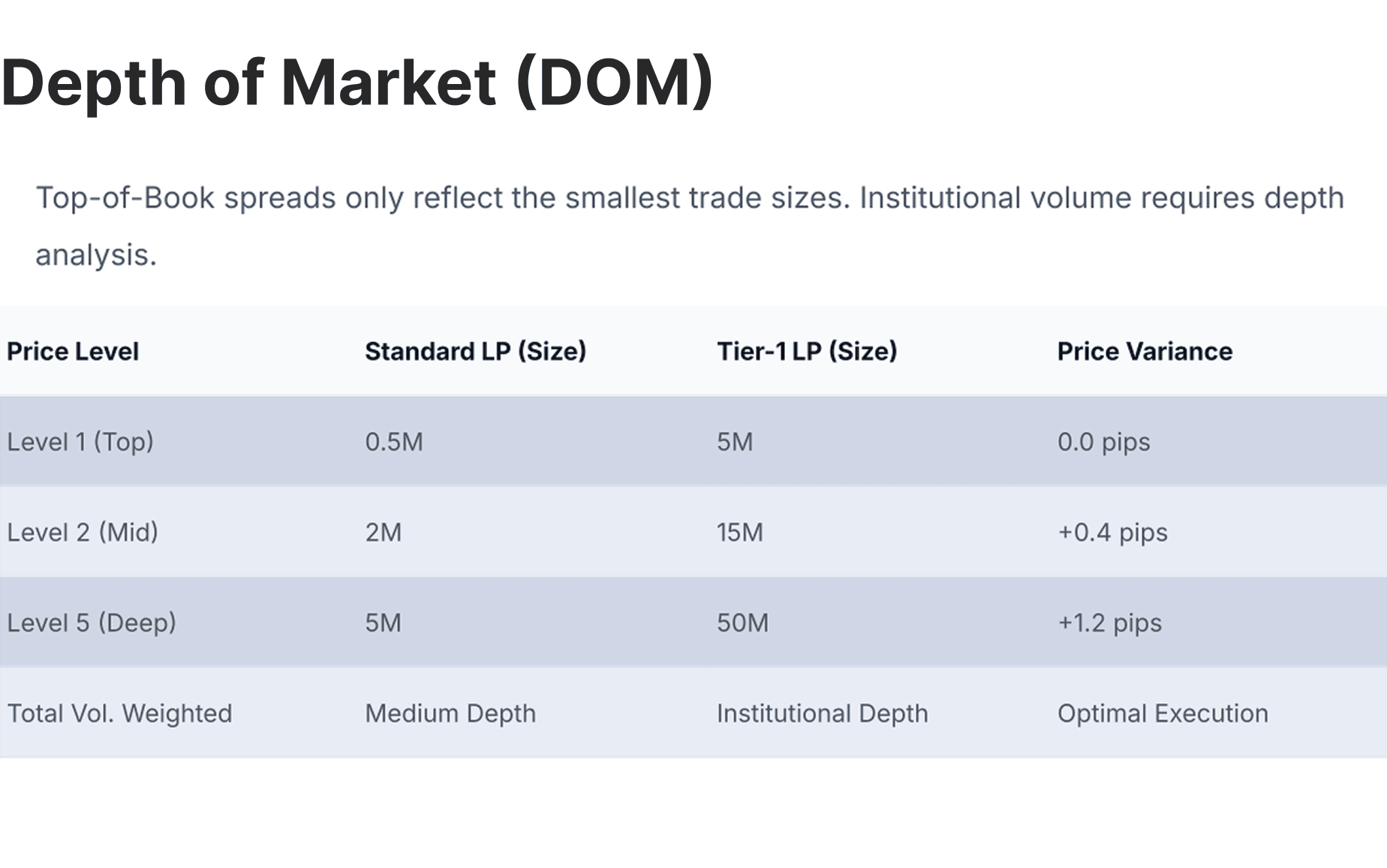
Reliable FX providers maintain thick books across multiple price levels, commonly separating “Level 1” top-of-book from “Level 2” depth-of-book views. Volatile sectors require even deeper analysis. Knowing how to find a crypto liquidity provider involves checking if market access remains stable when liquidity dries up.
Market depth and spread testing should occur during overlapping market hours and during high-impact news events. Consistency during these periods of market volatility reveals the provider's true capacity and the ability to absorb large orders without triggering cascading price movements.
Fill Rates and Reject Behavior
Fill ratios show the percentage of orders executed at the requested price. Low rates suggest insufficient liquidity at specific price levels. Frequent rejections indicate an inability to process rapid flow from proprietary trading desks and algorithmic traders during peak volatility.
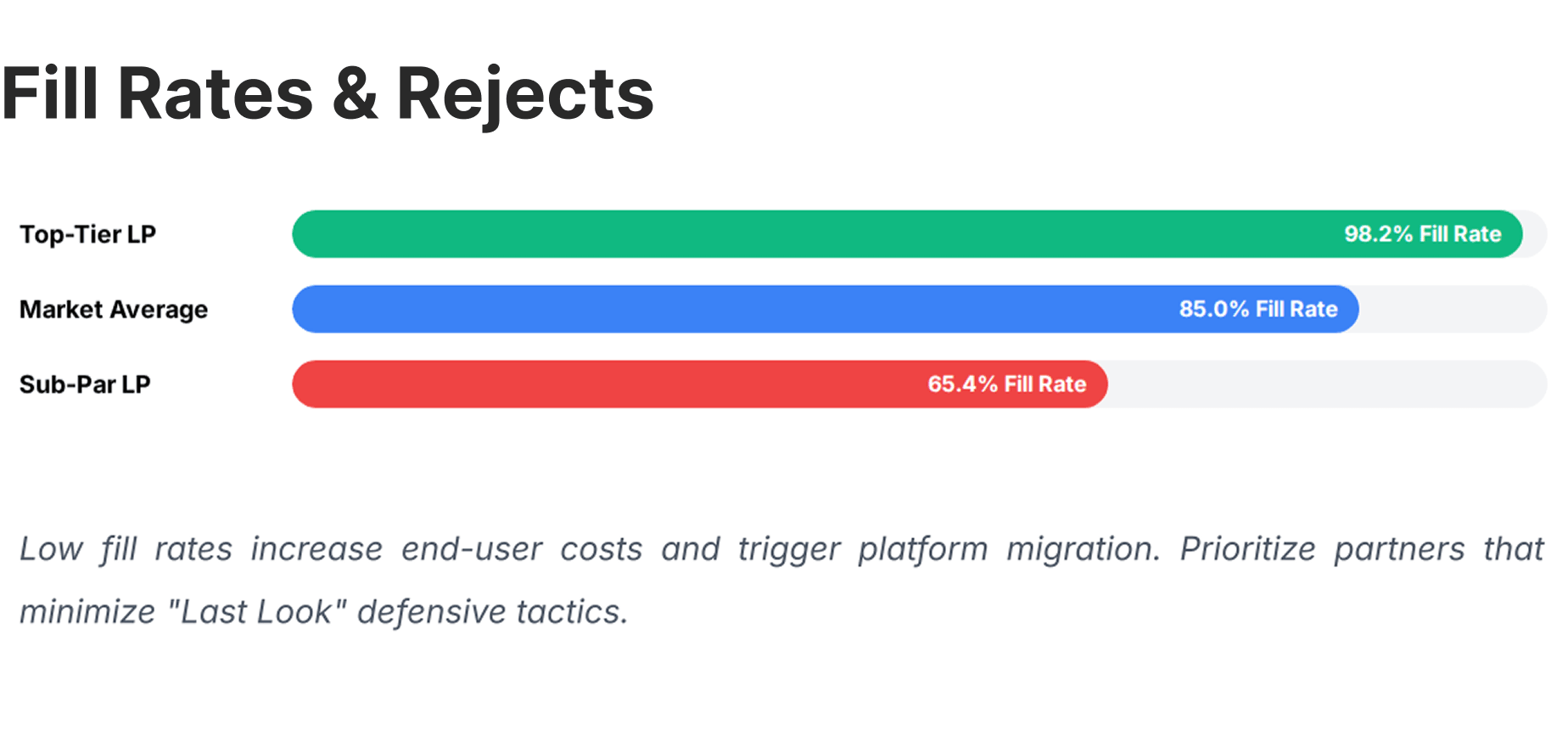
Partial fills increase end-user trading costs. This friction harms client retention and lowers the platform's perceived value. Constant requotes push traders toward venues with fast execution and higher certainty.
Analyzing the last look window helps identify hidden reject patterns. Aggressive delays allow providers to cancel trades as prices move. Prioritize partners that minimize defensive tactics to protect their own reputations.
Latency and Stability Under Load
Latency affects the price path between order acceptance and execution. A practical benchmark tracks median order-to-trade timing and tail latency, since spikes create slippage and operational noise, even when typical fills look clean.
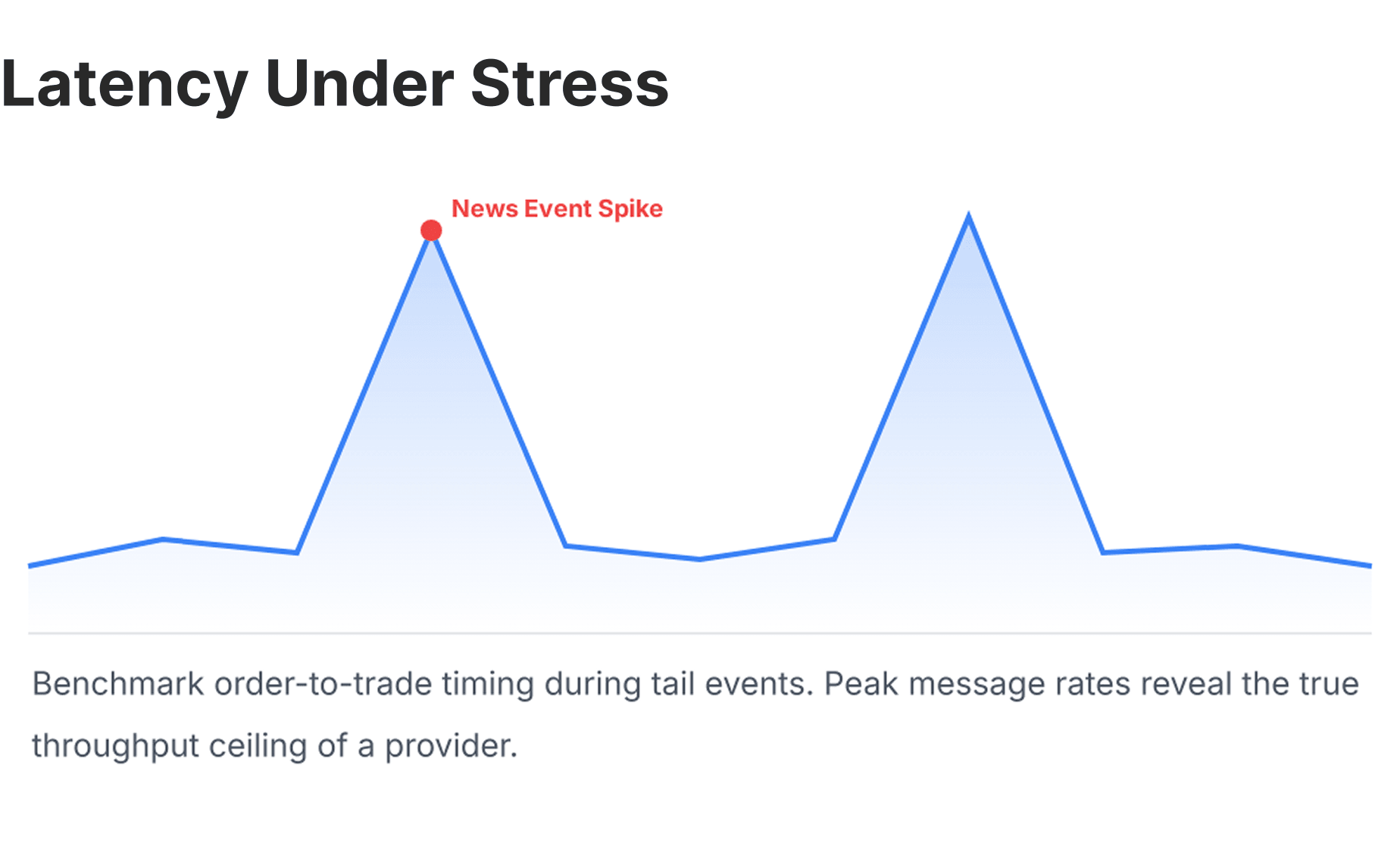
Peak conditions reveal whether performance stays predictable. News releases, session overlaps, and venue incidents can concentrate flow, so validation should include throughput ceilings, queue behavior, and reconnect logic at the gateway.
A useful review also ties timing to operating discipline. Uptime history, maintenance windows, and change-control practices show how often the provider touches the stack, and whether those changes correlate with execution degradation.
Slippage Patterns, Not Averages
Slippage analysis needs shape and direction. Average slippage hides whether clients systematically lose price improvement opportunities or whether outcomes cluster in the tails. In equities reporting contexts, regulators emphasize measures like effective spreads and price improvement as execution quality signals.
Execution reports need enough detail to support review. Time stamps, venue tags, and quote-at-entry fields make fills reconstructable, which reduces argument time when a client disputes a trade or a supervisor runs an execution review.
Multi-Asset Coverage and Aggregation Capabilities
Liquidity aggregation merges pricing from various banks and non-bank market makers into a single stream. This structural approach increases the available depth for every trade and prevents execution failures when one provider faces technical downtime or liquidity gaps during market stress.
Comprehensive coverage requires competitive order books across a wide range of assets. This setup provides trading firms with a stable foundation to support high-volume flow in specific categories:
- Forex and cryptocurrencies
- Commodities, energy futures, metals
- CFDs on global equity and ETFs
- Both spot and derivatives
While some firms focus on a single segment, such as crypto exchanges, a professional multi-asset partner integrates multiple specialized data feeds into a single platform pool. Centralizing aggregated liquidity depth simplifies managing separate vendor relationships for each class.
Strategic aggregation reduces dependency risk. If one venue widens spreads or throttles fills, the broker can shift flow without rebuilding connectivity. That flexibility protects execution KPIs and keeps expansion into new instruments from turning into a new integration project.
Risk Management and Flow Control Capabilities
Multi-asset brokers need one risk layer that supports holistic portfolio management and sees exposure across products in real time. Without that view, limits drift by desk or venue, and the firm only sees true concentration after the fact, when corrections get expensive.
Flow control starts with segmentation. A hybrid setup routes some client flow to external liquidity (A-Book) and internalizes some flow under defined rules (B-Book). Effective tooling ties those rules to the client tier, instrument, and live exposure, then logs each step of the decision-making process for review.
A liquidity partner should support portfolio-aware controls like net exposure limits, dynamic margin, and kill switches that trigger on latency spikes or reject surges. Those controls protect P&L and reduce client-facing incidents during fast sessions.
Technology Integration That Reduces Friction
Integration quality shows up in time-to-market and incident load. A partner that ships proven trading technology gateways shortens onboarding, reduces post-release fixes, and keeps your dealing team focused on execution oversight rather than vendor debugging.
Seamless back office, CRM, and trading platform compatibility is table stakes for most broker stacks. Native support for MetaTrader and cTrader environments minimizes the need for bespoke bridges. Utilizing the Financial Information eXchange (FIX) protocol provides a standardized method for transmitting high-speed market data.
Specific connectivity standards include:
- FIX API 4.4 for institutional-grade routing and Direct Market Access (DMA).
- Stable bridges for retail platforms.
- Low-latency cross-connects within data centers.
- Standardized WebSocket feeds for real-time pricing.
Proven integrations reduce the risk of system failures during peak load. Deploying tested connectivity modules maintains uptime without the maintenance burden of internal software builds, which protects the firm from the execution gaps that often occur with unverified technical setups.
One Connection to Rule Ten Markets
Aggregate Forex, Crypto, and ETFs into a single stream to reduce dependency risks and operational complexity.
Regulatory and Counterparty Considerations
Execution reports only matter when the counterparty can settle trades and honor credit terms during volatility. Under MiFID II, best execution stays with the investment firm, even when a third party handles routing, so the broker still owns the outcome.
Client money controls deserve the same scrutiny. Regulators require funds segregation and ongoing reconciliations, which puts operational discipline ahead of marketing claims.
Similar to a prime brokerage relationship, the Prime of Prime model bridges the gap between retail brokers and institutional liquidity pools. These entities offer the transparency required for best-execution audits. High regulatory maturity reflects a partner's ability to withstand shifting legal requirements across different global jurisdictions.
Understanding the Full Cost of Liquidity
Spreads are the most visible line item, but they rarely represent the full liquidity bill. Total cost of ownership also includes commissions, market data, connectivity, and the operational load required to keep pricing, routing, and reporting stable.
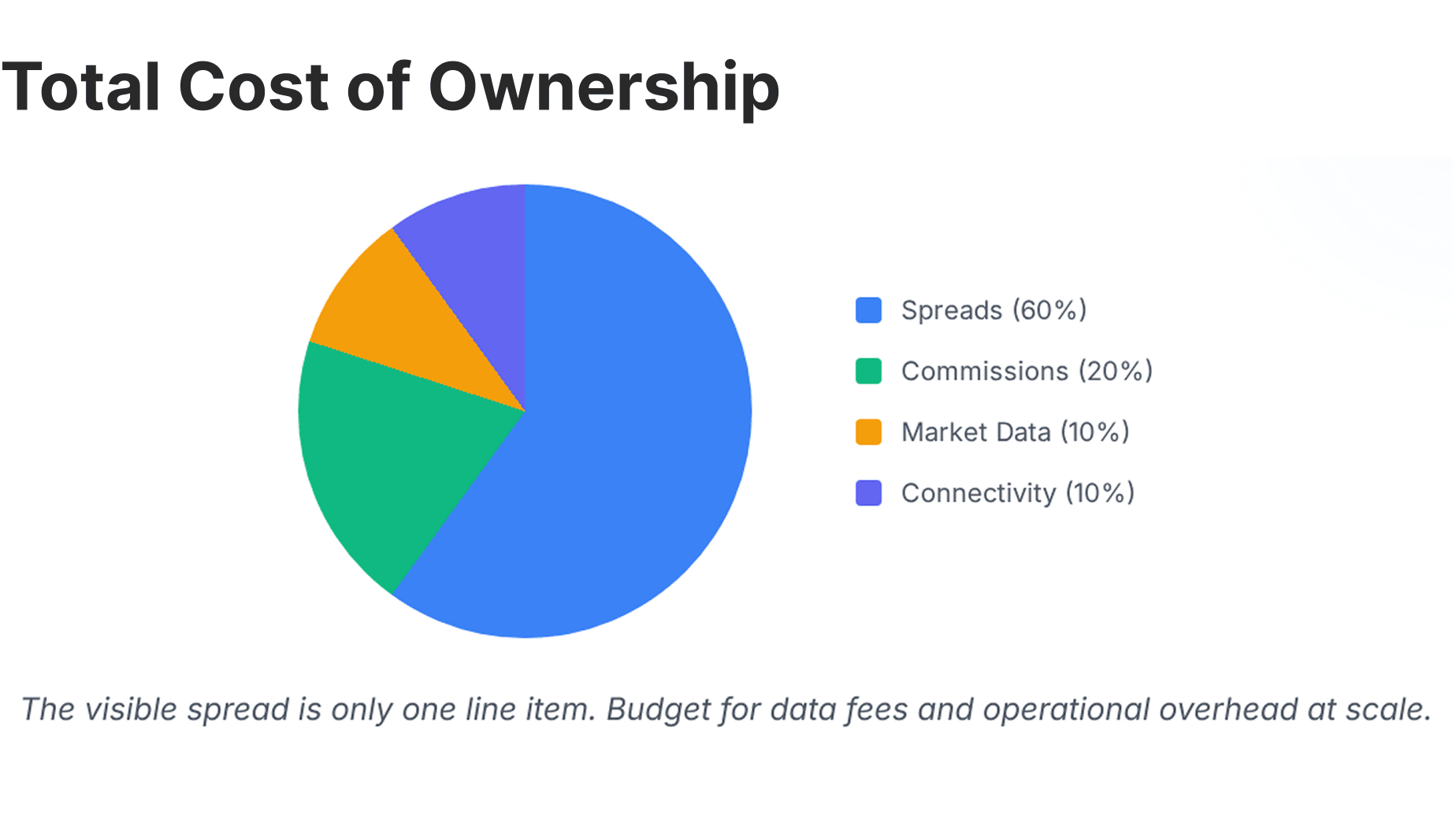
Market data can become a material cost center as product scope grows. In Europe, a Market Structure Partners report cited “machine-readable” equity data price increases of up to 481% from 2017 to 2024, which is why many firms now budget real-time data separately from execution.
Connectivity has its own recurring costs. Gateways, FIX sessions, bridge maintenance, and support SLAs sit on top of the raw price stream, and they tend to scale with venues, symbols, and message rates.
A practical way to model liquidity cost is scenario-based: current volume, a “2x active clients” case, and an expansion case that adds a new asset class. That approach surfaces when a quote with competitive pricing turns expensive once data, tech fees, and support are priced in.
How to Compare Liquidity Providers Without Wasting Time
Strategic evaluation requires a structured approach to filter marketing noise. The goal is to collect execution evidence early, then confirm it under live conditions. That sequence keeps decision time predictable and reduces rework when volumes rise.
Step 1: Request Comparable Execution Data
Start with a clean data pack that matches your symbols and trade sizes. Ask for spread and depth snapshots during normal hours and stressed windows. Include at least one rollover window for FX around 5:00 p.m. New York time, since pricing often shifts there.
Step 2: Run a Controlled Demo With Reporting
Use a demo that produces the same reports you expect in production. Focus on fill ratio, reject reasons, and order-to-trade latency under load. Gaps show up quickly when the log format is inconsistent or timestamps cannot be reconciled.
Step 3: Execute a Short Live Pilot
A live pilot validates what marketing cannot: routing behavior, stability, and support response. Watch for recurring partial fills, asymmetric slippage, or unexplained re-quotes. Any pattern that needs manual intervention becomes an operating cost the next time volume spikes.
Stop Guessing About Your Execution Quality
Secure deep liquidity across 10 asset classes with proven fill rates and transparent reporting for your brokerage.
Future-Proofing Your Liquidity Setup
A liquidity setup holds its value when new products can go live without rebuilding connectivity. That means the partner supports additional asset classes through the same pricing, routing, and reporting model, with clear specs and stable versioning.
Volume growth tests different limits than a demo. Queueing, throttling, and peak-session message rates shape spreads, fills, and slippage behavior once thousands of accounts hit the same venues. Capacity planning should be visible in monitoring and incident history.
Regulation and platform stacks also move. A future-proof partner keeps documentation current, publishes change windows, and maintains audited reporting outputs when rules or platform bridges update, so dealing and operations avoid last-minute remediation.
When a Liquidity Partner Is Limiting Your Growth
A brokerage usually outgrows its liquidity setup quietly. Common red flags show up in both trading data and day-to-day operations:
- Reject rates trend up during normal volatility, not just during headline events.
- Partial fills increase on standard ticket sizes, even in core hours.
- Latency gets “spiky,” with the 95th percentile jumping during peaks and rollovers.
- Slippage skews negative, with weak reporting on venue-level causes.
- New symbols take weeks to onboard, or coverage stops at one asset class.
- Credit terms stay tight while volumes rise, limiting client leverage plans.
- Support responses slow down on production issues, leaving workarounds as the default.
Switching partners in these cases reads as optimization. It protects execution quality and keeps growth plans tied to capacity.
Powering Multi-Asset Brokerages With B2BROKER Liquidity
Selecting the right liquidity solutions demands a balance between execution speed and regulatory safety. B2BROKER operates as a Prime of Prime provider designed for institutional scale. The infrastructure delivers consistent fill rates across diverse market conditions.
Our aggregation engine pools liquidity from top-tier banks and non-bank market makers into a single stream. This setup supports extensive coverage across 10 asset classes. Connectivity via FIX API integrates seamlessly with MetaTrader, cTrader, and white-label environments.
Founded in 2014, the group now serves over 1,000 corporate clients worldwide, including hedge funds, fintech startups, asset managers, and financial institutions. We maintain 10 regulatory licenses to guarantee counterparty stability. This framework provides the legal and operational security necessary for long-term brokerage expansion.
Upgrade Your Liquidity Infrastructure Today
Join institutions and financial services firms using our Prime of Prime regulated liquidity to power their multi-asset trading ecosystems.
Frequently Asked Questions about Best Liquidity Providers
- What should multi-asset brokers prioritize when comparing liquidity providers?
Multi-asset brokers should prioritize execution consistency that they can verify in reports, plus reliable depth on the sizes their client base actually trade. Counterparty stability and integration maturity matter because outages and messy logs become operational risk at scale.
- How can brokers test liquidity quality before committing?
They should run a structured test that includes a demo with full reporting and a short live pilot on the same symbols and ticket sizes. Results need to cover normal sessions and stressed windows, since that’s where reject behavior and tail latency show up.
- Why is aggregation important for multi-asset liquidity?
Aggregation reduces single-source dependency by pooling price and volume from multiple counterparties into one routed stream. It also keeps execution KPIs steadier when one venue widens spreads, throttles flow, or goes unstable.
- How does a liquidity partner impact operating costs?
Liquidity partners influence costs beyond spreads through data fees, platform gateways, integration support, and credit terms. Over time, these factors can materially affect profitability.
- When should a broker consider switching liquidity providers?
Brokers should reassess their liquidity setup if they experience rising reject rates, inconsistent execution during volatility, limited asset coverage, or operational bottlenecks when scaling. Switching providers proactively can mean better execution, improved client satisfaction, and greater flexibility for future growth.
Recommended articles