FIX API Liquidity: Solving Connectivity Challenges

Each liquidity provider you sign arrives as one more FIX session to certify and then babysit. The venue list is long: the Bank for International Settlements counts 200 to 250 active centralized crypto spot exchanges alone, before a single FX counterparty is counted.
How you connect to a FIX API liquidity provider shapes the execution quality you can deliver and decides how quickly you can open the next market.
This guide compares direct FIX integrations with a managed liquidity bridge across FX and crypto, and shows where B2CONNECT fits.
Key Takeaways
- FIX connectivity sets the latency of every order that leaves your platform and shapes the fill that comes back.
- Direct FIX sessions maximize control at the cost of certification, monitoring, and failover work that grows with every provider you add.
- A managed liquidity bridge combines provider sessions, price aggregation, and routing rules into one integration layer.
- Compare providers on execution data from your own order flow, measured in calm and volatile windows alike.
- Inside the B2BROKER stack, B2CONNECT feeds aggregated liquidity directly into the trading platform, keeping the whole order path on one vendor's systems.
What FIX API Connectivity Decides for Your Brokerage
FIX connectivity sets three things your brokerage gets judged on: the prices your clients trade on, how fast their orders fill, and the records you can produce when a client disputes an execution.
All three run over FIX sessions, the connections between your platform and your liquidity providers. Your team builds one per provider, certifies it with that counterparty, and monitors it for as long as it runs. That per-provider workload also limits how fast you can bring on the next provider or open a new market.
FIX stands for Financial Information eXchange. A FIX API is the application programming interface that sends messages defined by this protocol.
The protocol part happens once. The FIX Trading Community maintains the specification as a vendor-neutral standard, so your team learns FIX once rather than once per counterparty. What multiplies with every new provider is the session work, down to the dialect each one speaks.
The Business Outcome of Each FIX Message Class
Each outcome has its own class of message, and the three do not fail at the same speed. A stale market data subscription is visible on your client's screen right away. A slow round trip on order entry shows up in the fill.
Execution reports come back as the provider acknowledges, fills, or rejects an order, then sit unread until a client disputes an execution or a best execution review arrives months later. A gap in that record surfaces long after the session that caused it.
How FIX API Liquidity Providers Fit Into the Order Lifecycle
An order's route decides how well it executes. The order leaves the trading platform, crosses a bridge or a direct session, and reaches the provider. What comes back is an execution report that your back office records.
Each hop adds its own latency and its own ways to fail. The platform screen shows only the symptom. When fills degrade, the support queue blames the platform it can see, while the actual cause can sit a layer down in the connectivity. Check that layer first.
New Order Single to Execution Report: The Core Message Flow
The flow starts before any order exists, with pre-trade financial data already streaming in over the market data subscription. A New Order Single, one of the order types defined by FIX, then carries the client's instruction out.
The provider's trade processor answers with Execution Reports. These messages track order execution from acknowledgment to a partial fill, a full fill, or a reject. A cancel-replace request amends a live order without canceling and resubmitting it.
An acknowledgment that arrives late delays trade execution. Worse is an order state drifting out of sync with the provider, because end-of-day reconciliation then turns into an investigation.
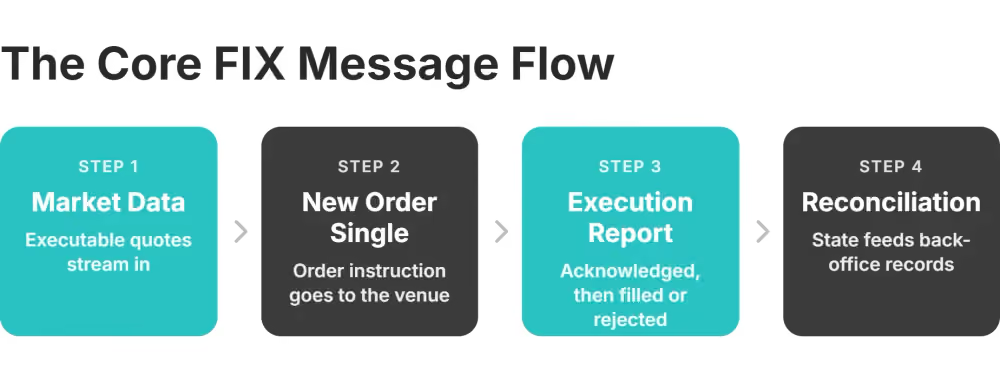
When your order state matches the provider's, the downstream feed into B2CORE or an external reporting engine stays reliable.
Where Liquidity Providers Sit: Banks, Non-Bank Market Makers, and Prime-of-Prime
Three groups supply the quotes behind a FIX session:
- Tier-1 banks price at scale and carry the credit relationships, dealing directly only with hedge funds and other counterparties above high capital and volume thresholds.
- Non-bank market makers compete on pricing technology, with deeper books in specific instruments and last-look behavior you only see in production.
- Prime-of-prime firms maintain upstream relationships with prime brokers and resell that access to financial institutions that cannot meet direct thresholds.
Mid-size brokers usually reach tier-1 pricing through a prime-of-prime relationship , because direct prime brokerage carries entry requirements that only the largest firms meet .
Direct FIX Connections vs. a Managed Liquidity Bridge
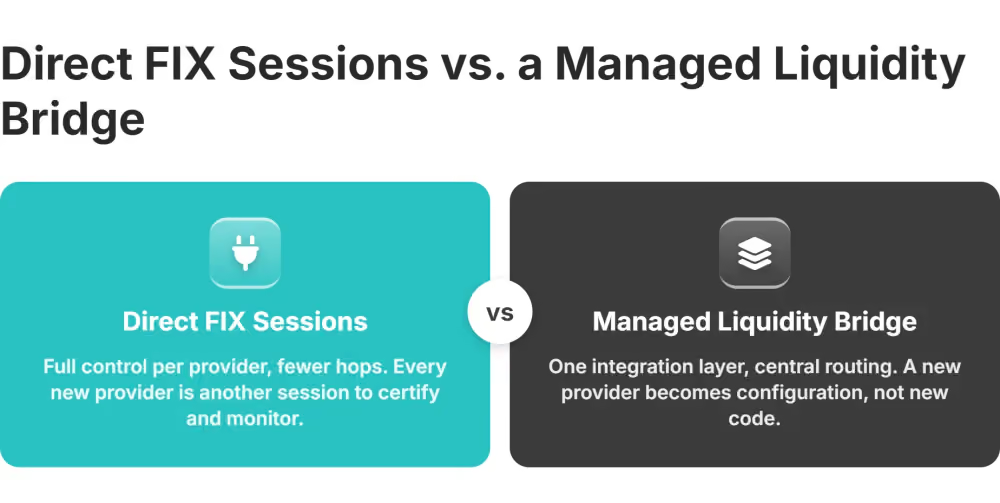
Direct sessions and a managed bridge solve the same connectivity problem, with costs that grow differently as you add providers. A direct connection removes the intermediaries between you and one provider, while a bridge cuts the integration work that every additional provider brings.
Which one fits depends on your growth stage, your asset mix, and how many engineers you can afford to keep on connectivity maintenance.
Direct market access can matter to high-frequency trading (HFT) and other algorithmic trading desks that need ultra-low latency. A managed bridge can still support STP, but the broker must measure the extra hop on its own order flow.
The Operational Cost of Managing Multiple FIX Sessions
The workload behind a direct session rarely appears in the provider's pitch. Every connection you sign brings:
- session authentication and heartbeat monitoring that run continuously
- version mapping and re-certification whenever either side upgrades its FIX dialect
- failover logic your team builds and then tests against real outages
- schema changes that arrive on the provider's schedule and force immediate remapping
Multiply that workload by every direct relationship. A launch into a new market now waits on certification cycles. Meanwhile, the engineers who should be building product spend their sprints keeping sessions alive.
What a Liquidity Bridge Consolidates and Why It Matters at Scale
A liquidity bridge replaces per-provider integrations with one layer. It holds each session, normalizes each provider's dialect, and applies your routing rules centrally.
At scale, onboarding a new provider becomes configuration instead of a project. When a provider changes something mid-relationship, the bridge absorbs most of the change before it reaches your codebase.
One normalized stream is also what post-trade automation needs downstream. A trading platform such as B2TRADER consumes that same feed instead of one per provider.
FIX API Connectivity Across FX and Crypto Markets
FX runs on FIX conventions that three decades of institutional trading have tested and settled. Crypto skipped that consolidation. Venues trading cryptocurrencies mix FIX with a REST API or WebSocket feed, and the market trades around the clock, with no weekend close for maintenance.
The October 2025 flash crash forced around $19 billion in liquidations across crypto derivatives venues in a day — a spike of that size reaches every venue connection at once.
Running FX and crypto side by side brings routine frictions. Liquidity thins over weekends while client positions stay open. Even EUR/USD can use a different symbol across venues, so quotes need normalizing before aggregation.
A broker may route forex trading from MetaTrader and equities or CFDs from cTrader into the same liquidity layer. Because perpetual futures feeds often arrive over venue-native APIs, a FIX-only stack still needs separate adapters for those feeds.
Those protocol and trading-hour gaps make evaluating crypto liquidity sources a separate exercise from vetting FX counterparties.
Execution Quality Metrics That FIX API Connectivity Directly Affects
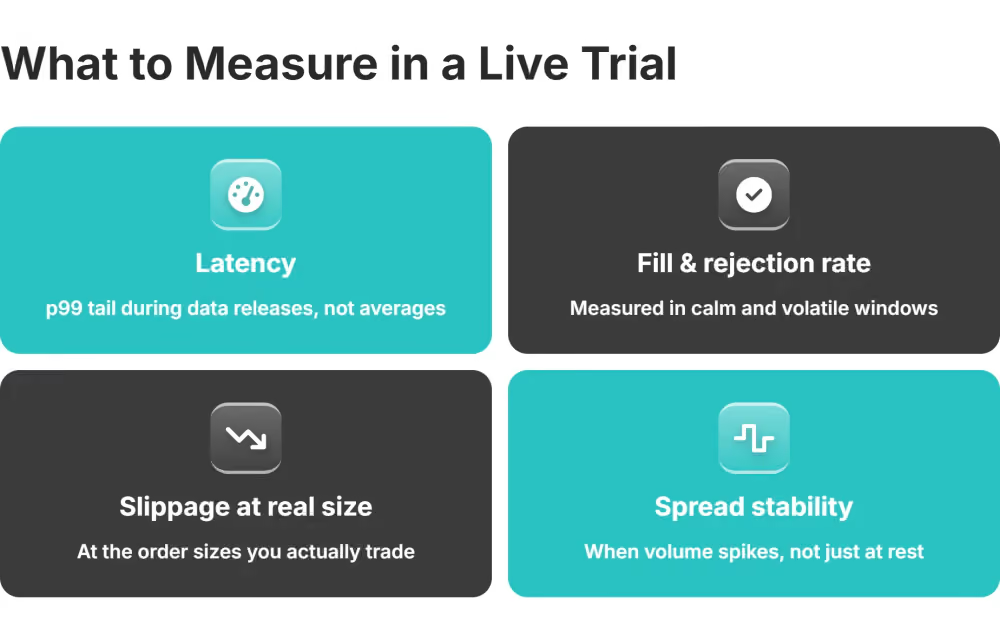
Connectivity choices show up in numbers you can collect. Before committing to a FIX API liquidity provider, pull the same short scorecard from every candidate:
- p99 response times during data releases, where an average latency figure hides the slow moments
- fill rate and rejection rate, measured separately in calm and volatile windows
- slippage against the quoted price at the sizes you actually trade
- spread stability and quote-to-fill consistency when volume spikes
For regulated brokers, the same data doubles as compliance evidence. MiFID II expects a firm to monitor and document the execution quality it delivers across venues. Timestamped FIX execution reports are a core input to that review.
How B2CONNECT Solves the FIX Connectivity Problem for Multi-Asset Brokers
You do not have to build that bridge yourself. B2BROKER's version is B2CONNECT , a crypto-native liquidity hub that runs the provider sessions and delivers one aggregated feed to your platform.
Your team integrates once. A new liquidity source after that is enabled inside the hub, with no fresh certification cycle on your side.

Negative Spread Filtering and Liquidity Distribution Optimization
Aggregation brings a failure mode of its own. A provider can briefly stream a bid above another provider's ask, usually because one feed went stale.
Routing without a filter treats the crossed prices as the best quotes in the book. Fills then price off the distorted quote, widening the broker's exposure with each order sent there.
B2CONNECT filters negative spreads at the connectivity layer. Distorted quotes stay out of the book your clients trade against, which is also the book its routing distributes orders from. The June 2025 B2CONNECT update rebuilt that FIX integration and improved how liquidity is distributed across sources.
Ecosystem Integration: B2CONNECT, B2TRADER, and B2CORE in a Single Stack
In a single-vendor stack, the order path runs through three connected systems. Quotes arrive through B2CONNECT already aggregated and filtered, which is what B2TRADER routes against and records as trades. B2CORE then picks those results up for client reporting and operational oversight.
One vendor builds and tests all three systems together. That gives you a single escalation path when something breaks, and releases that do not drift apart.
How to Choose Between Direct FIX and a Managed Bridge
Pick the architecture that improves your measured execution without growing your maintenance load. Building the sessions in-house fits a forex broker with a large engineering team and a short, stable provider list.
Whichever way you reach each FIX API liquidity provider, run the scorecard above during a live trial before committing. Retail brokers should also test whether the setup supports order flow from a white label platform and regional products such as spread betting.
The partner behind the bridge deserves as much scrutiny as the architecture. B2BROKER has been building brokerage infrastructure since 2014 and has helped launch more than 500 brokers. Over 1,000 corporate clients run on that infrastructure today.
If you are weighing a build against a bridge, size the decision against the number of provider sessions you expect to be running in two years.
Frequently Asked Questions about FIX API Liquidity
What is a FIX API liquidity provider?
A bank, non-bank market maker, or prime-of-prime firm that streams executable quotes and accepts order flow over the FIX protocol.
How do brokers connect to multiple liquidity providers using FIX API?
The common pattern is a liquidity bridge that holds one session per provider and merges their prices into a single book behind one integration. Direct sessions to each provider also work, at the cost of maintaining every connection separately.
What is the difference between direct FIX connections and a managed liquidity bridge?
A direct connection leaves your team responsible for every provider session it opens, for as long as that session runs. A managed bridge such as B2CONNECT takes that ownership over and applies routing and risk controls centrally, which scales better as providers multiply.
How does FIX API support best execution and compliance?
FIX execution reports carry timestamps and order state, the inputs you need to measure latency, slippage, and fill rates per venue. Kept venue by venue, those measurements are what a MiFID II best execution review asks you to show.
How do I evaluate a FIX API liquidity provider for my brokerage?
Test quote quality, rejection behavior under volatility, and session stability during a live trial, then weigh how much integration work the connection adds to your stack. If you already run the B2BROKER trading platform and back office, native connectivity through B2CONNECT shortens deployment and keeps quote and execution data on a single integration path.
Recommended articles

Subscribe to our newsletter