How Fast Can You Actually Launch a Crypto Exchange?

The fastest path to launch a crypto exchange runs about four weeks; the slowest runs past a year. Which end you land on comes down to one decision you make before any code is written: build the infrastructure yourself, or deploy a stack that already exists.
That decision matters more now because trading volume is consolidating onto a handful of incumbent centralized exchanges (CEX). A late entrant has to pull flow away from venues that already own the liquidity, and the longer you wait, the more entrenched that lead becomes. Opening earlier means competing against a shallower head start.
By the end you'll know what each launch path costs in time and money, and exactly what has to be in place before you can legally take a deposit. The figures below come from live deployments, including the 500-plus brokerages B2BROKER has helped bring to market.
Key Takeaways
- A turnkey white-label stack reaches go-live in roughly four weeks, while a custom professional exchange runs $150,000 to $400,000 and takes several months to over a year.
- Your licensing jurisdiction sets both timeline and locked-up capital: Panama registers a non-fiat operation in a week or two, a Seychelles VASP runs $25,000 to $150,000 in capital over 7 to 9 months, and full EU MiCA authorization clears a higher bar.
- Custom and open-source builds look cheap upfront and get expensive after launch, once security, liquidity, and ongoing engineering reach the budget.
- Compliance has to work on day one: KYC, AML screening, and the FATF Travel Rule all apply before the first deposit.
- A single-vendor stack removes the integration seams between the matching engine and the back office that stretch multi-vendor launches into extra months.
The Case for Launching Fast
Every month before go-live is a month of zero fee revenue against a fixed burn. It also cedes ground in a market that rewards incumbency: the top dozen exchanges cleared nearly $21 trillion in spot volume in 2025, and that flow keeps pooling on the venues that already have depth. Liquidity attracts liquidity, so a book that opens earlier keeps drawing the trades that make it deeper still.
That makes the timing of a launch matter as much as its execution. A book that opens six months from now has to win traders away from exchanges that spent those months building depth and tightening spreads. The earlier you enter, the less entrenched the market you're up against, and the less you have to spend pulling volume your way.
Three Launch Pathways Compared
Three routes lead to a live exchange, and they differ most in the months you spend before revenue starts. Each builds a centralized exchange, the CEX model this guide follows, rather than a decentralized exchange (DEX) running on blockchain smart contracts. A step-by-step launch guide covers the full sequence; this section focuses on the trade-off that sets your timeline.
Custom Development: Full Control, High Cost
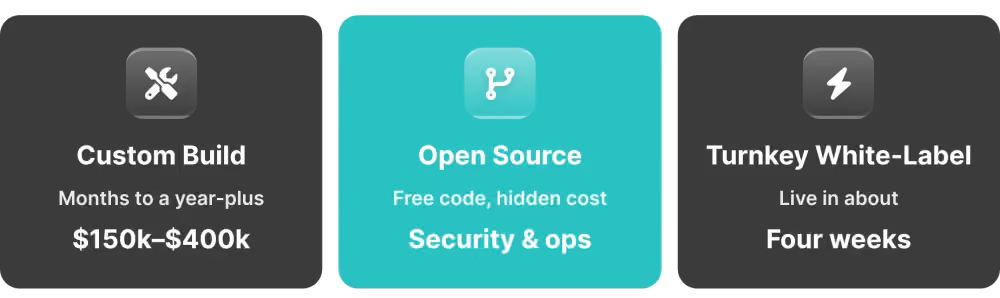
Custom cryptocurrency exchange development gives you control over every component, from the matching logic to the blockchain-based custody model, and it carries the highest price of the three routes. A hand-built matching engine has to clear orders at volume without adding latency, which is one of the harder parts to get right. A professional-grade centralized exchange with real liquidity and working compliance runs $150,000 to $400,000 and takes several months to well over a year to build and secure.
The part most teams underestimate: the cost after launch. The engineers who built the platform stay on the payroll to keep patching and scaling it as volume grows, so the spend never really stops. Security audits are their own recurring line: a production exchange usually needs two or three independent review cycles before launch, each running a few weeks, and a serious finding late in the process pushes the launch date out again.
Open-Source Platforms: Low Cost, High Overhead
An open-source codebase drops the upfront license to near zero, which is why it looks right for a tight budget, and the cost moves rather than disappears. You inherit code your team did not write and now has to secure, and public exchange software is a standing target for attackers probing known weaknesses. Reaching production still demands liquidity and a full compliance layer the free code leaves out, so the real bill arrives as engineering months and operational risk.
There is also an upgrade treadmill, because every upstream patch has to be reviewed, tested against your own changes, and redeployed, so the engineering time the free license seemed to save keeps getting spent after go-live.
Turnkey White-Label: Speed and Institutional Grade
A turnkey white-label stack resets the trade-off by shipping the hardest components already built and connected, so a production platform can go live in roughly four weeks instead of several quarters, the shortest time-to-market of the three. Tiered pricing starts in the low tens of thousands and scales as you switch features on, which keeps entry cost predictable against a custom build's open-ended figure.
This is the route the rest of this guide follows, because it is the one that answers the speed-and-budget question in the title.
What a Fast Launch Actually Requires
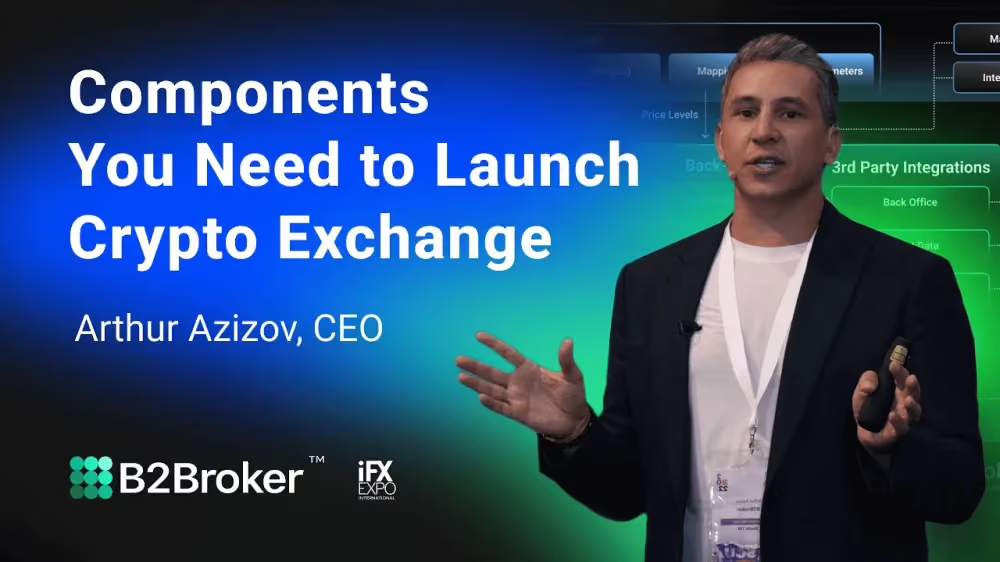
A fast launch is not one purchase. The technology stack is four systems that have to go live together: the trading engine, liquidity, compliance, and the client back office. Two of them set your timeline more than the rest, so start with licensing and compliance infrastructure.
Licensing and Jurisdictional Selection
Your choice of jurisdiction can swing your launch date by months and your locked-up capital by six figures:
- Panama: a non-fiat operation registers in a week or two, with no statutory capital minimum.
- Seychelles (VASP): $25,000 to $150,000 in capital depending on license class, over 7 to 9 months.
- Cayman Islands and BVI: no statutory minimum capital at all.
- EU (MiCA): the strict end. MiCA authorization became mandatory on July 1, 2026, only about 210 firms across the bloc have secured full authorization so far, and operating unlicensed risks fines up to €15 million or 10% of annual turnover.
Pick the jurisdiction that matches the markets you actually plan to serve, because it sets the compliance bar every later step inherits. Banking access matters as much as the license itself: an offshore registration that no payment partner will support leaves you licensed on paper but unable to move client fiat, which is why the cheapest jurisdiction is rarely the one that lets you operate.
KYC, AML, and Back-Office Infrastructure
Compliance has to run from the first deposit, and by 2026 that means three things live on day one: identity verification, real-time transaction monitoring, and the FATF Travel Rule , which now operates in 40 of 138 jurisdictions and shares sender and recipient data on transfers above roughly $1,000 to $3,000.
This no longer has to be slow. Automated KYC has cut onboarding cost by up to 90% and verification time to under ten seconds. What you cannot do is add it later: a back office that stores identity records, balances, and audit trails has to be wired in before you take a client.
B2BROKER's Crypto Exchange Turnkey
A turnkey stack only saves time if its parts arrive already integrated, and that is where an institutional-grade solution such as B2BROKER's Crypto Exchange Turnkey fits the four-week path described above.
What the Ecosystem Includes
The stack ships as one connected package rather than a set of vendors you wire together yourself:
- B2TRADER : the multi-asset trading platform that runs the order book and matching engine
- B2CORE : the CRM, client cabinet, and back office, with KYC, user authentication, and AML built in
- B2BINPAY : payment processing for digital assets across major blockchain networks and fiat rails
- Integrated liquidity : pre-connected order flow, so the book has depth on day one
Because these pieces are built to work together, you skip the integration months a multi-vendor assembly spends making systems talk to each other. The B2CORE backend surfaces real-time dashboards for every core metric, so operators track volume, exposure, and onboarding functionality from one screen.
Integrated Liquidity via B2BROKER Infrastructure
Liquidity is the piece most new exchanges underestimate, and sourcing it alone costs $150,000 to $500,000 in the first year. Rather than negotiating market-maker deals one at a time, a connected stack aggregates order flow through a single integration, so a new venue opens with tight spreads and real depth instead of an empty book that scares off the first traders.
Deployment Timeline: Phase by Phase
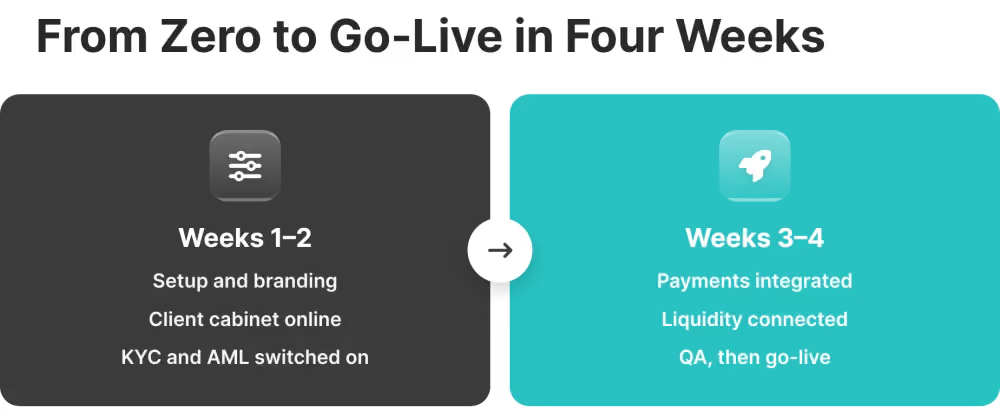
The four-week figure is not marketing; it breaks into two two-week phases with clear go/no-go points.
Weeks One and Two: Setup, Branding, and KYC
The first two weeks stand up the parts that do not depend on live market data. You configure the platform and apply white-label branding across the front-end, connect the B2CORE client cabinet, and switch on KYC and AML workflows against your compliance frameworks so onboarding is compliant before a single account opens. By the end of week two you have a working crypto platform that can register and verify a client.
Weeks Three and Four: Integration and Go-Live
Weeks three and four connect the exchange to money and markets. You integrate payments through FIX 4.4 or REST API, link B2BINPAY for deposits and withdrawals, and run QA against live conditions before the go-live checkpoint. Nothing reaches production until fills, funding, and reporting all reconcile against test data. When a check fails at that gate, the fix happens before launch rather than in front of live traders, which is the whole reason the review sits as a hard go/no-go rather than a formality.
Total Cost of Ownership Breakdown
The launch price is only part of the number. Total cost of ownership splits into what you pay to go live and what you pay every month after.
Software, Licensing, and Compliance Costs
Upfront cost concentrates in three places:
- Platform: from the low tens of thousands on a white-label tier to $150,000-plus for a custom build.
- Licensing capital: anywhere from near-zero to six figures, depending on the jurisdiction you picked above.
- Compliance tooling: its own setup bill, around $20,000 to $60,000 in a market like Turkey.
Read together, these explain why the cheapest headline license rarely means the cheapest launch.
Liquidity and Ongoing Operational Expenses
The recurring costs decide whether the exchange stays profitable. Liquidity leads at $150,000 to $500,000 in year one, compliance monitoring runs on the order of $5,000 to $10,000 a month in a mid-cost jurisdiction, and engineering, hosting, and support continue for as long as the venue operates. A turnkey stack folds most of these into one predictable vendor relationship. Headcount is the cost that outlasts the rest: a turnkey exchange still needs compliance and support staff, but a custom build adds the engineers who wrote the platform and cannot step away without taking system knowledge with them.
Why B2BROKER Accelerates Your Launch
Launch speed comes down to how many moving parts you have to coordinate, and sourcing them from one provider changes that math.
Single-Vendor Stack vs. Multi-Vendor Complexity
The single biggest time sink in a multi-vendor launch is integration, and a single-vendor stack removes it. When the matching engine, payments, compliance, and liquidity come from one provider, you skip the API reconciliation and supplier finger-pointing that stretch a multi-vendor build by months. You also get one team accountable when something breaks, which matters most in the first weeks after go-live, when every hour of downtime is lost volume.
Start Your Exchange with B2BROKER Today
The path from decision to live exchange can run four weeks on one integrated stack with one vendor to hold accountable, provided you pick the route that fits a speed-and-budget launch. A turnkey deployment gives you the matching engine, compliance, payments, and pre-connected liquidity without the year-long build or the multi-vendor drag.
B2BROKER built the Crypto Exchange Turnkey stack on the same liquidity and technology it supplies across the brokerage industry, the infrastructure behind the 500-plus brokerages it has helped bring to market. One provider stays accountable for the matching engine, payments, compliance, and liquidity well after go-live, which is where multi-vendor launches tend to strain.
Frequently Asked Questions about Launching a Crypto Exchange
What is the fastest way to launch a crypto exchange?
A turnkey white-label stack is the fastest route, reaching production in roughly four weeks because the matching engine, compliance, and liquidity arrive pre-integrated.
How much does it cost to launch a crypto exchange?
A white-label launch starts in the low tens of thousands, while a custom professional build runs $150,000 to $400,000 before liquidity and ongoing costs.
Is it better to build a crypto exchange from scratch or use a white-label solution?
Building from scratch is worth it only when you need control no existing stack offers and can fund a year-plus of development; for a speed-and-budget launch, white-label wins on both time and cost.
What licenses and compliance tools do you need before going live?
You need a license matched to your markets, from a Panama registration to full MiCA authorization, plus KYC, AML monitoring, and FATF Travel Rule support running before the first deposit.
How do new crypto exchanges get liquidity at launch?
Most connect to aggregated liquidity or market-maker partners through their platform provider, which delivers order-book depth from day one at a typical first-year cost of $150,000 to $500,000.
Recommended articles
Subscribe to our newsletter