The Importance of CRM Customization: Why One Size Fails Growing Firms

The importance of CRM customization becomes obvious at a predictable point in every brokerage's growth: onboarding slows to a crawl and client data scatters across disconnected systems, while compliance tracking migrates to spreadsheets because the CRM was never built for it. The system that worked fine at 500 accounts becomes a bottleneck at 5,000.
CRM customization means adapting customer relationship management software to match how a brokerage actually operates, from data structures to compliance workflows, instead of forcing teams into a rigid system designed for generic sales environments. According to industry data, 72% of active forex brokerages already use specialized CRM solutions, and the forex CRM market is projected to grow from $516 million in 2025 to $909 million by 2034 at a 6.5% CAGR.
Generic CRMs were not designed for multi-asset trading environments or KYC document management, let alone real-time margin monitoring. For brokerages spanning multiple jurisdictions and client segments, customization is a prerequisite for scaling without compounding operational risk.
This article covers why generic CRMs limit broker growth, what customization delivers in practice, and how to implement it safely.
Key Takeaways
- Generic CRMs create friction where brokerages need speed most: onboarding and compliance workflows across multiple platforms and jurisdictions.
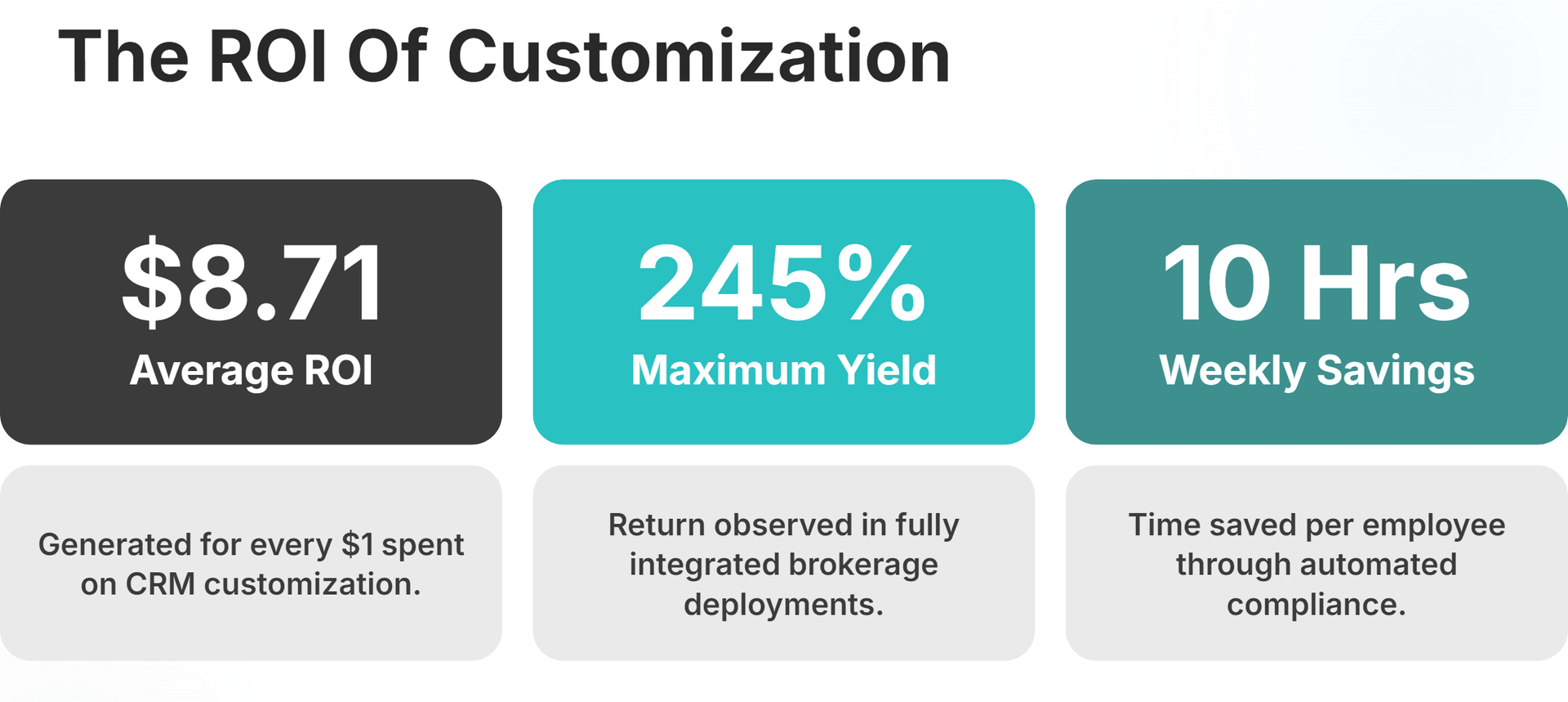
- CRM customization delivers measurable returns. Average ROI is $8.71 per $1 spent, with effective implementations reaching up to 245%.
- The highest-impact customization areas are onboarding workflows and MT4/MT5 integrations, supported by reporting dashboards and automated risk alerts.
- Warning signs that a CRM system needs customization include parallel spreadsheets, manual compliance tracking, and declining user adoption.
- Phased implementation with power-user validation protects the investment and ensures customizations address real workflow pain points.
Why Generic CRMs Limit Broker Growth
Off-the-shelf CRM software is built for general sales and marketing teams. These tools manage contacts and pipelines well, but they lack the architecture for jurisdiction-specific KYC workflows or real-time margin exposure monitoring. Brokerage business processes and compliance requirements differ fundamentally from generic sales environments, and a one-size-fits-all approach to CRM ignores that gap.
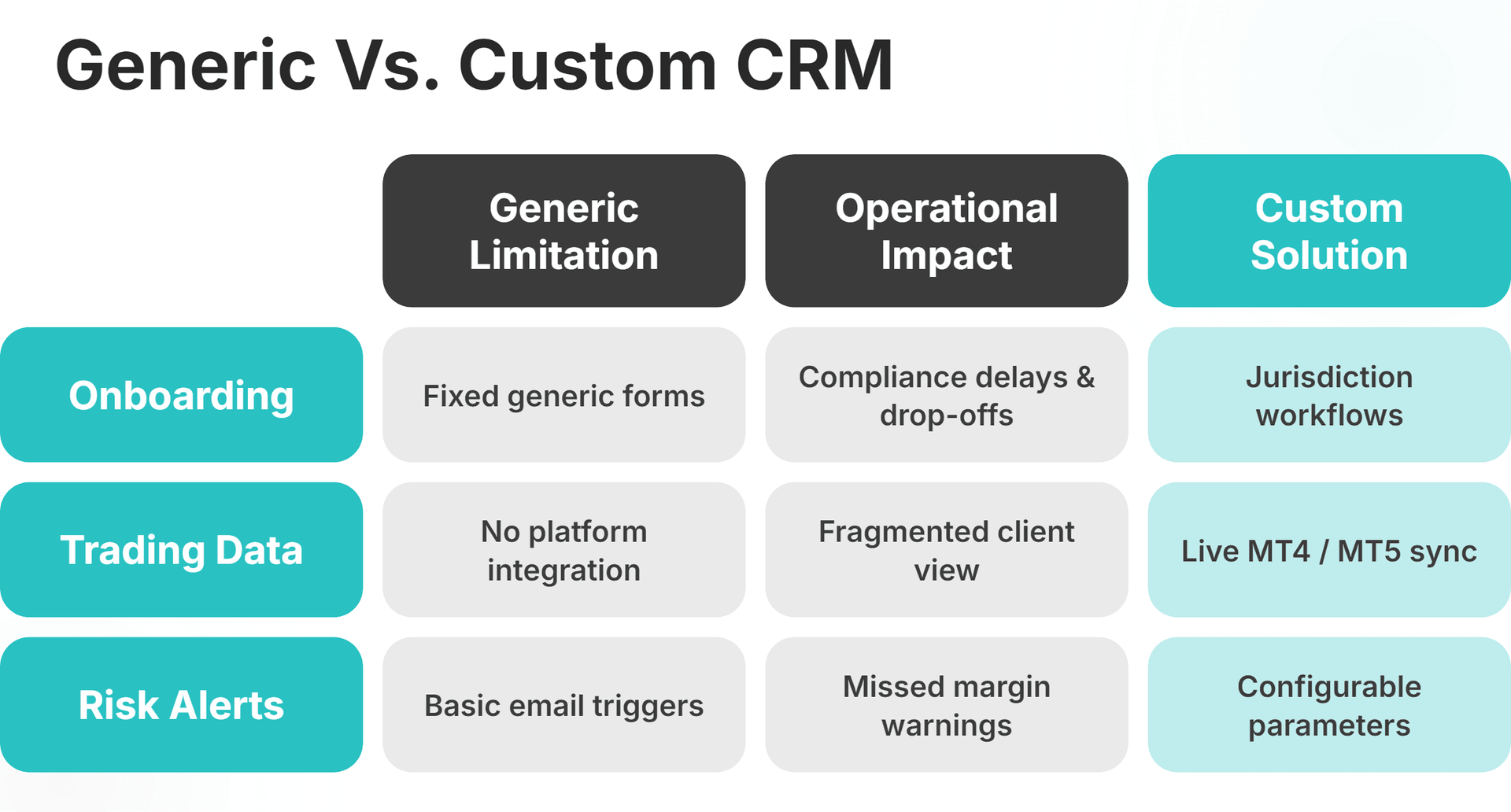
The friction points are predictable. Onboarding stalls when form fields miss regulatory requirements, and client data fragments when the CRM cannot pull live account status from MT4 or MT5. Compliance reporting becomes a manual exercise because the system was never built to track regulatory deadlines or generate audit-ready exports. At scale, these gaps become operational liabilities.
The compounding effect is what makes this a strategic problem. Choosing the right forex brokerage software early and ensuring it can be customized as operations grow is one of the most consequential infrastructure decisions a scaling brokerage makes.
Built for Brokers, Not Generic Sales Teams
B2CORE's deep customization tools let you configure onboarding, risk alerts, and client dashboards to match your brokerage's exact requirements.
Business Gains From CRM Customization
CRM customization is an investment with measurable business returns, well beyond its IT footprint. Average CRM ROI sits at $8.71 per $1 spent, with effective implementations delivering up to 245% ROI. Employees save five to ten hours per week through CRM-driven automation. For brokerages, those returns show up in specific operational outcomes that only a purpose-built CRM platform can deliver.
Tailored Workflows and Automation
Custom workflows eliminate manual handoffs and repetitive tasks. Automated assignment rules route new client inquiries by geography or account size immediately, replacing what used to be a manual step for account managers. KYC document requests trigger automatically by jurisdiction, follow-up sequences generate when verification stalls, and high-value client inquiries escalate before they go cold.
The result: time to onboard shortens, and operations teams shift focus from routine processing to exception handling. For a brokerage managing 1,000+ accounts across multiple trading platforms, that shift in workload has a direct impact on headcount efficiency and the overall customer experience. A custom CRM system that matches actual business processes also drives stronger user adoption, because teams use tools that fit how they actually work.
Integrated Risk Controls and Compliance
Custom CRM integrations embed compliance checks directly into daily workflows, making compliance part of the routine instead of a separate layer. Automated sanctions screening and jurisdiction-specific document requirements replace the disconnected spreadsheets that create regulatory exposure, while the system generates audit trails automatically.
For multi-region expansion, the stakes are even higher. Multi-jurisdiction compliance tracking breaks down at volume when handled manually.
A CRM with configurable compliance modules scales with client volume and adapts to new regulatory requirements without requiring a full system replacement. That flexibility is a key reason why premium CRM solutions save money for scaling brokers compared to bolt-on fixes. Custom CRM development in this area also protects data security by centralizing sensitive client information under a single governed system, eliminating the spreadsheet sprawl that creates exposure.
Multi-Asset Client Data Visibility
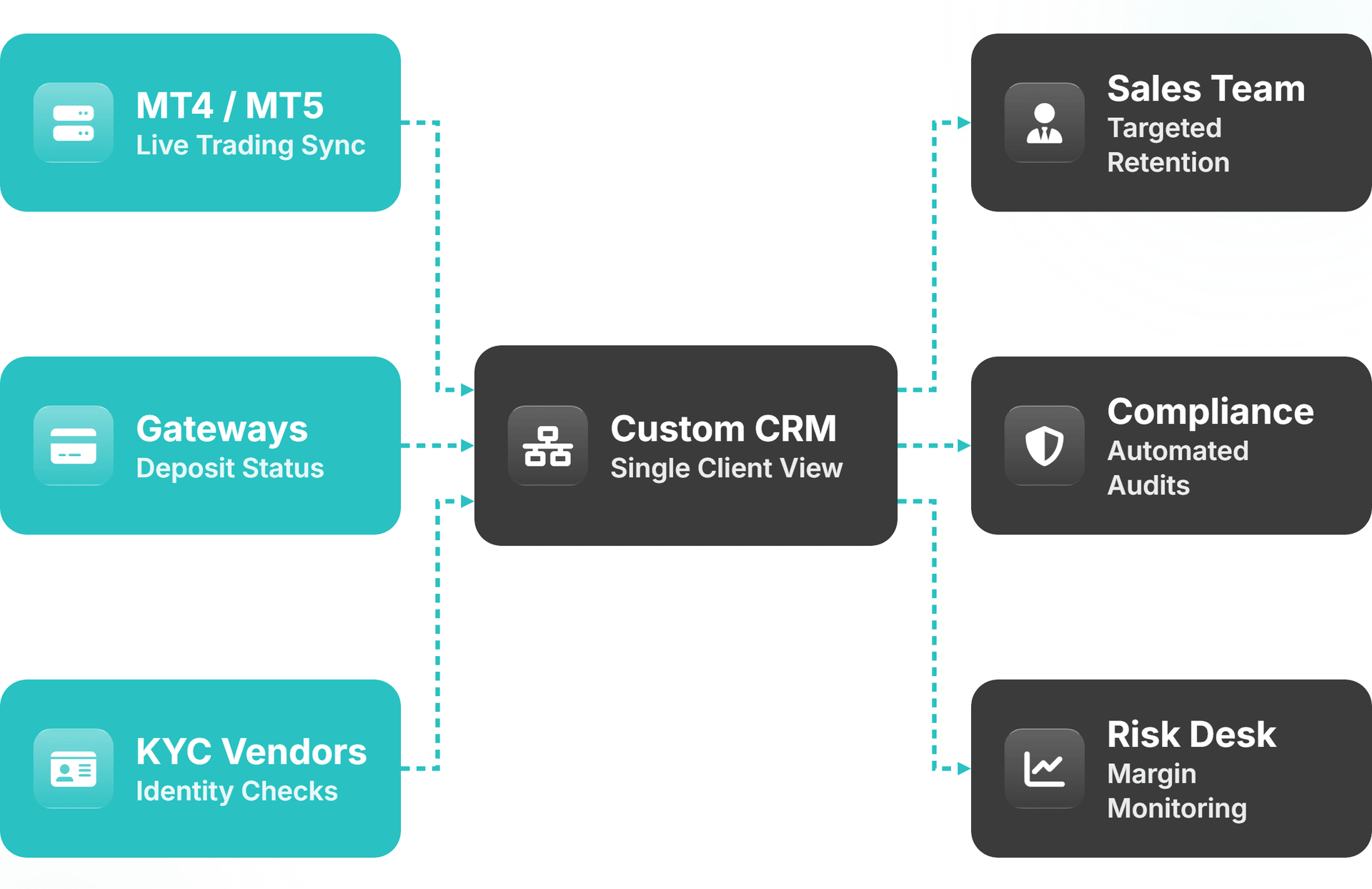
When CRM integrations surface live customer data from forex, crypto, and CFD platforms in a single client profile, account managers can assess activity and margin status alongside the full communication history without switching systems.
Segmentation becomes actionable: account managers can identify high-value clients for premium service tiers and flag at-risk accounts for retention outreach before they churn. Tracking customer behavior across asset classes and acting on it directly within the CRM is one of the clearest advantages of a purpose-built solution.
Core Areas to Customize in a CRM Platform
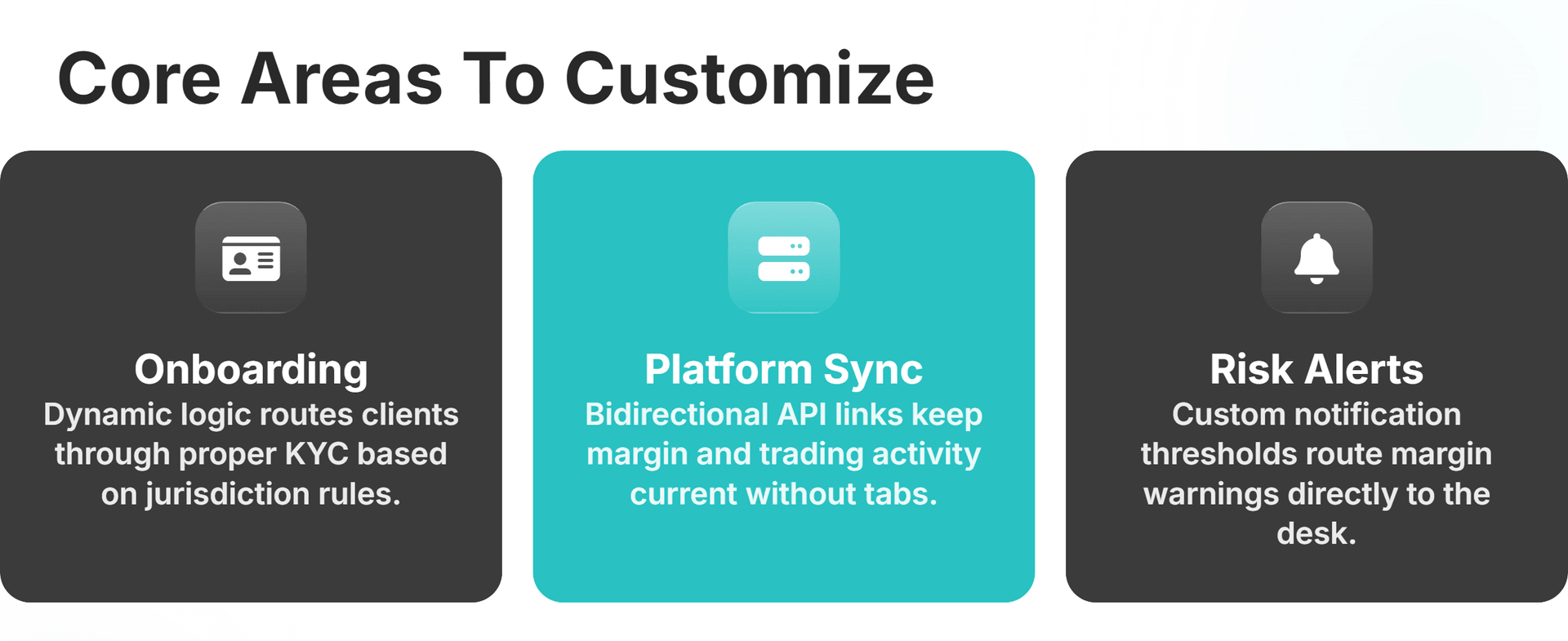
Some customization areas deliver significantly more value than others. These four consistently provide the highest return for brokerages and address the most common gaps in off-the-shelf CRM software.
Client Onboarding Journeys
Onboarding workflows should adapt dynamically to specific needs. High-risk jurisdictions may require additional verification steps, while pre-verified institutional accounts move through streamlined approval. Conditional routing handles the compliance logic without unnecessary friction. Custom fields and modular onboarding logic let brokerages configure the exact customer journey each client segment requires.
The business link is direct: faster time-to-fund and time-to-first-trade have a measurable impact on early customer retention, especially in competitive brokerage markets where clients expect rapid account activation.
Trading Platform Integrations
Bidirectional sync between the CRM and MT4, MT5, or proprietary platforms keeps account status and trading activity current alongside real-time margin data, all without manual reconciliation. When a client's margin utilization changes, the CRM reflects it immediately. When an account manager reviews a client, every piece of customer information is already in one place.
Integration depth varies significantly between CRM providers. Native connectors or robust APIs are a primary evaluation criterion. MT4/MT5 API connectivity has grown 40% year-on-year as brokerages increasingly treat platform integration as a core capability.
Reporting Dashboards and Custom Reports
Dashboards should surface role-specific metrics: operations teams track onboarding funnel velocity, compliance teams monitor KYC completion rates and expiry alerts, and executives review client lifetime value alongside regional performance breakdowns.
Custom reports segmented by client tier or region enable data-driven decisions and faster responses. Generic reporting that requires manual consolidation before it is useful signals a CRM that has outgrown its default configuration. Sales performance visibility across team members improves when reporting dashboards reflect actual business requirements.
Notification and Risk Alerts
Custom alert systems route notifications to the right team members when thresholds are triggered, from margin call proximity and expiring KYC documents to unusual activity in high-value accounts.
Effective alerts require mapping real business rules to system triggers. Configuring alerts that reflect actual risk tolerance and operational priorities goes well beyond enabling defaults. CRM functionality specific to brokerage operations pays for itself here through configurable modules that match the way a desk actually manages risk.
Stop Managing Compliance in Spreadsheets
B2CORE's configurable compliance modules automate KYC tracking, audit trails, and jurisdiction-specific workflows so your team focuses on clients, not paperwork.
Indicators Your Brokerage Needs a Customized CRM
If three or more of these apply, a formal customization assessment is warranted:
- Onboarding takes longer than competitors due to jurisdiction-specific manual workarounds
- Team members maintain parallel spreadsheets because the CRM does not capture or surface the necessary data
- Compliance relies on manual tracking outside the CRM, creating audit exposure
- Customer data lives in silos, requiring teams to switch between systems to build a complete account view
- User adoption is declining, signaling interface friction or misfit workflows
- Reporting requires manual spreadsheet assembly to answer routine executive questions
- Sales processes depend on workarounds rather than CRM functionality
Each indicator compounds at scale, and the earlier a brokerage addresses these gaps, the lower the cost of correction. A formal assessment before volume growth accelerates is significantly cheaper than remediation after it does.
Steps to Implement CRM Customization Safely
Rushed customization creates technical debt and user resistance. A structured approach protects the investment.
1. Map Processes and Data Flows
Document current workflows before designing changes: where customer data enters the system, how it moves between teams, and where manual steps slow it down. Cross-functional input from your team captures the full workflow picture and reveals business needs that a purely technical assessment would miss. The mapping stage also identifies which processes require custom development versus which can be addressed through configuration.
2. Prioritize Quick-Win Configurations
High-impact, low-complexity wins like automated notifications and role-specific dashboards build stakeholder confidence and demonstrate value before committing to complex integrations. Quick wins also surface workflow assumptions that more ambitious configurations should account for. A user-friendly implementation approach builds momentum and improves user adoption from the start.
3. Validate With Power Users
Piloting with experienced staff before full rollout exposes usability issues and training needs that technical testing alone will not catch. Structured pilot periods with defined success metrics yield more actionable feedback than informal testing. The pilot also ensures the user experience aligns with real team workflows, identifying mismatches between design assumptions and day-to-day operations.
4. Plan Ongoing Maintenance
Customization requires ongoing attention. Quarterly workflow reviews and annual compliance audits protect the time-to-value of the initial investment, backed by rapid-response protocols for integration failures. Marketing automation features and sales pipeline configurations also need periodic review as business growth shifts priorities.
All-In-One CRM & Back Office for Brokers and Exchanges
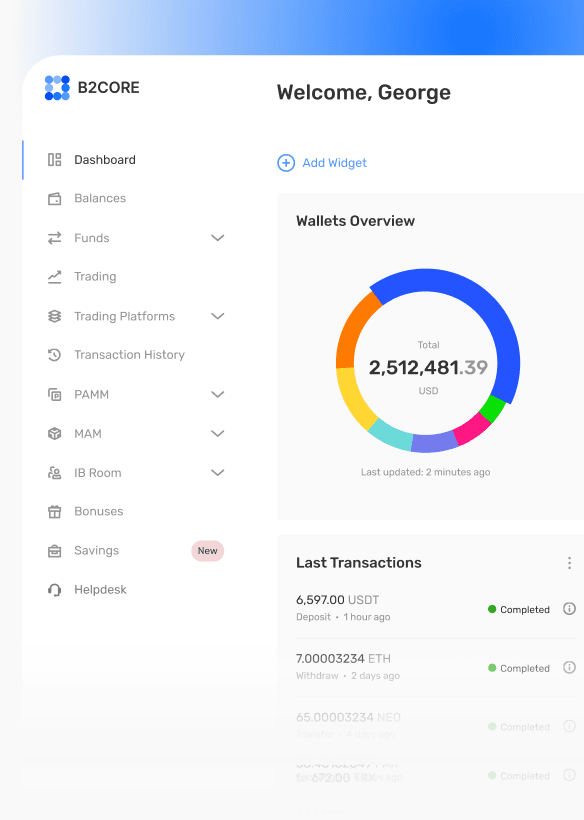
Fully Customisable Trader’s Room with Modular Features
Built-In IB Module, KYC, Payment Integrations, and Reporting Tools
Intuitive Interface that Boosts Client Engagement
Drive Growth With B2BROKER's CRM Customization Expertise
Growing brokerages cannot streamline operations on generic CRMs. Strategic customization improves operational efficiency and compliance posture while lifting client service outcomes at the same time. The ROI data support treating customization as a priority investment, well ahead of the scaling curve.
B2BROKER's B2CORE CRM platform is built for brokerage-specific requirements across multi-asset trading and multi-jurisdictional compliance, covering the full client lifecycle.
Its deep customization capabilities cover onboarding workflows and trading platform integrations alongside risk alert configuration and reporting dashboards, all designed around the operational realities of scaling brokerages. Pricing is structured for scalability, so brokerages pay for what they actually need at each stage of business growth.
An integrated approach, where CRM customization aligns with brokerage technology solutions and the broader liquidity and back-office infrastructure, reduces data fragmentation and gives teams the visibility they need to serve clients faster.
Scale Without the Operational Drag
B2BROKER builds custom CRM solutions for brokerages that need more than off-the-shelf CRM software can deliver.
Frequently Asked Questions about CRM Customization
- What is the difference between CRM customization and CRM configuration?
Configuration simply adjusts built-in settings like basic field labels or default workflows. Customization fundamentally modifies the software to handle unique brokerage processes like complex compliance rules and direct trading platform integrations.
- How long does CRM customization take for a mid-sized brokerage?
The timeline depends entirely on your project scope. Basic dashboard adjustments take just a few days, while deep MT4/MT5 integrations or multi-jurisdiction setups can require several months.
- Can CRM customization help with multi-jurisdiction compliance?
Absolutely. A custom CRM automatically enforces regional onboarding rules and tracks document expiration to keep you compliant as you expand into new markets.
- What are the risks of CRM customization?
The main risks involve uncontrolled scope creep and poor user adoption. You can easily avoid these pitfalls by mapping your exact processes first and testing modifications with your core team before a company-wide launch.