What Are the Real Sources of Liquidity for Brokerages?

In FX alone, a brokerage can pull pricing from more than 15 multi-dealer platforms and over a dozen non-bank market makers, by the BIS's count. Every one of those feeds is also an integration your team has to build and then keep alive.
So sourcing is never just a pricing question. The liquidity-provider agreements you sign shape execution quality on day one, and the integration model behind them shapes your engineering roadmap for years.
This guide maps the real sources of liquidity for brokerages and the operational overhead each one carries. It ends with an audit framework for deciding whether one Prime of Prime relationship can replace a shelf of direct connections.
Key Takeaways
- Brokerages draw liquidity from four source types: tier-1 banks, non-bank market makers, crypto-native exchanges, and Prime of Prime providers. Each comes with its own capital threshold and integration model.
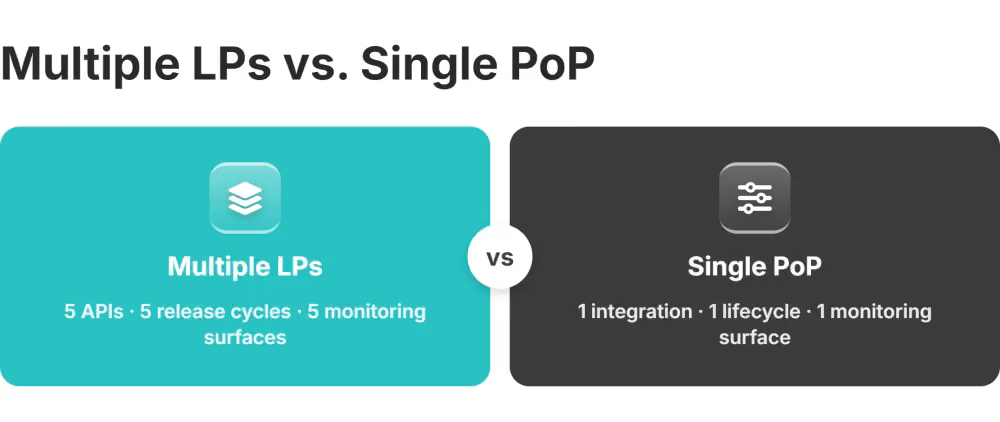
- Direct LP connections multiply quietly. Five providers put five independent API release calendars on your engineering team, and any one can break during a market stress event.
- A single PoP relationship consolidates tier-1 depth, multi-asset coverage, and connectivity into one commercial and technical arrangement.
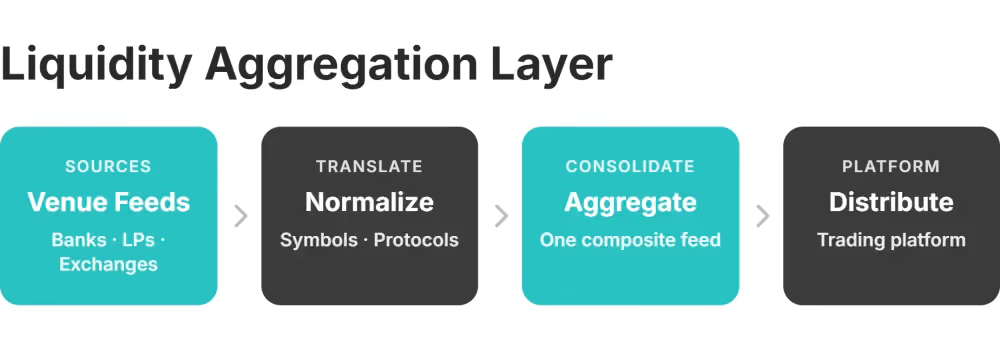
- Aggregated liquidity is only as usable as the bridge beneath it. Feed normalization and liquidity aggregation decide whether separate sources become one usable price stream.
- Before migrating off a multi-LP setup, audit every existing connection for protocol, latency, fill rate, and maintenance hours. That baseline is what the new provider has to beat.
What Liquidity Sources Mean for Brokerages
Where your quotes come from decides how your book behaves. When sourcing runs thin at size, client orders start filling away from the quote. Hedging gets more expensive at the same time, because your own fills degrade too.
The decision has two layers. The commercial layer is which counterparties you face. The technical layer is how their pricing physically reaches your platform. That second layer is where most of the long-term cost hides.
Market Liquidity vs. Funding Liquidity
Market liquidity is execution depth. It measures how close to the quoted price an order fills, through bid-ask spread, book depth, and fill rate. When it thins out, clients feel slippage and your hedges get more expensive.
Funding liquidity is different. It is your ability to settle obligations on time, from cash, marketable securities, and committed credit lines. The bills fall due whether or not your positions are winning.
That is why a broker can have deep market access and still get stuck. Tight funding caps how much client exposure the balance sheet can carry.
Supervisors treat the two as separate risk classes. The BIS Financial Stability Institute calls market liquidity risk the inability to trade at market prices without moving them, and funding liquidity risk the inability to meet cash obligations as they fall due.
They also pull sourcing in opposite directions. Market liquidity wants more depth per venue; funding liquidity wants fewer, larger relationships with negotiable credit terms.
The Taxonomy of Brokerage Liquidity Sources
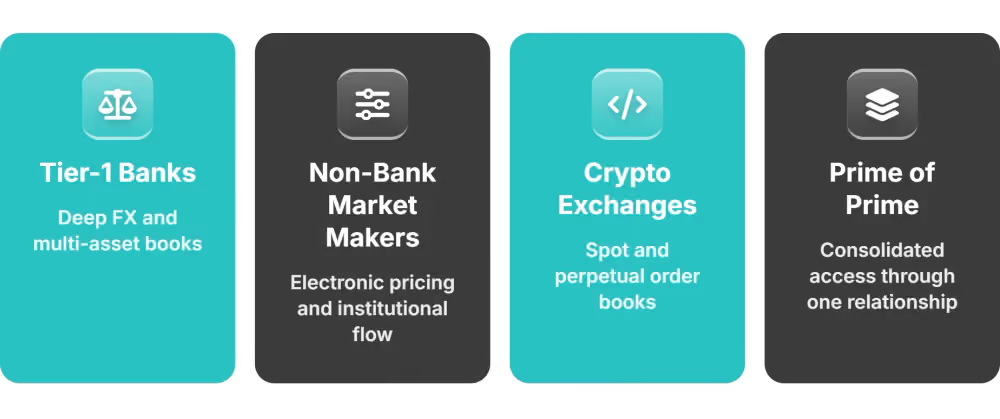
The primary sources of liquidity for brokerages sort into four types. Each type carries its own access threshold and its own integration model.
Tier-1 banks and non-bank market makers sit at the top of the depth curve in financial markets. Crypto-native exchanges hold most digital-asset volume, fragmented across CEX, DeFi, and OTC pools that rarely share infrastructure. Prime of Prime providers repackage access to all of the above.
Tier-1 Banks and Prime Brokers
JPMorgan, Deutsche Bank, Citi, UBS, and Goldman Sachs run some of the deepest books in FX and multi-asset markets, and they are selective about who connects. Direct access can require substantial capital, bilateral trading documentation, and a credit line through a prime broker. Those credit terms may also tie your margin requirements to prevailing interbank funding conditions.
The integration is just as bilateral as the paperwork. Each bank relationship brings its own legal documentation and its own FIX session to build and certify, and nothing about that setup transfers to the next provider.
Non-bank market makers such as XTX Markets, Citadel Securities, and Virtu Financial compete with the banks on execution quality, often at lower access thresholds than a direct tier-1 prime relationship. The access pattern is still bilateral, though, so every added counterparty repeats the full onboarding cycle.
For a mid-sized broker or exchange, the math rarely works. The pricing at this tier is the best available. The cost of reaching it directly is carrying several unstandardized integrations, each with its own capital commitment and certification path.
Prime of Prime Providers
A Prime of Prime holds those tier-1 relationships itself and redistributes the access downstream. The PoP maintains prime brokerage agreements with one or more banks, then opens sub-accounts for a broker-dealer or exchange that does not meet the banks' direct-access thresholds.
The economics rest on segmentation. A PoP spreads its institutional access across multiple downstream clients, so each client can reach tier-1 depth without carrying the full capital commitment. One PoP contract can also replace several direct LP integrations.
The stronger argument is operational. A PoP hands you tier-1 depth and multi-asset coverage through a single technical connection, which means one counterparty to negotiate with and one integration to maintain.
Operational Costs of a Multi-LP Configuration
Running many direct LP connections costs more than the sum of the contracts, because integration overhead compounds with each added provider. The expense hides in engineering hours rather than invoices. That is why it rarely shows up in the sourcing comparison until the team is already saturated.
Every direct LP connection is an independent failure point, a separate versioning lifecycle, and one more monitoring surface your team owns around the clock.
API Maintenance and Version Drift
Each provider updates its API on its own schedule. When one does, your integration needs updated client libraries, a regression pass over the aggregation layer, and a validated redeploy. With five providers, that cycle runs five times on five calendars you don't control.
Teams under delivery pressure postpone these updates, and the postponement has a name: version drift. A deprecated API version misbehaves quietly during volatility, then gets cut off when the provider retires it.
Normalization adds a quieter layer of the same tax. Every LP streams prices in its own dialect, down to decimal precision, timestamp conventions, and symbol naming. BTCUSD, BTC/USD, and XBT/USD are three spellings of one instrument. The code reconciling those dialects, and the monitoring that watches each session, grows with every connection.
Single-PoP Model as a Strategic Choice
Consolidating onto a single PoP concentrates connectivity maintenance in one place. Execution quality then depends on how the PoP builds its feed.
How PoPs Aggregate Tier-1 Access
A PoP does not relay a single bank's quote. It assembles a composite feed from several tier-1 sources, taking the best available bid and offer across providers at each moment. The composite can preserve pricing availability when one provider's feed degrades.
The same logic carries extra weight in crypto, where no single venue holds the depth story. Coverage across BTC, ETH, and the major altcoins means facing several exchanges at once. Each of them ships its own API versions and rate limits. Crypto brokers often consider consolidated sourcing when they want to reduce that venue-by-venue maintenance.
The Connectivity Layer Makes It Work
A PoP relationship is only as good as the middleware underneath it. That middleware is the liquidity bridge. Depth from several sources becomes usable only if the bridge keeps translating and consolidating their feeds correctly under live load.
What a Liquidity Bridge Actually Does
A liquidity bridge is the middleware that translates order flow between your trading platform and external liquidity sources. In practice it carries a fixed set of jobs:
- Protocol translation. Converting platform-native messages into whatever each source speaks, typically FIX 4.2 or 4.4 or REST and WebSocket.
- Symbol mapping. Matching your instrument names to each provider's identifiers so orders land on the right book.
- Feed normalization. Standardizing symbols, precision, and timestamps across incoming price streams.
- Liquidity aggregation. Combining normalized feeds into one composite price stream.
- Position tracking. Keeping net exposure per provider visible for hedging and risk control.
Each item on that list is a requirement. A bridge that translates protocols but maps symbols poorly leaves your team reconciling mismatched instruments by hand. Skip position tracking, and risk management goes blind to per-provider exposure.
Liquidity Aggregation and Feed Consolidation
Liquidity aggregation takes normalized quotes from the connected sources and combines them into one composite stream. The aggregation layer keeps price levels comparable across venues in real time and exposes the available depth behind each quote.
Deep, aggregated liquidity pools become operationally useful through this consolidation. Without a common feed format, the broker sees separate venue streams; with aggregation, the platform receives a unified view of prices and depth across its connected sources.
How B2CONNECT Solves the Integration Problem
B2CONNECT is B2BROKER's crypto-native liquidity hub. It sits between venue feeds and trading platforms, so brokers can source and distribute liquidity through one connectivity layer instead of a separate build per exchange.
Native Integration With B2TRADER and B2CORE
B2CONNECT connects to B2TRADER , B2BROKER's multi-asset trading platform, over FIX, and sits in the same product stack as B2CORE , the back office and CRM. On the live product page, setup is framed as connector and configuration work rather than a custom integration project per venue.
Compare that with a generic third-party bridge attached to an unrelated platform stack, where every platform upgrade can reopen compatibility testing and regression work. Keeping liquidity connectivity inside the same vendor surface reduces that upgrade friction on the broker's roadmap.
Configuration Instead of Per-Venue Builds
For the venues and protocols supported on its live product page, B2CONNECT turns source onboarding into configuration work. Your team sets connectors, symbols, consolidation rules, and risk controls through the hub, avoiding a separate API build for each listed venue.
The scaling behavior is the point. A brokerage going from five sources to eight adds feed configurations behind one hub. The maintenance burden stays anchored to a single integration surface, so engineering capacity can stay on trading logic and client experience.
Technical Criteria CTOs Should Evaluate
Benchmarks and architecture should decide a connectivity agreement, not pricing or reputation. A weak provider shows its consequences only in production, after the contract is signed, during a liquidity crisis or a 2 a.m. flash move.
Latency Benchmarks and SLA Commitments
Request measured latency figures. The numbers that matter are quote response time, order acknowledgment time, and fill confirmation time. Each figure should use a stated measurement methodology, because a vendor left to choose will quote a theoretical minimum.
The gap between 99.99% and 99.9% uptime is 52 minutes versus almost nine hours of downtime a year. Neither figure binds anyone unless the SLA defines how uptime is measured and what a breach costs the provider. Also ask for mean time to recovery on LP reconnection events, since reconnection speed matters more day to day than baseline uptime.
Failover Architecture and Redundancy Design
Redundancy design decides whether execution continues when a liquidity source or a connectivity path drops. The questions worth asking a provider are concrete:
- Where do the primary and backup servers sit, and are the data centers geographically separate?
- What triggers automatic failover, and what requires a manual switch?
- What RTO and RPO targets do the documented procedures commit to?
Regulators now read those documents too. In May 2026 the Basel Committee put ICT risk management inside the operational-resilience agenda for banks . It binds banks and their supervisors, not brokerages, but it sets a useful benchmark. A connectivity provider should still be able to produce tested recovery metrics.
Migrating From Multi-LP to Single PoP
Migration is a sequenced audit-and-validation process, and coverage is the risk to manage. The consolidated configuration has to match or exceed the combined depth, asset coverage, and latency profile of the setup it replaces before any live client flow moves.
Preparation means knowing your current state precisely. Understanding how liquidity provision works at the operational level, from quote streaming to fill confirmation, turns the baseline from impressions into measurement. That same baseline feeds liquidity risk management after migration, giving the team thresholds for depth loss and funding pressure.
Auditing Your Existing LP Connections
Build the audit as one document per connection, covering:
- Protocol type and the API version currently running, which exposes accumulated version drift.
- Asset classes covered and typical order size ranges on each.
- Execution latency measured from your own infrastructure, since vendor-stated figures flatter the vendor.
- Fill rate at the requested price, broken down by asset class and order size.
- Monthly maintenance hours the integration consumes across updates, incidents, and monitoring.
- Commercial terms, including spread markup and minimum volume commitments.
- Funding terms, including collateral calls and repayment schedules.
The combined picture is your coverage baseline, and the candidate PoP has to clear it. Run parallel feeds from the existing providers and the candidate through a validation period. Then migrate one asset class at a time, so any coverage gap surfaces on a contained slice of flow.
This staged cutover also gives forecasting and cash flow management teams time to test how the new margin cycle affects working capital.
Build a Smarter Liquidity Stack With B2CONNECT
Sources of liquidity for brokerages are an architecture choice before they are a vendor choice. Multiple LPs may improve depth and pricing redundancy, but that execution gain has to justify the maintenance burden attached to every connection. Effective liquidity management starts by making that trade-off visible.
A consolidated stack removes that overhead. B2CONNECT gives a brokerage one integration point into multi-venue crypto liquidity, with FIX connectivity into B2TRADER and a place in the wider B2BROKER stack alongside B2CORE. The operational gain is fewer venue-by-venue builds, and one surface to monitor when sources change.
If a sourcing change is on your roadmap, start with the audit, then test the consolidated model against your baseline.
Frequently Asked Questions About Liquidity Sources
What are the main sources of liquidity for a brokerage?
Brokerages source pricing from tier-1 banks, non-bank market makers, crypto-native exchanges, and Prime of Prime providers. The workable mix depends on your asset coverage needs, typical order sizes, and how much integration overhead your team can carry.
What is the difference between a liquidity provider and a Prime of Prime?
A direct provider, especially at tier-1 level, requires bilateral credit agreements and capital commitments that exclude most mid-sized brokers. A Prime of Prime holds that tier-1 access itself and redistributes it through one commercial and technical relationship with a far lower entry threshold.
Is it better for a brokerage to connect to multiple LPs or one PoP?
Multiple direct connections buy pricing redundancy at the cost of parallel API lifecycles and monitoring surfaces that compound as the count grows. For most mid-sized operations, one PoP relationship delivers comparable execution depth with a fraction of the integration burden.
How do brokerages aggregate liquidity from different providers?
Aggregation runs through a liquidity bridge, which normalizes every source's feed into one composite price stream with a unified view of prices and depth. Solutions like B2CONNECT handle protocol translation and symbol mapping centrally, so new sources plug in without per-source development.
What should a CTO evaluate before switching liquidity partners?
Audit every existing connection for protocol, measured latency, fill rate, and maintenance hours to establish the coverage baseline a new provider must beat. Then hold the candidate to documented SLA methodology, failover architecture, and tested recovery targets, since regulators now expect operational resilience too.
Recommended articles
Subscribe to our newsletter