What Is Trade Reconciliation for Multi-Asset Brokers?

Trade reconciliation is the check that the fills, positions, and cash in your records match what your counterparties recorded. A multi-asset broker runs it against several at once: MT5* shows a fill, the liquidity provider confirms a different quantity, and a crypto wallet posts the funding an hour later.
Settlement risk shows what rides on those records. In April 2025, $1.4 trillion a day settled on a gross bilateral basis in the FX market, fully exposed to one side failing to pay. A quarter of that amount could have settled with protection and did not.
Key Takeaways
- Reconciliation confirms that your internal trades, positions, cash, and fees agree with what your counterparties and payment rails recorded.
- Breaks cluster at the seams between systems: platform fills against LP confirmations, ledger timing between asset classes, and fee or IB logic that runs apart from the trade.
- Every asset class you add brings another settlement rail, data format, and cutoff to match.
- T+1 settlement and next-day regulatory reporting leave an overnight batch only hours to fix what it finds, too little for anything but intraday exception handling.
- Automation scales through rules and APIs: normalize once, match continuously, route exceptions to an owner, and keep the audit trail without adding headcount.
What Is Trade Reconciliation for a Multi-Asset Broker?
For a multi-asset broker, trade reconciliation means proving that your own record of a trading day matches the records of everyone else involved in it. The control has four matches:
- Trade-level: every fill on your platform has a confirmation from the liquidity provider or exchange that executed it.
- Position: your net exposure per instrument on the platform equals what each counterparty shows against you.
- Cash: client and house balances tie to the deposits, withdrawals, and P&L booked against them.
- Fee: every markup, swap, rebate, and commission matches the schedule you published.
Under MiFIR Article 26, an investment firm reports complete and accurate details of every reportable transaction by the close of the next working day. The technical standard under it makes firms reconcile their front-office trading records against the reports they filed, field by field.
A break found after that deadline sits inside the regulator's own records, where the only fix is a correction filing.
Where Do Reconciliation Breaks Happen in Brokerage Operations?
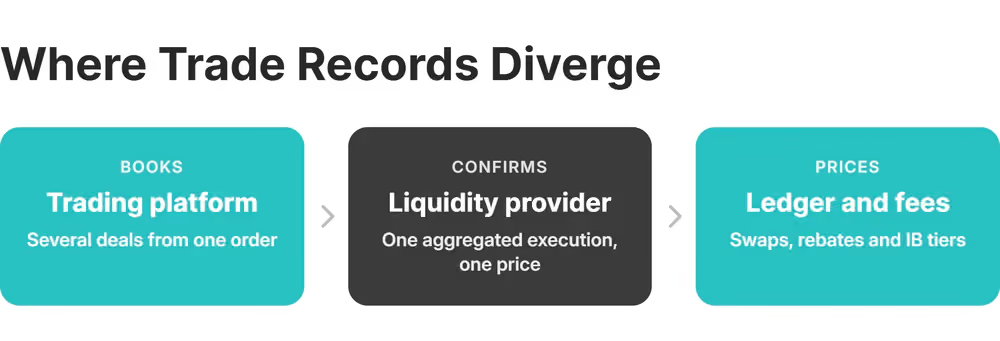
Reconciliation breaks happen at the seams of the trade lifecycle, where a trade leaves one system and is re-created in another. On a normal fill, there are three: the platform hands a fill to the liquidity bridge, the bridge's execution report reaches the ledger, and the fee engine prices what the ledger holds.
Mismatched Trade Reports Across MT4*/MT5*, LPs, and Exchanges
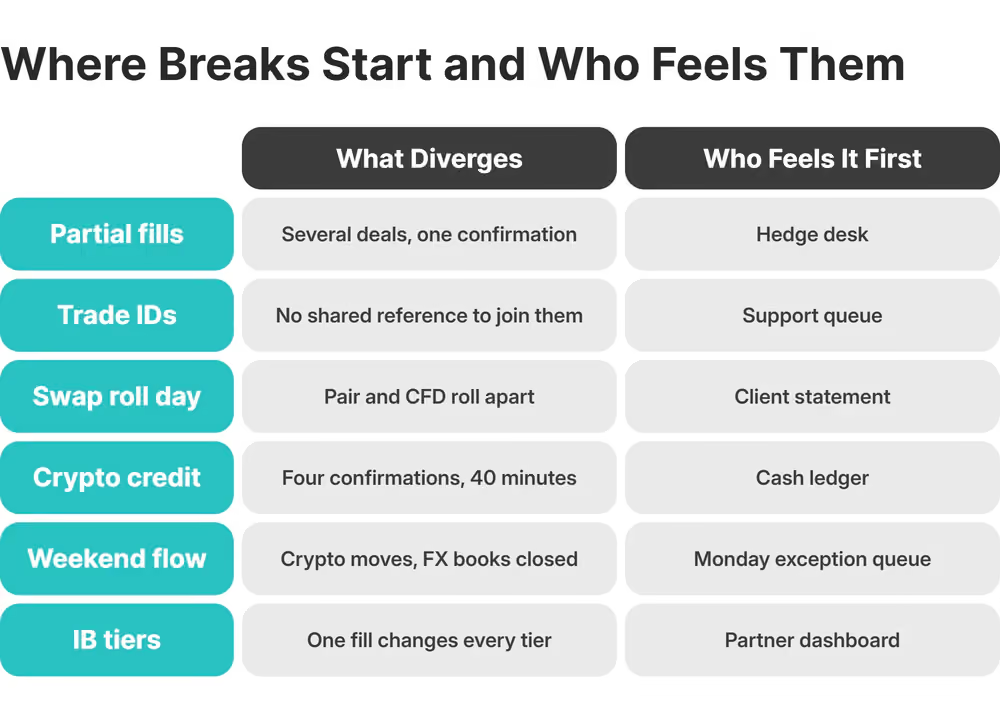
Mismatched trade reports arise when trade capture in two systems produces different IDs, times, symbols, prices, or quantities for the same fill. The most common case is the partial fill. Under the Immediate or Cancel fill policy , the platform takes whatever volume the market offers, often across several offers at different prices.
The provider confirms one aggregated execution at the average price, with no shared trade ID to join the two records. Until someone joins them by hand, those unmatched trades leave the hedge desk looking at exposure that may not exist.
Timing Gaps Across FX, Crypto, and CFD Settlement
Timing gaps appear when execution, booking, funding, and settlement reach your ledgers at different speeds, each asset class on its own clock.
In FX and CFDs, swaps post once a day at server rollover. A spot FX trade settles two business days out.
Hold a position over the night whose settlement date lands past the weekend, and the charge triples. With that three-day roll set per symbol , a currency pair and a CFD on the same server can roll on different days.
A Bitcoin transfer lands in a block within minutes. The exchange typically credits it only after four confirmations, about 40 minutes . Over the weekend, crypto keeps trading and moving between wallets from Friday close to Sunday open while the FX and CFD books stand still.
Fee and IB/Partner Payout Discrepancies
Spreads, swaps, rebates, and IB commissions run through separate engines that never check each other. A break in any of them distorts the trade economics. A swap charged on the wrong roll day or a commission tier applied to the wrong account group shows up weeks later as a variance against the LP statement or as a client refund.
IB payouts multiply the problem. In a multi-tier program, each level's reward is built from the volume below it, so one unmatched fill changes the payout of every partner above the client who traded.
When trade and partner data live in one system, the payout comes from figures the desk has already reconciled. B2CORE calculates partner rewards from B2TRADER trades over a shared data set and runs them daily or in real time.
Why Settlement Compression and Regulatory Pressure Raise the Stakes
The gap between a trade and the moment your books must be right keeps narrowing, which turns reconciliation from overnight housekeeping into an intraday control.
From 7 December 2026, allocations, confirmations, and the settlement instructions behind them have to go out on trade date. The EU, the UK, and Switzerland then move securities settlement to T+1 on 11 October 2027 . A break that the evening batch turns up has only that night to clear before it counts among the day's settlement failures.
Regulators have already folded reconciliation into risk management rules for derivatives, which include CFDs. Under EMIR, two financial counterparties with 500 or more OTC contracts outstanding reconcile every business day , weekly between 51 and 499, and quarterly below that. Every jurisdiction adds its own settlement cutoffs and reporting deadlines .
Manual Batch Processing vs Real-Time Automated Reconciliation
Every exception in manual batch reconciliation needs someone to open two reports and decide. That is where the time goes and where manual errors enter. Automated reconciliation scales on the rules your team maintains, not on headcount. Both run the same six steps, differing only in who performs each one and when:
- Ingestion and standardization: nightly extracts an analyst aligns by hand, versus records arriving over APIs against one schema.
- Matching: a lookup across two exports, versus a rule that fires per record.
- Exceptions and approvals: a morning list for the whole team and an email thread, versus a case in an owner's queue with a role-based sign-off recorded against it.
- Audit log: reconstructed for the auditor, versus written as the work happens.

When the US moved to T+1 in May 2024, same-day affirmation by the 9 PM cutoff rose from 73% in January to 94.55% by the end of May , because firms could no longer finish the work the next morning.
When the trading platform and the back office run on one record set, post-trade automation has nothing to re-enter.
In B2CORE, a transfer whose confirmation never came back from the platform sits in a Partial status , visible the same day, until an operator verifies the funds on MT5* or cTrader and closes it.
Turn Reconciliation into a Scaling Advantage, Not a Bottleneck
Treat trade reconciliation as infrastructure. Each new asset class, liquidity provider, partner tier, or jurisdiction is one more external record your books have to match.
A broker running batch jobs adds a person for every new source. A broker whose back office already holds client, trade, payment, and partner data only has to switch that source on.
B2CORE keeps the transaction ledger, the exception statuses, and the scheduled reports on balances, transactions, and IB partners in one place, so adding a source it already integrates is configuration work. It connects to MT4*, MT5*, and cTrader among its 150-plus ready integrations , and to B2TRADER through a pre-built connection.
The workflows above come from a partner that has built brokerage infrastructure since 2014, runs it for more than 1,000 corporate clients, and holds 10-plus regulatory licenses.
If your month-end still starts with two exports and a spreadsheet, that process is where your next asset class will break first.
Frequently Asked Questions about Trade Reconciliation
What data should brokers normalize before automating trade reconciliation?
Identifiers, timestamps, symbols, account IDs, quantities, prices, fees, swaps, and execution venues, mapped to one schema before matching starts. Crypto flows also need the wallet address, transaction hash, network fee, and confirmation status.
How often should brokers perform trade reconciliation?
Continuously for execution and cash events, with a formal end-of-day control review on top. Partner payouts can follow their own weekly or monthly schedule once you have matched the trades behind them.
What is the difference between trade reconciliation and settlement?
Reconciliation verifies that your trade, cash, and position records agree with your counterparties' records. Settlement is the transfer of cash or assets that completes the obligation. Breaks caught before the funding deadline are the ones that do not turn into settlement failures.
Which KPIs show whether trade reconciliation controls are working?
Track match rate, break aging, exception volume, manual touch rate, and resolution time by break category, and the reconciliation reports will name the recurring causes. A brokerage should add unmatched LP fills, wallet variances, and commission disputes per IB tier.
What should brokers evaluate before choosing trade reconciliation software?
Start with native connectivity to your trading platforms, LP feeds, payment rails, wallets, and CRM, then test rule-based matching with configurable tolerances, role-based approvals, and an audit trail that covers every instrument you list. B2CORE covers the connectivity and record-keeping side of that list, holding client, payment, regulatory compliance, and partner records in the system the reconciliation runs against.
Recommended articles


Subscribe to our newsletter