What Does It Really Cost to Start a Crypto Exchange?

Ask a development shop what a custom centralized exchange costs, and the answer comes back as $500,000 to $1.5 million and a 12- to 18-month build.
That quote covers the software alone. The costs to start crypto exchange operations also carry the license, the liquidity contracts and the compliance hires. Those arrive every year after launch.
This guide prices the two manual routes only: building from scratch and using a clone script. Blended ranges like $30,000 to $350,000 mix white-label pricing into the same figure and tell you nothing about either path.
Key Takeaways
- A manual build leaves licensing, liquidity and compliance staffing with the operator, making the software quote the opening line of a much longer budget.
- Building from scratch costs the most and takes the longest. A clone script launches in weeks and locks you into its template.
- Where you hire developers moves the build cost more than any other decision, with senior rates in 2026 differing roughly fivefold between the United States and India.
- License fees and locked capital arrive with every jurisdiction, and every liquidity provider is another contract. A white-label fee folds those liquidity connections into one line and leaves the license with you.
- Salaries, hosting and compliance renewals can pass the development spend by the end of the first year of operation.
How Do Manual Build Costs Compare With White-Label Alternatives?
A manual build makes you the owner of both the technology and the regulatory obligations of an exchange launch. A white-label deal puts the technology on a vendor's invoice.
Regulators treat the launch as a regulated activity regardless of who wrote the code. In the UK, the Cryptoassets Regulations 2026 bring exchange activity under FCA authorization from October 25, 2027, with the application window set to open on September 30, 2026. An existing money-laundering registration does not convert automatically. A manual build adds every post-go-live engineering problem to that timetable.
A white-label platform ships a tested back end with wallets, payment gateways and know your customer (KYC) checks already integrated, leaving your team with UI/UX design, configuration and the license itself. On that route, a platform reaches go-live in about four weeks at a price of its own. The rest of this article stays with the independent build.
Should You Build From Scratch or Use a Clone Script?
A scratch build buys control over the matching-engine logic and the architecture underneath it. That control costs more and takes longer than a clone script.
The type of venue sets the size of that bill before any code exists. A centralized crypto exchange (CEX) spends most of its budget on the order book, order matching and client custody. Move to a decentralized crypto exchange and the money shifts to smart-contract audits and seeding liquidity pools. A hybrid crypto exchange carries both bills.
How Much Does a Scratch-Built Exchange Cost?
The crypto exchange development cost of a scratch build runs $500,000 to $1.5 million or more over 12 to 18 months, the largest upfront investment and the longest timeline of any launch path.
Three components account for most of that figure:
- a matching engine, $20,000 to $50,000 for a basic build and $100,000 to $500,000 for one that clears tens of thousands of orders a second
- hot and cold wallet integration with multi-signature approval, data encryption and two-factor authentication on admin access, at $50,000 to $200,000
- independent security audits at $20,000 to $80,000, repeated after every major change
In labor terms, one vendor prices a 15-person build team at around $100,000 a month, or $1.2 million for a year of building before anyone has placed a trade.
How Much Can Clone Scripts Reduce Launch Costs?
A clone script cuts the upfront bill to $5,000 to $30,000 and the launch to one to three weeks. That speed costs you control over how the platform scales. Spot trading with limit orders comes standard, with margin trading and P2P platforms usually sold as paid modules.
The trading engine, admin panel and wallet layer arrive as one package, already sold to other operators. Find a vulnerability in one deployment and it may be sitting in every other instance of the same script. The license also rarely hands over the source outright.
Over three years the gap narrows. Vendor support and renewals run $3,000 to $10,000 a year, the audit the script never had costs $5,000 to $20,000 when a bank or a regulator asks for one, and a migration once the template is outgrown costs $50,000 to $150,000 or more.
How Do Development Team Regions Affect Exchange Build Costs?
After scope, where you hire your developers is the largest cost variable you control in a manual build, one a vendor's fixed price hides entirely.
A senior engineer billed through a vendor costs about $192 an hour in the United States, compared with $39 in India. On payroll the gap holds, with a fully loaded US engineer costing roughly 3.8 times the Indian one at the same seniority.
Team shape decides how much of that gap you keep. One US tech lead with a four-person pod in India runs $540,000 to $680,000 a year all-in, against $1.05 million to $1.45 million for the same five people hired entirely in the United States.
How Much Do North American and Western European Teams Cost?
North America and Western Europe carry the highest engineering costs of any major hiring region. A senior engineer in the United States costs $248,000 a year fully loaded, or about $192 an hour through a vendor. The same role in the UK costs $144,000 on payroll.
Ten engineers at that figure cost $2.5 million a year, spent before a license application is filed.
The premium buys access to engineers who have shipped systems under US or UK financial regulation and who keep the same hours as your regulator and your banks.
How Much Do Eastern European and Asian Teams Cost?
Employers in Eastern Europe and Asia pay far less for the same seniority: $115,000 a year fully loaded in Poland, $88,000 in Romania and $66,000 in India. That gap is the main reason manual builds get outsourced to these regions. Polish rates have risen 35% to 50% since 2020 and now sit within about 15% of UK regional-city rates for many roles.
Time-zone distance shows up as delivery speed. A team with roughly an hour of daily overlap ships 15% to 30% slower than a team working the same hours, adding months of payroll to a year-long build. With no overlap at all, a one-day review cycle stretches to three or five days.
What Licensing, Compliance, and Liquidity Costs Should You Budget For?
A manual build funds three cost centers on its own: licensing, compliance and liquidity. A white-label contract typically bundles the compliance tooling and the liquidity connection into its fee and leaves only the license with you.
How Much Can Licensing and Regulatory Compliance Cost by Jurisdiction?
Licensing cost depends on the jurisdiction, with the EU the most time-critical. The MiCA transitional period expired across the EU on July 1, 2026. ESMA's position is that serving EU clients without authorization after that date breaches EU law.
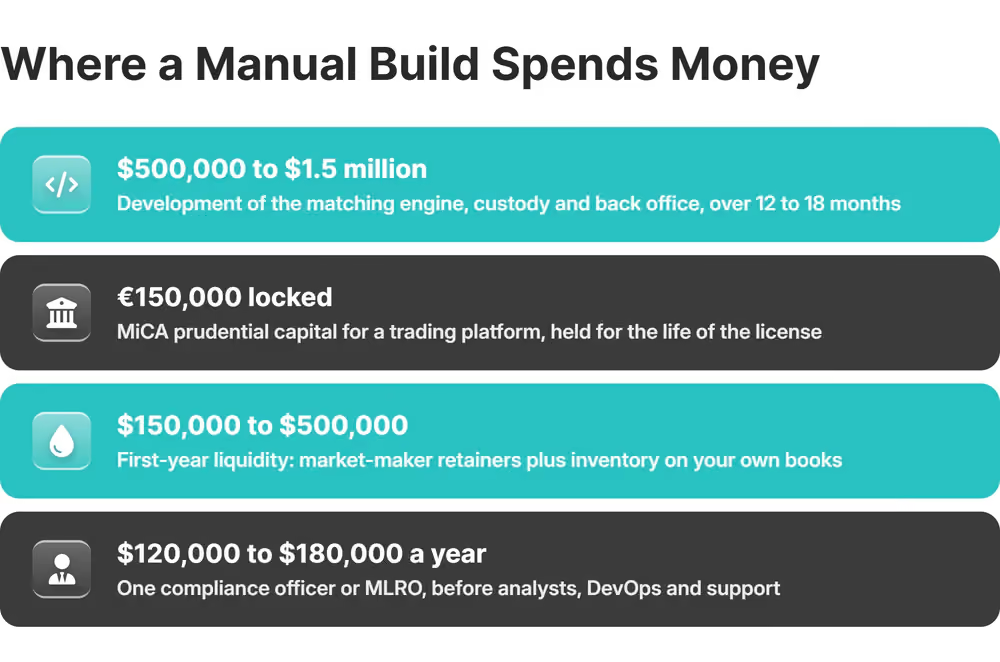
Authorization brings a capital requirement as well as a fee. Under MiCA Article 67, a firm operating a trading platform holds at least €150,000 in prudential capital, or a quarter of last year's fixed overheads if that is higher, reviewed every year. The firm has to hold that capital for as long as it stays authorized.
In the UK, registering a cryptoasset business under the money-laundering rules sits in the FCA's £11,260 application category, with full authorization under the 2027 regime arriving on top.
The United States has no single license. Forty-nine states require a money transmitter license for exchange activity, though a handful exempt standalone crypto with no fiat leg. New York adds a BitLicense with a $5,000 application fee on top of a state license whose surety bond commonly runs around $500,000. California has run its own digital-asset regime since July 1, 2026.
The state fees are the small part. The legal work of filing in dozens of states turns a national footprint into a six- to seven-figure project spread over 12 to 18 months.
What Does It Cost to Source Institutional Liquidity?
Sourcing liquidity independently costs a monthly retainer, capital parked on your own order books, and months of relationship work per provider, all before any spread is earned.
Market makers and other liquidity providers price two-sided quoting by the number of venues and pairs they cover, at $5,000 to $50,000 a month on retainer in the current market. Under a retainer the inventory behind those quotes is capital you supply or borrow, sitting on the books for as long as the venue needs depth.
Those desks are few. On the largest decentralized exchange, liquidity provision is concentrated among a small group of sophisticated participants. A new venue competes for those same firms against every established one.
Across live deployments B2BROKER puts first-year liquidity sourcing at $150,000 to $500,000, payable from the day the books open.
Buying aggregated liquidity replaces those bilateral deals with one integration. A crypto-native hub such as B2BROKER's B2CONNECT connects your platform to liquidity pooled from many providers. Your order books open with aggregated depth behind them, and the hub keeps the provider relationships.
Which Hidden and Recurring Operational Costs Affect a Manual Build?
Recurring operating costs, with staffing at the top, can pass the original development budget within the first year of running a self-built exchange.
How Much Should You Budget for Infrastructure, Security, and Staffing?
Infrastructure, security tooling and compliance staff form the largest recurring line for a self-built exchange.
Hosting is the predictable part. One blockchain RPC node workload runs about $1,112 a month on AWS before egress at $0.09 per gigabyte. Each additional blockchain integration brings its own node bill on top of the technology stack itself.
Payment gateways charge a transaction fee on every movement of client money. A venue prices those fees into its own deposit and withdrawal fees.
Testing recurs on the calendar. A web application penetration test costs £3,000 to £15,000 and has to be repeated after every significant release. Firms in scope for DORA's threat-led testing add an exercise every three years that often exceeds £50,000.
The largest line is payroll. A crypto AML or KYC analyst earns $60,000 to $90,000 at entry level and $85,000 to $130,000 at mid-career. The compliance officer or MLRO who runs the program commands $120,000 to $180,000, a premium of 20% to 40% over the equivalent bank role.
Those seats are not optional. The FATF's July 2026 review found Travel Rule legislation in force in 83% of surveyed jurisdictions, up from 73% a year earlier. In most markets a venue can serve, screening originator and beneficiary data is now daily work that needs staff on it.
How Do Unforeseen Expenses and Budget Overruns Affect Launch Cost?
Part of the overrun on a manual build comes from the security bill, a line that resists estimation. Quotes from equally credible firms for the same audit scope come back three to five times apart. Until the offers arrive, that line is a guess.
Remediation then compounds it. Every finding means rework, and every pass adds $5,000 to $20,000 to the audit bill. The application waits under technical review with the corrected code while the team stays on payroll.
A vendor that has already remediated the same findings on its own platform absorbs part of that risk. The custom route carries the higher overrun risk even when the initial quotes look similar.
What Is the Multi-Year Total Cost of Ownership?
Total cost of ownership is the initial invoice plus every year of licenses, audits, salaries and hosting after it. That figure turns the costs to start crypto exchange operations into a budget a board can approve. It is also the number the venue's crypto exchange fees have to earn back.
What Costs Drive Year-One Launch Burn?
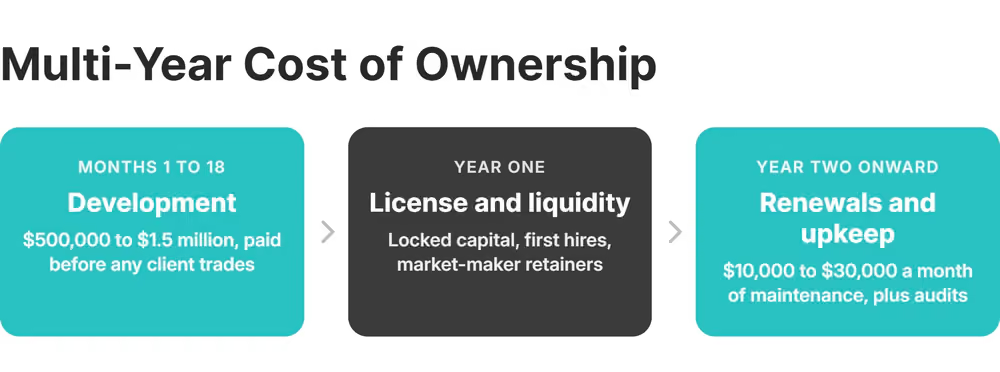
Year-one burn combines the last of the development spend, the first licensing fees and locked capital, the initial liquidity onboarding and the earliest hires into one figure that arrives before revenue.
A midsize EU venue built from scratch pays the last development invoices while its first authorization costs and legal fees land on top of the locked capital. The market-maker retainer starts the day the books open. Three to five compliance and operations people are on payroll before the first client arrives.
With revenue often 18 to 24 months away from the project's start, the reserve has to cover that whole line without trading fees of its own. Maker fees and taker fees only start paying down the burn once volume builds.
What Costs Continue in Year Two and Beyond?
From the second year, the spend shifts from building the exchange to keeping its license, with renewals, audits and maintenance replacing development as the main lines.
Maintaining a custom platform runs $10,000 to $30,000 a month. MiCA reviews the capital floor every year against a quarter of fixed overheads. Every hire you add raises the capital you must hold.
Regulators also rewrite the rulebook mid-license. Japan legislated a move of crypto trading from the Payment Services Act to its securities law in July 2026, with the crypto provisions expected to commence around 2027. Exchanges registered there will meet a new regime without launching anything new.
How Do Crypto Exchange Launch Paths Compare at a Glance?
The three launch paths differ most on who carries the ongoing burden. A white-label crypto exchange solution, for reference, runs from $8,000 to $250,000 by tier.
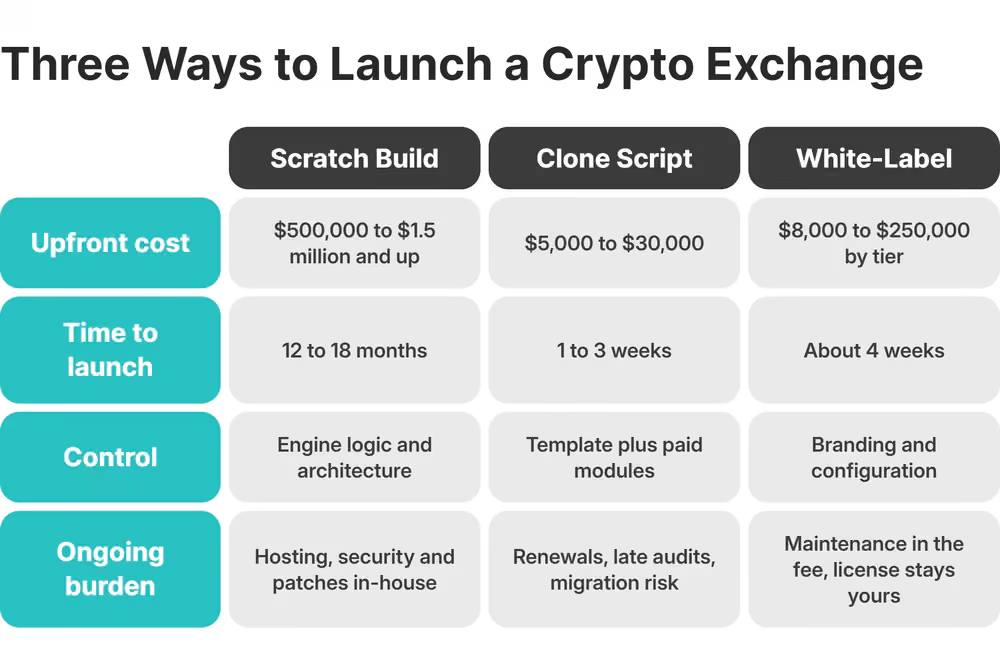
The license and the capital behind it stay with the operator in every column. No path changes the licensing budget.
How Can Firms Reduce Manual Exchange Build Risk?
Reducing the risk of a manual exchange build means putting licensing, liquidity and staffing in the budget on day one, at the sizes described above.
The costs to start crypto exchange operations that surprise a board are the ones that never appeared in the development quote. For the sequence of the build itself, work through licensing, technology and liquidity in order.
How Can Experienced Developers and Lean Scope Reduce Risk?
Hiring blockchain development engineers who have already shipped an exchange and limiting the first release to a lean feature set both cut overruns by shrinking the list of findings an auditor sends back.
A lean first release with registration, wallets and spot trading in a limited set of pairs validates the market for $150,000 to $400,000, well under a full custom build. Margin trading, derivatives and staking can wait until volume pays for them.
How Can Scalability and Regulatory Planning Protect Long-Term Costs?
Architecture designed for ten times today's volume turns growth into a configuration change. A compliance function that tracks rule changes on a schedule keeps each new rule from landing as emergency engineering.
MiCA showed what that is worth. The deadline was fixed years in advance. Firms that treated compliance as a standing function filed in time. The ones that did not wound down their EU business.
The alternative to funding every one of those lines yourself is an integrated ecosystem, where the pieces of the venue come from a single connected stack with one escalation path when something breaks. B2BROKER's Crypto Exchange Turnkey assembles that stack around:
- B2TRADER, the multi-asset and multi-market trading platform
- B2CORE, the CRM and back office, with KYC and payment integrations already wired in
- aggregated liquidity through B2CONNECT
- crypto payments through B2BROKER's partner B2BINPAY, integrated with B2CORE
That route is only as good as the company behind it. B2BROKER has built brokerage and exchange infrastructure since 2014, has helped launch more than 500 brokers, and holds more than 10 regulatory licenses of its own.
If your board is weighing a build against a partnership, compare two multi-year budgets before the first engineer is hired, with the development quote as one line in each.
Frequently Asked Questions about Crypto Exchange Costs
Is it cheaper to build a decentralized exchange than a centralized one?
Usually on infrastructure and custody, with a decentralized exchange running on smart contracts and non-custodial wallets where a centralized venue pays for an order book and client custody. Contract audits and the cost of bringing liquidity across chains take back part of that saving. Centralized venues also tend to have a clearer licensing path.
What team size and roles are typically required to manually build and launch a crypto exchange?
A small launch runs on eight to twelve people: backend engineers, a matching-engine architect, security and DevOps specialists, and at least one compliance officer. Institutional-grade builds add dedicated risk, legal and 24/7 support functions.
What happens if a manual crypto exchange build exceeds its initial budget?
Overruns usually trace to audit rework, delayed licensing or scope creep. The firm then chooses between bridge funding, a later launch or a smaller feature set. A contingency reserve of 15% to 25% above the estimate absorbs most of them.
Can a firm switch from a manual crypto exchange build to a white-label solution mid-project?
Yes, at the cost of the code already written. Migrating client data and compliance workflows to an integrated platform is often faster than finishing a stalled build. Firms make the switch when licensing delays or liquidity sourcing threaten the launch date.
How much capital reserve should a firm hold before starting a manual crypto exchange build?
Well beyond the development quote. Licensing, liquidity onboarding and salaries accrue for 18 to 24 months before the exchange earns anything. A firm that underestimates that runway ends up cutting features or delaying regulatory filings mid-launch.
Recommended articles
Subscribe to our newsletter