Why Brokers Need a Copy Trading Tool in 2026

A client who wants to mirror another trader opens an account where that is possible, and the deposit and the volume stay with them. That is why brokers need a copy trading tool: the copied trades run inside your client's own account, and both stay on your books.
The volume that comes with it is measurable. Brokers that ran active copy trading campaigns in 2024 and integrated them across their other services drew 10% to 20% of their total trading volume from copied trades.
This guide treats copy trading as a product decision: what it earns, how it differs from PAMM and MAM, what a supervisor will ask to see, and whether to build the engine or integrate one.
Key Takeaways
- Copy trading's effect on client retention comes from follower-side loss limits and visible drawdown data, the two things that keep followers from quitting after their first losing streak.
- Copy trading, PAMM and MAM differ in who controls the account and where the money sits. The client segment picks between them.
- One replication engine across MT4*, MT5*, cTrader and B2TRADER replaces a separate copy system for each server and platform.
- With supervisors treating auto-executed copying as portfolio management, the tool has to produce the approval logs and performance records that duty implies.
- An integrated platform can go live in about a week and post commissions into your existing CRM. An in-house build adds a second system to reconcile.
Copy Trading's Shift to Infrastructure
Active clients now count copy trading as standard trading infrastructure, in the same tier as the mobile app or the client portal. They check for it before they fund an account.
The demand shows at consumer scale. eToro grew to 40 million registered users on a social trading platform built around copying other traders' positions, then extended copy trading to US clients in 2025.
The feature runs through systems you operate anyway. A follower finds a master on the leaderboard on your public website, subscribes in the client portal, and the copied trade lands on your trading server, where the IB module records it for the referring partner's payout. Every step runs on a component of your brokerage technology stack . The copy tool belongs in the same evaluation as the CRM and the trading platform.
The Business Case for Copy Trading
The short answer to why brokers need a copy trading tool is that it earns in three places at once: more trades per client, a second revenue layer in master fees, and accounts that stay active while the client is away.
An Ontario Securities Commission experiment, cited by IOSCO, measured the lift in trade frequency. On a simulated trading platform, participants who could copy a high-performing trader placed 18% more trades than a control group without that option.
Follower count multiplies that volume. Once a master has 100 followers, every position they open is mirrored into 100 accounts and sized to each account's balance.
Master fees are the second layer. The follower pays a performance fee, usually a share of net profit above a high-water mark, which the master and the broker share under terms you set. Subscription or management fees on top turn a strategy into a priced product with recurring revenue.
Copying also works on accounts that would otherwise go quiet. A discretionary client who loses three trades in a row often stops logging in, after which the account earns nothing. A follower account keeps executing the master's trades whether or not its owner is watching.
Retention and Lifetime Value Impact
Drawdowns are the main reason followers quit. Copy trading keeps clients longer only when the tool limits how much a follower can lose on one master.
In a 2025 survey of 1,420 retail copy traders, 41% had stopped copying because of losses, high drawdowns or disappointing results , and drawdowns alone accounted for 27% of those who left.
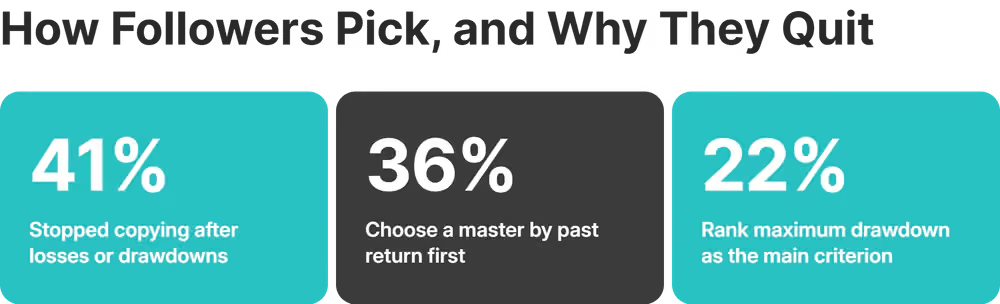
Those drawdowns start with how followers choose. Past return is the criterion they rank first. Sort the leaderboard that way and it steers clients toward the strategies most likely to empty their accounts, away from diversification across several masters.
Two controls change that outcome. A per-subscription loss limit closes the copied positions once a set amount is lost. Proportional copying sizes every trade against the follower's balance. With both set as broker defaults, the damage a master's bad month can do to one follower is capped before it reaches the whole balance.
A follower who stays deposits again and becomes the client you later move into a PAMM or MAM product as their balance grows.
Copy Trading Vs PAMM Vs MAM
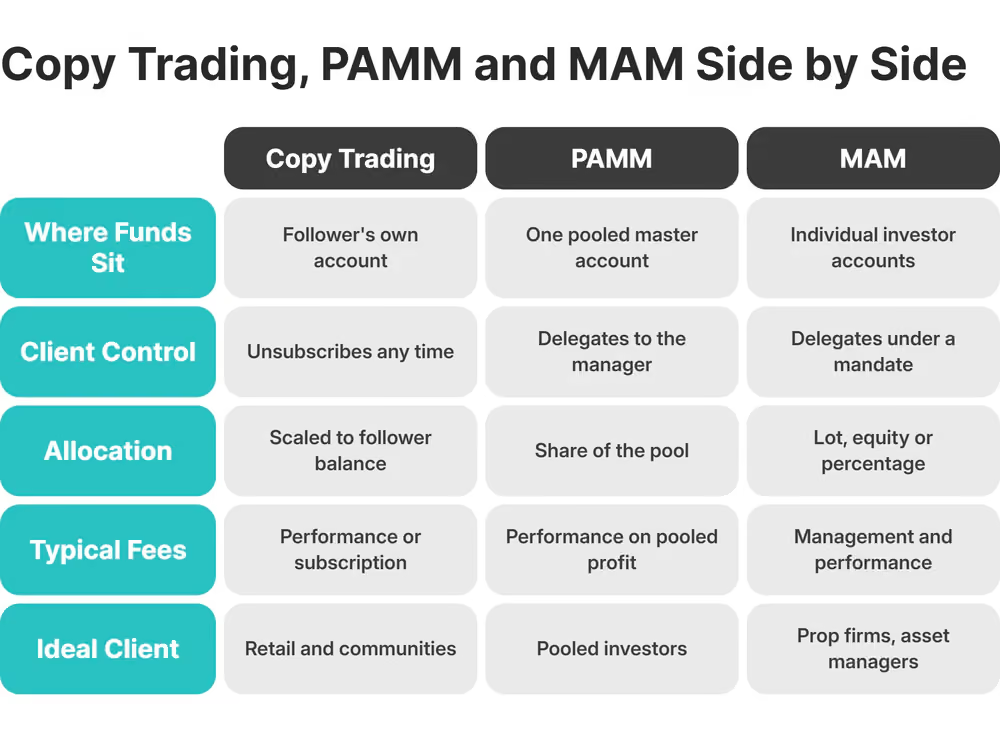
Who controls the account separates the three models. A copy trading follower keeps their own account and can stop copying at any time. A PAMM or MAM investor hands discretionary control to a manager. Mirror trading sits closest to copy trading, with the client following a strategy that has no person behind it.
PAMM pools every investor's money into one master account and shares profit and loss in proportion to each stake. MAM keeps each investor's money in a separate account and lets the manager trade all of them with one order, with position sizing set for each account separately.
The control question is also the regulatory one. ESMA's supervisory briefing on copy trading treats copying that executes without further client intervention as portfolio management under MiFID II, with the suitability duties that classification brings. PAMM and MAM are discretionary management by design.
A platform such as B2COPY runs all three models side by side. Before you price PAMM or MAM, the fee and allocation differences between them deserve their own read.
Matching Model to Client Segment
Match the model to how much control the client wants to keep and how much reporting they need.
- Retail traders get copy trading, the only one of the three that leaves the money in their own name and the exit in their own hands. Influencer-led communities join through the same model.
- Investors comfortable with pooled delegation fit PAMM, with one master account and automated profit distribution keeping the manager's workload flat as investors join.
- Prop firms, asset managers and high-net-worth clients need per-account sizing and statements they can hand to their own clients or auditors. MAM provides both.
Few brokers serve only one of these segments. Serve two through separate vendors and you run two admin panels and two leaderboards.
Comparison at a Glance
Compare the three models on where the funds sit, how much control the client keeps and which client each one fits, before you pick the one to launch first.
Platform Evaluation Criteria for Brokers
Evaluate a copy trading platform on six dimensions, asking each vendor for evidence on every one.
- Deployment speed. Ask for a timeline that names your servers. B2COPY, for example, quotes about five business days for a production white-label setup, and two to three weeks for a full REST or gRPC integration.
- Allocation logic. Lot, equity and percentage allocation for MAM, proportional shares for PAMM, and a follower risk ratio for copy trading. A platform missing one forces that model onto the wrong mechanism.
- Follower risk management tools. A per-subscription loss limit, stop-loss limits on copied positions, exposure caps and a master approval flow, all configurable by the broker as defaults.
- Provider ranking. ROI, maximum drawdown and Sharpe ratio per master, shown together on the client-facing leaderboard, where return never appears without its risk.
- Admin permissions. Read-only master accounts, the option to hide allocation methods you do not offer, and role-based access for dealing and support staff.
- Ecosystem integrations. Native links to the CRM's IB module and the client portal, covered in the next two sections.
Before signing, run a replication test on your own server pair. Open, modify and close positions on a master during a news release, measure the latency and the slippage between the master's fill and the follower's; then compare providers on the same criteria with that data in hand.

Cross-Platform Replication Across MT4*, MT5*, cTrader, B2TRADER
A single engine serves followers on MT4*, MT5*, cTrader and B2TRADER from any master. A broker with mixed servers can then run one copy trading system.
Every new server used to bring its own leaderboard and its own isolated masters and followers, whether it was a MetaTrader 5* instance for a new region or a cTrader offering for another segment.
B2COPY sits between the servers as a connecting layer. When a master opens a position, the engine captures it, applies the follower's allocation and risk settings, and replicates it to subscriber accounts on other servers and platforms in real time, with every master listed on one leaderboard.
A new server then opens with your full master list available from day one. An investor can move capital between servers as part of subscribing. Around that replication core, a production platform still needs symbol mapping, statistics and fee accounting .
CRM and IB Integration for Commission Tracking
The copy trading platform posts into your CRM's IB module. The commission an IB earns on copied trades then clears in the same run as every other IB reward, with no second workflow to build.
Copy trading complicates IB payouts in two ways. The IB who referred a follower expects a share of the master's fee on top of the usual volume rebate. In PAMM, the investor holds a virtual share of pooled positions, and no per-account lot exists to rebate.
Through the IB module of B2CORE , B2COPY credits an IB with volume rewards plus a percentage of the fees the investor pays to a master, on single- or multi-level plans. For PAMM, B2COPY 2.0 added a broker-funded rebate system that calculates each IB's reward from the investor's proportional share of copied trades .
VantoTrade, already running B2CORE, chose B2COPY for that integration and embedded it in its existing client portal, where its IB partners now earn from copy activity through the module that pays their other rebates.
Compliance and Governance for Copy Trading
Copy trading governance comes down to three things a supervisor can ask for: the license the service operates under, the protection the retail follower has, and the location of the records behind both answers. The tool produces the operational half of those records.
Retail protection is where scrutiny is concentrating, down to the marketing around a leaderboard. Under the EU's Retail Investment Strategy, agreed in December 2025, responsibility for influencer marketing will sit with the broker , which will have to hold a written agreement with each promoter and keep documented control over what they post. A broker that recruits masters through influencers inherits that whole file.
Once trade execution happens without the client acting, ESMA's briefing puts the service in portfolio management. The broker then assesses and records each follower's suitability and answers for every master it approves.
The platform side of that work is three controls the broker sets:
- master approval before anyone reaches the leaderboard
- a default loss limit on every subscription
- per-master risk statistics shown before a client subscribes
Audit Trails and Regulatory Reporting Standards
When a supervisor or a complaining client asks, a broker demonstrates oversight of signal providers and PAMM or MAM managers from a per-master record of approvals and performance over time.
IOSCO's 2025 good practices report cites platforms that risk-rate each lead trader algorithmically and disable copying above a threshold . That works only where the platform stores each rating and the moment copying was switched off.
Regulators are rewriting the rules for pooled money management at the same time. The FCA's CP26/28 consultation, opened in July 2026, would replace the UK regime for fund managers with size-tiered rules , while a parallel consultation would rebuild fund reporting for 2028. Whether a pooled PAMM structure falls inside that perimeter is a legal question for each broker. The answer starts from the manager-level records the copy platform keeps.
In practice, that means performance analytics kept per master over time, a fee log showing the high-water mark applied to every charge, and an approval timestamp for every master.
Build, Buy, or Integrate Copy Trading
Compare the three paths on how fast each launches, how much engineering it takes, and how many systems you end up reconciling. Launch speed usually decides it.
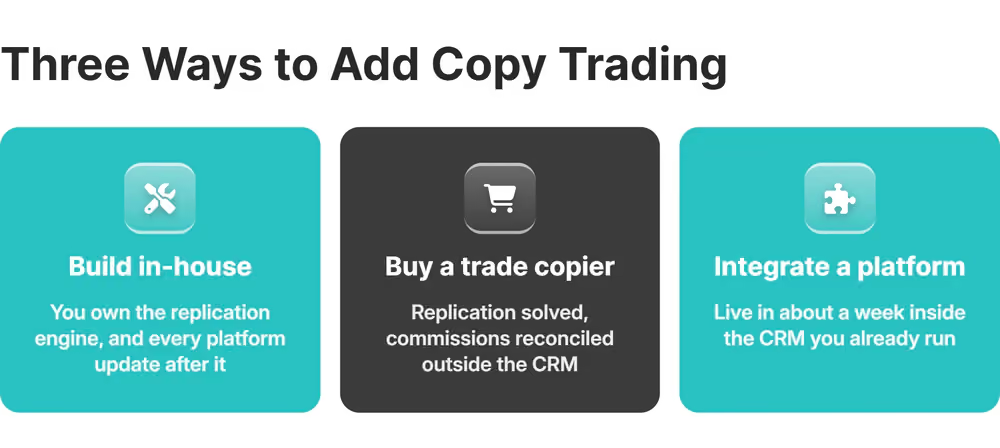
Building in-house puts the replication engine on your team, plus the allocation, fee accounting and statistics around it, and the re-testing against every platform update MetaQuotes or Spotware ships.
Buying a standalone trade copier solves replication and adds a second system. IB commissions on copied trades land outside the CRM. Someone reconciles them by hand every month.
Integrating a platform that connects natively to your CRM and trading servers is the shortest path. VantoTrade, a forex broker founded in 2023, went live with copy trading and MAM within one week on B2COPY, with hosting and monitoring on the vendor's side.
Choosing B2COPY to Future-Proof Your Brokerage
For a brokerage asking why brokers need a copy trading tool in 2026, B2COPY runs all three managed-trading models, replicates across the four platforms above, and tracks IB commissions through B2CORE from one back office.
It ships as managed SaaS, with B2BROKER's team running the hosting and pushing platform updates. B2BROKER publishes the pricing on the product page, with plans from $1,500 a month.
Behind the platform sits a company that has been building brokerage infrastructure since 2014 and has helped launch more than 500 brokers. B2CORE and B2TRADER come from the same team that maintains the copy layer alongside the CRM and the trading platform it plugs into.
If your clients are asking for copy trading, the open question is how many systems you want to run to offer it. Map that against the servers and CRM you have before you shortlist vendors.
Frequently Asked Questions about Copy Trading Tools
How long does it typically take to launch a copy trading feature after selecting a vendor?
About a week for an integrated platform, with B2COPY quoting five business days for a production white-label setup once accounts and permissions are configured. Ask any vendor for a date that names your servers and platforms.
How do brokers typically compensate or structure payouts for signal providers and money managers?
Most brokers let the master charge a performance fee on new profit above a high-water mark and take their own share under terms they set. With B2COPY connected to B2CORE, the IB's cut of those fees runs through the same IB module as ordinary rebates.
What due diligence should brokers perform before approving a signal provider or master trader?
Check track-record length, maximum drawdown and how the master traded through past market volatility, then confirm the style matches the risk tolerance of the followers who will see it. Monitoring continues after approval, with IOSCO's good practices expecting a platform to keep rating lead traders and to stop copying when a rating passes the limit.
Can a single copy trading solution support both forex and crypto asset classes for the same client base?
Yes, when the engine replicates whatever instruments the trading platform offers. B2COPY copies across MetaTrader*, cTrader and B2TRADER. A master trading crypto CFDs alongside forex pairs is copied the same way, and the follower tracks both financial markets from one account.
Is copy trading a viable product for smaller or newly launched brokerages, not just large firms?
Yes, and at small scale the case is stronger. Copy trading converts community and organic traffic into active accounts without leaning on a paid-acquisition budget. VantoTrade went live within a week of choosing a managed platform and reported growth in strategy providers, followers and average deposit size.
Recommended articles
Subscribe to our newsletter