Starting a Forex Brokerage in MENA

Starting a forex brokerage in MENA means licensing one legal entity under one of the region's regimes and operating inside what that license permits. No regional license exists, so the same company can be authorized in Dubai's financial free zone and unlicensed on the mainland a few kilometers away.
The rules changed while you were planning. On January 1, 2026, the UAE reconstituted its federal securities regulator as the Capital Market Authority, whose law reaches firms targeting UAE clients wherever those firms are incorporated.
A regulator decides the jurisdiction, a bank decides whether it will settle for you, and only the technology runs on your own schedule.
Key Takeaways
- With no single forex market regulator in the region, the jurisdiction you pick sets the operating model: a UAE free-zone firm, a Saudi capital market institution, and a Jordanian licensee each face a different regulator, capital floor, and client perimeter.
- Automatic replication counts as portfolio management once the client stops approving each trade, and that permission is granted jurisdiction by jurisdiction. Copy trading needs a country-level review in each one.
- Banking access can stop a licensed launch. Correspondent banks have been cutting relationships in the region for a decade, and Morocco and Lebanon add exchange or capital controls on top.
- Licensing timelines belong in the launch plan as a variable, with liquidity connectivity, CRM setup, and reporting built while the regulator reviews the file.
- One integrated stack can run several MENA entities when onboarding rules, product permissions, payment rails, and reporting are set per entity.
Jurisdiction-by-Jurisdiction: Regulatory Frameworks Across MENA
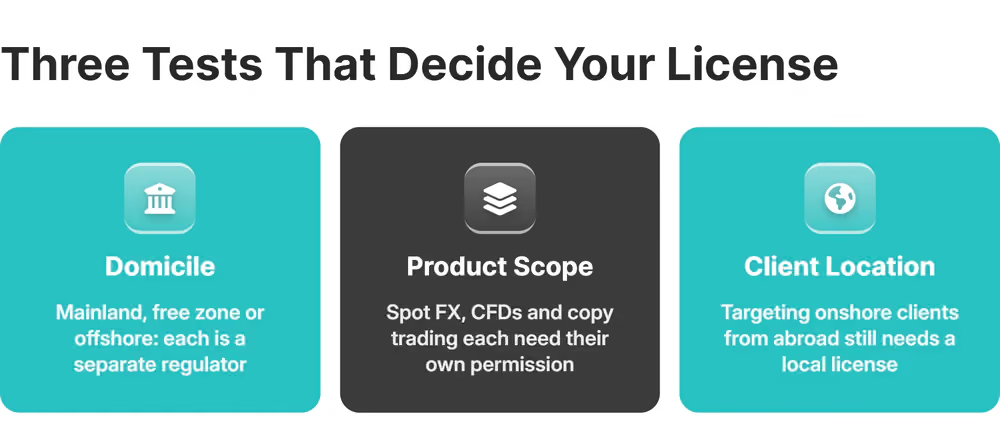
MENA brokerage regulation asks three questions at once: where the entity sits, what it sells, and where its clients live. A license that answers the first but not the third does not cover the business you actually run.
Guessing wrong now costs more than a rejected application. Unlicensed financial activity in the UAE carries fines of up to AED 250 million and a prison term of at least a year.
United Arab Emirates: CBUAE, DFSA, and FSRA
UAE licensing depends on where the entity sits. Mainland firms answer to the federal Capital Market Authority (CMA), DIFC firms to the Dubai Financial Services Authority (DFSA), and ADGM firms to the Financial Services Regulatory Authority (FSRA).
On the mainland, a forex and CFD broker holds a CMA Category 1 license with an endorsement for OTC derivatives and spot currencies.
In the DIFC, dealing as an agent sits in DFSA Category 3A with a base capital requirement of US$200,000 . Retail clients and client assets each need their own endorsement.
In ADGM, the FSRA starts Category 3A at US$500,000 and raises it to US$2 million for matched-principal dealing with retail clients.
The ADGM public register shows each authorized firm with its exact permissions, which is where a counterparty check starts.
The category also fixes execution: an agent passes client orders to a liquidity provider under straight-through processing (STP), and only a principal license lets a dealing desk take the other side.
Saudi Arabia: the Capital Market Authority (CMA)
Serving Saudi clients starts with the Capital Market Authority's licensing test, before any decision on product, leverage, or marketing.
A firm that deals for clients must be established in the Kingdom with paid-up capital of SAR 50 million and its head office inside the country.
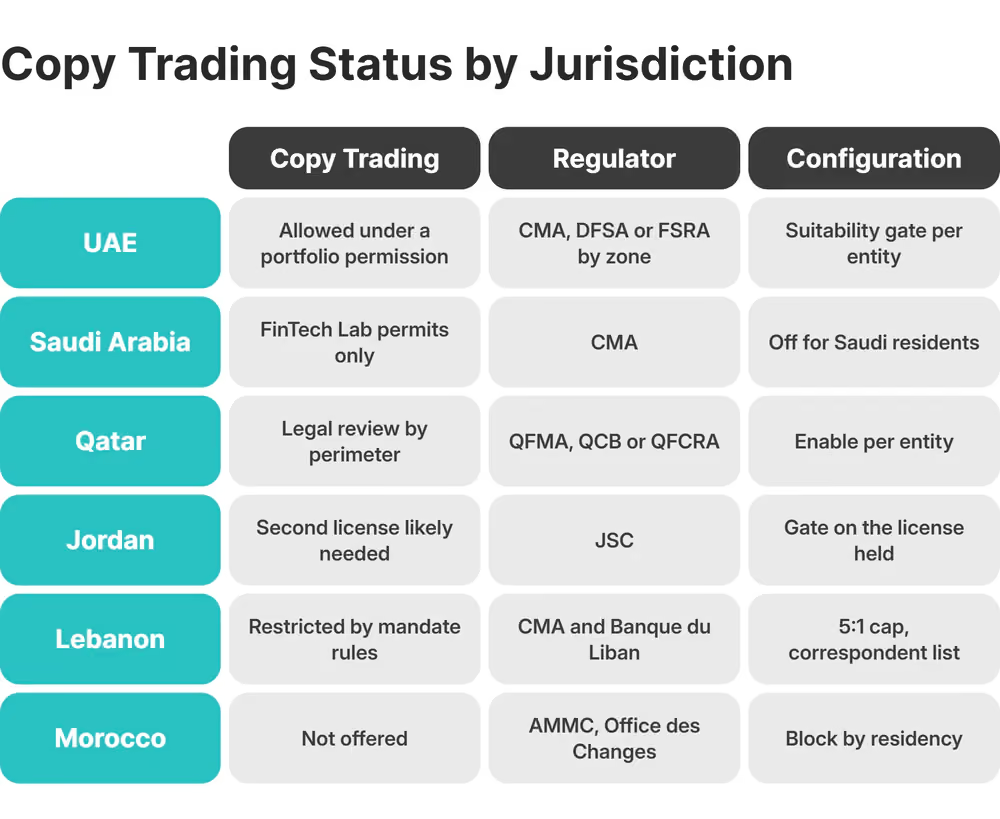
Social trading has so far appeared only inside the CMA's FinTech Lab , under time-limited experimental permits, so expect a conversation with the regulator before switching copy trading on for Saudi clients.
Qatar: QFMA, QCB, and QFCRA
Qatar splits its market by domicile, and a QFC authorization is not an onshore permission. Onshore, the Qatar Financial Markets Authority licenses brokerage and margin trading; inside the QFC, the Regulatory Authority (QFCRA) grants dealing in investments one activity at a time.
Serving retail clients resident in Qatar from the QFC needs a separate authorization, which the QFCRA grants only where protective measures are in place. Legal review therefore comes first for any leverage or copy-trading claim aimed at Qatari clients.
Jordan: the Securities Commission (JSC)
The Jordan Securities Commission publishes the companies licensed to deal in foreign exchanges , with the activities each one may perform and the foreign brokers behind them. It is the place to check whether a local partner holds the license its pitch implies.
An intermediary acting for third parties needs JOD 3 million in capital and an irrevocable bank guarantee in the regulator's favor.
Lebanon: Capital Markets Authority and Banque du Liban
In Lebanon, the Capital Markets Authority has written the conduct rules for retail forex, and its business conduct regulation allows off-exchange retail forex only through a correspondent licensed by the NFA and CFTC or based in a country with an investment-grade sovereign rating.
The banks have not settled their half. Banque du Liban bars payouts from foreign-currency accounts opened before November 2019 beyond its ceilings without written approval, while money that arrived after the crisis moves more freely. Confirm which bank, which account, and which correspondent will settle client funds before you commit to a Lebanese entity.
Morocco: AMMC and the Office des Changes
In a December 2025 warning to the public , the securities regulator AMMC stated that trading platforms for gold and currencies sit outside its control, and there is no AMMC authorization route to apply for.
The Office des Changes adds the funding constraint: a resident's allowance for foreign online payments covers online purchases only, and funding a trading account falls outside it. Put Morocco in your onboarding rules as a restricted country of residence.
Comparison at a Glance: Copy Trading Legality Across MENA Jurisdictions
Whether the client approves each trade decides what copy trading counts as. Where another trader's orders reach a client account without the holder approving each one, European supervisors treat the service as portfolio management , a licensable activity that owes suitability duties to the followers. Each MENA regulator reaches that question through its own rulebook.
For virtual-asset firms, the UAE CMA has already written the rule down, restricting retail copy trading to firms licensed to manage portfolios or run a multilateral trading facility. Where no primary rule is cited below, treat the position as unresolved and take local advice before enabling the feature.
Operational Risks That Drive Churn: Banking Access and Licensing Delays
Banking access and licensing delays are the two clocks that stall a MENA launch. The regulator's runs outside your control; the bank's shortens when the entity structure and the documents match what a compliance officer expects.
Teams starting a forex brokerage in MENA with a license strategy in hand still stall in three places: a jurisdiction rule that blocks a planned product, a bank that declines the account, and an approval that arrives a quarter late.
A forex CRM and back office such as B2CORE holds onboarding rules, product permissions, and payment routes as per-entity settings, so a jurisdiction change starts as configuration. Legal advice still decides what those settings are, and the KYC and AML obligations behind them come from each regulator.

Correspondent Banking Friction Across MENA Corridors
Correspondent banks have been cutting relationships in the region for a decade, and the friction shows up late, at account opening and settlement design. Between 2011 and 2022, the number of correspondent banking relationships fell 34.7% across Western Asia and 37.4% across Northern Africa , the two UN sub-regions that hold most of MENA.
The banks that remain ask every applicant the same four things:
- who owns the entity, down to the natural persons
- where the clients are and which regulator covers them
- where client money comes from and how it is evidenced
- how client funds are segregated from the firm's own
Where the license and the bank allow it, crypto settlement through B2BROKER's partner B2BINPAY , integrated with B2CORE, adds a rail outside the correspondent chain, though fiat conversion at either end lands back in the banking system and the KYC and licensing obligations stay with the entity.
Licensing Timelines as a Time-to-Market Variable
Regulatory timelines stay uncertain. Technology deployment runs on your own schedule. Put the infrastructure work inside the review window.
The DFSA needs about four months to reach in-principle approval , counted only from a complete file, and each condition attached to that approval carries its own lead time.
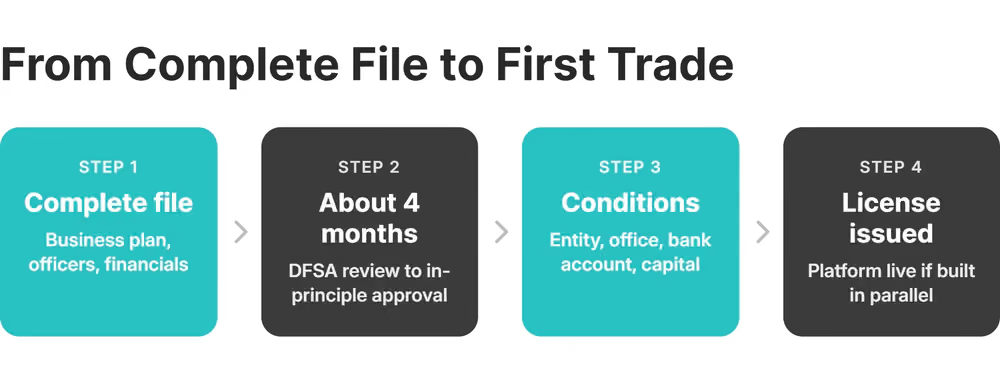
Inside that window, three tasks are yours to run in parallel:
- liquidity connectivity over FIX, plus REST or WebSocket feeds for crypto venues
- CRM and client portal setup, with onboarding tiers per client residency and reporting in the regulator's return formats
- bank and payment-provider integration against the approved account structure
Offshore Tier-1 License or Onshore MENA Entity: Structuring Your Regulatory Footprint
Choose the footprint by where your clients are and where a bank will open your accounts. Product scope and the credibility your segment demands then decide how many entities you need, and none of the three substitutes for another:
- An onshore MENA entity carries the domestic permission you need to serve retail clients locally, and with it a local bank relationship.
- A free-zone firm in the DIFC or ADGM carries a license that banks and counterparties recognize, without automatic permission to solicit mainland clients.
- An offshore license carries whatever credibility its own regulator has and none of the local permissions.
An FCA or CySEC entity gets a different risk rating at a correspondent bank than one licensed in Seychelles, Vanuatu, or Mauritius.
The UAE draws the legal boundary most sharply. An offshore license does not authorize soliciting UAE residents. Marketing that reaches them is unlicensed activity there, whatever the license says.
Decide which entity takes the first clients before either application is filed. The free-zone or offshore entity usually opens with institutional and professional clients, and the onshore entity follows once the bank and the regulator are ready. The capital threshold and the credibility trade-off differ by route.
Build Your MENA Brokerage on Infrastructure That Adapts to Regulatory Complexity
A MENA brokerage needs one stack that runs several entities with different permissions as configuration. For a team starting a forex brokerage in MENA, it breaks down like this:
- B2TRADER for currency pairs, indices, and other CFD classes, with leverage set by market, group, and account
- B2CORE as CRM and back office, holding each regulator's onboarding tiers and product permissions
- multi-asset liquidity from banks and non-bank market makers, connected once over FIX
- B2COPY for copy trading, PAMM, and MAM, with follower access switched per entity
- crypto settlement through partner B2BINPAY where the license and the bank allow it
A MENA retail audience often expects MetaTrader 4* or cTrader, which a white label solution covers, and the platform and liquidity layer have to support whichever execution model the license allows.
When the onshore license arrives, the same components carry its permissions, as they do for a multi-asset expansion later.
B2BROKER works on these structures from its Dubai offices , has operated since 2014, holds 10+ regulatory licenses across its group, and has helped launch more than 500 brokers.
Settle the technology plan before the first application goes in, and have the platform ready on the day the license is issued.
Frequently Asked Questions about Forex Brokerage in MENA
What license do you need to start a forex brokerage in MENA?
Whichever one matches the entity's domicile, product scope, and client segment. In the UAE alone, that means the federal CMA, the DFSA, or the FSRA, depending on the zone. Saudi Arabia, Qatar, Jordan, and Lebanon each have their own regulator on top of that. Morocco has no onshore track for leveraged forex at all.
How long does licensing take when starting a forex brokerage in MENA?
It varies by regulator and by how complete the file is. The DFSA, for example, reaches in-principle approval in roughly four months. Incorporating the entity, leasing an office, opening a bank account, and depositing capital all come before the license.
Can a MENA forex brokerage offer copy trading?
Only where the entity's regulator permits it. Automatic execution may require a portfolio-management permission, and which jurisdictions demand one differs across the region. Set follower eligibility, leverage caps, and audit trails per entity.
What banking risks affect forex brokers operating in MENA?
Correspondent banks have thinned out across the region since 2011 and scrutinize leveraged FX, cross-border client money, ownership, and source of funds before opening an account. Morocco and Lebanon add exchange and transfer restrictions. Get written confirmation that the account you are offered can take deposits and pay withdrawals for your client base.
Should brokers use an offshore Tier-1 license or an onshore MENA entity?
An offshore license supports institutional credibility but does not license onshore solicitation, which the UAE's law treats as a licensable activity even when it comes from abroad. An onshore entity improves bank access and retail trust. Most operators sequence the two and run both on one multi-entity stack.
Recommended articles

Subscribe to our newsletter