How to Meet White Label Forex Broker Regulations and Launch Profitably

White label forex broker regulations determine whether a brokerage can operate legally, win banking relationships, and retain sophisticated clients over time. Getting them right from the start determines whether a launch is sustainable or structurally exposed from day one.
A white label forex broker licenses its trading infrastructure from a technology provider (the platform, liquidity feed, and back-office stack) and operates under its own brand. The white label trading platform (whether MT4, MT5, or cTrader) is the front-end clients interact with, but the brokerage firm that deploys it retains full regulatory accountability. The operator remains accountable for everything from KYC and AML to client money protection and leverage controls, regardless of who supplies the underlying technology.
This misconception (that "white label" means the provider handles regulation) is among the most expensive mistakes a founding team can make. Enforcement actions, banking offboarding, and reputational damage follow from it. FCA fines can exceed £1 million, and PSP offboarding is often the first consequence of a weak compliance posture.
The sections below cover operating models, key regulators, non-outsourcable compliance obligations, jurisdiction strategy, and the technology controls needed to launch profitably.
Key Takeaways
- White label providers supply technology and liquidity infrastructure, but regulatory accountability for client protection and AML stays with the operating broker.
- Jurisdiction selection determines capital requirements and market access. Top-tier licenses cost more but open more doors, especially with banking and liquidity counterparties.
- KYC, transaction monitoring, and leverage enforcement cannot be outsourced; the broker must own the policies, the exception handling, and every audit trail behind them.
- Technology controls, such as segregated accounts and trade surveillance, are regulatory expectations, not optional features.
- Proactive compliance is cheaper than enforcement: regulatory costs are predictable, while remediation and litigation are not.
Operating Models for a White Label Forex Brokerage
The choice of operating model sets the scope of licensing and compliance liability, along with how much independence the brand retains over its own operations. For a startup entering the forex industry, understanding these distinctions early prevents costly restructuring later and shapes the business model the entire trading business is built around.
Full License Ownership vs. Provider Umbrella vs. Tied Agent
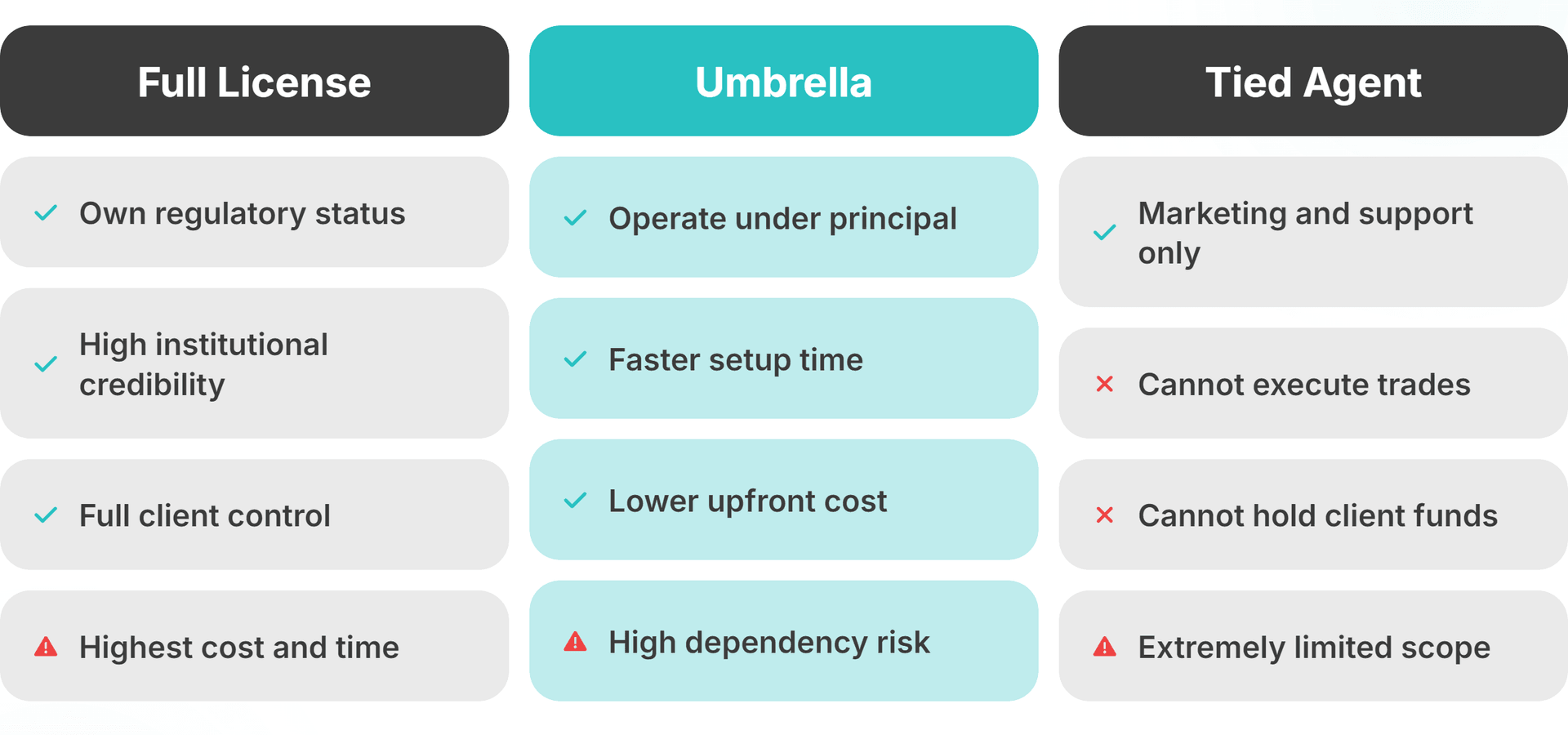
Full license ownership means the broker obtains its own regulatory authorization (a CySEC CIF, FCA, or ASIC license, for example) and assumes end-to-end compliance responsibility. It is the most independent model, with full control over client relationships and the greatest credibility with institutional counterparties.
Umbrella and appointed representative models allow the broker to operate under a licensed principal's permissions, typically reducing upfront cost and time to market. The trade-off is significant: the broker's ability to operate depends entirely on the principal's regulatory standing, and the principal retains ultimate oversight over commercial terms.
Tied agent structures are more limited in most jurisdictions, generally restricted to marketing and client support activity rather than execution or dealing.
The key consideration for umbrella structures is dependency risk. If the principal loses its license or faces enforcement action, the dependent broker's entire operation is immediately affected. Independent licensing takes longer and costs more, but it eliminates that structural vulnerability and significantly strengthens relationships with prime brokers and institutional counterparties. A white label partner relationship can accelerate client acquisition, but regulatory standing must be the broker's own.
Build Your White Label Forex Broker on Compliant Infrastructure
B2BROKER provides regulated white label solutions with MT4/MT5 integration, institutional liquidity, and audit-ready reporting tools.
Key Regulatory Bodies Governing White Label FX
Jurisdiction selection determines which regulator's rules apply and what "compliant" means in practice. Regulators differ significantly on capital requirements and leverage restrictions, as well as client money rules, reporting obligations, and how aggressively they enforce.
FCA, CySEC, ASIC, and CFTC Overview
FCA (UK): Capital requirements range from £125,000 to £730,000, depending on activities. The regime includes strict conduct standards, client money protection under CASS, leverage caps (30:1 for major pairs, retail), and marketing restrictions. FCA fines can exceed £1 million, and enforcement activity against undercapitalized or non-compliant brokers has intensified. Compliance expectations are high, but so is credibility with European and global institutional clients.
CySEC (Cyprus): EU framework with MiFID II passporting rights across European markets. Application fees range from €7,500 to €12,000, with a minimum capital of €75,000 to €730,000 by license type. Client protection through the ICF reaches up to €20,000 per client. The leverage cap is 1:30 for retail clients. It is a widely used route for European-facing brokers seeking passportable EU access.
ASIC (Australia): The regime features strong retail protections and leverage caps, with broad product intervention powers. Local substance expectations have increased in recent years, and ASIC has been active in enforcement against non-compliant FX operators targeting Australian retail clients.
CFTC/NFA (US): High capital thresholds, strict registration requirements, and restrictive leverage rules make this regime difficult for most new entrants. Most white label brokers entering the US market through non-CFTC channels face significant access limitations.
Top-tier regulation improves banking approvals and institutional credibility, but it requires ongoing monitoring of rule updates. Compliance never stops. Regulators in top-tier jurisdictions also increasingly require data protection disclosures across client-facing materials, including the trading platform interface.
Offshore Authorities and Their Limitations
Offshore jurisdictions such as SVG, Vanuatu, Seychelles, and BVI offer lower barriers and faster setup at a fraction of the capital cost. SVG has not issued dedicated FX licenses since 2018, operating instead through corporate registration. Vanuatu's VFSC requires a minimum deposit of approximately $45,000 to $50,000. Seychelles FSA requires $50,000 minimum capital with a 1.5% corporate tax rate.
The limitations are structural. Offshore-registered brokers face significant friction with EU, UK, US, and Australian clients. Banks and PSPs frequently decline offshore FX operators or impose higher fees. Institutional counterparties conduct their own due diligence and often require tier-1 licensing for prime brokerage access.
AML/KYC standards and fair dealing practices still matter operationally, even in lighter regulatory environments, because banking partners and liquidity providers require them regardless of the broker's regulatory status. Offshore brokers offering financial instruments such as CFDs and forex pairs to clients in financial markets still face leverage restrictions and risk disclosure requirements imposed by payment processors and prime brokers, not just by regulators.
AML and KYC Tooling for Compliant Broker Operations
B2CORE integrates KYC workflows, compliance audit trails, and reporting APIs into your brokerage operations, without replacing your policy ownership.
The Core Compliance Requirements You Cannot Outsource
Providers can supply tools and infrastructure, but the operating broker remains accountable for client-facing compliance outcomes.
Client Onboarding and KYC (CDD/EDD)
The broker is responsible for identity verification, suitability assessments, sanctions and PEP screening, and source-of-funds checks on higher-risk accounts. Government ID and proof of address are the baseline, and KYC refresh cycles must stay under the broker's direct control.
Provider tooling can streamline collection and checks, but policy ownership and audit trails must sit with the broker, along with every exception-handling decision. Weak AML and KYC compliance increases regulatory exposure and banking offboarding risk faster than any licensing cost erodes profitability. Record retention requirements typically span five to seven years, depending on jurisdiction.
Transaction Monitoring, Reporting, Marketing, and Leverage Controls
Transaction monitoring requires real-time surveillance of deposits and withdrawals, plus behavioral analysis of trading patterns, to detect suspicious activity and potential market abuse. STR/SAR filing obligations and documented escalation procedures are universal audit themes regardless of jurisdiction. Risk management tools that generate automated alerts and case management dashboards make this process auditable at scale.
Marketing compliance means accurate risk warnings and a prohibition on misleading performance claims, along with restrictions on bonus structures where applicable. Liability sits with the broker even when creative materials are supplied by a white label provider.
Leverage enforcement must be applied at the account and client classification level, with documented criteria for granting professional-client status where higher leverage is permitted.
B2BROKER's infrastructure can support monitoring and reporting through automation and APIs, but brokers still need competent review and documented escalation procedures. Effective risk management across trading volume and counterparty exposure is an operational responsibility that technology supports without replacing.
Jurisdiction Tiers and Their Impact on Risk and Cost
Jurisdiction selection is a balancing act between credibility, market access, setup and ongoing cost, and operational complexity.
Top-Tier vs. Mid-Shore vs. Offshore (Practical Comparison)
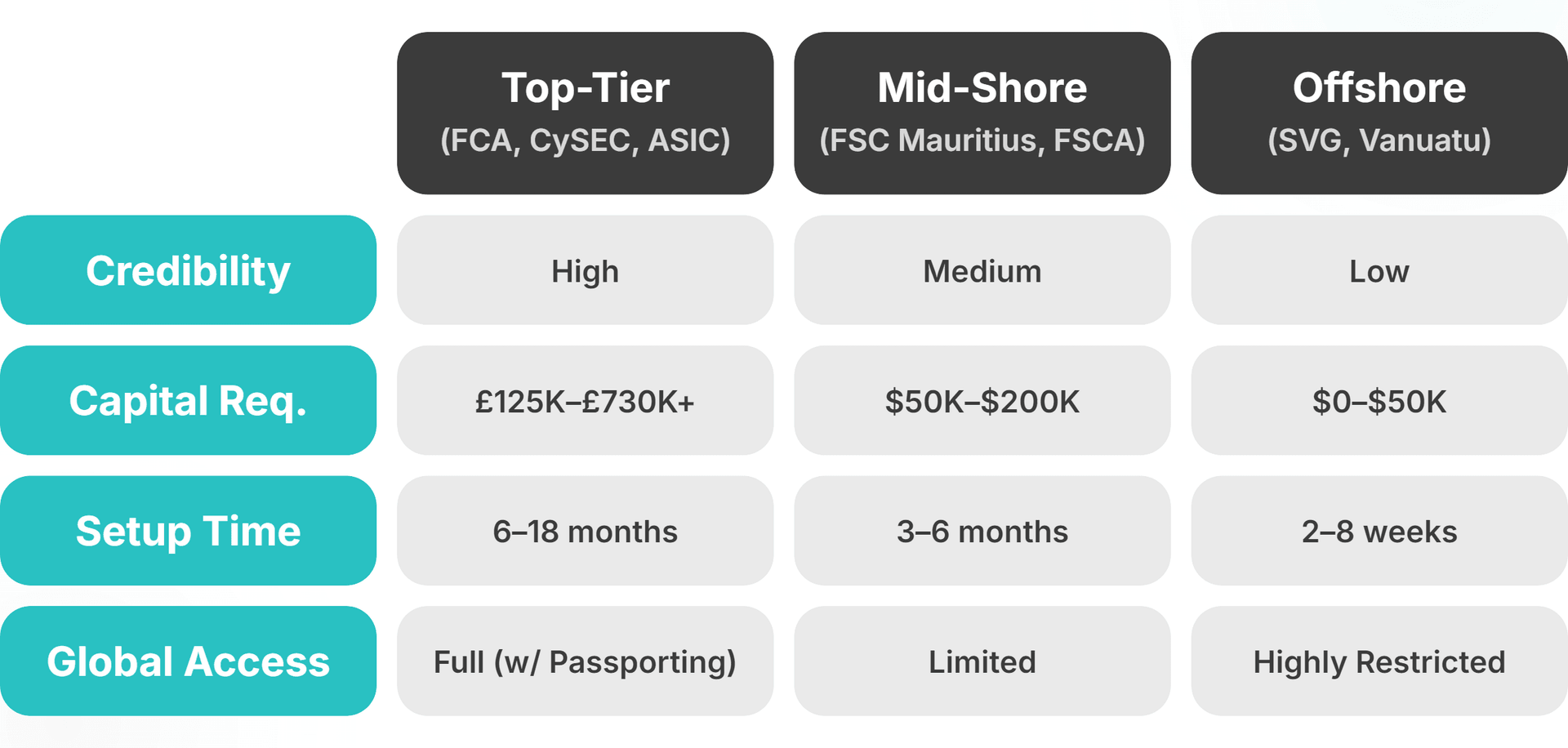
Mid-shore jurisdictions are a common stepping stone: lower barriers than top-tier, with enough credibility to build an operational track record that supports a future licensing upgrade. Offshore remains viable only for specific target markets and risk profiles where the access limitations are acceptable.
Technology Controls Regulators Expect From an FX White Label
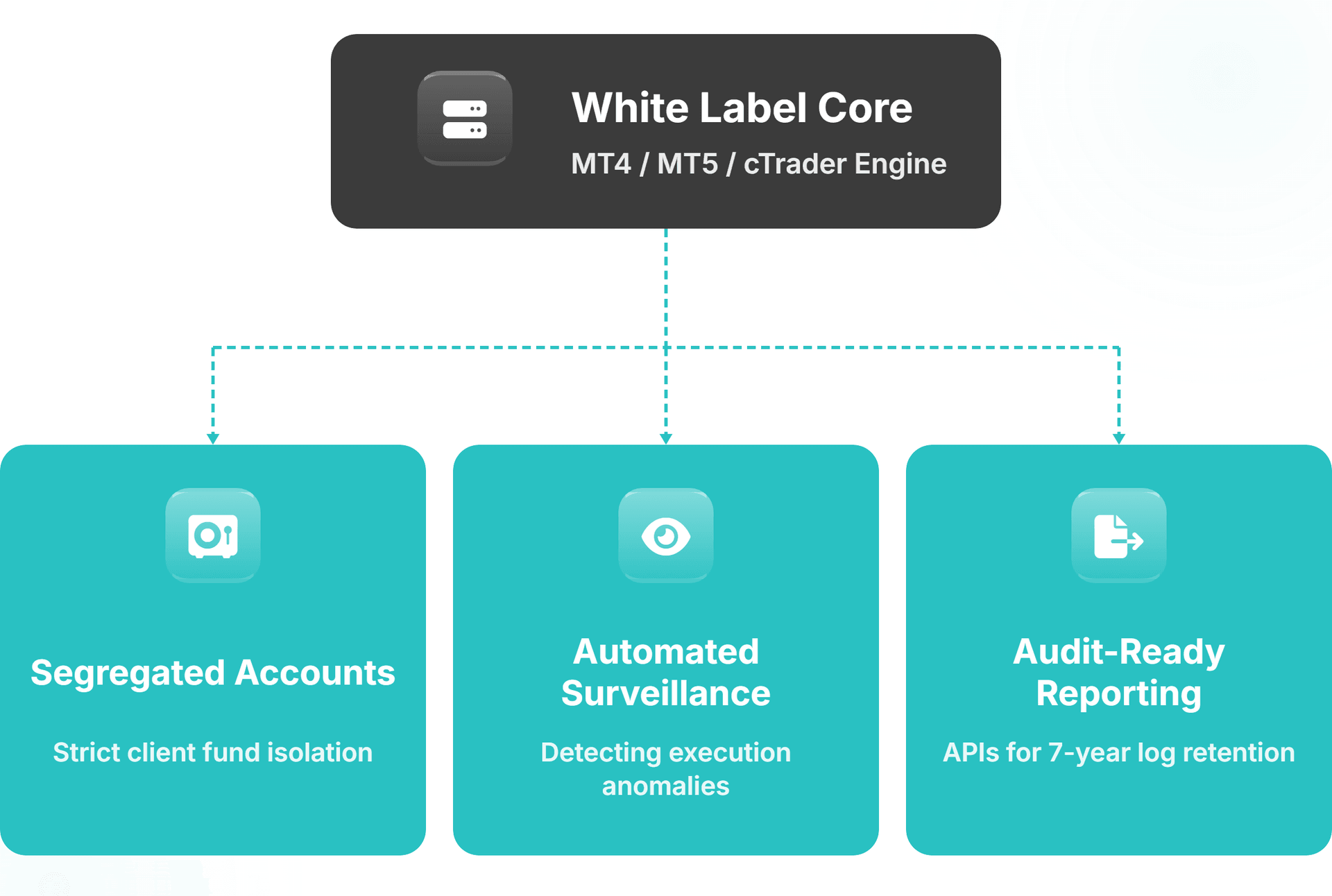
Regulators increasingly assess systems and controls alongside written policies. Auditability and client money handling receive the most scrutiny during examinations, with trade surveillance close behind.
Baseline Controls: Segregation, Surveillance, and Audit-Ready Reporting
Segregated account architecture keeps client funds separate from operating funds, with clear fund-flow records and daily reconciliation to prevent commingling. Regulators treat this as a baseline requirement.
Automated trade surveillance monitors execution quality and flags unusual patterns for documented investigation. Manual review without system support is not scalable and will not satisfy a regulatory audit as volumes grow.
Audit-ready reporting means APIs and exports that cover trades, communications, onboarding evidence, and compliance logs. Retention periods must align with jurisdictional requirements (typically five to seven years), and tamper-evident logging is expected where possible.
During vendor selection, verify what is native versus what requires configuration, and how quickly evidence can be produced under audit deadlines. B2BROKER's infrastructure provides the technical foundation for these controls, but configuration and accountability remain with the broker.
A well-chosen white label trading platform should deliver a strong user experience, multi-asset coverage (forex, CFDs, crypto), real-time pricing with charting tools, and technical support with defined response SLAs. Platforms that offer a turnkey solution with deep liquidity reduce setup time significantly, but they do not transfer compliance ownership to the technology provider.
Step-by-Step Launch Checklist for a Compliant White Label
1. Choose Jurisdiction and Legal Entity
Match jurisdiction to your target markets and available capital. Establish the legal entity with appropriate directors and, where applicable, local substance. Use specialized financial services counsel to avoid mis-scoping permissions or underestimating compliance expectations. Changing jurisdictions after launch can mean relicensing and migrating your entire client base, with significant operational disruption.
2. Select Platform and Liquidity Provider, Then Build Compliance Procedures
Evaluate providers on execution quality, liquidity depth, platform reliability, and how complete their compliance tooling is (KYC workflows, monitoring, reporting, record retention). Regulators increasingly treat platform capabilities as part of the systems and controls assessment, so check multi-asset coverage, real-time pricing, charting, and API connectivity as well. Build a documented compliance program covering AML/KYC, onboarding, complaints, best execution, and marketing approvals. Procedures must match the actual operational setup.
Decide on compliance resourcing (in-house versus external support) and define clear accountability for reviews and escalations, including who signs off with the regulator.
3. File for Authorization, Then Soft-Launch
Submit the license application with complete documentation. Use the authorization period to finish system integration and compliance testing, and to train the team. Soft-launch with a limited client set before full commercial rollout to validate that compliance controls work under real conditions before scaling volume.
4. Establish Ongoing Compliance Rhythms
Schedule quarterly compliance reviews and annual audits, with a standing process for monitoring regulatory updates. Assign clear accountability for regulatory filings and complaint handling. Ongoing compliance maintenance is predictably costed. Enforcement actions and remediation are not.
Start your Forex Brokerage in Weeks, not Months
All Technology, Liquidity & Payment Integrations Included
White-Label cTrader/B2TRADER with Full Back Office Support
Compliance-Ready Setup with Ongoing Technical Support
Launch With Confidence Using B2BROKER's White Label Infrastructure
Meeting white label forex broker regulations means building a brokerage that can retain banking relationships while scaling without existential regulatory exposure.
B2BROKER's white label solutions provide regulated infrastructure spanning cTrader and B2TRADER platforms, prime of prime liquidity across 1500+ instruments, B2CORE CRM with integrated KYC workflows, and audit-ready reporting APIs. The infrastructure is cost-effective relative to building from scratch: it reduces setup time and technical overhead while giving access to deep liquidity and fintech-grade compliance tooling. Pricing is structured around the brokerage's operational scale. B2BROKER supports a compliance-ready launch without replacing broker-owned governance, which is the distinction that matters when a counterparty conducts due diligence.
Our fintech solutions serve financial institutions and startup operators alike. The white label forex model remains one of the most accessible and capital-efficient routes into the forex market, provided the regulatory foundation is treated as a core business function rather than a cost to be minimized.
For founders and COOs evaluating their launch strategy, getting the regulatory foundation right from the beginning determines whether the business grows on a solid footing or eventually faces the costly remediation process under pressure.
Audit-Ready Infrastructure for Regulated FX Brokers
Secure the institutional liquidity and compliant technology stack you need to impress regulators and attract serious traders.
Frequently Asked Questions about Launching a White Label Forex Broker
- Does using a white label provider mean my brokerage is regulated by them?
No. A white label provider supplies technology and liquidity infrastructure, but regulatory accountability remains with the operating broker. You are responsible for your own AML/KYC program, client money handling, marketing compliance, and leverage controls, regardless of who provides your platform.
- What is the cheapest way to become a regulated forex broker?
Offshore registration through jurisdictions like SVG or Vanuatu carries the lowest upfront cost and fastest timelines. The trade-off is significant: EU, UK, US, and Australian clients are largely inaccessible, and banking and PSP acceptance is low. Mid-shore jurisdictions like FSC Mauritius offer a more credible balance between cost and market access.
- Can a CySEC license be used to serve clients across Europe?
Yes. CySEC authorization provides MiFID II passporting rights, allowing a regulated broker to provide services across EU member states subject to notification procedures and local requirements. That passporting access is a primary reason CySEC remains a popular route for European-facing white label brokers.
- How long does it take to get FCA authorization?
FCA authorization typically takes 12 to 18 months from application submission to grant, depending on the completeness of the application and the type of permissions requested. The process requires detailed business plans, compliance procedures, capital evidence, and fit-and-proper assessments for key individuals.
Recommended articles