What Should Brokers Look for in Commodity Trading Software?


Client demand for commodities keeps rising even as headline derivatives volume falls. Energy futures and options traded 3.79 billion contracts in 2025, up 30% from the year before, while total exchange-traded volume fell 42.2% on a collapse in equity options.
Commodity instruments do not behave like FX pairs. They carry expiration dates, quote in their own units, and move together in ways your margin engine has to model.
"Commodity trading software" also means retail broker rankings and CTRM systems for firms that move physical barrels. This guide covers neither. It works through what to check in the best commodity trading platform software, from feeds to the build-versus-buy math.
Key Takeaways
- Broker-facing commodity platforms run execution and client operations, while CTRM systems run physical trade logistics.
- Commodity expansion depends on normalized pricing feeds and exact contract controls for tick sizes, expirations, rollovers and settlement terms.
- Native cross-margin and collateral management frees capital across commodity, FX and crypto positions when the risk limits behind it stay testable.
- The CFTC has consulted on 24/7 energy futures and on perpetual energy contracts. Put both on the procurement checklist.
- A turnkey multi-asset platform shortens deployment and reduces vendor sprawl across liquidity, execution, CRM and back office.
Why Commodity Trading Software Means Something Different for Brokers Than for CTRM Buyers
Two unrelated product categories answer to the same phrase, a difference that decides which vendors belong on your shortlist.
CTRM, commodity trading and risk management software, runs the life of a physical cargo: trade capture, storage and freight, inventory, and settlement against delivered volume. A grain merchant or an energy major runs its business on it. A brokerage listing commodity CFDs or futures deals only in the price.
Your brokerage does something else. It sources liquidity, prices commodities to clients and holds margin against their positions, exactly as it already does for FX. Only the instruments change, arriving with expiration dates, delivery terms and session calendars of their own.
So compare platforms on how fast they match, how they margin a book holding gold next to EUR/USD, and whether the back office treats commodity positions the way it treats FX. A CTRM feature list answers none of that.
The Infrastructure Challenges of Adding Commodities to a Multi-Asset Platform
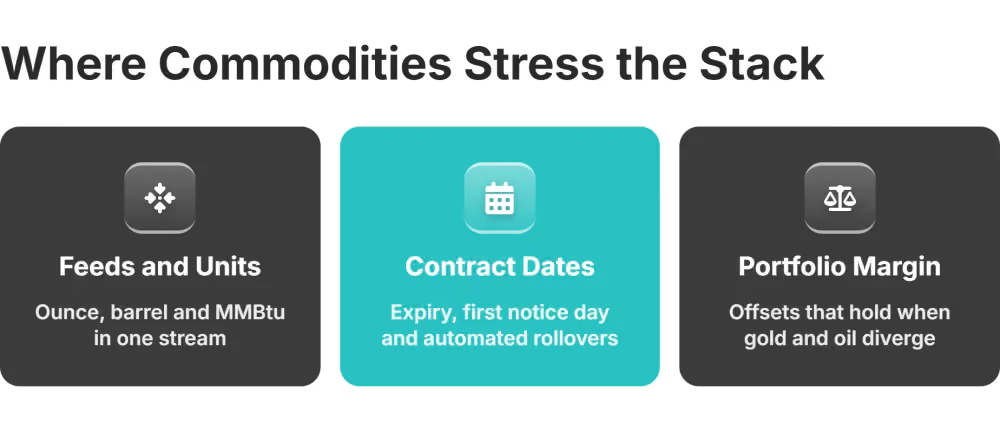
Commodities stress three parts of a working multi-asset stack. A checkbox reading "commodities supported" confirms that the symbols exist. It says nothing about what the platform does with them when the market moves.
Pricing Feed Sourcing and Normalization
Sourcing commodity prices is the easy half. Exchanges, futures venues and liquidity providers will all sell you a feed, but making them agree with each other is your team's job.
Gold trades per troy ounce, crude per barrel, natural gas per MMBtu. Each venue then adds its own symbols, timestamps and trading calendar on top. Until the platform reconciles units and sessions into one stream, your pricing engine is comparing quotes that do not describe the same thing.
So ask for evidence in the request for proposal: documented stale-quote controls, what happens when a feed drops, and latency percentiles measured during data releases rather than daily averages.
Contract Specification Management
Every commodity contract lives in the instrument master, where the date fields carry the risk. Tick size, lot size and quotation unit are easy to configure and easy to verify. Expiration, settlement type, holiday calendar and first notice day cost clients money when they are wrong, because no one sees the mistake until that date arrives.
A futures roll also has to reach every system at the same moment. When the front end moves to the new contract while the back office still books the expired symbol, positions go orphaned and profit and loss stops reconciling. With automated rollovers and consistent symbol mapping, the roll runs as a scheduled job and nobody opens a ticket.
Margin Model Design Across Correlated Assets
Margin is where your clients' commodity exposure becomes yours. Gross position margin treats every open trade separately, which is conservative and expensive. A correlation-aware model nets a long crude position against a short energy index and releases the difference to the client, which is efficient until those instruments stop moving together.
That efficiency needs hard limits around it. Look for configurable haircuts per instrument, concentration limits per client, and liquidation thresholds you can rehearse against a gap scenario before one arrives. Platforms built around cross-asset margin engines with unified risk dashboards handle this better than a module bolted onto an FX core.
Regulatory Trends Reshaping Commodity Platform Requirements
US regulators are weighing two changes that reach commodity platforms: how far margin can be netted across products, and whether energy futures will trade around the clock. Both went to public comment in mid-2026, so check where each stands before you build against either.
Cross-Margining and Portfolio Margining Proposals
On June 26, 2026, the SEC and the CFTC jointly asked the market how far portfolio margining and cross-margining should extend across securities and derivatives, setting a comment deadline of August 31 that year. The agencies describe the current structure, where related positions sit in separate accounts under separate margin rules, as one that leaves collateral stranded.
If offsets widen, your platform has to show which positions were netted, under which model, and with which collateral counted, jurisdiction by jurisdiction. That record also has to survive manual intervention. Ask who approves a margin model in production and where the platform logs an override.
The Shift Toward 24/7 and Perpetual Futures Trading
Most of the movement in commodity prices happens outside core trading hours. Over the twelve months to December 2025, COMEX gold futures returned 61.5% outside pit hours of 8:20 a.m. to 1:30 p.m. EST and lost 7.2% inside them .
The contracts are starting to follow the clock. In June 2026 the CFTC requested comment on extending standard energy futures to a 24/7 schedule , and on perpetual contracts referencing storable energy commodities such as crude oil. Industry requests then pushed the comment window out to August 26, 2026.
Continuous trading stretches the operating day into the weekend. Find out how the platform prices when liquidity thins but positions stay open, what funding logic applies to a contract that never expires, and who answers a margin incident at three on a Sunday morning.
Build vs. Buy: Deciding How to Add Commodities to Your Platform
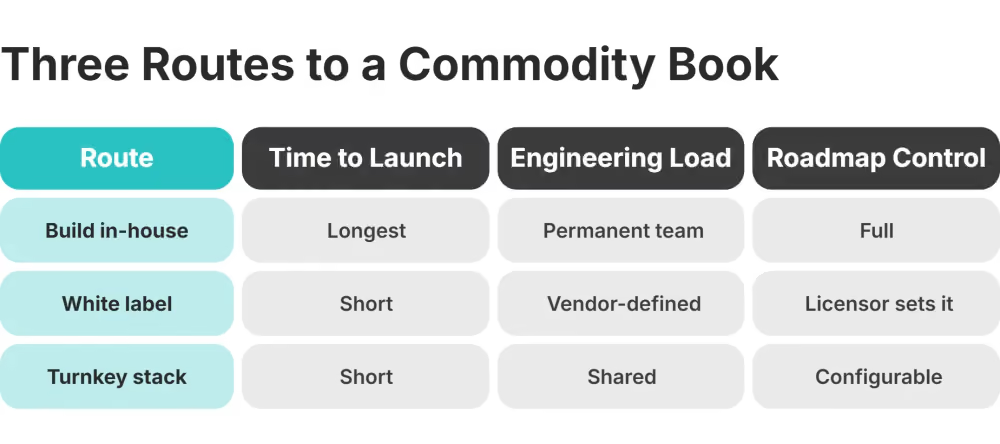
An internal build maximizes control and concentrates delivery risk on your team, while buying shortens the calendar and ties part of your roadmap to a vendor. The question is which of those risks your business can carry.
Whichever route you pick, price the operation as a whole. Market data, liquidity connectivity and compliance changes all recur. The first of those is the line you control least. Non-display licenses for firms operating trading platforms rose by as much as 481% between 2017 and 2024 at major European equity venues, against inflation near 24%.
Then count the revenue you miss for every month the commodity book is not live. A build that wins on the spreadsheet often loses once you add those months. The same math applies to choosing between a white label and custom development for the rest of the platform.

Key Criteria for Evaluating Commodity Trading Platform Software
The best commodity trading platform software is the one that fits how your desk already runs, so score production evidence rather than feature counts. Five criteria matter most, and each one needs proof attached.
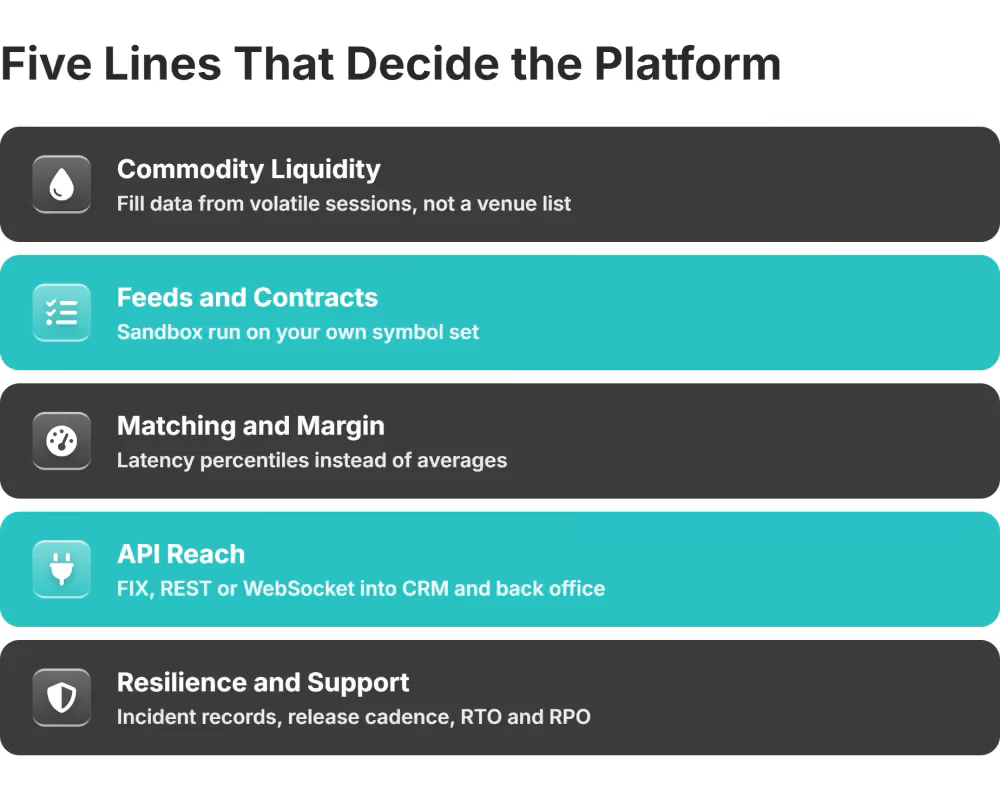
Weight them by what your desk trades most heavily, and treat anything the vendor cannot evidence as an open risk.
Talk to reference clients at comparable multi-asset volume about what broke rather than what worked. A wider view of what institutional-grade trading infrastructure has to deliver helps separate the claim from the record.
Native Cross-Margin and Collateral Management
Native cross-margin decides how much capital a client ties up with you. One account should hold the collateral behind their commodity, FX and crypto positions at the same time, with haircuts you set per instrument, per client and per concentration.
Test how the engine behaves under stress. Check real-time recalculation, partial liquidation and negative-balance controls during a price gap, then ask the platform to explain a liquidation after the fact. If your risk team cannot reconstruct why a position closed, it cannot defend the decision to the client or to a regulator.
How B2TRADER Supports Commodity Expansion Without Rebuilding Your Stack
The platform already running your FX and crypto books is usually the cheapest place to put commodities, because the client account, the collateral and the reporting stay where they are. B2TRADER is B2BROKER's platform in that class.
It carries cross-margin collateral management, per-trade leverage and per-second margin recalculation, with TradingView charting and a full web and mobile experience on the client side.
Its risk engine works to the margin call and stop-out levels you set. Below the stop-out level, it closes positions only until margin climbs back above your threshold.
Test each capability against your own scenarios. Because they arrive as one system, the connections between them are the vendor's work.
The surrounding systems connect natively:
- B2CONNECT covers the crypto side of the same book, with 20+ crypto liquidity sources behind it
- B2CORE holds the client accounts, wallets and statements behind those positions
- B2COPY adds copy trading, PAMM and MAM accounts on the same client base
With one vendor from quote to client statement, your team builds and maintains fewer integrations. Brokers already running MT4 or MT5 keep those platforms and add B2TRADER beside them. B2BROKER supports all three.
Build Your Commodity Offering on Infrastructure Designed to Scale
A commodity launch touches more than the platform. Feeds, margin models and reporting change together, and someone has to be on call for them. If you would rather not build all of that, choosing the best commodity trading platform software is choosing a vendor to run on for years.
Over that horizon, the vendor's history tells you more than a feature list. B2BROKER has been building brokerage infrastructure since 2014 and has helped launch more than 500 brokers, with over 1,000 corporate clients running on that infrastructure today.
If commodities are on the roadmap this year, the first decision is whether the stack you already run can carry them or whether you are about to buy a second one.
Frequently Asked Questions about Commodity Trading Software
Which platform is best for commodity trading?
For a brokerage, the right platform normalizes commodity pricing, controls contract specifications and margins positions at the portfolio level across commodities, FX and crypto. Connectivity into CRM, reporting and risk systems over FIX, REST or WebSocket matters as much as the trading screen.
What software do commodity traders use?
Brokerages run multi-asset execution platforms. Physical traders run CTRM software instead, built around trade capture, logistics and settlement. For CFDs or listed derivatives, the requirement is liquidity connectivity, a matching engine, contract lifecycle control and real-time margining.
Should brokers build or buy commodity trading platform software?
Building suits firms with unique market structure, proprietary risk logic and the engineering capacity for permanent maintenance. Buying usually wins on time to revenue, and the comparison should weigh total cost of ownership, integration risk and roadmap control rather than license fees alone.
Why does cross-margining matter for commodity trading platforms?
Netting offsetting exposures across asset classes releases collateral that would otherwise sit idle in separate accounts. The capability only holds up with configurable haircuts, dynamic leverage and an audit trail that explains every liquidation.
How does B2TRADER support commodity expansion?
B2TRADER adds commodity exposure to a multi-asset account that already carries FX and crypto, with cross-margin collateral and per-trade leverage on one risk engine. B2CORE, B2COPY and B2CONNECT connect client management, copy trading and liquidity inside the same ecosystem.
Recommended articles
Subscribe to our newsletter