Which Forex Brokerage Solution Fits Your Stack?


A brokerage platform decision made in a demo room tends to fail in production. The demo shows the interface. It says little about how the engine behaves under real order flow, what integration will cost, or who controls your access.
That last question stopped being theoretical in 2024, when a wave of MetaQuotes access cutoffs for firms on grey-label licenses left operators locked out of their own trading environments. Every layer you cannot inspect at the demo is a risk you inherit at launch.
That is what this guide is for: CTOs and COOs building a shortlist of the best forex brokerage solutions. It starts with an evaluation framework for the infrastructure layer, then applies it to six trading platforms operators actually deploy: MT4, MT5, cTrader, B2TRADER, DXtrade, and Match-Trader.
Key Takeaways
- A brokerage platform is an infrastructure commitment. The choice shapes your execution quality and your engineering workload for years after launch.
- Fragmented vendor stacks slow you down twice: each integration takes time to build, then keeps consuming engineering hours for maintenance.
- Evaluate the execution layer first. Matching engine throughput and API depth decide whether a platform survives growth; interface polish does not.
- Copy trading, PAMM, and MAM give a broker more than a feature checkbox. They raise client lifetime value and open the money-manager segment.
- White label deployment cuts launch risk, but vendors differ sharply in the quality of the stack underneath the label.
Why Platform Selection Is a Strategic Decision
Your platform choice fixes your execution architecture for the next three to five years. It also decides your liquidity integration model, your compliance reporting surface, and how much of your engineering capacity goes into keeping integrations alive instead of building product.
Vendor lock-in is the clearest commercial risk. Once your client base, IB relationships, and compliance documentation sit on top of a platform, the vendor controls your roadmap and your licensing costs. Brokers and prop firms hit by the 2024 MetaQuotes cutoffs had no direct vendor relationship to fall back on: access disappeared at the provider level, and recourse paths were thin.
Operational risk accumulates more quietly. When the trading platform , liquidity providers, CRM , and payments come from four different vendors, every new instrument group and every regulatory update touches several systems at once. Components with attractive individual pricing often produce an expensive total stack within the first year or two of operation.
The evaluation logic below works for a new launch and for a rebuild alike: judge the infrastructure commitment before the feature list.
If your brokerage itself is still on paper, this complete guide to starting a forex brokerage covers the licensing and operational groundwork that comes before any platform decision.
Key Criteria for Evaluating Brokerage Solutions
The questions that matter at the operator level rarely appear on a platform's marketing page. You need to know whether the engine holds up under a growing forex trading book, whether the platform connects cleanly to the rest of your stack, and who answers when something breaks at 3 a.m. Four criteria carry most of the weight.
Execution Infrastructure, Latency, and API Depth
Start with the matching engine. Execution speed expectations differ by segment: as a rule of thumb, retail flow tolerates execution measured in tens of milliseconds per fill, while institutional and high-frequency flows expect sub-millisecond and, at the top end, microsecond execution. Throughput matters most during volatility spikes in the forex market, because peak load is exactly when a weak engine drops orders, widens slippage, and inflates client trading costs.
API coverage decides how much glue code your team will write:
- FIX remains the institutional standard for order management,
- REST serves back-office and portal integrations,
- WebSocket feeds real-time market data.
A platform that offers only one of these layers pushes translation work onto your engineers, and that translation layer becomes yours to maintain.
Latency-critical institutional desks still colocate this layer next to liquidity venues and ECNs rather than run it from general-purpose cloud regions, which says a lot about how much these specifications matter at scale.
Check order type depth and risk management controls at the same time. The everyday trading tools matter too: sophisticated clients expect limit, stop, trailing stop, OCO, and conditional orders as a baseline. Position limits, margin checks, and circuit breakers should be configurable per account group rather than only globally.
Instrument Breadth and Multi-Asset Coverage
Brokers that launch with forex brokerage software commonly add crypto, indices, commodities, or metals soon after, as clients diversify across financial markets. The platform question is not whether those instruments appear in a catalog. It is whether currency pairs from EUR/USD to exotics, cryptocurrencies, and exchange-traded derivatives run through the same execution engine, account model, and risk framework.
Platforms that bolt on asset classes through middleware create a separate reconciliation problem for each addition. A natively multi-asset engine lets you list a new instrument group without adding a new system to monitor.
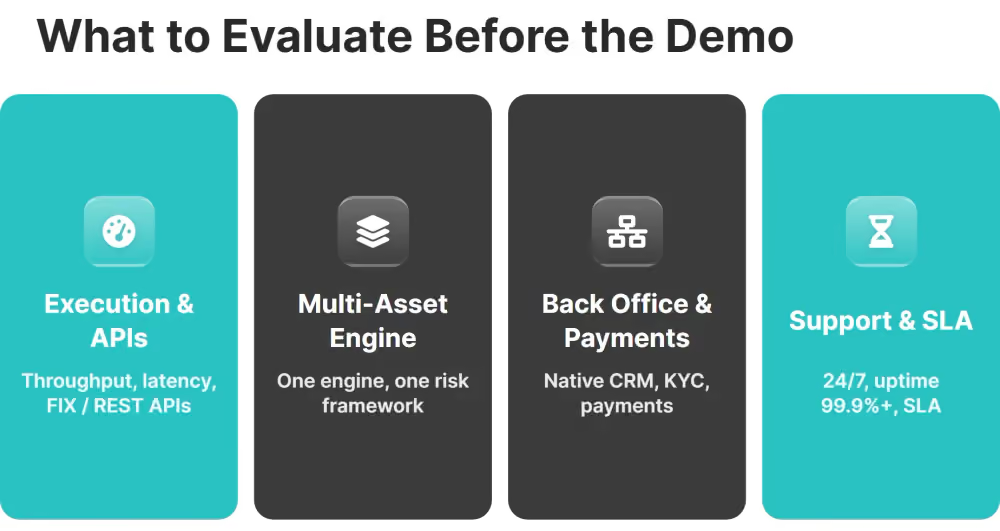
Back-Office, Compliance, and Payment Integration
CRM, KYC, billing, and payment connectivity decide how fast you onboard clients and how clean your audit trail stays. When trading events reach back-office records through custom synchronization scripts, those scripts fail under load and leave gaps that regulators read as compliance findings.
Native CRM connectivity moves the client lifecycle through one system: registration, KYC, first deposit, margin events, withdrawals. This is the layer a vendor demo account never stresses, and the one that breaks first at scale.
Payment integration deserves its own checklist. Verify which payment methods work out of the box, whether crypto processing is included, how minimum deposit rules apply per method, and how the vendor's pricing scales with your volume.
Vendor Support Model and SLA Commitments
Execution outages and liquidity drops rarely happen during business hours, so 24/7 support with documented escalation paths is a baseline requirement for a live brokerage. Best-effort support without a written SLA leaves you carrying risk you cannot quantify until an incident lands.
Read the SLA for specifics: an uptime guarantee of 99.9% or higher, response times per severity tier, and service credits when the vendor misses them. Ask about the roadmap too. You need to know whether compliance updates and API versioning stay on the vendor's plate or land on your team.
Top Forex Brokerage Solutions Compared
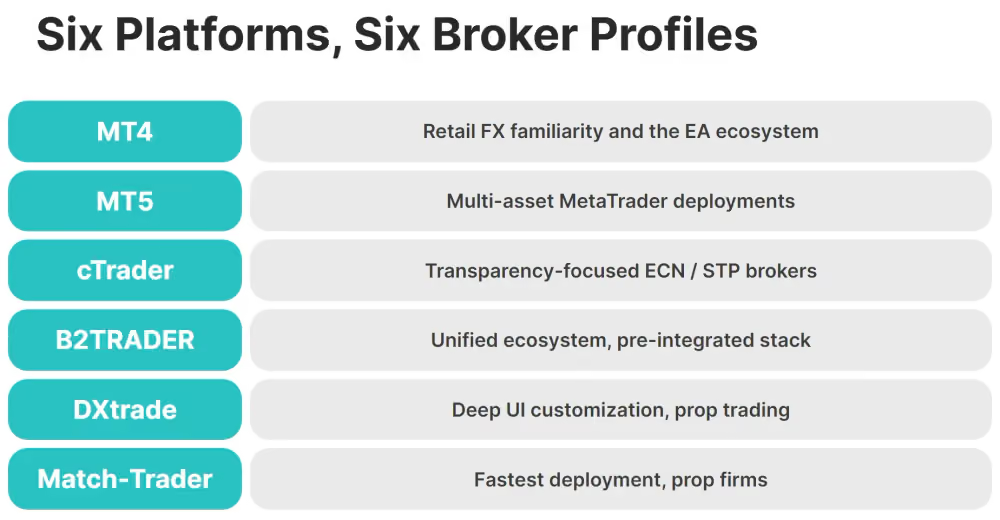
The six trading platforms below are the common shortlist candidates for a brokerage operator today. Each entry looks at deployment model, integration architecture, and the broker profile the platform fits best.
MetaTrader 4 (MT4)
MetaTrader 4 remains one of the most widely deployed forex trading platforms in the world, even though MetaQuotes long ago shifted its development focus to MT5 . Its grip on retail forex trading comes from an enormous expert advisor ecosystem, client familiarity, and two decades of liquidity bridges and back-office integrations built around it.
For a retail FX broker whose forex traders ask for MT4 by name, it remains a defensible choice. Its limits are structural: a far narrower multi-asset model than MT5, no switching between hedging and netting modes, and a dated trading experience for newer client segments. White label MT4 also carries the licensing dependency shared with MT5, since the broker operates through a provider rather than a direct MetaQuotes relationship.
Best for: retail FX brokers who prioritize client familiarity and the EA ecosystem.
MetaTrader 5 (MT5)
MT5 extends the MetaTrader line to equities, futures, and crypto CFDs, adds both hedging and netting modes, and ships a stronger back-testing environment. It is the current MetaQuotes flagship and the natural pick for brokers growing past core FX inside that ecosystem.
The licensing structure is the caveat. MT5 white label arrangements run through providers, and the 2024 disruption described above affected grey-label access on both MetaTrader platforms, leaving affected brokers without a direct recourse path. Plans that involve custom commission logic or cross-asset margin usually require middleware, which your team then maintains.
Best for: multi-asset retail brokers, especially those serving European and institutional segments.
cTrader
cTrader, built by Spotware, is designed around a native ECN/STP architecture , which makes trade execution transparency easy to demonstrate to sophisticated clients who judge a broker on tight spreads and fill quality. It is developed and licensed by Spotware, outside the MetaQuotes ecosystem, so that dependency question does not apply. Its cBots algorithmic framework and advanced charting appeal to experienced traders in the semi-professional segment.
Best for: ECN/STP brokers whose clients care about execution quality more than platform familiarity.
B2TRADER
B2TRADER is B2BROKER's multi-asset platform, built for brokerage operators. It supports nearly 5,000 live markets across asset classes, FIX and REST APIs, and setup measured in days.
Its real differentiator in this list is native ecosystem connectivity. B2TRADER links directly to B2CONNECT for liquidity aggregation, B2CORE for back office and KYC workflows, and B2COPY , which runs copy trading across B2TRADER alongside MT4, MT5, and cTrader. All four layers of the stack arrive pre-integrated on one vendor's architecture: trading, liquidity, back office, and copy trading.
The platform also includes cross-margin management, TradingView integration and charting, a mobile app, and a configurable commission engine.
Best for: operators building a multi-asset brokerage on a unified stack instead of assembled point solutions.
DXtrade
DXtrade is the white label trading platform from Devexperts, built cloud-native and known for deep interface customization. It supports FX, crypto, equities, and CFDs, with flexible product structure and pricing configuration, and it has gained real traction among prop trading firms. Plan for integration work, though: DXtrade ships without a bundled CRM or liquidity ecosystem, so back-office and liquidity connectivity run as separate integration projects.
Best for: brokers whose trading needs center on heavy UI customization and multi-asset breadth, particularly in prop trading.
Match-Trader
Match-Trader, from Match-Trade Technologies, is a cloud-native platform optimized for deployment speed. The prop trading space adopted it quickly because new operators there value fast go-to-market and rapid iteration on the trading environment. Against legacy MetaTrader deployments, its faster customization cycle is the main operational advantage.
Best for: new brokerage launches and prop firms that prioritize speed of deployment and configuration.
The B2BROKER Ecosystem Advantage
Comparing platforms one by one hides a second question: what does the rest of the stack cost you?
A brokerage runs on a trading platform, liquidity, CRM, payments, and often a copy trading module . In a fragmented stack, each pair of components meets through a custom integration with its own API contract, upgrade cycle, and failure mode. A change in any component ripples into regression testing and reconciliation checks across all of them.
B2BROKER ships that stack pre-integrated: B2TRADER, B2CONNECT, B2CORE, and B2COPY share one architecture and one vendor roadmap. The savings show up less at deployment and more in every quarter afterward, as integration maintenance that never lands on your team. The full picture of the stack is described in the guide to the best brokerage technology solutions available today .
Copy Trading, PAMM, and MAM With B2COPY
Copy trading looks like a trader-facing feature, but the strongest argument for it belongs to the broker. Managed trading gives a broker a lever on client lifetime value, keeps passive investors funded, and opens a client segment that an execution-only brokerage cannot serve: money managers.
B2COPY is B2BROKER's infrastructure for this layer, and deployment is measured in days rather than months.
Trade Replication and B2CORE IB Integration
B2COPY replicates trades from a single master account across MT4, MT5, cTrader, and B2TRADER at the same time. A broker running several platforms would otherwise need a separate copy trading system for each; cross-platform replication removes that duplication.
The B2CORE integration extends the IB model into social trading. Introducing brokers earn commissions on the copy activity of referred clients, not only on their direct trading volume, and the attribution runs through the existing IB module without custom development.
Social Trading for Brokers and Money Managers
Retention is the core commercial effect. A passive investor allocated to trading strategies that perform keeps a trading account funded far longer than an active trader riding their own losses, and funded accounts are what protect revenue during quiet markets.
PAMM and MAM open the professional segment. PAMM pools investor funds into one proportional account managed by a single trader. MAM keeps sub-accounts separate and lets the manager allocate positions per account with individual risk settings. B2COPY runs both models with configurable performance and management fees, and the fee calculations share a data layer with execution, so allocation records need no cross-system reconciliation.
White Label vs. Custom Development
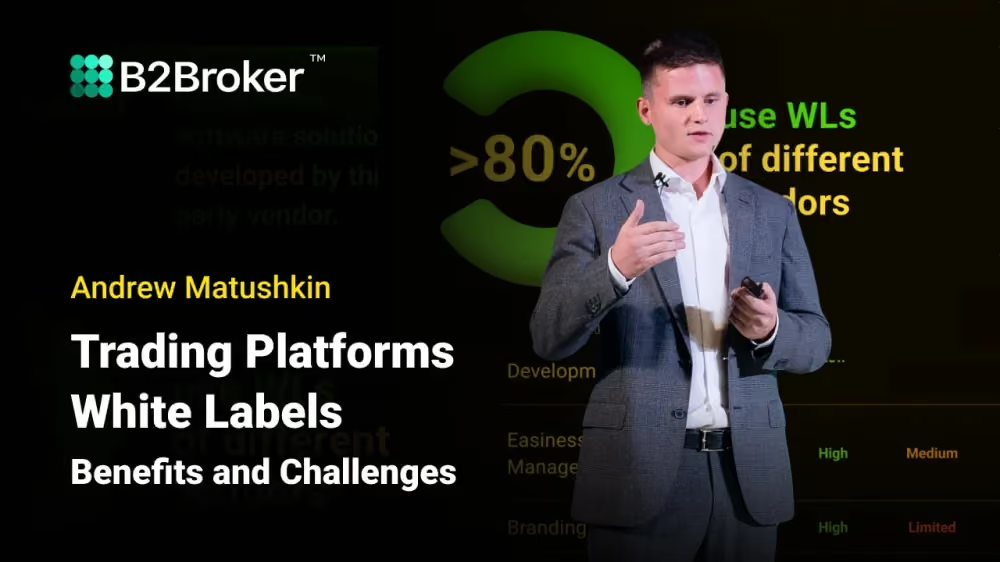
The build-or-buy question comes down to engineering capacity and risk tolerance. Custom development buys design freedom at the price of a permanent engineering commitment that few brokerage operators can sustain . White label compresses risk and time-to-market.
Time-to-Market and Deployment Risk
A slow build defers everything at once. Revenue waits, the track record you need as a regulated broker waits, and so does the product feedback that tells you what clients actually want.
White label infrastructure turns that construction project into a configuration project. B2COPY reaches full API deployment in two to four weeks, with widget-based setups live in as little as five business days, and B2TRADER setup is measured in days rather than weeks. A custom matching engine build keeps you waiting a year or more before the first client trades on it.
Custom builds also hide a maintenance bill: API versioning, security audits, performance tuning under production load, and compliance updates continue for the life of the system. For most operators, that ongoing cost overtakes the expected savings within a few years of launch.
Build Your Brokerage on Infrastructure That Scales
Platform selection is the one brokerage decision whose consequences compound the longest. The framework above narrows it to the variables that matter at the infrastructure level: execution capability, multi-asset architecture, back-office integration, and vendor accountability. Run every shortlist candidate through those four filters before a demo impresses anyone.
B2BROKER's answer to the framework is a single integrated stack: B2TRADER for multi-asset execution, B2CONNECT for liquidity, B2CORE for CRM and back office, and B2COPY for managed trading, backed by 24/7 support and documented SLAs. If you are weighing that stack against a multi-vendor build, the fastest way to test the fit is a direct conversation.
Frequently Asked Questions about Forex Brokerage Solutions
What features matter most when comparing forex brokerage software vendors?
Execution infrastructure, API depth, and ecosystem integration decide more than interface features. Check matching engine throughput and FIX/REST/WebSocket coverage first, then how the platform connects to CRM, payments, and liquidity.
How do brokers compare MT4, MT5, cTrader, and newer alternatives like DXtrade or Match-Trader?
Each platform maps to a broker profile: MT4 for retail FX familiarity, MT5 for multi-asset MetaTrader deployments, cTrader for transparency-focused ECN/STP models. DXtrade and Match-Trader favor cloud-native deployment speed, while B2TRADER connects natively to liquidity, back office, and copy trading in one stack.
Which forex platforms support copy trading, PAMM, or MAM for brokers?
Most platforms rely on third-party integrations for managed trading. B2COPY replicates trades across MT4, MT5, cTrader, and B2TRADER simultaneously and plugs into B2CORE's IB module, so introducing brokers earn on copy activity within one ecosystem.
Should a broker choose a white label platform or build custom infrastructure?
White label wins on deployment risk and time-to-market for most operators, and the deciding variable is the quality of the vendor's underlying stack. Custom development pays off only when configuration genuinely cannot meet the product requirements.
How important are CRM, back-office, and payment integrations in a brokerage stack?
They are core infrastructure, not add-ons. Fragmented vendor stacks accumulate integration overhead and reconciliation risk with every added component, while an integrated stack keeps onboarding, compliance workflows, and client lifecycle data in one system.
Recommended articles
Subscribe to our newsletter