Data Center Latency: What It Is and How to Minimize It

In the fast-paced ecosystem of modern financial technology, data center latency is the invisible hand that either secures a profitable trade or leaves a strategy suffering from slippage.
Data center latency is the delay between initiating a request and receiving a response. In standard environments, this delay is measured in milliseconds (ms), but in highly optimized trading infrastructure, it is relentlessly tracked down to microseconds.
This is a critical performance metric for brokerages, trading desks, and fintech firms, where execution speed directly impacts profitability and client satisfaction. With increasing market demand and trading volumes, network latency has become a concrete execution issue for dealing desks.
This article offers a practical overview of latency and its sources. We will explore key fundamentals, diagnose the core sources of delay within facilities, outline brokerage-specific requirements, and detail actionable optimization approaches that platforms can deploy to safeguard their execution quality.
Key Takeaways
- Data center latency directly affects trade execution quality, with slippage potentially costing brokers significant revenue.
- Four primary latency sources, including propagation, processing, queueing, and storage, each require distinct optimization strategies.
- Low-latency data centers positioned near liquidity venues and equipped with direct cross-connects can reduce round-trip times.
- Continuous monitoring with microsecond-precision tools allows brokers to identify latency spikes before they impact client trades.
What Is Data Center Latency?
Data center latency is the total time delay required for data to travel across data center components, from the exact moment a request is initiated to the precise instant a response is received.
Normal delay within a localized facility typically ranges from tens to hundreds of microseconds. However, when a network experiences sudden congestion, hardware bottlenecks, or packet loss, these values can spike dramatically into the milliseconds, compromising execution quality.
In networking terms, the standard measurement for this is round-trip time (RTT), which encompasses all hops, processing steps, and physical distances a packet must traverse before the originating server receives an acknowledgment.
It is a common pitfall to confuse latency with bandwidth. Bandwidth, or throughput, measures the volume capacity of data transferred over a network connection within a given timeframe. Latency strictly measures the time it takes for an individual request to complete.
For example, a brokerage might possess massive bandwidth capabilities, but if the latency is high and orders take longer to appear on the trader’s dashboard, trade execution will still suffer.
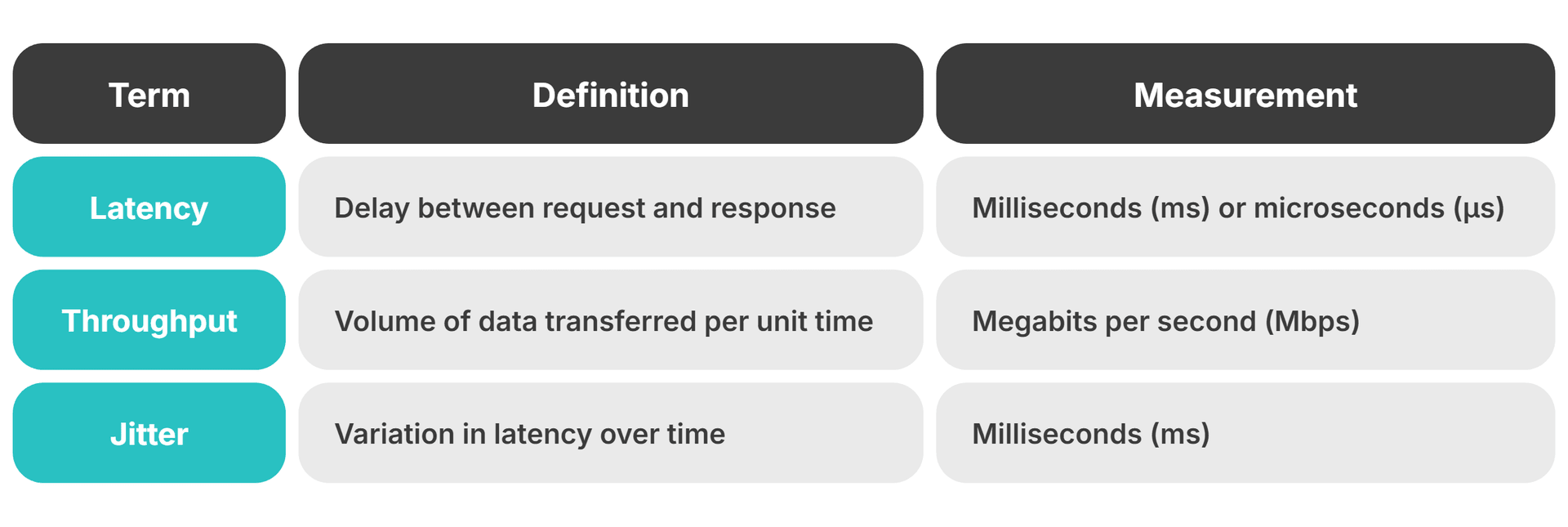
Let’s compare latency, throughput, and jitter as key data center metrics.
Low Latency Data Centers and Trading Performance
There is a clear connection between data center latency and trading outcomes. When an order is routed to a liquidity provider or an exchange, the microseconds it takes to cross the network dictate the execution quality.
In highly volatile instruments, microsecond delays directly correlate with diminished fill rates and increased slippage. By the time a delayed order reaches the matching engine, the optimal price may have already been consumed by a faster market participant.
The impact of these delays is highly quantifiable because even a fractional increase in latency can bottleneck throughput and create a measurable, compounding disadvantage relative to faster competitors.
In modern algorithmic trading, if your execution stack operates just a few milliseconds behind the market average, your strategies are essentially trading on historical data rather than real-time conditions.
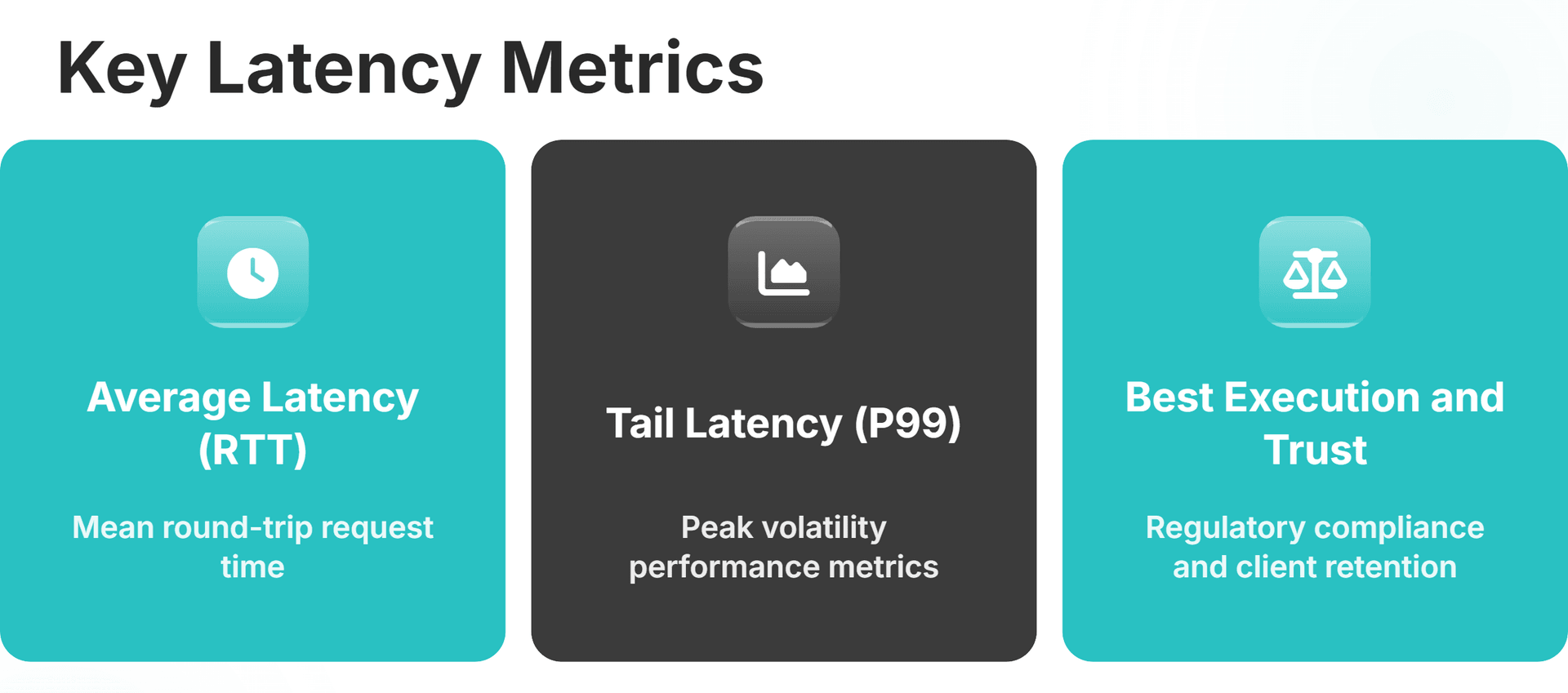
Consequently, low-delay data centers have become essential for multi-asset platforms or brokerages serving institutional clients. When evaluating this infrastructure, average latency is merely a baseline; the true test of a trading network is its tail latency.
Tail latency refers to the 99th (p99) or 99.9th (p99.9) percentile values during peak market volatility. During sudden market shocks, p99.9 latencies can surge to 80 to 120 times their median values. A network that averages 50 microseconds but spikes to 5 milliseconds during high volume is unsuitable for serious trading.
Ultimately, response optimization is a vital competitive differentiator. It supports long-term client retention, builds institutional trust, and enables brokerages to successfully sustain premium execution service tiers.
Core Sources of Latency Inside a Facility
Achieving ultra-low latency requires serious precision diagnostics and strategic platform optimization. Delays compound within data center environments through four distinct sources: propagation, processing, queueing, and storage. Understanding the mechanics of each source enables you to apply targeted, highly effective optimization strategies.
Propagation Paths
Propagation latency is the time it takes for data signals to travel physical distances, which is heavily influenced by the type of cabling utilized and the length of the path the data must take.
In high-performance environments, fiber optics are heavily favored over traditional copper cabling because they significantly reduce signal attenuation. However, the geographic distance between brokerage servers, network switches, and external liquidity venues remains the ultimate arbiter of propagation delays.
As such, if your matching engine is located in London and your liquidity provider is in New York, the trans-Atlantic fiber dictates a hard physical limit on your RTT. Even inside a single facility, careful attention to facility layout and direct cable routing decisions has measurable implications.
Processing Overhead
Processing latency is the time servers, routers, or switches require to inspect, handle, and route data requests. This delay is affected by CPU load, the efficiency of the software stack, and the complexity of the routing logic.
Standard software processing in a well-optimized network introduces delays ranging from 1.2 to 3.8 microseconds per hop. However, by transitioning to hardware-accelerated solutions like P4-programmable switches, dealing desks can drive processing overhead down to 0.3 to 0.5 microseconds.
As such, processing optimization is a high-impact endeavor for brokerages that run complex order-routing protocols or pre-trade risk-management practices. This becomes highly critical in HFT settings or during peak activity, where task complexity and concurrent workloads can amplify processing delays if the architecture relies solely on CPU-bound software.
Queueing and Buffer Bloat
Queueing latency introduces delays when a data packet is forced to wait in hardware buffers during periods of sudden network congestion. In a trading environment, this is most dangerous when it escalates into buffer bloat.
Buffer bloat occurs when network equipment is configured with oversized buffers that do not drop packets during congestion, instead queuing them endlessly. Ultimately, this can wildly inflate delays by 100 to 1000 times, turning a stable 10-millisecond connection into a sluggish 200- to 500-millisecond bottleneck.
Queueing issues rarely manifest as consistent delays. Instead, they appear as sudden delay spikes during critical market events when order bursts create temporary congestion, making them notoriously difficult to diagnose.
Storage and I/O Waits
Storage latency encompasses the delays stemming from disk seek times, input/output (I/O) waits, and cache misses when an application accesses persistent data.
For a brokerage, database queries for client balances, trade logging operations, and mandatory compliance recording all continuously contribute to storage-related delays.
The physical medium matters. Solid-state drives (SSDs) offer massive advantages over traditional Hard Disk Drives (HDDs) by eliminating mechanical seek times. To push storage delays even lower, sophisticated caching strategies and storage architectures offer significant optimization opportunities for data-intensive operations.
Optimize Your Execution Speed
Get top-tier execution quality that retains traders and enhances the user experience.
What Are Data Center Latency Requirements for Brokerages?
Latency requirements vary depending on the target market, asset classes traded, and the broker’s strategic positioning.
- For standard retail brokerages, sub-100 millisecond latency is generally acceptable and will not trigger significant client friction.
- For enterprise-grade platforms, expectations increase, and institutional investors expect sub-10-millisecond execution times.
- For high-frequency trading firms, ultra-low-latency infrastructure is required to operate consistently in the sub-1-millisecond range.
These requirements are dictated heavily by asset classes and client expectations. Furthermore, meeting latency requirements consistently is far more vital than achieving occasional, localized low values.
For example, a trading platform that reliably delivers 5-millisecond execution is far superior to a system that fluctuates between 1 millisecond and 50 milliseconds.
Finally, consistent response time is increasingly viewed through the lens of regulatory compliance, directly impacting a brokerage’s ability to fulfill its best execution obligations.
Five Strategies to Build a Latency Optimized Data Center
Minimizing latency requires a holistic, multi-layered approach. Implementing intelligent network policies alongside physical edge proximity can reduce RTT by up to 30% compared to legacy architectures. The following five strategies represent a progression from foundational infrastructure decisions to operational excellence.
1. Edge or Metro-Proximate Placement
The most reliable method for reducing propagation delay is to minimize the physical distance data must travel. By positioning infrastructure closer to end-users and major liquidity venues, brokerages can eliminate vital milliseconds from their RTT.
Standard industry studies on Content Delivery Networks (CDNs) and edge computing consistently demonstrate that bringing processing power closer to the request origin reduces network travel time. This makes metro-proximate placement particularly valuable for regional brokerages.
However, placement decisions involve trade-offs between latency, operational costs, and regulatory jurisdictions.
2. Direct Cross-Connects to Liquidity Venues
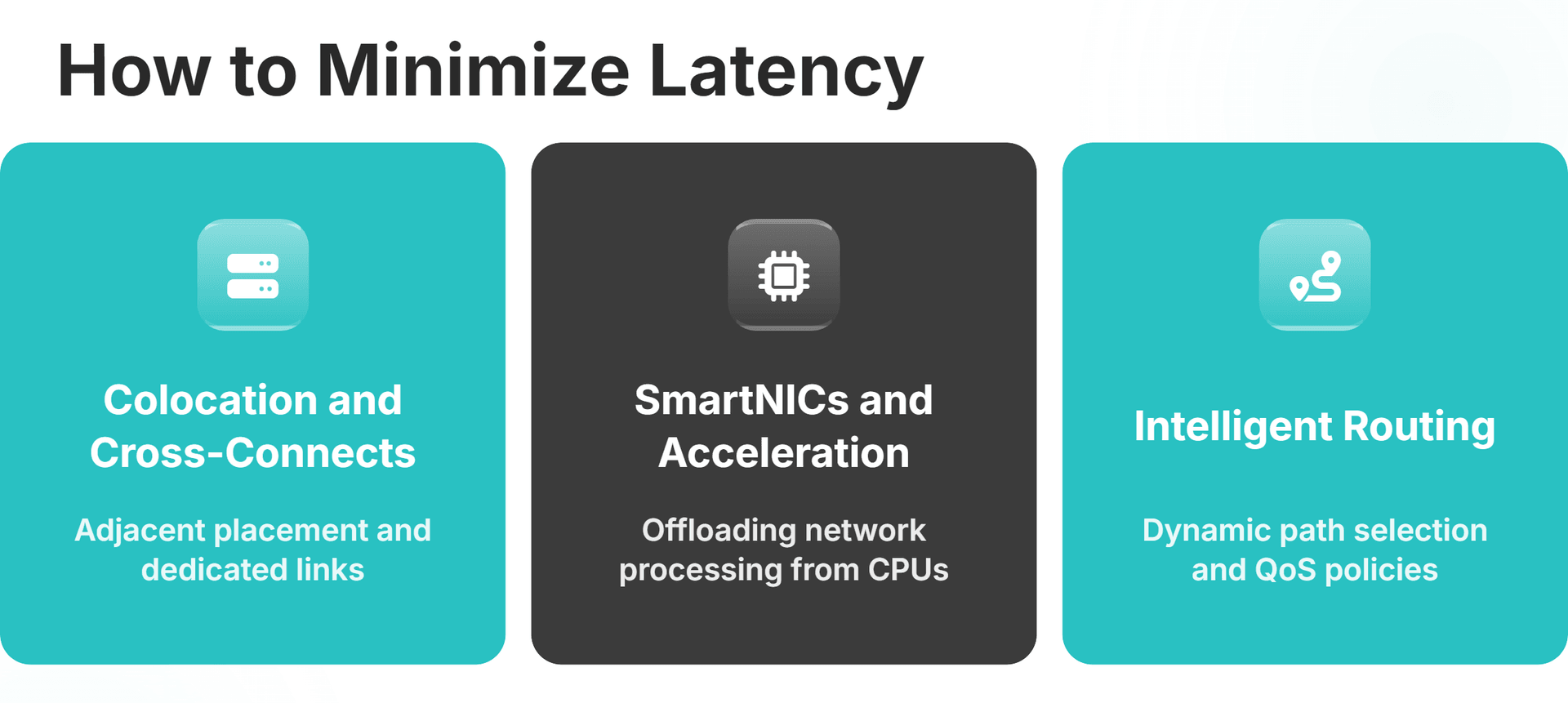
A cross-connect is a dedicated physical cable linking a brokerage’s infrastructure directly to a liquidity provider’s equipment within the exact same colocation facility. By bypassing the public internet entirely, cross-connects drastically reduce total latency and connection variability.
When building an institutional-grade execution stack, establishing direct cross-connects is standard operating practice. However, the feasibility of this strategy relies heavily on choosing a colocation facility that already maintains deep relationships with major exchanges.
3. Hardware Acceleration and SmartNICs
When processing overhead represents a dominant latency bottleneck, brokerages must move beyond traditional CPU-based networking.
Hardware acceleration utilizes Smart Network Interface Cards (SmartNICs) and P4-programmable switches to offload network processing tasks away from primary CPUs.
The devices handle routing at the hardware level, reducing latency to fractions of a microsecond. Such an investment is well-suited to brokerages that rely on high-speed key-value stores or machine learning inference engines.
4. Intelligent Routing and Quality of Service Policies
Quality of Service (QoS) policies are essential configurations that prioritize latency-sensitive trading traffic over background operations. When pairing QoS with the intelligent routing approach, brokers access dynamic network path selection based on real-time congestion and response metrics.
Moving further, AI and DRL-based scheduling algorithms can proactively predict workload bursts and dynamically reroute traffic to maintain pristine response times during market shocks.
5. Continuous Monitoring and Fine-Tuning
An optimized data center is never truly finished. You must continuously monitor metrics and peak performance output as network conditions organically change.
Brokerages must deploy microsecond-precision tracking tools, such as PTPmesh or PTPd, to track latency and packet loss within production environments. Moreover, proactive monitoring allows engineering teams to identify infrastructure degradation long before it negatively impacts client trades.
By establishing rigorous execution baselines and setting automated alerting thresholds aligned with service-level commitments, brokerages guarantee that their execution edge remains sharp.
Power your Brokerage with Next-Gen Multi-Asset & Multi-Market Trading
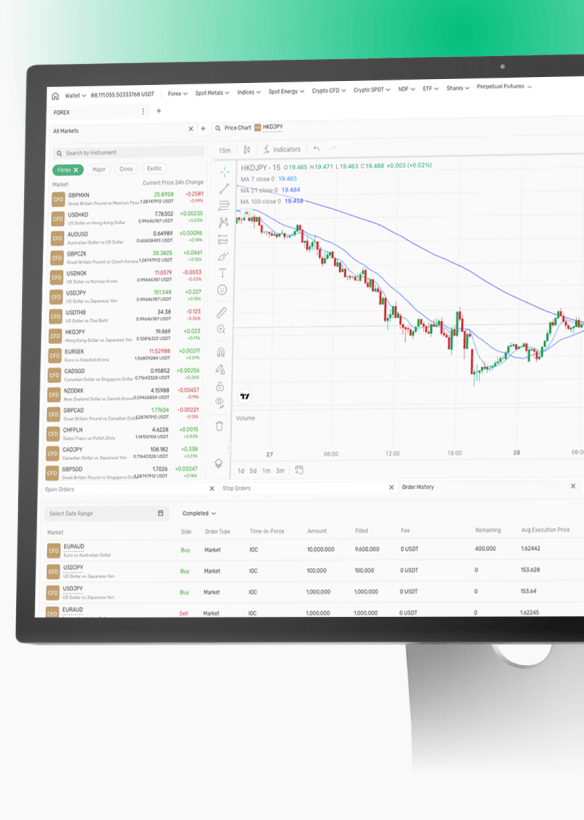
Advanced Engine Processing 3,000 Requests Per Second
Supports FX, Crypto Spot, CFDs, Perpetual Futures, and More in One Platform
Scalable Architecture Built for High-Volume Trading
Partnering With B2BROKER for Ultra-Low Latency Execution
Building and maintaining an ultra-low-latency infrastructure from the ground up requires substantial capital expenditure and deep networking expertise. B2BROKER seamlessly addresses these requirements by offering strategically positioned data centers and pre-established, direct cross-connects to premium liquidity venues.
Beyond connectivity, B2BROKER provides a complete, high-performance ecosystem, from multi-asset liquidity aggregation to enterprise-grade CRM systems and secure wallet infrastructure.
With comprehensive 24/7 technical support and continuous platform optimization, you gain ongoing operational value well beyond the initial deployment phase. By partnering with a dedicated infrastructure provider, you can confidently scale global trading operations while maintaining the pristine latency performance of key industry players.
Upgrade your Execution Infrastructure Today
Achieve institutional-grade execution without the burden of building the architecture from scratch.
Frequently Asked Questions about Data Center Latency
- What is latency for data centers?
Data center latency is the delay between sending a data request and receiving a response, typically measured in milliseconds or microseconds, arising from signal travel, processing, queueing, and storage operations within the facility.
- What is considered high latency in trading?
For institutional trading, latency above 10 ms is generally considered high, while retail platforms may tolerate up to 100 ms, though latency-sensitive strategies often target sub-millisecond execution.
- Can virtualization increase latency?
Yes, virtualization can add processing overhead through hypervisor layers and resource contention, which often increases latency versus bare-metal for the same workload.
- Which latency is better, 40 or 60?
40 ms is better than 60 ms because the lower latency means faster request completion, which generally improves execution speed and reduces slippage risk.
- Is 100 ms latency bad?
For many retail trading experiences, 100 ms can be acceptable, but it is typically too slow for institutional execution expectations and fast-moving market conditions where speed materially affects outcomes.