The Best Crypto Trading APIs for Brokers


A CTO scoping a trading venue starts with a ranked list of crypto APIs, comparing free tiers, SDK quality, and rate limits. That comparison is a reasonable start when one venue still holds most of the flow.
Binance's spot share fell from a 67% peak to 25.9% between February 2023 and May 2026, and the rest of the volume now sits with competing centralized and decentralized venues. A brokerage searching for the best crypto APIs for trading is choosing how client orders will reach that spread, and which counterparty answers when a venue throttles under load.
This guide sorts the options into three tiers, shows where each stops carrying brokerage order flow, and closes with a build-versus-buy view.
Key Takeaways
- Market-data feeds, single-exchange execution APIs, and institutional infrastructure solve different jobs; classify before comparing products.
- Institutional order routing needs FIX sessions, because REST and WebSocket do not guarantee message order or recovery.
- Every point API fragments liquidity and leaves your team another integration to maintain whenever a venue changes something.
- Judge providers on measured latency, contractual SLAs, and regulatory standing before documentation or price.
- One integrated stack cuts vendor count and shortens the launch calendar.
Why 'Best Crypto API' Searches Undersell What Brokerages Actually Need
API rankings measure developer convenience. A venue operator answers for p99 latency during a volatile open and for the records it can produce when a client disputes an execution. Neither shows up in a comparison of docs.
Treat the choice as an RFP for your future order flow. Ask who owns execution when a venue throttles and how the system recovers after a disconnect, because that work lands on your team.
The Three Tiers of Crypto Trading APIs and Infrastructure
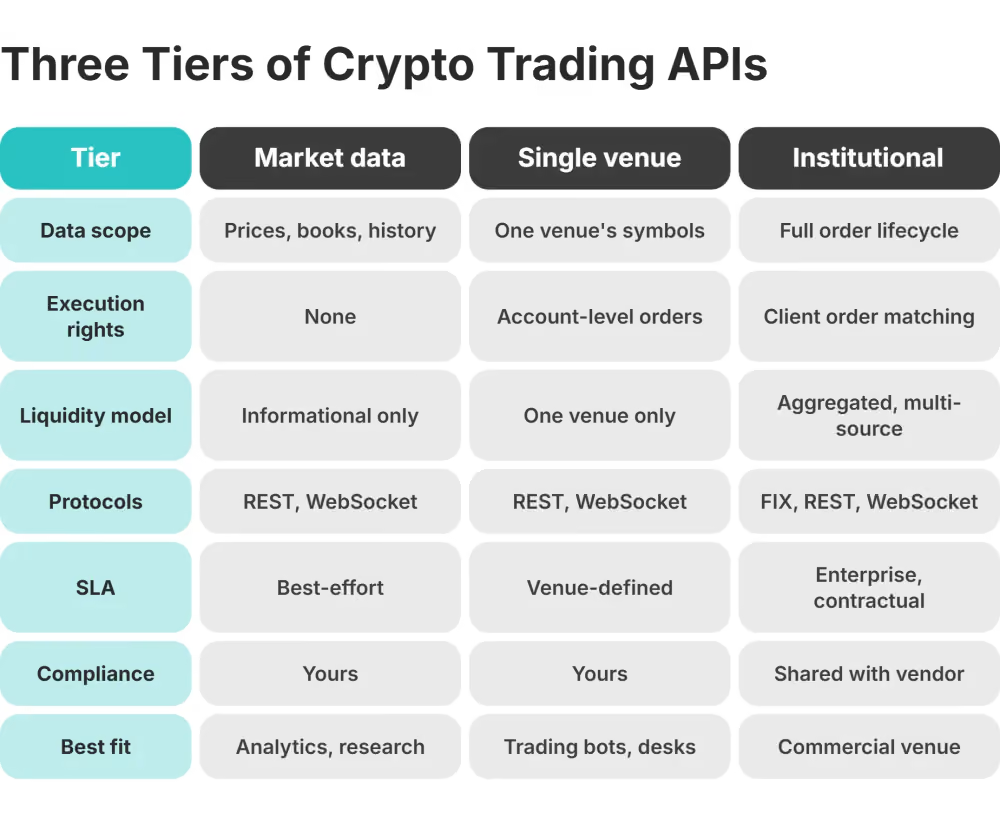
Crypto trading APIs fall into three tiers with different jobs. Lists of the best crypto APIs for trading usually mix all three, which is how a venue build gets under-scoped.
The tier you pick decides how much of the venue your team still has to build.
Market-Data APIs for Price Feeds and Analytics
A market-data API reports prices, books, and trades across venues. Real-time data arrives over a WebSocket; historical data is a download you use for backtesting. Neither lets you place a client order.
CoinGecko and CryptoCompare sit in this tier, rewriting each venue's OHLCV candles and trade prints into one schema. Judge the feed by whether it keeps ticks through a volume spike. Dropped ticks corrupt every model and dashboard you build on top. Check the redistribution rights before those prices reach a client screen.
Single-Exchange Execution APIs
A crypto exchange API places and cancels orders on one venue. Your clients then trade on that venue's terms. An outage halts their orders, and a throttle during a volume spike leaves them queued. Every exchange also sets its own rate limits. The Binance API meters each REST call by weight and caps the total you can spend per minute.
Read the venue's own documentation, such as the Crypto.com Exchange API , to see what its API actually allows. Then test API key authentication and order-state recovery in its paper trading sandbox, with enough traffic to hit those limits.
Institutional Liquidity and Matching-Engine Infrastructure
This is the tier a client-facing venue runs on. It puts liquidity aggregation and a matching engine behind the API. Back-office integration and enterprise support can sit in that contract too.
Request the same scorecard from every candidate:
- p95 and p99 latency under sustained load
- fill and reject ratios in calm and volatile sessions
- supported order types and order book depth at your trade sizes
- documented failover tests with recovery time objectives
- a support escalation path with named contacts
Choosing the liquidity provider sets the ceiling on execution quality for every client.
Where Point APIs Break Down at Institutional Scale
Point APIs hold up until client flow crosses venues and systems. A proof of concept feels complete because it never carried real volume.
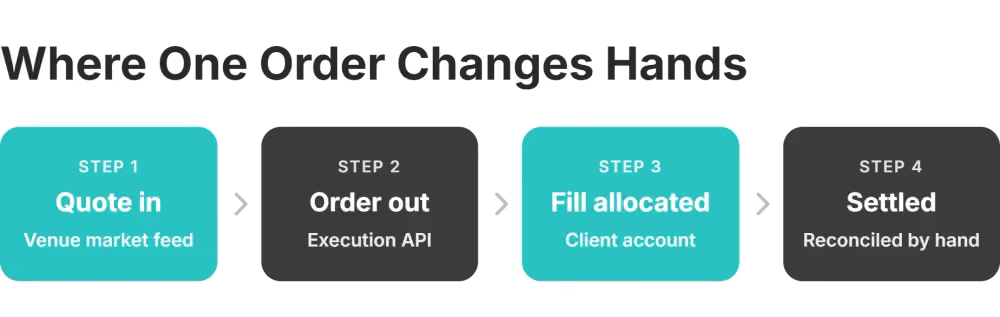
Trace one client order through that stack. Each system in the path hands the order to the next, so every handoff adds latency and one more way to fail. A loud failure pages someone, while a silent mismatch waits in the books until an operations analyst finds it by hand.
Fragmented Liquidity Across Trading Venues
Every isolated venue connection multiplies what your team must keep consistent. Each venue names trading pairs its own way and holds separate balances and collateral, so your team normalizes all of it before quoting one client price.
Evaluate the combined book under stress, because a market order fills against whatever depth exists at that moment. Executable depth at the size you trade tells you more than headline volume. Redundant sources are what keep prices flowing when one venue drops out.
Missing FIX Protocol for Institutional Order Routing
REST and WebSocket handle account administration and streaming data. Institutional order routing usually runs over a FIX 4.4 or 5.0 session instead. Every message in the session carries a sequence number, and if the connection drops, your system and the venue can name exactly what went missing. Kraken and Coinbase run FIX gateways alongside their REST and WebSocket API endpoints, because high-frequency trading desks want that recovery in the protocol rather than in your code.
Make the provider demonstrate the two failure paths before you certify the session: sequence recovery after a forced disconnect, and cancel-replace while quotes are moving. A provider that cannot script that demo will debug those paths against your live flow.
Regulatory Credibility as a Core Selection Criterion in 2026
In 2026, regulators decide which counterparties a venue can build on. An API cannot substitute for the license and client-asset controls the operator must hold.
The FCA finalized the UK's cryptoasset regime in June 2026 with five policy statements spanning authorization, custody, and financial-crime rules. Existing money-laundering registrations will not convert automatically. Firms that want transitional cover must apply between September 30, 2026, and February 28, 2027, before the regime comes into force on October 25, 2027. IOSCO asks member regulators to hold crypto service providers to the same regulatory outcomes as traditional markets, custody and operational risk included.
Translate that into procurement evidence. Ask each provider for:
- current licenses and the jurisdictional scope of each one
- AML and KYC workflows
- tamper-evident audit trails
- a documented process for absorbing regulatory change
A partner that cannot produce that evidence becomes your liability the day a regulator asks.
Inside the B2BROKER Ecosystem: Infrastructure Beyond the API Layer
B2BROKER treats APIs as access points into one operating stack, where execution, liquidity, compliance, and back-office workflows run on one vendor's systems. Your team integrates that stack once.
Each failure point traced earlier lands on a specific capability:
- liquidity aggregation and the matching engine absorb venue fragmentation
- native FIX sessions carry institutional flow
- built-in onboarding and access controls cover the compliance exposure
B2TRADER for Matching Engine and Liquidity Aggregation
B2TRADER is a multi-asset and multi-market trading platform that pairs its matching engine with multi-source liquidity aggregation, the third tier packaged as a product. Netting accounts collapse same-instrument positions into one, and leverage adjusts per trade against cross-margin collateral.
Run it through the same scorecard: latency percentiles, failover results, and whether algorithmic trading clients can issue their own API tokens. Test the liquidity feeding the engine at your own trade sizes as well. Depth and slippage there decide the fills clients receive.
B2CORE for Compliance, Onboarding, and Payment Processing
B2CORE covers client onboarding and back-office work, from KYC checks through billing, and orchestrates payments separately from execution and liquidity. Each domain then scales and gets audited separately.
With client and transaction records in the same back office, your operations team reconciles from one set of books. The same controls apply from deposit through withdrawal.
Build vs Buy: Choosing the Faster Path to a Compliant Trading Venue
Weigh a custom build against a turnkey stack on two numbers: five years of operating cost, and the months to a compliant launch. A build usually wins the first estimate and loses the years after it, because your engineers end up working to each partner's maintenance schedule.
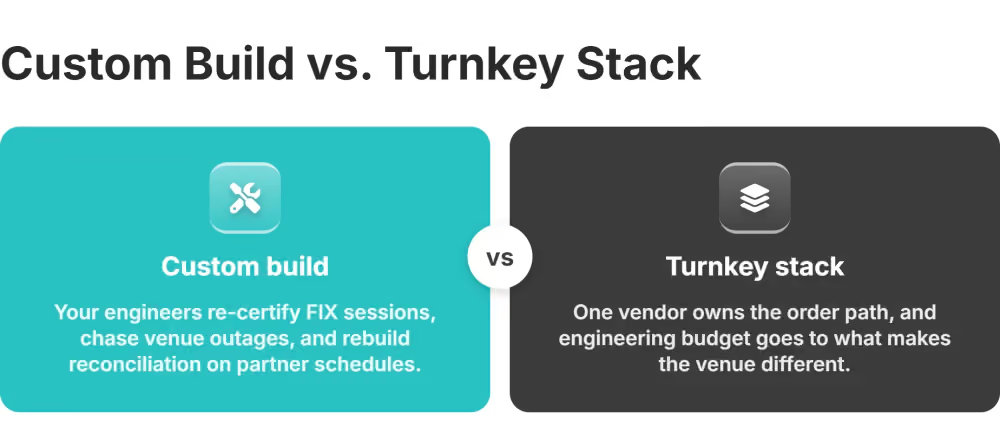
Buying starts the venue on components that arrive tested, while regulatory licenses and configuration stay your job. A full-stack technology provider also cuts the number of vendors you coordinate for a release. With one vendor on the contract, a broken order has one owner.
A brokerage weighing the best crypto APIs for trading in 2026 should count the handoffs each stack adds to a client order, then ask who answers for them. B2BROKER has been building brokerage infrastructure since 2014, has helped launch 500+ brokers, and holds 10+ regulatory licenses.
If you are scoping a venue now, B2BROKER's team will walk your order flow with you and come back with an architecture and a launch timeline.
Frequently Asked Questions about Crypto Trading APIs
Which crypto trading API is best for brokers and exchanges?
One that combines FIX, REST, and WebSocket connectivity with contractual SLAs and named support. The infrastructure behind the endpoint matters more than the endpoint itself, so review the matching engine and the liquidity feeding it.
What is the difference between a crypto market-data API and a trading API?
A market-data API streams prices and order books, while a trading API submits and cancels client orders. A commercial venue needs its execution connectivity wired into liquidity aggregation and risk controls before it can carry live orders.
Are free crypto APIs suitable for high-frequency or institutional trading?
They fit prototypes and dashboards. Rate limits and best-effort support rule them out in production, where you need documented uptime and latency commitments.
Why do institutional crypto trading systems need FIX connectivity?
FIX provides session-based messaging with sequence numbering and defined recovery, which high-throughput order routing depends on.
When should a brokerage choose turnkey crypto trading infrastructure over point APIs?
When deployment speed and unified accountability outweigh assembling the stack in-house. B2BROKER pairs B2TRADER's matching and aggregation layer with B2CORE's onboarding and back-office workflows to remove that integration work.
Recommended articles
Subscribe to our newsletter