What Are the Best Forex Technology Providers?


Your forex technology provider sets the ceiling on what your brokerage can offer and how fast you can launch. It is the hardest part of the stack to change later: once everything is wired into it, swapping providers means re-integrating the whole operation.
That makes the first choice the one that counts, and the right answer depends on your business model. A retail startup chasing a fast launch and a prime broker built for microsecond execution need very different things from the same category of vendor.
This guide profiles nine leading providers and shows which kind of broker each one fits, so your shortlist matches how you actually operate.
Key Takeaways
- Forex technology providers split into clear categories, and matching the category to your business model is the fastest way to cut integration work and launch time.
- Sourcing liquidity, platform, and back-office tools from separate vendors compounds operational overhead and raises the cost of switching providers later.
- Colocation drives execution quality, because sitting physically close to major liquidity hubs shortens round-trip latency.
- White-label deployments leave regulatory accountability with the broker, so compliance responsibility stays in-house no matter which provider powers the back end.
- Scoring providers on the same dimensions, such as liquidity depth and API standards, produces a more defensible shortlist than comparing feature lists side by side.
What Forex Technology Providers Actually Do
Forex technology providers run the infrastructure layer beneath a brokerage, everything that sits between the trader and the financial markets. They range from full-stack partners that cover the entire operation to narrow point solutions that do one job well, and where a provider falls on that spectrum shapes every later decision you make.
Four layers make up that stack:
- Matching and order management. The engine sequences incoming client orders against available liquidity and applies the broker's risk management rules.
- Liquidity architecture. The provider aggregates real-time pricing from banks and non-bank market makers, then distributes it to client venues.
- Back-office and compliance. The CRM, the KYC and AML workflows, payment processing, and reporting all live here.
- Operational resilience. Failover systems for trading platforms , live monitoring, and disaster recovery keep the brokerage running when something breaks.
Pick a provider category that fits how your brokerage works, because the wrong fit is the most common and most expensive mistake brokers make here.
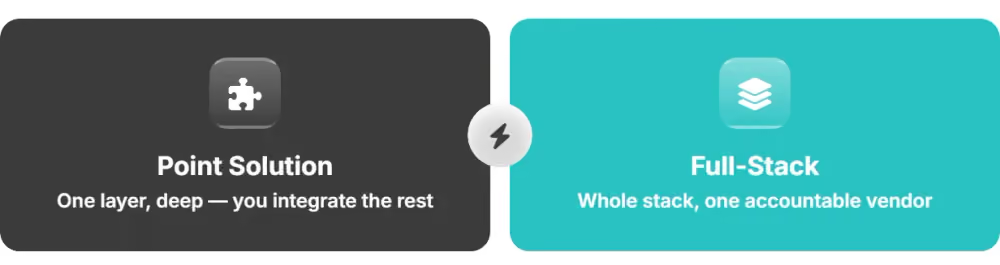
Full-Stack Infrastructure Partners vs. Point Solutions
A full-stack provider covers the whole operation in one place, handling matching and liquidity alongside the CRM, payments, and compliance layers, which cuts vendor sprawl and shortens time to market. A point solution instead goes deep on a single layer, giving you best-in-class depth there, which you pay for with more integration work and higher switching risk later.
Full-stack partners fit brokers who want to launch fast with one counterparty to hold accountable, which is where most new and growth-stage firms land. Point solutions fit firms with in-house engineering that want best-of-breed in each layer and can manage the integrations themselves, usually institutional desks and banks.
9 of the Best Leading Forex Technology Providers
The strongest fit usually comes down to one question: how much of the stack can you run in-house, and how much do you need a provider to own? Answer that, and the right provider type narrows quickly, well before you compare individual features.
1. B2BROKER: Integrated Infrastructure for Brokerages
B2BROKER runs as a single full-stack ecosystem for brokerages, exchanges, and institutions. Its solutions operate as one connected system, sharing the same APIs and authentication, so the data schemas line up cleanly. Standing up a brokerage on that architecture takes weeks, where it would normally take months.
The product list matters less than what consolidation buys you.
- B2TRADER runs matching and trade execution for FX, crypto, perpetual futures, and CFDs, clearing ten asset classes at sub-millisecond speed.
- B2CORE bundles the CRM, trading account management, and client area with KYC workflows and back-office tools in one console.
- B2BINPAY handles crypto payment rails.
- The liquidity solution offers aggregated Tier-1 bank flow and non-bank market maker pricing across 1500+ instruments and 10 markets and into a single venue, from one margin account.
FIX 4.4/5.0, REST, and WebSocket APIs behave identically at every layer, which gives the broker one connectivity model where six would normally sit.
For brokers weighing B2BROKER against point solutions, the deciding factor is whether a unified stack at this depth strips out more operational cost than a best-of-breed assembly adds back in specialization.
2. LMAX Group: Institutional Execution and Liquidity
LMAX Group runs as an institutional execution venue built on a central limit order book. Liquidity is firm and there are no last-look rejections, so the price you see is the price you trade. That model fits prime brokers and hedge funds, along with the algorithmic shops that need transparent execution and predictable fills when message rates spike.
The deployment scope is narrower than a full-stack provider's. LMAX is strong on execution quality. The broker still has to bring its own CRM and back-office, plus client onboarding. Most firms run it alongside the platforms and systems they already operate, using it purely as the execution layer.
3. oneZero Financial Systems: Connectivity and Distribution
oneZero specializes in connectivity and distribution. Its core strength is hub-and-spoke liquidity routing, pushing orders out to multiple venues through low-latency software that sits between brokers and their liquidity providers. Think of the product as network infrastructure for a brokerage, closer to plumbing than to a trading front end.
It fits brokers who already run a platform and need institutional-grade routing into several liquidity sources at once. Firms after a turnkey launch get less from it. The platform sits with the broker, and so do the CRM and compliance layers.
4. smartTrade Technologies: Multi-Asset Trading Infrastructure
smartTrade builds multi-asset electronic trading systems with heavy workflow automation and pre-trade risk management tooling, plus liquidity aggregation that spans FX, equities, and fixed income. The client base leans hard toward banks and hedge funds, with institutional desks rounding it out. Retail brokerages are not really the target.
For retail or startup brokers, the deployment complexity often outweighs what they get back. smartTrade performs best where there is a dedicated engineering team and institutional workflows already in place. Firms without that setup usually find a turnkey partner cheaper to run.
5. Integral: FX Technology for Banks and Brokers
Integral specializes in the platform layer, serving banks and institutional brokers with particular strength in FX pricing engines. The platform sits behind many bank-tier FX desks, feeding price construction and white-label distribution down to broker clients.
Integral takes real integration effort and fits firms with dedicated technology teams running their own infrastructure. Operators usually come to it for one specific piece, the price construction or distribution layer, and they already have the rest of the brokerage in place.
6. MetaQuotes Software: Retail Platform Ecosystem
MetaQuotes runs the dominant retail forex trading platform ecosystem through MetaTrader 4 (MT4) and MetaTrader 5 (MT5). Wide white-label availability and a deep installed base of brokers have made it the default front end for the retail forex market. A large community of third-party plugin developers building technical indicators and expert advisors reinforces that position, and most forex traders already know the interface.
MetaQuotes delivers the platform layer and nothing beyond it. To run a full brokerage, you still supply your own liquidity and CRM, along with the compliance layer. In practice, most MT4 and MT5 deployments pair the platform with external liquidity aggregation from a provider like B2BROKER and a separate CRM. Treat it as the starting point of a brokerage build, with the rest of the stack added around it.
7. Match-Trade Technologies: White-Label Brokerage Stack
Match-Trade offers a white-label brokerage stack on a cloud-native deployment model built for fast retail launches. Speed to market is the whole pitch. A broker can stand up a user-friendly, branded platform with a CRM, a mobile app, and basic back-office functionality on compressed timelines.
For a new retail broker, Match-Trade delivers on launch speed. As the brokerage scales beyond launch, liquidity depth and institutional-grade compliance tooling often need to be topped up. Firms that already see prime-of-prime liquidity or multi-jurisdiction compliance on the horizon should plan for that extra infrastructure early, before it becomes urgent.
8. Spotware Systems: cTrader Platform and Liquidity
Spotware develops cTrader , a trading platform known for its strong support for algorithmic and automated trading and its open API. That openness has earned it a favored spot among ECN brokers. The platform draws traders seeking real depth-of-market visibility and technical analysis tools, as well as brokers seeking an alternative to the MetaTrader ecosystem.
cTrader is a platform specialist, so operators run it alongside external liquidity aggregation and back-office tools, CRM included. ECN-focused brokers typically keep cTrader as the front end and source both from a full-stack partner that connects cleanly to the Spotware API.
9. XTX Markets: Algorithmic Liquidity Provider
XTX Markets is a non-bank algorithmic liquidity provider. It generates executable prices with systematic market-making models and supplies them through aggregation venues and direct connections.
XTX solves one part of the stack and nothing else. It is a liquidity source you connect to through an aggregator, and the broker keeps matching and CRM in-house, including compliance. Treat it as a feed inside your liquidity layer, kept apart from your platform and back-office decisions.
Provider Comparison by Use Case
No two brokers need the same infrastructure. A vendor that fits a retail startup can be the wrong call for a prime broker or a crypto exchange adding FX rails.
Retail FX Brokers: Platform Depth and Onboarding Speed
Retail FX brokers care most about white-label availability, fast onboarding, and demo accounts. MetaQuotes (MT4/MT5) and Match-Trade cover the front end and quick launch; B2BROKER adds platform, liquidity, and CRM in one turnkey deployment, so there are fewer vendors to wire together.
For a retail operation, the platform itself rarely decides the outcome. What separates brokers is the depth of liquidity sitting behind that front end and how mature the client-facing CRM, customer support, and KYC workflows are. Choosing the right Forex brokerage software keeps paying off through the whole life of the brokerage, well beyond launch day.
Prime Brokers and Institutional Market Makers
Prime brokers and institutional market makers need deep liquidity aggregation and solid credit line management, backed by multi-venue routing and institutional-grade matching infrastructure built for heavy trading volume. LMAX, oneZero, and B2BROKER fit this segment.
Evaluation here turns on execution quality and latency architecture, with colocation strategy close behind. The unit that matters is the microsecond. When you compare vendors, weigh round-trip benchmarks captured during high-volatility windows, because the averages a vendor publishes hide exactly the moments that test the system.
Crypto Exchanges Requiring FX and Payment Rails
A crypto exchange adding foreign exchange (FX) or fiat rails needs payment processing and multi-asset liquidity, plus compliance workflows that cover both asset classes at once. The overlap is harder than it looks, because KYC and settlement both shift the moment a fiat leg sits beside a crypto leg, and reporting has to follow.
B2BINPAY handles the crypto payment side, including deposits and withdrawals, with broader support for cryptocurrencies and blockchains, plus faster settlement than most legacy gateways. On the trading side, B2BROKER's multi-asset liquidity coverage pulls FX, crypto, indices, and commodities into one aggregation layer. Firms mapping out this expansion can line up the top white label crypto exchange platforms against their FX provider shortlist at the same time.
Prop Trading Firms and Fintech Startups
Prop trading firms and fintech startups put API depth first, then fast deployment and modular infrastructure they can scale as their trading strategies grow, without rebuilding the whole platform. The front end is often custom-built to their own spec. Underneath it, the back end has to deliver institutional-grade execution from day one.
API availability is a hard requirement here. FIX 4.4/5.0, REST, and WebSocket support should already ship as standard, available the day you sign. Connectivity also has to handle both retail-style and institutional flows, since prop firms route through both regularly.
The Case Against Vendor Sprawl
Pull liquidity, platform, CRM, payments, and compliance from five different vendors and the integration overhead compounds. Deployment slows, and operational risk climbs with every extra connection. The real cost lands in engineering hours and downtime, and in the friction of swapping a provider out later, none of which shows up in a pricing comparison.
For the CTOs and COOs running the math, the number that matters is the total cost of operating six integrations at year three, when one vendor sunsets a deprecated API, another switches to a new authentication model, and a third gets acquired and quietly changes its data schema. Consolidation is the operational answer, and it holds up regardless of who is selling.
Integration Overhead Across Disconnected Systems
Every extra vendor adds another API contract and data schema for the engineering team to maintain, plus another authentication layer and one more component that can fail. Run six vendors and the maintenance load multiplies:
- six SDKs to keep current
- six release cycles to plan around
- six SLAs to enforce
- six separate places where an outage can break the client experience
Across that many systems, maintaining a genuine institutional FX data infrastructure becomes a standing commitment. Two vendors stay manageable. Six turn into an engineering organization of their own.
Core Evaluation Criteria for Infrastructure Buyers
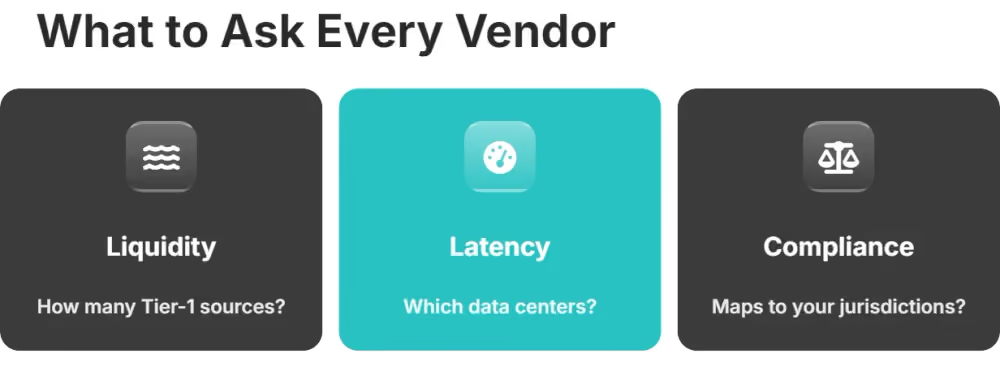
Scoring every vendor on the same dimensions is what makes a selection comparable. The ones that decide infrastructure quality are liquidity and latency, with compliance close behind, and each comes with a concrete question worth putting to a vendor on a call.
Liquidity Aggregation and Prime-of-Prime Architecture
Prime-of-prime architecture sits between Tier-1 banks and retail-facing brokers, opening up direct market access to liquidity that a retail broker could never reach on its own balance sheet. The model blends Tier-1 bank pricing with non-bank market maker flow, which produces tight spreads and deeper, more resilient liquidity than any single source can deliver on its own.
Ask each vendor how many active Tier-1 and non-bank sources they aggregate per asset class and currency pair. Then ask for fill rates and average RFQ response times on a liquid pair like EUR/USD during high-volatility windows, specifically around major releases on the economic calendar. A published average smooths over exactly the moments that decide execution quality.
Execution Speed, Latency, and Colocation Strategy
Institutional execution assumes latency under ten milliseconds, but that number has two parts. Network transit between the broker and the liquidity venue is one. Order queuing and pre-trade risk checks inside the matching engine are the other, and they can add tens of milliseconds on their own, whatever the network is doing.
Network latency comes down to colocation. Sitting close to major hubs like Equinix NY4 (Secaucus), LD4 (Slough), FR2 (Frankfurt), and TY3 (Tokyo) can cut round-trip times by 10 to 50 milliseconds versus general internet routing. Ask each vendor which data centers they colocate in and what their platform-level latency is; execution quality holds up only when both numbers are acceptable.
Compliance, KYC, AML, and Regulatory Readiness
Compliance for a financial services firm comes down to jurisdiction. The major actors, including the CFTC and the National Futures Association (NFA) in the United States, the FCA in the United Kingdom, ASIC in Australia, and CySEC in Cyprus, each set their own capital, client-fund, KYC, and AML rules. So a vendor's compliance tooling has to map to every jurisdiction you operate in.
A white-label deployment does not move regulatory accountability: the broker keeps full responsibility for KYC and AML workflows, suspicious activity reporting, and audit trail integrity, whoever provides the technology. White-label compliance is a fact of how licensing works, so judge a vendor on whether its tooling makes that work lighter, since none of it ever leaves your desk.
End Vendor Sprawl: Launch Your Brokerage with B2BROKER
The right infrastructure partner cuts vendor sprawl, speeds up deployment, and holds reliability steady over liquidity, matching, compliance, and payments. The wrong one, or six wrong ones in parallel, costs you months of time to market, higher operational risk, and switching costs that lock early mistakes in place.
B2BROKER brings technology and multi-asset liquidity together as a single full-stack ecosystem. You get one vendor and one accountability chain, with failover, audit-grade reporting, and Prime-of-Prime liquidity in the same place.
The company has operated since 2014 and now backs more than 1,000 clients, holding 10 regulatory licenses worldwide.
Brokers ready to skip the assembly work and run institutional-grade infrastructure from day one can start the conversation directly.
Frequently Asked Questions about Forex Technology Providers
What's the difference between a full-stack forex technology provider and a point solution vendor?
A full-stack provider delivers the entire stack from one integrated system, from matching and liquidity to CRM, payments, and compliance, while a point solution covers a single layer and leaves the broker to wire several vendors together. The full-stack route, like B2BROKER, cuts time to market and integration overhead.
How do you evaluate a forex technology provider before committing to a deployment?
Score every shortlisted vendor against the same criteria: liquidity depth, execution latency, API standards, compliance readiness, scalability, and support SLAs. The two questions that surface real differences fastest are fill-rate data during high-volatility windows and jurisdiction-specific compliance documentation.
Does using a white-label forex platform transfer regulatory responsibility to the technology provider?
Regulatory accountability stays with the licensed brokerage entity, even though the provider supplies the platform and often the liquidity. The broker keeps full responsibility for KYC, AML, suspicious activity reporting, and audit trail integrity, whoever powers the back end.
How does a colocation strategy affect execution quality for forex brokers?
Placing servers near major hubs like Equinix NY4, LD4, FR2, and TY3 cuts round-trip latency against general internet routing. Platform-level latency from order queuing and risk checks stacks on top of that, so assess both data-center placement and the matching engine's internal processing.
Which forex technology provider is best suited for a brokerage that needs liquidity, a trading platform, and back-office infrastructure in one place?
Look for a genuinely integrated ecosystem where the layers are built to work together from day one. B2BROKER fits this by combining B2TRADER, B2CORE, B2BINPAY, and multi-asset liquidity under one infrastructure layer with FIX, REST, and WebSocket connectivity, which cuts vendor sprawl and shortens
Recommended articles

Subscribe to our newsletter