CFDs vs. Futures: Which Instrument Should Brokers Offer?

A broker choosing between CFDs and futures is choosing between two market structures. Exchange-traded futures grew 8.6% in 2025 to 30.6 billion contracts. CFD volume has no comparable public count because every CFD trade settles privately between a broker and its client.
The CFD vs futures decision determines where your prices come from and who stands as the counterparty to every client trade. Licensing follows the same split, and a platform configured for one product rarely converts to the other without a rebuild.
This guide compares the two as product categories, from contract mechanics to the infrastructure and licensing decisions each one commits you to.
Key Takeaways
- Futures clear on regulated exchanges through a central counterparty, while contracts for difference settle bilaterally between the broker and each client. The two products need different connectivity and different risk setups.
- A CFD desk aggregates prices from OTC liquidity providers and manages its own counterparty exposure. A futures desk needs exchange access and a clearing relationship before the first trade.
- CFD desks typically earn from spread markup and overnight financing fees, while futures desks typically charge per-contract commissions.
- Licensing splits by instrument. Retail CFDs in the EU run under MiFID II with ESMA leverage caps, while the US does not permit the same off-exchange retail CFD model.
- A shared operating layer can unify client and back-office workflows, but CFD liquidity and futures clearing still require distinct connections.
CFDs and Futures: Core Mechanics
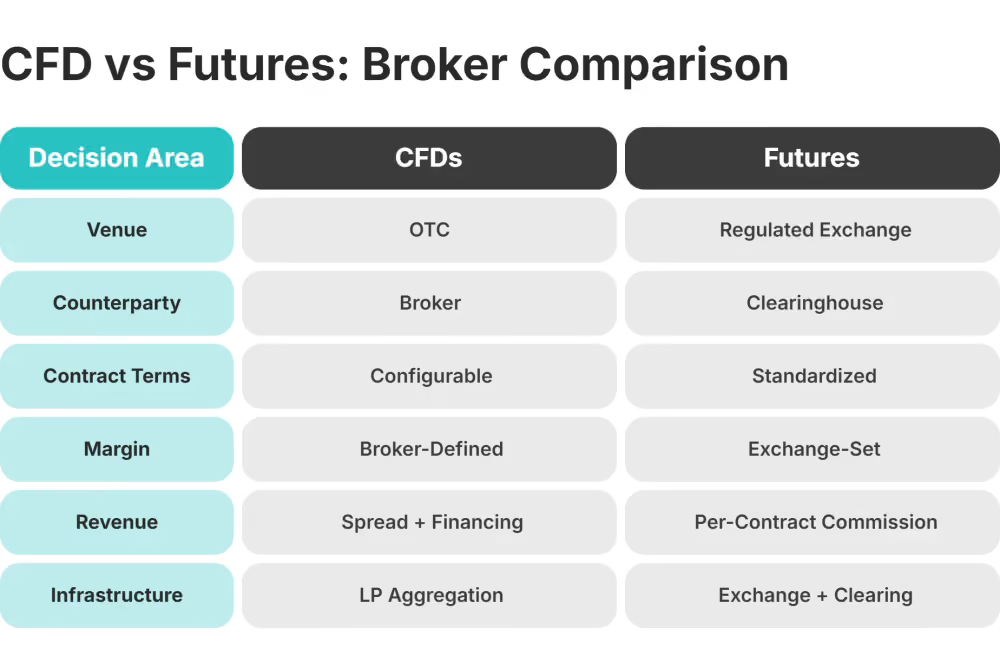
Both futures and CFD instruments are financial derivatives. The difference that matters to an operator is market structure: futures live on exchanges under fixed specifications, while a CFD is a bilateral contract the broker issues itself. Every infrastructure decision downstream follows from that split.
How Futures Contracts Work as a Product
A futures contract is a standardized agreement to buy or sell an asset at a set future price on a set date. The exchange defines every parameter of the product. CME's EUR/USD , for example, is fixed at €125,000 per contract. CME lists quarterly benchmark expirations plus additional contract months and publishes the settlement procedure.
For the operator, this standardization cuts both ways. Institutional clients and commercial hedgers value it, but the broker has nothing to configure. The third-party firm must support the specifications exactly as the exchange publishes them, for every delivery month it lists.
Offering futures therefore means connecting to exchanges and maintaining a clearing relationship before the first client order arrives. The platform must also handle each contract's lifecycle.
How CFDs Work as a Product
A CFD pays the difference between the opening and closing price of an underlying asset. Its quote follows the underlying market, but nothing is delivered, with no exchange sits in the middle.
Because the broker issues the contract, the broker designs the product. Lot sizing, per-group leverage, and rollover logic all live in platform settings, so the offering can be tuned to a specific client segment.
The cost of that freedom is that the broker sources its own pricing depth. With no exchange order book behind the quotes, the desk builds its feed by aggregating prices from OTC liquidity providers , typically prime brokers and non-bank market makers streaming quotes into the platform.
Exchange-Traded vs. OTC Execution Models
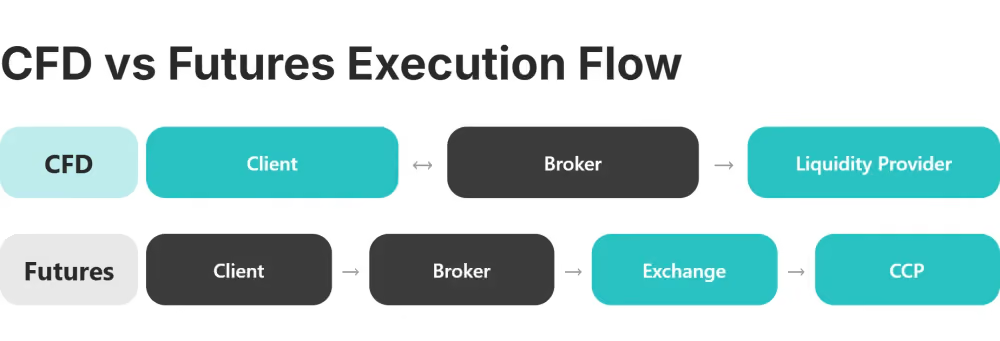
The two instruments run on opposite execution models. A futures trade goes to a regulated venue from the CFTC's list of designated contract markets . A clearinghouse steps in here as buyer to every seller and seller to every buyer.
An over-the-counter CFD trade never leaves the bilateral relationship. The broker fills the order against its own book or against a hedge, and the credit risk a clearinghouse would otherwise absorb stays with the broker. That single fact drives most of the capital and risk decisions below.
Contract Structure: Key Differences
Structure decides configuration work. Futures require lifecycle support for a fixed contract calendar, while CFDs require the broker to define and risk-manage the product.
Expiration, Rollover, and Lifecycle Management
Futures expire on a fixed schedule, and each contract carries a last trading day and a defined settlement method. The expiration date must stay synchronized across the trading platform, client records, and clearing workflows.
For the platform, that means running several delivery months side by side and supporting clients who close or roll positions as the front-month contract expires.
Many cash CFDs have no fixed expiration, while futures-based CFDs may expire or roll. A position held overnight accrues a financing charge, which the platform assesses nightly. The broker sets those rates and has to disclose and apply them accurately.
Standardization vs. Flexible Contract Terms
For futures, the exchange fixes everything from tick size and contract size to expiration dates and settlement method. Every participant trades identical terms.
CFD terms belong to the broker. The same platform can offer a 0.01 lot to a retail client and a custom leverage tier to a professional one, which turns contract design into a segmentation tool.
The logic mirrors the structural split between spot and margin exchange models , where instrument structure dictates margin design and risk controls.
Margin, Mark-to-Market, and Daily Settlement
Baseline futures margin comes from the exchange or clearinghouse, while the broker or FCM may impose higher house requirements. Positions are marked to market daily. Variation margin moves between accounts every session, and a breach of the maintenance level triggers a margin call.
CFD margin requirements are broker-defined within regulatory floors. The operator sets the initial deposit and maintenance levels. It also configures liquidation thresholds and the automated response to a breach. In regulated jurisdictions the floor comes from rules such as ESMA's leverage caps, but the design space above that floor belongs to the broker.
Pricing, Transparency, and Counterparty Risk
Prices form differently in the two markets, and counterparty risk lands on different balance sheets. Both facts feed directly into how much capital a broker needs and what its risk desk does all day.
Order Book Transparency in Futures Markets
A centralized exchange shows one limit order book to every participant. The broker does not set a proprietary client quote, which simplifies best-execution documentation. Price formation happens at the exchange, and the broker's job is routing.
That transparency removes the spread as a revenue lever for the desk.
Central Clearing vs. Bilateral Counterparty Exposure
In futures, the clearinghouse interposes itself between the two sides of every trade. If a member defaults, losses run through the CCP's (central counterparty's) published default waterfall.
Institutions use exchange-traded derivatives when central clearing and standardized terms fit their needs. ESMA maintains a public register of CCPs authorized to clear under EMIR .
A CFD broker carries that exposure itself. When market volatility pushes a client account into negative territory, the loss lands on the broker's book.
Hedging client flow with a liquidity provider moves the market risk out, but the contract with the client stays on the broker's paper. The counterparty obligation never leaves.
Operator Decision Framework
Start with the target client base, then test whether the expected revenue covers the applicable licensing and infrastructure costs.
Client Segmentation and Instrument Fit
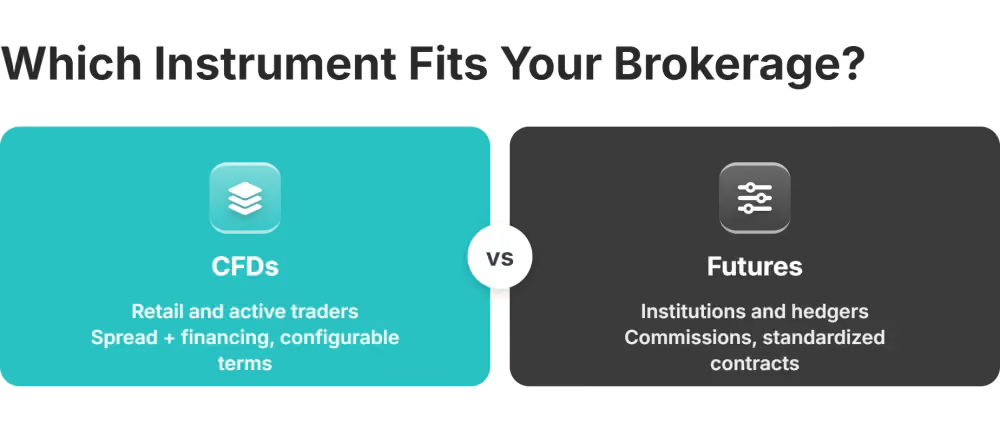
Retail-focused brokerages may favor CFD trading because position sizes can be fractional and onboarding does not require exchange access. Retention in this segment tracks spread competitiveness and platform quality.
Institutional and professional clients may prefer futures when central clearing and published contract terms fit their compliance frameworks. Commercial hedgers may also need standardized contracts for defined exposures.
A brokerage targeting funds or corporates may need exchange-traded futures, with CFDs as a complement for active traders.
Revenue Model: Spread-Based vs. Commission-Based
A CFD desk earns the markup between the liquidity provider's price and the client-facing price, plus overnight financing on open positions. A desk that internalizes flow adds trading gains on top, at the price of carrying directional risk on its own capital.
A futures desk typically earns a commission per contract, with exchange fees and other trading costs passed through to the client. High trade counts make clearing cost control central to the model.
The split matters at the planning stage because each model needs different plumbing. Spread-based revenue needs markup and financing engines inside the pricing layer; commission-based revenue needs precise per-contract fee accounting and clearing cost control.
Regulatory Licensing Requirements by Instrument Type
In the EU, offering retail CFDs requires authorization as a MiFID II investment firm. ESMA's product intervention measures capped retail leverage between 30:1 for major forex pairs and 2:1 for cryptocurrency CFDs, and national regulators have since written those caps into their own rulebooks.
Clients validly classified as professional fall outside ESMA's retail CFD caps, which makes client categorization a commercial function as much as a compliance one.
The US draws a harder line. Off-exchange derivatives with retail clients are unlawful unless traded on a regulated exchange, which rules out the retail CFD model. Futures require registration with the CFTC plus clearing access through a futures commission merchant.
Futures also sit outside ESMA's retail leverage caps in Europe. Jurisdiction and instrument decide together what a broker may legally sell, and to whom.
Execution, Risk, and Liquidity Infrastructure
The instrument you offer determines the infrastructure you need. The gap between the two builds is wider than most operators expect.
A-Book vs. B-Book Execution for CFD Desks
An A-Book desk routes client flow to external liquidity providers and earns the spread differential. Most hedged directional market risk moves to the provider, although execution and counterparty exposure remain with the broker.
A B-Book desk takes the opposite side of client trades on its own book. The desk needs real-time position monitoring so it can hedge exposure before losses exceed allocated capital.
In practice, many established CFD brokers run a hybrid model: selected flow stays on the book, while other exposure gets hedged.
Which models are available depends on the brokerage software the desk runs on . The platform must assign each position to a book and apply the corresponding risk controls.
Exchange Connectivity and Clearing for Futures
A futures offering starts with market access (either direct membership or DMA through an existing member) and a clearing path (either self-clearing or an agreement with a clearing firm). These arrangements can take months to negotiate and carry ongoing capital and membership obligations.
On top of access sits per-contract engineering. The platform must calculate margin by delivery month and manage rolls across expirations. Physically settled products need delivery logic of their own.
This overhead creates a meaningful barrier to entry. A CFD desk connects to liquidity providers and can go live without an exchange relationship.
Supporting Both Instruments Under One Integration
A brokerage may eventually want both product lines. Separate operating stacks increase reconciliation work and support load.
The demand side can push in the same direction, because the strategies that drive CFD volume may need instruments beyond a single OTC product line. Adding futures lets the broker serve that demand internally.
Supporting both does not make their connectivity identical. A unified operating layer can centralize account and risk workflows, while CFD liquidity and futures clearing remain separate connections.
Build Your Multi-Asset Platform with B2BROKER
The CFD vs futures comparison ends in the same place for most operators. The two products complement each other more often than they compete, so the choice comes down to what your infrastructure can support. CFDs can serve retail and active traders with configurable OTC products, while futures can serve clients who need cleared, standardized contracts.
B2BROKER's ecosystem is built for that path:
- B2TRADER , the multi-asset and multi-market trading platform, handles margin trading and supports netting with dynamic leverage.
- Multi-Asset Liquidity spans 10 asset classes through a single connection.
- B2CORE manages client and account operations behind both product lines.
- B2BINPAY adds crypto payment processing where the client base needs it.
Whether you launch CFD-first and add futures later, or build multi-asset from day one, choose a platform roadmap that can accommodate both models as the product mix expands.
Frequently Asked Questions about CFDs and Futures
What is the main difference between CFDs and futures for brokers offering both?
Futures run through exchanges and central clearing, while CFDs settle directly between the broker and the client. Each line therefore needs its own connectivity, with exchange and clearing access on one side and OTC liquidity aggregation on the other.
How does offering CFDs versus futures change a broker's execution and risk model?
A CFD desk chooses between hedging client flow with liquidity providers and internalizing it on its own book, and holds capital accordingly. A futures desk does not act as the bilateral derivatives counterparty, but it still manages client credit exposure and funds exchange margin.
What regulatory approvals are needed to offer CFDs compared with futures?
In the EU, retail CFDs require MiFID II investment firm authorization under ESMA leverage caps that range from 2:1 to 30:1 by asset class. Futures require exchange membership or a clearing relationship, and in the US a CFTC-registered futures commission merchant structure.
Can a brokerage offer both CFDs and futures through the same trading infrastructure?
Yes, at the operating layer, but the products still need different execution connectivity. The platform must support OTC liquidity aggregation for CFDs alongside exchange access and contract lifecycle handling for futures.
How do revenue models differ between CFD and futures brokerage operations?
CFD desks earn from spread markup and overnight financing, so profitability tracks trading volume and overnight positions. Futures desks earn per-contract commissions, so revenue follows trade count and clearing cost efficiency.
Recommended articles
Subscribe to our newsletter