How to Achieve Superior Fill Rate Optimization in Liquidity Management

Reliable execution defines a venue's reputation. While various metrics track performance, focusing on fill rates keeps orders moving without friction. High execution standards prevent the operational bottlenecks that often frustrate active traders when market participation peaks and liquidity thins out.
Consistent fulfillment translates into institutional-grade trust. Clients value platforms that handle large tickets without excessive slippage or recurring partial fills. This guide breaks down the mechanics of fill rate optimization in financial markets, how to calculate it, and the strategies that maintain high execution quality.
Key Takeaways
- Fill rate optimization focuses on matching client demand with available liquidity to minimize partial fills and slippage costs.
- Effective monitoring requires tracking order, line, and volume fill rates separately to identify specific execution bottlenecks.
- Smart order routing prevents rejections by automatically splitting large tickets across multiple liquidity providers.
- Real-time analytics enable immediate intervention when rejection rates spike, preventing minor glitches from becoming systemic failures.
Have a Question About Your Brokerage Setup?
Our team is here to guide you — whether you're starting out or expanding.
What Is Fill Rate in Liquidity Management?
Fill rate tracks the percentage of order volume successfully matched at requested price levels. In electronic trading, this metric measures how much customer demand finds an immediate counterparty without requiring secondary fills. High percentages reflect a robust matching engine, a high-performance execution environment, and a superior customer experience.
Financial fill rates prioritize execution speed over static availability. A broker's ability to maintain a higher fill rate depends on several dynamic factors:
- Dynamic Market Depth: Liquidity providers update quotes across various venues in microseconds. A high-quality setup synchronizes these movements to prevent rejections during market spikes.
- Source Aggregation: Connecting diverse liquidity providers creates a pool deep enough to absorb large tickets. This connectivity prevents slippage by ensuring volume exists at the touch price.
- Infrastructure Latency: Reliable matching engines rely on low-latency infrastructure. The system must capture available volume before the market moves and the price becomes stale.
Institutional-grade performance often targets fill rates exceeding 99 percent for major currency pairs. Achieving this level requires balancing internal matching with external routing.
Accurate metrics help firms identify when specific venues begin to underperform or provide stale pricing. Fill rate monitoring reveals the health of a broker's connectivity. Sudden drops in this percentage indicate technical latency or insufficient market depth.
Why Fill Rate Optimization Drives Efficiency and Risk Mitigation
Optimizing fill rates transforms execution from a technical metric into a primary competitive advantage. Brokers and exchanges with high fill ratios attract professional volume that demands certainty over speed alone. Poor optimization exposes the firm to operational risks where market volatility triggers cascading trade failures.
Superior metrics directly minimize market impact on large institutional orders. When clients trust that their full size will execute at the quoted price, they increase trading turnover. This reliability improves operational efficiency by lowering the overhead associated with manual trade interventions and frequent dispute resolution processes. Ultimately, consistent execution is the biggest driver of customer satisfaction.
How to Calculate Fill Rate Formula and Key Metrics
Understanding how to accurately calculate fill rate is the first step toward optimization. The baseline formula divides successful trades by total demand:
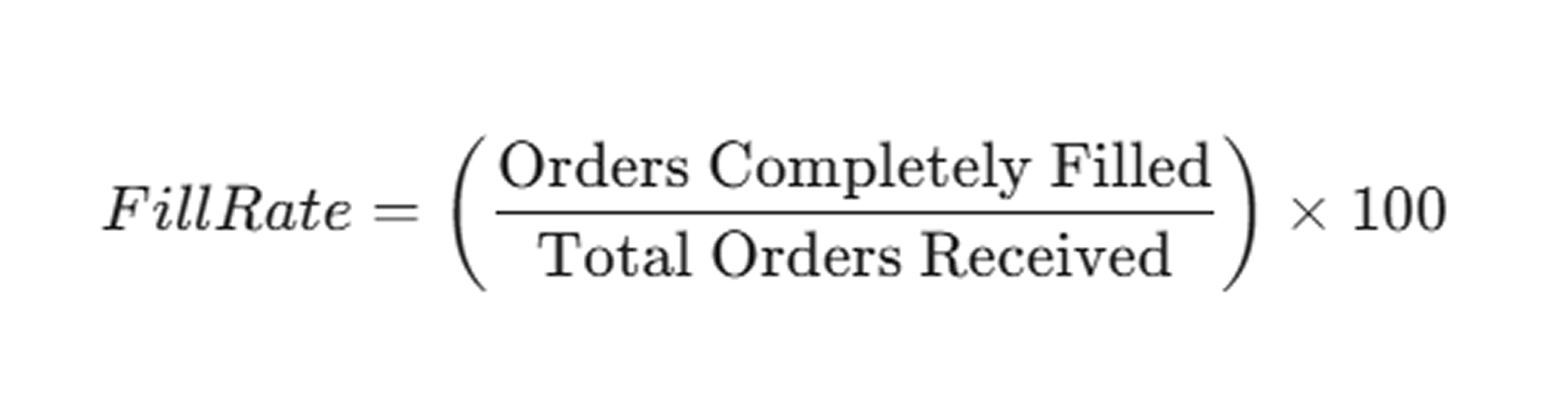
While simple, this single number often hides underlying issues. Risk managers break this down into three specific fill rate metrics and KPIs to identify whether a problem is technical or liquidity-related. Analyzing these figures separately allows firms to pinpoint exactly where execution logic fails.
Order Fill Rate
Order fill rate tracks the percentage of trades executed completely without partial fills. This metric serves as a high-level performance benchmark for the matching engine.
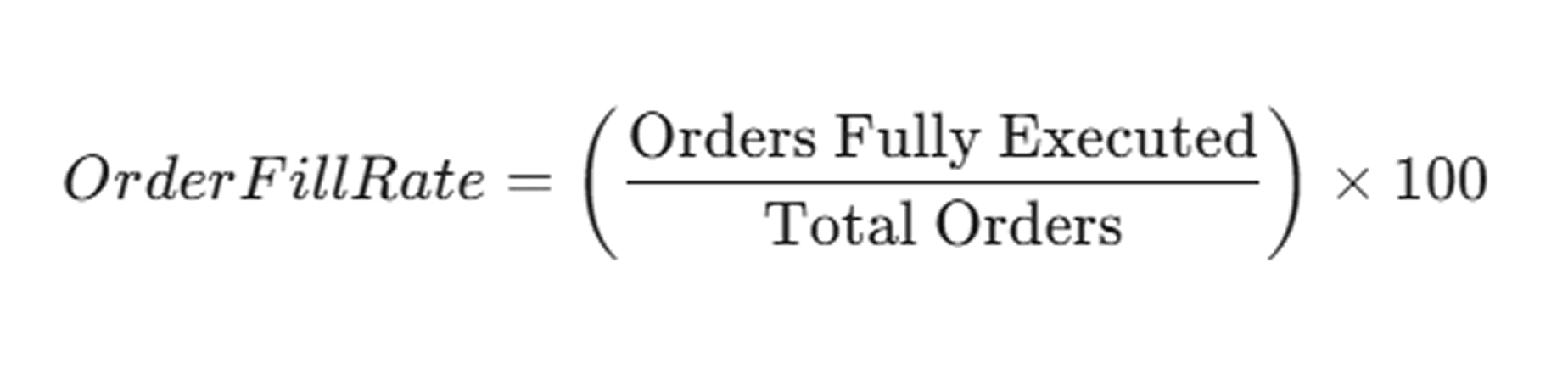
Retail traders expect 100% execution on standard ticket sizes, making this figure a direct proxy for meeting customer expectations. A high ratio proves the infrastructure handles standard flow without fragmenting positions or rejecting orders due to momentary depth gaps.
Line Fill Rate
Multi-asset strategies require tracking performance at the individual instruction level. Line fill rate measures which specific line items or components of a basket order succeeded.
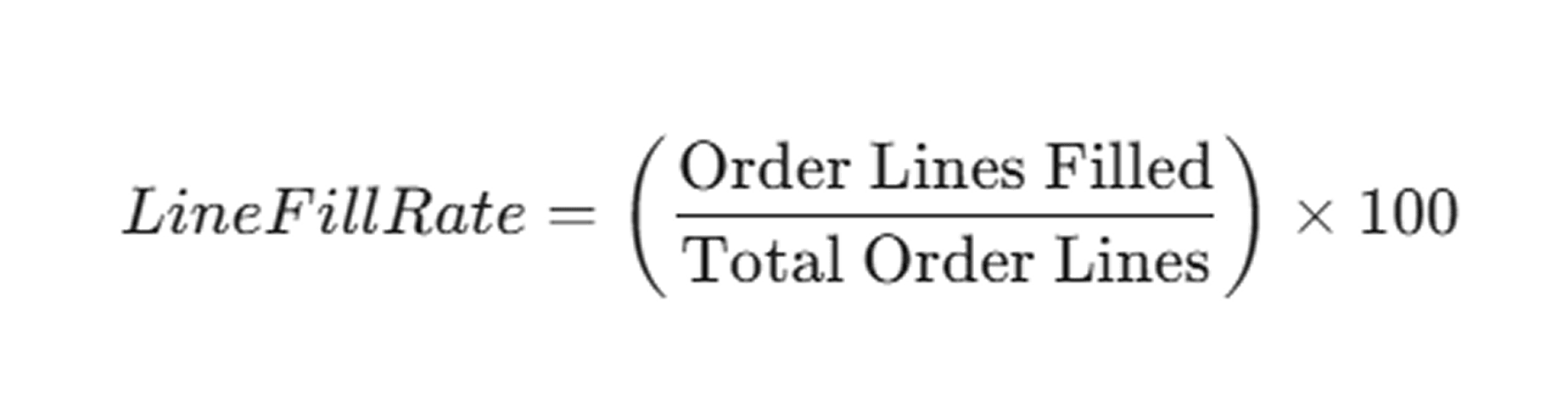
This metric isolates specific liquidity gaps within complex trades. If a portfolio order fills for EUR/USD but fails for Gold, the line fill rate data highlights the specific instrument causing the rejection. This feedback lets firms adjust routing logic for assets that frequently underperform.
Volume Fill Rate
Institutional desks prioritize the total quantity matched rather than a simple pass/fail status. Volume fill rate measures the actual capital deployed against the requested amount.
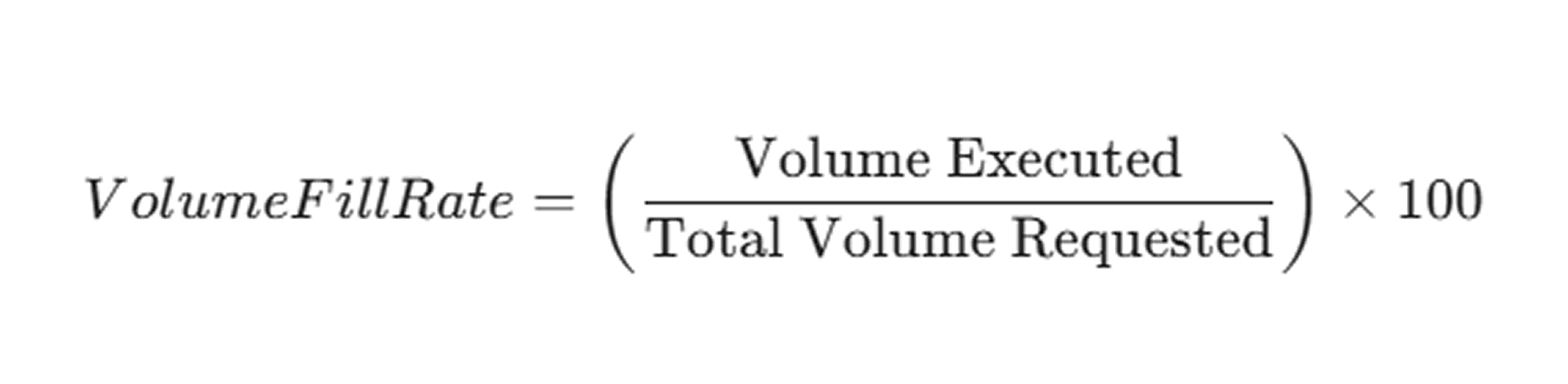
For block trades, a 95% volume fill offers significantly more value than a complete rejection. Tracking this figure helps prime brokers understand how much size their liquidity pools actually absorb during peak demand, distinguishing between total washouts and partial successes.
Types of Fill Rate in Supply Chain Versus Financial Context
The concept of fill rate originated in inventory management to track physical stock. Financial markets adapted this metric to measure execution quality, though the underlying mechanics differ significantly. Supply chain managers optimize for static availability, whereas liquidity managers fight against microsecond price decay.
Supply Chain Perspective
In logistics and e-commerce, fill rate measures whether inventory levels are high enough to ensure a smooth fulfillment process without backorders or stockouts. Key metrics typically track physical fulfillment:
- Warehouse fill rate: Inventory availability at specific storage locations.
- Case fill rate: Complete cases shipped versus the total ordered.
- Vendor fill rate: Supplier reliability in fulfilling purchase orders.
These metrics focus on physical possession and shipping timeframes measured in days. Low fill rates expose distributors to risks and lost sales.
Liquidity Management Perspective
In financial markets, fill rate describes how effectively orders execute against available liquidity. Orders compete for limited volume at specific price levels, and execution quality changes continuously as markets move.
Financial fill rates depend on execution speed, real-time market depth (available liquidity at each price level), and liquidity aggregation across multiple sources. Pricing adjusts dynamically with volatility, so fill rates must be monitored in real time. Decisions occur in milliseconds, and delayed execution directly impacts slippage and client outcomes.
Eliminate Rejections With Deep Liquidity Pools
Aggregated depth from Tier-1 banks and top exchanges ensures your clients get the fill they expect, instantly.
Proven Strategies to Improve Fill Rates
Brokers looking to optimize fill rate performance must combine advanced technology with robust liquidity partnerships. This approach helps solve market inefficiencies and protects against disruptions caused by fragmentation.
Implementing these strategies creates compounding improvements in fill quality across all asset classes.
Enhance Forecasting Precision
Reactive liquidity management fails during stress events, making accurate demand forecasting essential. Predictive analytics allows desks to anticipate demand before orders hit the book.
- Review peak trading windows to align depth with expected volume.
- Deploy machine learning algorithms to flag abnormal order flow patterns.
- Track economic calendars to prepare for volatility spikes.
Analyzing historical client behavior and volatility markers helps your risk teams to pre-position collateral and adjust limits to accommodate incoming flow.
Streamline Order Routing and Aggregation
Smart Order Routing (SOR) logic identifies which connected provider offers the best probability of a full fill at the current moment. The system assesses depth across multiple venues instantly, and if a primary source dries up, the engine splits the order or reroutes it to a secondary pool.
Failover mechanisms prevent rejection by accessing distinct pools simultaneously. Automated failover protocols reroute traffic instantly if a specific provider experiences latency.
Implement Real-Time Monitoring
Passive reporting hides execution decay until after the trading session ends. Active desks rely on live dashboards that track fill percentages by instrument and liquidity provider.
Setting automated alerts for threshold breaches enables immediate intervention. If a specific provider's fill rate drops below 95% on Gold, the desk can pause routing to that source, which protects clients from receiving partial fills due to a counterparty's technical issues.
Optimize Liquidity Mix
Relying on a homogenous group of providers creates concentration risk. A robust liquidity stack blends Tier-1 banks with non-bank market makers (NBFIs). Banks typically offer depth during London and New York sessions, while NBFIs provide tighter pricing during off-hours.
- Combine bank streams with specialized market makers for reliable off-peak execution.
- Integrate native crypto liquidity to maintain continuous 24/7 coverage.
- Leverage volume data to negotiate "last look" privileges with providers.
How to Apply Advanced Liquidity Tools for Optimal Fill Rates
Basic connectivity rarely handles complex order flow efficiently. Modern execution relies on a technology stack that actively manages liquidity rather than just piping it through.
Liquidity Aggregation Platforms
Liquidity aggregation platforms solve market fragmentation by merging diverse pricing streams into a single executable pool. This unified depth absorbs institutional volume that would otherwise suffer slippage on a single feed. Once this depth is established, SOR automation scans the combined sources to pinpoint the optimal execution path in microseconds.
B2BROKER’s aggregation technology connects over 70 liquidity providers simultaneously, creating the robust environment needed to maintain high fill ratios across volatile assets.
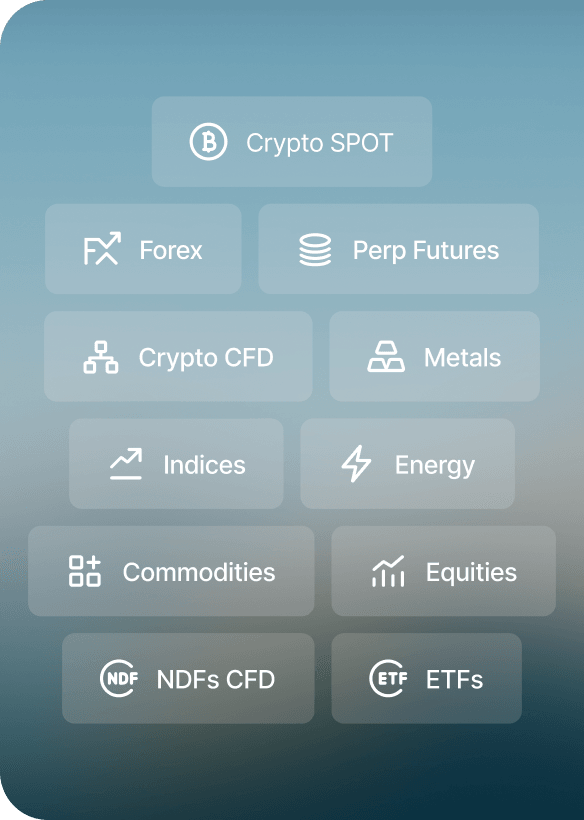
Deep, Reliable Liquidity Across 10 Major Asset Classes
FX, Crypto, Commodities, Indices & More from One Single Margin Account
Tight Spreads and Ultra-Low Latency Execution
Seamless API Integration with Your Trading Platform
Automated Risk Management
Protecting the order book from toxic flow maintains execution relationships. Configure pre-trade risk checks to validate every instruction against available margin limits. Dynamic position limits should automatically tighten during volatility spikes to prevent exposure blowouts.
Automated hedging systems further stabilize operations and offset client risk immediately to maintain market neutrality. Removing manual intervention from the hedging process ensures that liquidity channels remain open for legitimate client flow.
Regulatory Compliance Systems
Verifying execution quality satisfies regulatory mandates. Transaction Cost Analysis (TCA) software measures realized fill prices against market benchmarks at the exact moment of trade.
Detailed audit trails log every routing decision alongside these metrics. This granular data provides the documentation needed for frameworks like MiFID II. Offering this transparency proves to clients that their orders receive optimal handling.
Fill Rate vs. Service Level: Are They the Same?
Brokers frequently confuse fill rate with service level, though these metrics track distinct performance areas.
Service level measures adherence to a specific timeline, such as execution latency thresholds or platform uptime. In contrast, fill rate tracks the percentage of volume successfully matched, regardless of the timestamp.
Speed implies little value without sufficient market depth. A venue might boast 99.9% uptime and microsecond latency (a high service level) while consistently rejecting institutional block orders. Fill rate is a superior indicator of success because it reflects actual capital turnover rather than just system availability.
Smart routing engines incorporate both data points to optimize flow. The logic typically filters providers by service level to ensure connectivity, then ranks the remaining options based on historical fill probability. Balancing these factors prevents the system from routing customer orders to venues that are fast but lack the necessary liquidity to absorb size.
How to Avoid Suboptimal Fill Rates
Even sophisticated trading desks struggle to maintain consistent fill rates during unforeseen stress events. Identifying operational weaknesses early prevents the execution failures that drive institutional clients to competitors.
Demand Volatility
Market shocks like interest rate decisions create immediate liquidity vacuums. Calibrating systems only for average volume leads to freezing when throughput triples. Engineer your system with buffer capacity designed to handle 300% of standard order flow without latency spikes.
Activate backup liquidity providers to absorb overflow when primary channels dry up. Switching routing logic instantly during high-volatility windows prevents the bottlenecks that typically cause partial fills.
Technology Silos and Integration
Friction between your trading platform and risk engine causes measurable latency. Milliseconds lost moving data between disconnected silos result in missed prices and rejected trades. Eliminate this internal lag by unifying execution and risk management within a single environment.
Use standard FIX APIs to ensure seamless connectivity with external venues. Direct integration enables your matching engine to process external market data without translation delays, keeping internal pricing synchronized with the live market.
Monitoring Metrics Continuously
Relying on end-of-month reports hides daily execution decay. Identify problems while the market remains open to protect profitability. Deploy real-time dashboards that allow your dealers to visualize fill performance per second across all asset classes.
Set automated alerts to trigger when rejection rates exceed specific thresholds. Immediate intervention lets you disable a malfunctioning feed before a minor technical glitch becomes a client-facing crisis.
Improving Execution Performance Through Better Fill Rate Optimization
Inconsistent fill rates erode profit margins and drive professional traders away. Managing liquidity across fragmented sources requires infrastructure capable of handling volatility without technical failure.
B2BROKER provides the integrated infrastructure needed to secure market leadership. Serving over 1,000 corporate clients, we deliver deep multi-asset liquidity coupled with institution-grade execution infrastructure.
Our comprehensive ecosystem of solutions ensures your trading environment remains stable and competitive regardless of market volatility.
Turn Execution Quality Into Your Competitive Edge
Equip your brokerage with the institutional-grade infrastructure and deep multi-asset liquidity required to dominate the market
Frequently Asked Questions about Fill Rate Optimization
- How do regulatory requirements impact fill rates in financial contexts?
Regulations like MiFID II mandate best execution, making high fill rates a compliance necessity rather than just a performance metric. Brokers must document these statistics to prove they consistently deliver optimal results to clients.
- Can brokers measure fill rate in real time for swift decision-making?
Yes, modern execution bridges utilize real-time APIs to track fill performance in milliseconds. This instant visibility allows trading desks to spot latency immediately and reroute flow before clients experience rejections.
- Does fill rate calculation account for partial fills in multi-asset orders?
Yes, volume fill rate metrics specifically track the percentage of capital executed versus the total requested amount. In multi-asset baskets, the system isolates performance by instrument to identify exactly which asset class caused a partial fill.
Recommended articles