5 Best Forex Back Office Software for Brokers: Key Features and How to Choose

Running a successful brokerage requires a reliable operational backbone that brings the entire workflow together and ensures everything runs smoothly, including client management, compliance processing, user verification, risk oversight, and scalable growth.
Modern Forex back office software automates these functions to reduce manual errors, simplify operational burden, and maintain regulatory standards. This is the key to ensuring a productive FX brokerage that focuses on superior execution and growing returns.
In this article, we will discuss how the back office software ecosystems work, the core features you need to consider, and the top solution providers that will support your business growth and scalability.
Key Takeaways
- FX back office software is the technical ecosystem that combines all brokerage activities in one place.
- Back office solutions simplify main brokerage tasks, including client onboarding, financial transactions, trading platform integrations, and more.
- Brokers can streamline KYC, AML, auditing, and other compliance requirements through automated CRM systems.
- B2CORE, FXBO, UpTrader, DXfina, and CurrenctDesk are top Forex back office solutions that suit growing and established operators.
What Is Forex Back Office Software?
Forex back office software facilitates the non-trading functions of brokerage houses, like account administration and risk analysis. It is essentially integrated software that links trading systems, payment systems, and compliance systems, giving brokers end-to-end transparency for their business.
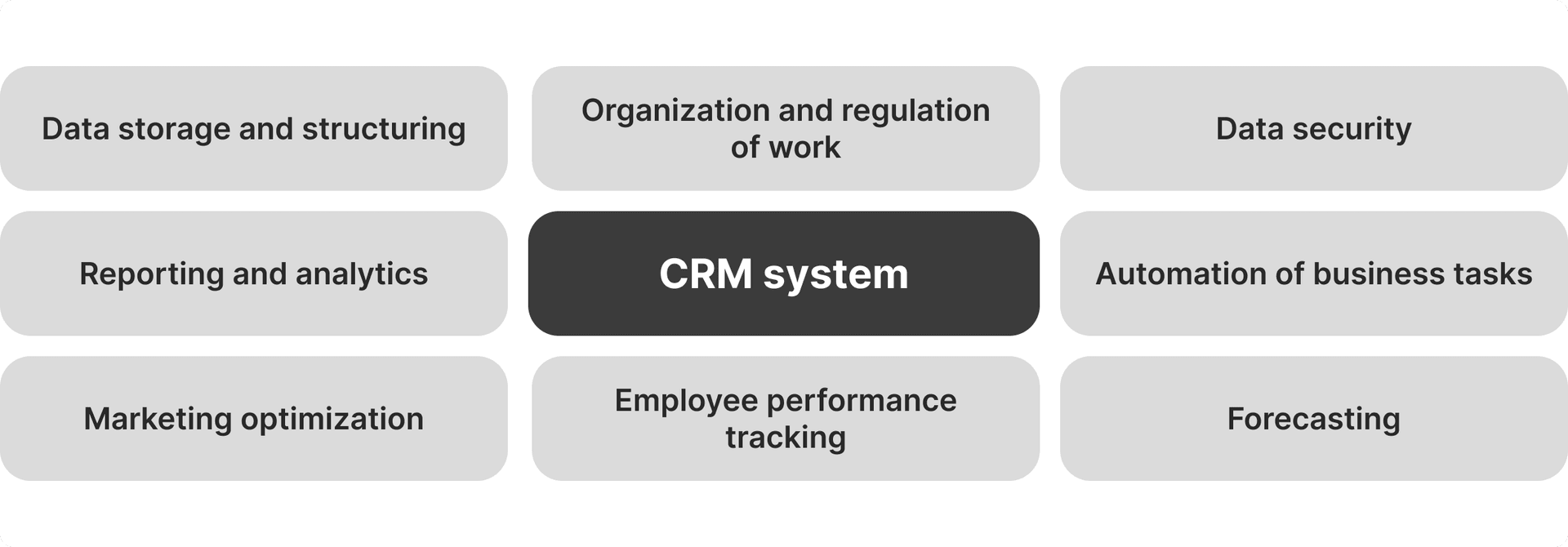
All brokers, whether it is a start-up wanting an out-of-the-box solution, an existing brokerage wanting to scale, or trading desks that need risk information in real-time, require this setup as the operational backbone.
In summary, it can be said that it is the digital version of manually recording every single business operation, making it easier to implement, increasing business productivity, improving customer satisfaction, increasing profits, and giving reports much faster compared to manual documentation.
Admins can fine-tune the entire user journey through the Forex back office software, handling registration flow, document verification, data management, deposits and withdrawals, account opening and closing, and more. All conformed to globally accepted standards and protocols.
As such, having reliable software is crucial for effectively operating your brokerage and reaching your objectives since it helps monitor teams and each stage of the process.
Connect with a Market-Leading Forex CRM
Explore B2CORE and integrate compliance, trading platforms, payment systems, and more into one interface.
How Does Forex Back Office Software Improve Operational Efficiency for Brokers?
FX back office systems have effectively replaced slow manual tasks with automated workflows that accelerate onboarding, simplify administration, and improve oversight.
They centralize compliance, account actions, and risk data, supporting brokers in reducing operational friction and maintaining a consistent, scalable structure across all departments. Let’s explain in detail how your back office software benefits your brokerage business.
Automating Client Onboarding and Verification
The FX back office automates KYC and AML processes, which are necessary to ensure legal compliance and safeguard the platform from malicious behaviors.
This automation eliminates repetitive steps that slow down traditional onboarding, such as manually checking each document, verifying IDs, validating proof of address, screening clients against global watchlists, and assigning risk scores to certain activities.
These instant checks allow users to go through the registration process and start trading quickly, giving brokers the advantage of fast activation and better engagement.
Streamlining Account Management and Daily Operations
Operating through a single software brings together all key management tools, including account updates, balance adjustments, funding actions, user permissions, and operational reporting in one interface. For example, sales and finance teams can access the same synchronized data to obtain key client information, boosting team synergy and efficiency.
This consolidation removes the need to jump between different systems or spreadsheets, which often leads to duplicate entries and inconsistencies.
Enhancing Risk Monitoring and Real-Time Decision Making
Real-time monitoring is essential to gain instant visibility into exposure, order flow, and client margin levels. Instead of manually measuring risks per account, modern back office systems track market positions as they develop, sending alerts when a client approaches critical thresholds.
These systems also automate stop-out mechanisms and segment-based rules, enabling teams to react quickly to potential issues instead of relying on delayed reports. This immediate insight helps prevent unexpected losses and simplifies risk departments’ daily decision-making.
Reducing Manual Reconciliation and Reporting Tasks
The brokerage back office software automates most of the repetitive financial tasks that typically consume staff time. Deposit and withdrawal reconciliation, commission payout calculations, and regulatory reports preparation can be generated automatically and with greater accuracy thanks to these modern systems.
Moreover, automation eliminates inconsistencies across departments, generating detailed logs and producing audit-ready reports that meet regional regulatory standards, supporting long-term compliance that is necessary for legal operations and trust.
Key Features of a Modern Forex Back Office Solution
When looking for a reliable Forex back office solution, there are non-negotiable features for your platform, including compliance, client management, risk oversight, automation, flexible configuration, and broad integrations. Let’s explain in more detail.
Client Profile and Financial Management
The back office FX software should facilitate easy storage and maintenance of clients’ information, allowing traders to create and update new profiles quickly without relying on the admin’s input. Additionally, the user interface should be simple and clear, providing organized and easy access to the trading experience, residency, and other information.
The system must be prepared to track and manage consolidated customer balances, supporting various financial activities, such as transferring funds between multi-currency accounts, conducting cross-currency exchanges, adding credits and rebates, and issuing refunds.
KYC/AML Automation
Automated KYC and AML functions ensure faster and more compliant onboarding, where the system accurately verifies ID documents, confirms residential information, screens clients against sanctions lists, and assigns a risk profile based on given attributes.
The Forex brokerage back office also helps admins maintain audit trails, which are needed for regulatory purposes and to allow brokers to revisit historical checks. By reducing manual verification work, brokers avoid processing delays and maintain a more efficient onboarding pipeline.
Forex CRM and IB Management
Integrated CRM tools centralize communication logs, client engagement histories, and marketing automation workflows. This consolidation helps brokers segment clients, track activity, assign follow-up tasks, and manage retention campaigns from one place, without back-and-forth communication between teams.
Brokers can also create and manage IB and partner programs more effortlessly through the CRM, supporting multi-tier commission structures, recording referrals, and simplifying partner performance and payout.
Risk Management and Exposure Monitoring
Brokers need real-time risk dashboards to visualize exposure levels, margin usage, client trading activities, order execution flow, and routing behavior across A-Book and B-Book models.
This automation triggers specific actions when stop-out rules and segment-specific parameters are met, helping brokers control risk and maintain a safe trading environment without constant manual intervention.
Reporting and Analytics Tools
A comprehensive reporting engine delivers insights into trading volumes, revenue streams, user behavior, system performance, and compliance obligations. Admins can use customizable dashboards to focus on key performance metrics and automate regulatory reports to remain compliant.
White-Label Solutions and Scalability
White-labels are pre-built platforms and features that can be customized to the broker’s requirements without a major development overhaul. This advantage is crucial for adopting unique products and services and ensuring scalability that accommodates growing user numbers and transaction volumes without performance issues.
Top white-label providers offer cloud-based architecture, ongoing software maintenance, and load balancing to ensure uptime and stability, especially during periods of high market activity.

Explore the best Forex white label platforms for brokers in 2026, with a breakdown of features, technology, costs, and what to look for in a provider.
FX Marketing Tools
Back-office FX software should include marketing tools for both clients and IBs. The software should allow for the identification of active and reduced trading activity, enabling targeted email campaigns and exclusive promotion links for tracking new leads.
This functionality allows for targeted marketing and efficient communication with clients, ensuring a successful trading experience.
Trading Platform and Payment Processor Integrations
A reliable back office system must integrate smoothly with trading platforms, liquidity hubs, payment gateways, and digital wallets. These integrations synchronize balances, trading activity, and payment statuses, enabling brokers to manage all platform aspects without juggling multiple software or applications.
Moreover, this unified connectivity reduces processing delays, makes deposits and withdrawals more efficient, and ensures traders see accurate real-time account information across all connected systems.
Partnership Programs and IB Management
Partnership programs effectively attract new clients and increase traded volumes on platforms. Forex firms that work with introducing brokers should have an ecosystem that calculates and pays partners’ commissions and rebates, and provides tools for IBs to assist their clients.
Direct access to the software will enable IBs to execute their obligations effectively, and when they receive the correct remuneration, they will be motivated to excel in their respective fields.
Real-Time Account Monitoring
Integrating back office software with FX trading should allow the platform to monitor all accounts in real time, obtaining information such as margin, profit and loss, position sizes for client orders, and more.
This information enables timely margin calls and risk advice and helps control exposure, which is particularly beneficial for firms operating as dealing desk brokerages.
5 Best Forex Back Office Software for Brokers
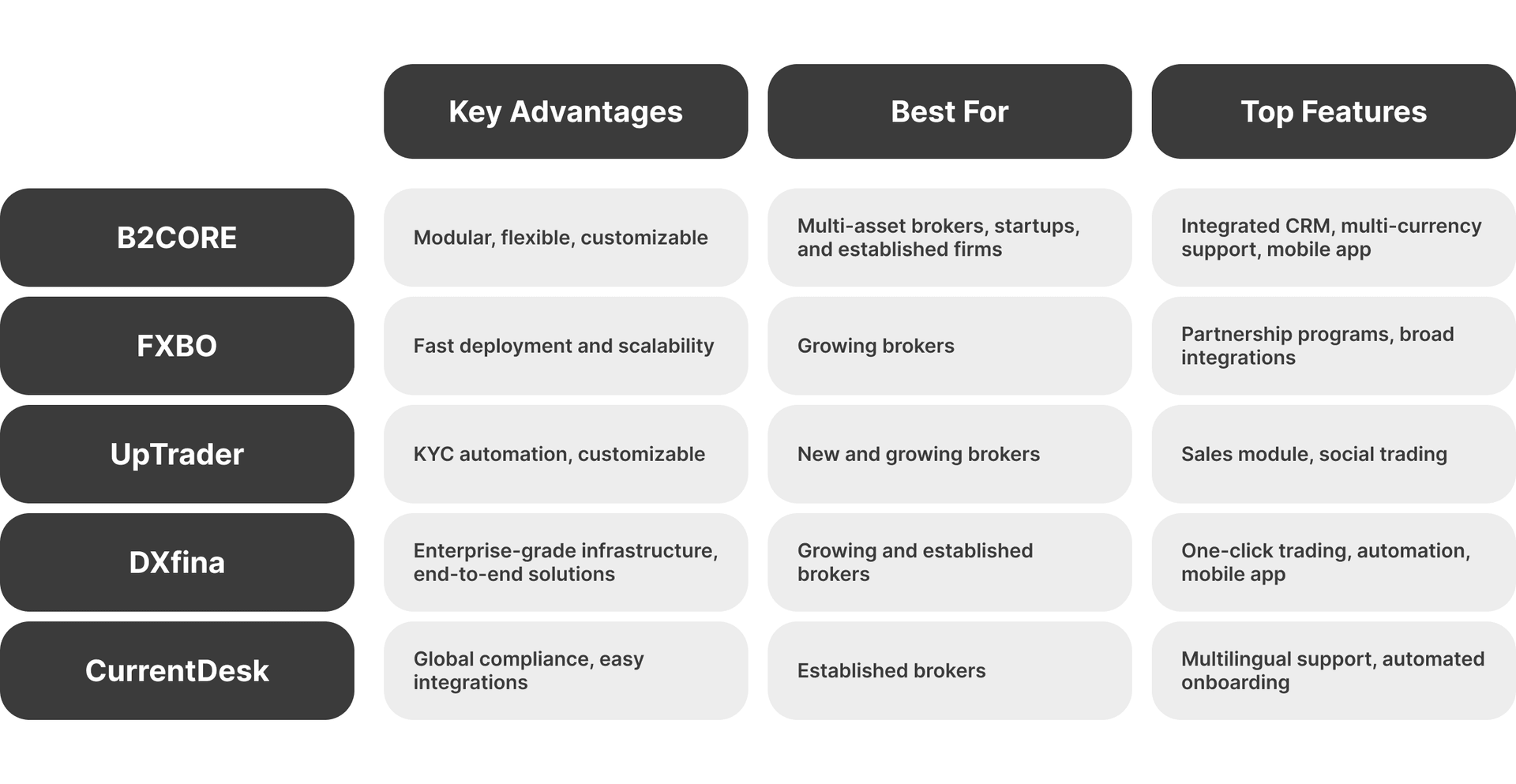
There is an abundance of back office providers that offer operational tools for brokers, but only a few offer top-notch technology, flexible infrastructure, and proven industry experience. Below, we list the top back office CRM developers offering reliable solutions that incorporate scalability, rich features, and key integrations.
1. B2CORE
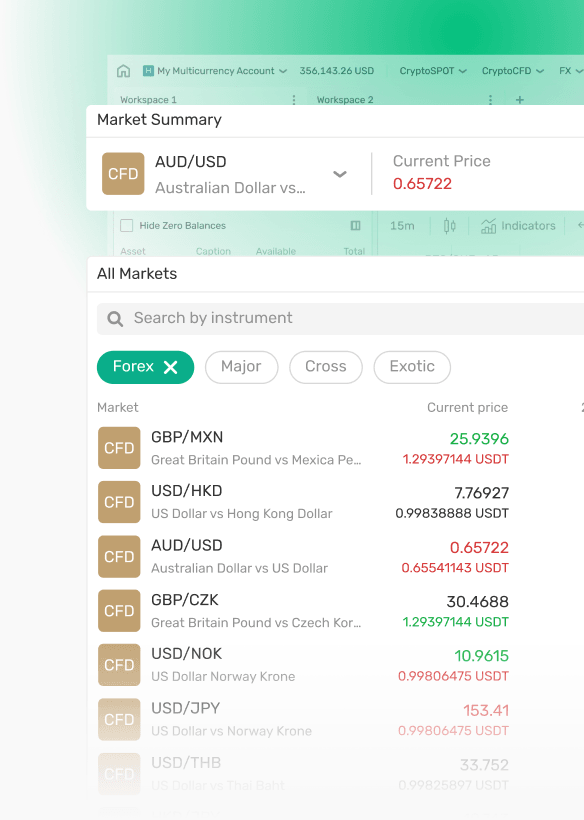
B2CORE is a market-leading CRM solution developed by the liquidity and fintech pioneer, B2BROKER. The company with 10+ years of experience and serving hundreds of brokers around the world offers a feature-rich back office solution that aligns with clients’ demand, such as multi-currency wallets, PAMM money-making model, IB modules, and trading leaderboard.
B2CORE is a multifunctional system that supports Android, iOS, Windows, and macOS platforms with affordable pricing plans that suit brokers of all levels and save millions in development costs.
It offers in-house affiliate and IB programs and is deeply integrated with B2BROKER’s ecosystem, including crypto payment gateways, liquidity bridges, broad asset class support, copy trading solutions, and more.
The main components of B2CORE include a trader’s room, a back office with client management and support, and a CRM system for automating customer interactions, making it one of the most versatile tools available.
All-In-One CRM & Back Office for Brokers and Exchanges
Fully Customisable Trader’s Room with Modular Features
Built-In IB Module, KYC, Payment Integrations, and Reporting Tools
Intuitive Interface that Boosts Client Engagement
2. FXBO
FXBO focuses on scalability and fast deployment, making it a suitable choice for brokers expanding their operations, entering new markets, or onboarding large partner networks. The CRM comes with flexible configurations, extensive tracking capabilities, and multi-tier IB schemes that give broker more control over their operations.
The infrastructure is designed to handle growing trading volumes and increasing onboarding demands while maintaining consistent performance. It also integrates with various trading platforms, payment gateways, and external tools easily, thanks to its sophisticated API architecture.
3. UpTrader
UpTrader Forex CRM is a dedicated CRM provider that offers a unique ecosystem adapted for brokerage companies. The company’s design is intuitive and modern, focusing on the broker’s financial and administrative needs.
The platform offers a dedicated Sales Module, a powerful tool that enables admins to configure sales funnels, gain insights, design forecasts, and create synergies between sales teams.
The company also offers a multilevel partnership program with advanced partnership reports, allowing for custom partnership details and automated fee calculation.
Its extensive CRM ecosystem includes modules like the Partnership Program, CopyTrading Platform, Sales Interface, Traders Room, Back Office, and Admin Portal, making it a solid choice for growing brokers.
4. DXfina
DXfina by Devexperts is a dedicated back office solution designed to support high-performance brokerages with a reliable, enterprise-grade infrastructure that delivers real-time synchronization, high-tech trading platforms, and granular visibility over platform activities.
The platform combines powerful reporting tools with automated workflows for dealing, compliance, and account management, giving brokers clearer oversight and faster decision-making. The software also supports flexible configuration, multi-asset operations, and scalable architecture that suits both growing and established brokerages.
5. CurrentDesk
CurrentDesk is another popular Forex back office software for brokerage firms and financial institutions. It streamlines client relationship management, administrative hub, multi-asset management, and internal processes to increase the visibility of key data and support business growth.
CurrentDesk CRM offers self-registration, complete commission control, and multi-tier IB trees for managing partner networks. It also streamlines KYC processing and account creation and sends auto-reminders to chase incomplete document uploads.
The software tracks leads, increases trader engagement, automates back-office operations, speeds up compliance processes, and connects to multiple MetaTrader 4/5 servers, providing clients with reliable tools to manage their platforms.
How to Choose the Right Back Office Provider
Deciding on the back office software that suits you requires technical, operations, and strategic considerations. This step will affect your long-term stability, compliance, and efficiency. Here’s what you need to know.
1. Assess Security and Compliance
Security and compliance are core to your brokerage operations. A reliable provider should implement strong encryption standards, granular access controls, and streamlined compliance protocols that make it easier for you to adhere to local and global laws.
As such, audit logs must be detailed and easily accessible, allowing you to track every operation and automate reporting to regulatory authorities. Moreover, you must confirm that the provider supports multiple reporting formats, data retention rules, and monitoring requirements that align with different jurisdictions.
2. Evaluate Integration Options
Integrations are key for your platform operations. Therefore, you must confirm that the software connects smoothly with trading servers, CRM systems, payment gateways, and IB programs tools.
Reviewing API documentation helps determine the ease of migration and future scalability, as vendors should offer structured integration support and clear timelines to minimize disruption during the transition phase.
3. Compare Pricing and Support
Pricing structures vary widely across providers and markets. You should calculate the true cost of ownership, including licensing fees, initial setup, custom modules, and ongoing maintenance. Check if the provider offers 24/7 assistance, dedicated account managers, and meaningful SLA commitments to ensure better value in the long term.
4. Request a Demo and Conduct Trials
Before committing to a solution, request a structured demo to gain a practical look into onboarding flows, verification pipelines, report generation, and risk updates in real time.
These trials are crucial to assess platform usability, especially for teams handling high-volume client activity. They reveal performance under realistic workloads, market changes, and evolving customer demands, helping you understand whether the system aligns with your requirements.
How Much Does It Really Cost to Start a Brokerage in 2026?
Starting a brokerage in 2026 requires a clear understanding of both upfront and ongoing expenses, which vary widely based on jurisdiction, brokerage model, and chosen technology.
- Licensing remains the highest cost, ranging from around $25,000–$100,000 in offshore jurisdictions to over $100,000 in highly regulated regions that demand strict audits and capital reserves.
- Technology adds another major layer, with white-label setups starting from $10,000–$50,000 upfront, while custom platforms can exceed $100,000–$500,000.
- Liquidity integrations involve setup fees and monthly commitments. These fees depend on the monthly volume, with initial connection expenses ranging from $5,000.
- Staffing, compliance, support, risk, and marketing add high recurring costs that vary based on your platform’s size.
- Supporting services, such as hosting, security tools, software renewals, legal services, and marketing, typically add tens of thousands annually that you must account for.
Overall, lean offshore brokers may launch with $50,000–$150,000, while fully regulated, high-end operations often require $150,000–$500,000+ to build a sustainable, competitive brokerage.
Save $5 Million in Back Office Setup
See how our CRM software saves you precious bucks in hiring teams, developing a platform, and other hidden costs
Common Challenges and Best Practices for Brokers
Even the strongest back office solution must be deployed correctly to deliver the full value, leaving no service gaps and ensuring that you don’t pay for unused services.
Most brokers face operational challenges due to legacy processes, inconsistent training, or fragmented systems. Therefore, you must address these issues from the early doors to create a smoother operational environment.
Overcoming Manual Processes
Many brokerages still rely on spreadsheets and repetitive data entry. Replacing these manual workflows with automation reduces errors, increases processing speed, and frees staff for higher-value tasks.
Implement a phased integration and change to ensure teams adjust gradually, alongside systematic training and ongoing monitoring.
Avoiding Regulatory Pitfalls
Compliance is tricky, with many loopholes and lapses that affect your operations. Therefore, you must ensure complete KYC documentation, accurate audit trails, up-to-date compliance records, and timely reporting submissions supported by legal teams.
Clear documentation and structured oversight are essential for long-term regulatory stability and avoiding penalties.
Streamlining Partner and IB Onboarding
Efficient onboarding leads to more reliable partnership networks. As such, you must offer automated commission models, transparent reporting, and self-service dashboards that create smoother interactions with IBs and affiliates.
This also helps reduce administrative overheads, as partners can independently track their clients, earnings, and performance.
Optimizing Scalability and Cloud Hosting
As trading volumes rise and more traders land on your platform, infrastructure must keep pace without impacting performance and pricing. Cloud-native deployment, load-testing, and redundancy planning help prevent downtime during peak market conditions.
You must also conduct ongoing performance monitoring to ensure systems remain responsive and secure as you expand into new regions or add more assets.
Support Sustainable Growth Through B2CORE’s Complete Forex Back Office Platform
The right back office system supports long-term growth through faster onboarding, streamlined operations, and a controlled risk environment. B2CORE offers all these capabilities and more in a unified ecosystem consisting of a strong back office designed for multi-asset operations, high-volume processing, and global brokerage models.
Start your Forex Brokerage in Weeks, not Months
All Technology, Liquidity & Payment Integrations Included
White-Label cTrader/B2TRADER with Full Back Office Support
Compliance-Ready Setup with Ongoing Technical Support
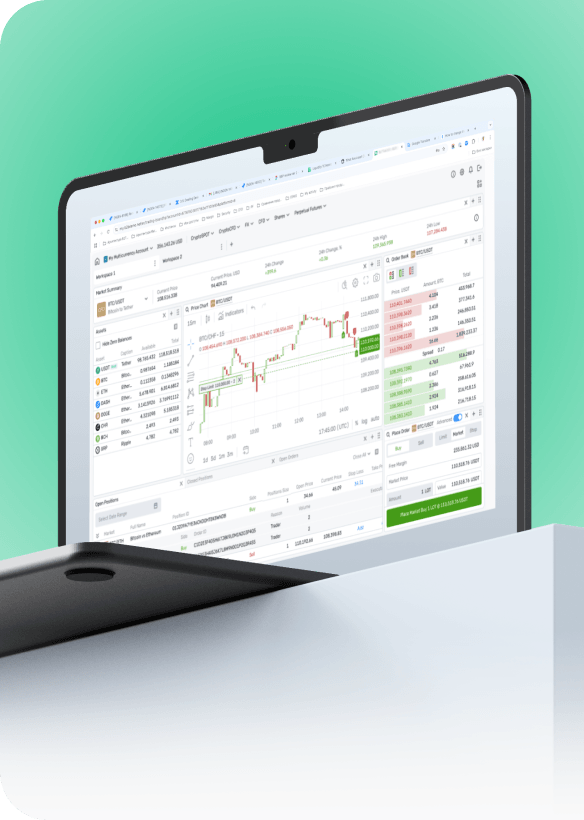
It empowers brokers with smooth client verifications, granular financial oversight, and reliable reporting across all departments. Its key feature, the trading room, is a focal point for all trading activities, including interactive charts, price feeds, market news, economic calendars, payment gateways, and all tools that your traders require.
With modular features, deep integrations, and reliable support, B2CORE enables you to scale faster, remain compliant, and expand smoothly to new markets.
Frequently Asked Questions about Forex Back Office Software
- How long does Forex back office software implementation typically take?
Implementation timelines vary depending on the brokerage’s needs. Standard deployments with preconfigured modules can go live within a few days. More complex setups that involve multiple integrations, data migration, and API mapping usually take several weeks.
- Can Forex back office software integrate with multiple trading platforms simultaneously?
Yes. Modern back office systems support multi-platform connectivity via unified APIs, enabling integration with MT4, MT5, cTrader, DXtrade, and proprietary platforms within a single operational environment.
- What Makes Up a Perfect Forex Back Office Software?
A strong back office solution should include advanced client profile tools, automated KYC/AML, CRM & IB management, real-time risk dashboards, flexible reporting, and scalable architecture.
It should also integrate seamlessly with trading platforms and payment providers, while supporting white-label customization for unique branding.
- What support channels are available after a Forex back office deployment?
Most renowned providers offer a mixture of dedicated account managers, 24/7 technical assistance, ticketing portals, live chat, and scheduled performance reviews. Some even offer onboarding specialists and periodic system health checks to ensure smooth operation as the brokerage scales.