How Do You Migrate a Forex Broker Platform Safely?

It's cutover weekend, and a single mismapped liquidity session starts rejecting fills the moment live traffic moves to the new stack. Positions drift and the support queue fills while a routine platform migration turns into an incident. That risk is why brokers treat a forex broker platform migration as controlled infrastructure work.
Migrating safely means moving the whole trading stack, from the matching engine to the compliance records, as one controlled program rather than a front-end swap. What makes it hard is that a brokerage never closes: currency markets trade around the clock, five days a week, so there is no quiet window to move infrastructure while client flow stays live.
This guide is written for the technology and operations leaders who own that risk. It lays out how to migrate a forex broker platform safely, with a phased framework that protects execution quality and client continuity while regulatory standing holds from audit through go-live.
Key Takeaways
- Moving a brokerage safely means treating the matching engine, liquidity bridge, CRM, and compliance data as a single coordinated program instead of a series of separate swaps.
- Running the old and new systems side by side is how most brokers confirm that fills, latency, and data all line up before they send live traffic to the new stack.
- Compliance survives a migration only when client records, KYC and AML workflows, audit trails, and third-party ICT duties keep working the entire time.
- The usual trigger is a legacy FX-only stack that starts to cap multi-asset expansion, institutional liquidity access, or the resilience that serious clients now expect.
- An integrated destination cuts the number of vendors and API seams involved, which shortens the path to tuning performance once the move is done.
Why Broker Operators Are Migrating Platforms Now
Brokers that were happy on legacy infrastructure two or three years ago are rethinking that position, and three structural pressures explain why.
The first pressure is execution quality at scale. Electronic foreign exchange (FX) trading has moved from voice-era workflows measured in minutes to algorithm-driven execution that now clears in milliseconds , as the New York Fed has documented, and older architecture cannot keep that pace. A matching engine from an earlier generation struggles to hold competitive fill quality, throughput, and execution speed, and its failover behavior tends to lag when volatility spikes. That gap is why modern brokers are moving beyond single-platform stacks : an FX-only stack turns into a strategic constraint over time.
The second pressure is multi-asset demand. Products that used to be optional extras, from crypto CFDs to equity indices to tokenized instruments, are now core lines for forex brokers chasing both retail and institutional flow. A single-asset forex trading platform can only stretch to cover them through workarounds, and each workaround adds technical debt that gets harder to unwind later.
The third pressure is operational resilience regulation. DORA, the EU's Digital Operational Resilience Act , which became fully applicable in January 2025, requires financial entities to document their ICT risk management and to test business continuity on a schedule. It also obliges them to keep a formal register of every third-party ICT provider. A legacy multi-vendor stack spreads accountability across suppliers, which raises the compliance and audit burden DORA measures, while an integrated architecture keeps those lines shorter.
Migration answers all three at once, which is why operators treat it as capacity building.
What a Full Broker Platform Migration Actually Involves
Whether the brokerage runs MetaTrader 4, MetaTrader 5, cTrader, or a proprietary trading platform, a migration reaches well past the front end. The migration process spans execution, liquidity, data, compliance, and client operations at once, which is why underestimating the scope is the most common failure mode. A team that treats it as a simple platform upgrade reaches go-live with unmapped dependencies, and those gaps show up as outages or broken records.
Matching Engine and Order Routing Infrastructure
The matching engine holds the order queue logic, the mechanics of each order type, and the latency and failover design that set the performance ceiling. Change any of it without controlled validation, and identical orders start filling differently. That becomes a trade-execution problem with direct client impact and possible best-execution consequences under MiFID II and ASIC RG 265 .
Before the engine moves, the migration team confirms each of these against the live system:
- queue logic, whether strict FIFO or an alternative matching model
- order type support across market, limit, stop, OCO, and trailing stop
- round-trip latency targets and throughput at peak load
- FIX protocol version alignment with every LP connection
- failover behavior under a simulated outage
The A-Book and B-Book decision shapes much of this: how a broker's execution model affects migration complexity and costs determines the engine configuration to preserve and the LP routing rules that have to carry across unchanged.
Liquidity Bridge and Prime Connectivity
The liquidity layer carries everything that shapes a fill, from LP sessions and symbol mappings to the markup and spread rules behind pricing, last-look settings, and the prime connectivity underneath. All of it has to move without changing what a client sees at execution.
During parallel running, the team measures the target system's liquidity behavior against the legacy baseline on:
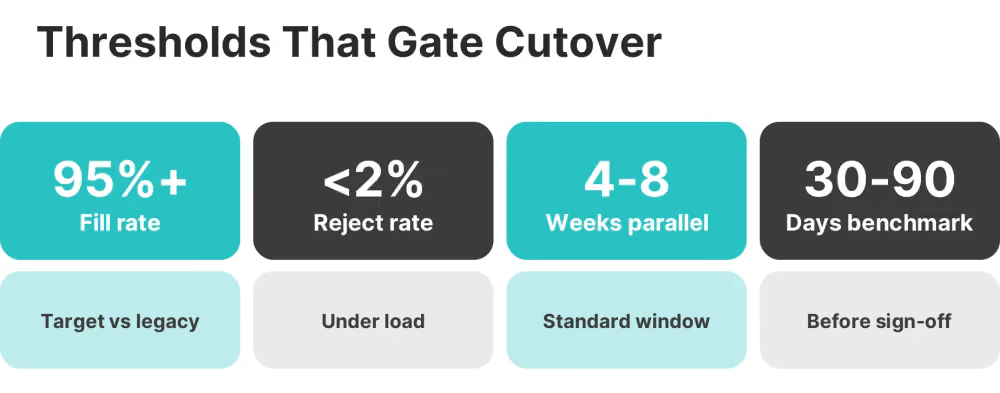
- fill rate, with a target above 95%
- reject rate, with a target below 2%
- spread consistency and pricing versus the old system
- slippage under volatile market conditions
- swap-rate accuracy across instruments, checked in real-time
API differences between the two systems, like a FIX version change or a restructured REST endpoint, can introduce silent execution differences that stay invisible until live traffic runs through the new stack.
Back-Office, CRM, and KYC/AML Data Continuity
The data layer covers everything tied to a client account: profiles and balances, open positions and permissions, identity documents, and the historical trades and reporting archives behind them. Retention rules make this the least forgiving part of the move. FATF Recommendation 10 calls for an unbroken audit trail on customer due diligence, MiFID II sets a five-year floor on order records , and some AML regimes push that to seven years.
When data lineage breaks mid-migration, two problems land together. A client hits immediate friction like a wrong balance or missing history, while the firm takes on compliance exposure through audit-trail gaps that cannot be rebuilt later.
The standard that avoids this starts with field-level data mapping between the two environments. Dry-run migrations get reconciled against legacy statements, and both compliance and operations sign off before any cutover begins.

The Regulatory Dimension: Compliance Obligations During Migration
A migration changes technology risk while leaving regulatory accountability where it was. Every obligation that applied before the move still applies during and after it, and regulators across financial markets expect the controls to keep running throughout rather than come back online at completion. In the United States, the CFTC and the NFA impose parallel oversight on FX and derivatives brokers.
Several obligations have to hold for the entire migration window:
- KYC and AML screening continuity
- access to retained records at all times
- uninterrupted regulatory reporting capability
- the access-control and permissions architecture
- incident classification and reporting under DORA
- documented accountability for every third-party ICT provider involved
DORA treats a platform migration as a material ICT change, so depending on the regulator and scope, a broker may have to notify supervisors in advance and update its ICT register with every third-party provider and the contractual duties involved. When core infrastructure fails at a financial intermediary, the damage rarely stays contained to one firm, so a structured migration method is the responsible choice for the market and the operator alike.
A Phased Migration Framework for Forex Broker Infrastructure
Sequence carries the whole method. A broker that starts parallel-phase work before the audit is finished, or opens cutover before acceptance thresholds exist, manufactures failure modes at each gate. A named, five-phase model is how to migrate a forex broker platform safely: it keeps the order honest and gives operations a measurable checkpoint before each step.
Phase 1: Pre-Migration Infrastructure Audit
Before any architecture work begins, the team builds a full dependency inventory of the current stack:
- symbol sets and order types
- LP connections and custom plugins
- regulatory reports and payment processors
- retail, institutional, and prop trading client segments, plus jurisdiction-specific controls
A trading platform maintenance framework that already documents this layer shortens the audit considerably: brokers who keep that documentation live often finish in days, while those starting cold spend weeks reconstructing what they run.
Phase 2: Architecture Design and Vendor Alignment
With the inventory in hand, the team designs the target state across execution model, asset coverage, APIs, hosting, resilience, and compliance workflows. Vendor alignment runs alongside it and comes down to explicit ownership: who maps the data, who runs UAT, who handles client communications, and who can trigger a rollback.
Phase 3: Parallel Running and Execution Validation
Parallel running is live validation. The legacy and target systems run at the same time while the team compares execution, reconciliation, and compliance output across engine fills, liquidity behavior, and swaps. Acceptance thresholds get set before the phase opens rather than argued out while it runs, and sign-off comes from trading, operations, compliance, and support together. Four to eight weeks is the standard window for an institutional FX migration.
Phase 4: Controlled Cutover
Cutover runs as a controlled event built to minimize downtime: defined freeze windows, client position notices, clear rules for open positions, a planned routing switch, and rollback triggers the team has already tested. Communication discipline matters most for VIP clients and partners, who need to know what changes, when it happens, and where support sits during the launch window.
Phase 5: Post-Migration Benchmarking and Optimization
Once traffic is on the new stack, the team benchmarks it against the legacy baseline on latency and uptime, fill and reject rates, spread stability, and support load. A window of 30 to 90 days is standard before anyone calls the migration complete. This phase also opens the upside that justified the move: multi-asset rollout, fewer vendors to manage, and cleaner daily operations.
Migrate Your Broker Platform on a Foundation Built for Institutional Scale
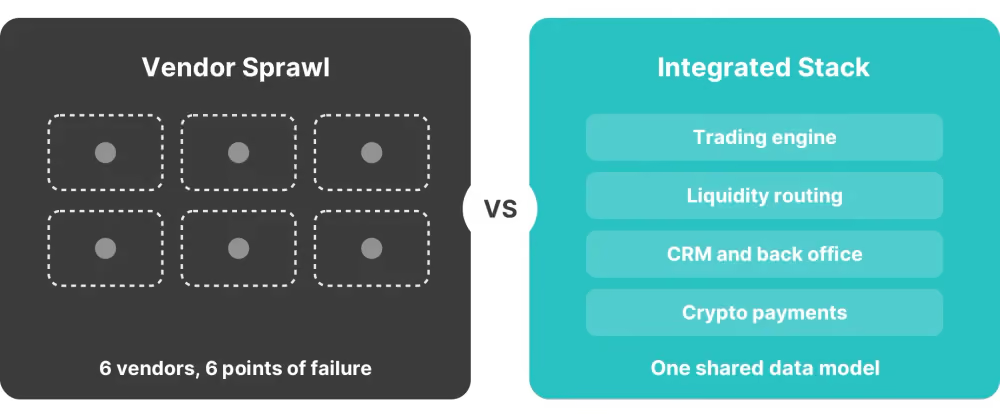
The five-phase method supplies the structure, and the destination architecture decides how much complexity survives the move. A broker consolidating vendors, upgrading execution, and opening up multi-asset trading gets the cleanest result from an integrated stack: B2TRADER handles matching and execution, B2CONNECT is the crypto-native liquidity bridge, B2CORE runs the CRM, back office, and KYC/AML workflows, and B2BINPAY provides crypto payment and settlement rails. Because those components share one data model, the integration seams that usually create migration risk never have to be rebuilt.
When the matching engine, liquidity layer, CRM, and back office read from one data source, the Phase 5 optimization loop mostly runs itself: transaction cost analysis feeds routing, KYC shares client data with the back office without an API translation layer, and reporting draws from one source.
B2BROKER has powered brokerages and exchanges since 2014, operating under 10 regulatory licenses and serving more than 1,000 corporate clients across its trading and back-office ecosystem. That track record is what makes it a destination built for a full-stack migration rather than a single-component swap.
For a broker weighing the move, the practical next step is a scoped assessment of the current stack's dependencies and a target architecture designed to make the transition safe.
Frequently Asked Questions about Migrating a Forex Broker Platform
What are the key risks of migrating a forex broker platform?
Execution can degrade, data can go missing or mis-map, reports can develop gaps, and cutover is where clients feel it. Parallel running, tested rollback, and pre-agreed validation thresholds keep those failure modes contained before live traffic moves.
What components of a forex broker technology stack need to be migrated?
The matching engine, order routing, liquidity bridge, pricing and risk logic, CRM, back office, and payment workflows all move together. Client permissions, trade history, open positions, and KYC and regulatory records have to carry across intact so operations never break.
How do you migrate client data and trading history when switching broker platforms?
Begin with a field-level map that reconciles profiles, balances, positions, documents, and historical orders across both environments. Validate samples against statements, reports, and KYC workflows before cutover so audit trails and support processes reproduce exactly.
How can a broker migrate platforms without disrupting active client trades?
Run the legacy and target platforms in parallel and test latency, fills, rejects, and routing under live conditions first. Tight cutover windows, clear client notices, and predefined rollback criteria then protect open positions and limit churn.
Why do brokers migrate their forex platform to B2BROKER?
An integrated stack of B2TRADER, B2CONNECT, and B2CORE covers trading, liquidity, back office, and support from one data model, which cuts vendor sprawl and clarifies accountability. For CTOs and COOs, that shortens delivery timelines while keeping execution, compliance, and client servicing coordinated.
Recommended articles

Subscribe to our newsletter