Can Better Liquidity Terms Increase Brokerage Profitability?

Most brokers look for higher margins by adjusting prices and cutting costs. The bigger lever is the deal you negotiate with your liquidity providers: those terms set the spreads and fill rates your clients see, and that decides how much of each trade you keep.
Most mid-sized brokers get that deal through Prime of Prime , now the standard way to reach institutional liquidity. It aggregates Tier-1 pricing from several banks and non-bank market makers into a single feed, without the tens of millions in capital that a direct bank relationship demands.
This guide shows how to assess whether improved liquidity terms affect your profitability, and how to measure the effect. It comes down to two metrics: the margin you capture per trade and the daily cost of running the book.
Key Takeaways
- Better liquidity terms widen the margin you keep on each trade, without making you raise prices for clients.
- Aggregating liquidity tightens your spreads and steadies fill rates, so you keep more volume when markets turn volatile.
- If you run an A-Book, liquidity quality sets your revenue ceiling: tighter pricing from your provider leaves room for your markup on top.
- If you run a C-Book, smarter routing turns good liquidity terms into margin, because you can hedge risky flow cheaply.
- One connected stack across the front and back office protects margin by cutting the reconciliation errors and vendor costs that grow as you scale.
Why Liquidity Terms Belong in Your Profitability Calculation
Liquidity terms are a revenue input, and treating them only as a procurement cost caps what your book can earn. The executable spread and fill quality you negotiate determine how much margin you keep on each trade, and your reject rate and settlement terms also affect that number.
Weak terms cost you directly. A wider executable spread forces a choice: raise the price your clients pay and lose them to cheaper brokers, or hold your price and absorb the spread yourself.
High reject rates damage the client experience and send clients to other brokers during volatile sessions, exactly when they are most likely to leave. Slow settlement and messy post-trade data create reconciliation work, and that workload climbs as your volume grows, just when you expect cost per trade to fall.
Charles Schwab shows what good infrastructure does to margin. In Q1 2026, it posted a 49.2% pre-tax margin on $6.5 billion in revenue, with average daily trades up 34% year over year. A margin like that reflects how well the operation runs, well beyond its trading volume.
How Spread Economics Decide Your Per-Trade Margin
Per-trade margin lives in fractions of a pip. Start with the spread your provider quotes, add your markup on top, then subtract slippage and rejected orders. Rebates add a little back, and what is left is what you keep.
Across active flow, a few tenths of a pip separate a profitable book from a marginal one.
The math for a single EUR/USD trade looks like this:
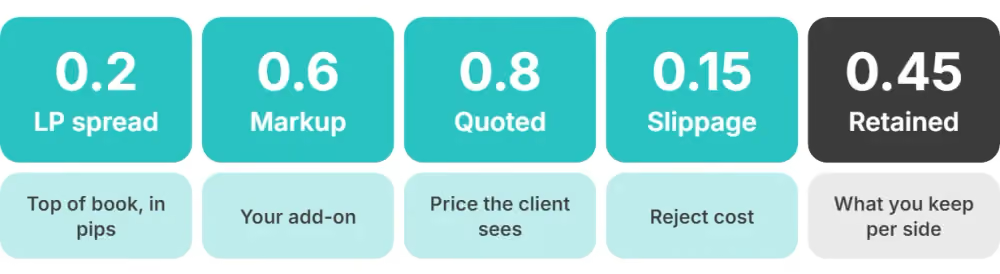
That 0.45-pip margin is the number to manage and optimize, well ahead of the spread you advertise on the homepage. Volume-tiered FX commission structures work the same way. A tighter deal at higher volume protects your markup and pulls in extra flow, because you no longer have to price defensively against weak liquidity.
Brokers using aggregators here commonly see fill rates of 97 to 99% and rejection rates of 30 to 70% during periods of volatility. Both feed straight back into the margin you keep.
Liquidity Aggregation as a Competitive Positioning Tool
Aggregation is a commercial tool. Beyond cleaner execution, good market access helps you win new business from rivals and keep them trading with you, and a broader product range grows your share of their wallet.
When you evaluate an aggregator, score it on five things:
- How many independent liquidity sources it has
- How much real depth sits behind the top price
- How fast each venue responds
- Whether a backup venue takes over when one source drops
- Whether it covers the instruments your clients actually trade
A well-configured aggregator aggregates bid and ask quotes from banks, prime brokers, ECNs, and market makers into a single order book. It then sends each order to the venue with the best price, factoring in fill probability and how fast the venue responds.
You get tighter pricing in normal conditions and faster failover when a source drops under stress. Both keep clients trading and protect your margin. How much you capture depends on the liquidity provision model underneath the aggregator.
How Tighter Spreads Protect Your Per-Trade Economics
A tighter advertised spread only helps if your fills hold up during volatility. Your marketed spread and your executable spread are two different things, and clients notice fast when orders get rejected on a news print or at the session open. Keep your executable spread close to your marketed one to protect the client relationships that keep volume on your book.
That gap decides how much of a client's volume you win. With good-enough LP terms, you can tighten pricing while still keeping most of your markup. That wins more volume from existing clients and pulls flow from rivals stuck with weaker liquidity.
Multi-Asset Coverage and Its Effect on Client Volume
Multi-asset liquidity grows your share of a client's trading by keeping activity that would otherwise spread across other venues. A trader who runs FX in the European session and metals around the London fix already has reason to keep it all in one place. Add weekend crypto, and that reason gets stronger.
A trader who has to split flow across providers has no reason to stay. Consolidating onto one venue is worth several points of retention and noticeably more transaction volume per active client.
More volume means more profit. Offer FX, crypto, metals, indices, and equities CFDs side by side, and you capture more of each client's lifetime trading. For exchanges, the same logic shows up in liquidity management strategies for exchanges , where tiered fees and deeper order books keep volume steady as clients move between asset classes.
Execution Model Selection and the Role Liquidity Terms Play
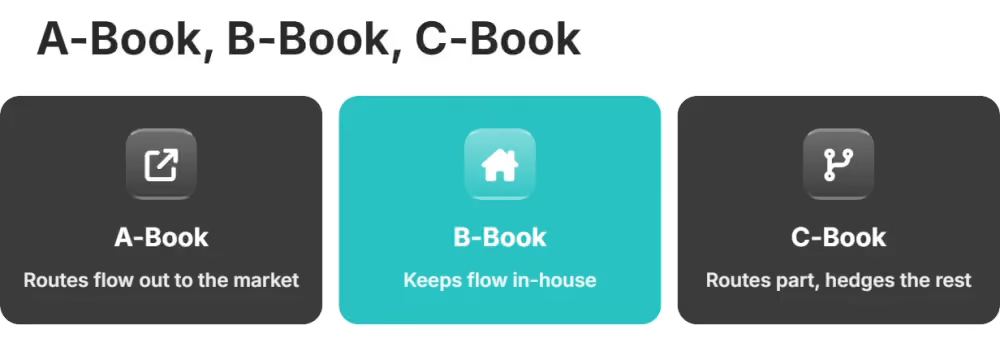
Choosing an execution model is really a decision about capital and risk. A-Book and C-Book hybrids each make money in a defensible way, and the right choice for you depends on a few factors:
- The capital risk you can take
- The kind of clients you serve
- The rules you operate under
- The quality of liquidity you can actually get
Liquidity terms affect every part of that decision, from routing and hedging costs to your revenue ceiling and client segmentation.
A-Book Models: Where Liquidity Quality Determines Revenue Ceiling
An A-Book sends client flow to the market and earns from commissions and markups. That caps your revenue per trade compared with keeping the flow in-house, and the cap rises or falls with your LP's pricing.
Weak terms force you to either widen client spreads or accept a thinner markup. Both lower the cap and send institutional clients to better-priced competitors.
Deeper liquidity raises that cap in two ways. Spreads tighten, so you can quote institutional-grade pricing and still keep margin. Fills get more consistent, and reliable fills are the biggest reason VIP and high-volume accounts stay and keep bringing repeat business.
So your LP quality sets the limit on A-Book profit, and that limit moves with the terms you negotiate.
C-Book Hybrids: How Routing Logic Amplifies Liquidity Advantages
A C-Book depends on routing as much as on access to liquidity. Good routing keeps safe flow in-house and hedges risky flow quickly, so you protect margin even when external liquidity worsens.
Run it well, and routing becomes a real-time risk job. You segment clients and net exposure, then hedge the remainder via a fast, low-latency connection.
Strong liquidity terms make hedging cheap. When external execution is fast and reliable, you hedge risky flow at close to the market price.
When liquidity is weak, every hedge eats into the margin, and the routing that made money under good conditions starts losing money. So judge a provider on what hedging actually costs, well beyond the headline spread at the top of the book.
The Hidden Profitability Drain That Better Liquidity Infrastructure Prevents
Most of the margin you lose leaks out quietly, below the cost lines that management watches. These leaks share one cause: the quality of your execution and post-trade processing.
- Rejected orders that never fill
- Slippage during volatility that widens realized spreads
- Reconciliation breaks that pile up after the trade
- Slow onboarding that delays new clients
- Client attrition that better execution would have prevented
Over the course of a year, these add up to real money, and better liquidity infrastructure fixes each one at the source.
Reconciliation is worth a closer look. It is the control layer that catches issues before they become regulatory or client problems, so treating it as routine admin is a mistake.
When your liquidity feed and trade-capture system run separately from the back office, breaks multiply, and your ops team spends its days chasing them instead of building capacity. Connect those systems into one layer, and the same information surfaces on a single dashboard that your team can act on.
Onboarding is the other steady drain. Research from WNS finds that automated KYC cuts onboarding times by 40 to 60% and lowers false positives by 20 to 40%.
Faster onboarding means clients start trading sooner, which lifts your signup-to-funding conversion rate. That shortens the time to recover acquisition cost and lifts the revenue each staffer handles. How you build this infrastructure decides whether those numbers move for you or against you.
Building a Profitability Architecture Around Institutional Liquidity
Raising profitability comes down to four levers that work together:
- Keeping more spread on every trade
- Routing flow to where it earns the most
- Automating manual work
- Covering more products to capture more client activity
All four run on the same input: institutional-grade liquidity on a connected technology stack. Build them as one system rather than separate vendor buys, and they reshape your revenue over 12 to 24 months and lift the firm's valuation.
CME Group pulled about 82% of its $1.88 billion in quarterly revenue from a single clearing-fee line , and Schwab's margin tells the same story. When one execution stack carries most of the value, your operating model becomes the part that competitors cannot copy.
Build versus buy is the last call. Building in-house can work if you have a deep engineering budget, but disconnected systems push back your launch and add integration risk, which delays the day the margin shows up.
A connected stack that links liquidity and execution to the back office cuts vendor overhead and brings revenue online sooner. That is why operators and business owners increasingly judge ecosystems like B2CONNECT , B2TRADER , and B2CORE on profitability, well beyond the technology itself.
Either way, the goal is a scalable liquidity operations infrastructure that holds up as your book grows.
If weak liquidity terms and back-office friction are draining your margin, and your routing is leaving money on the table, talk to a partner who can map the full stack to your client mix and capital limits.
Frequently Asked Questions about Brokerage Profitability
What are the most profitable revenue streams for a forex or crypto brokerage?
Transaction fees stay central, but margin grows faster once you add interest income, custody, or other non-spread lines. Running several new revenue streams cuts the dependence on spread income that competition compresses first.
What role does liquidity aggregation play in improving brokerage margins?
Combining several liquidity streams lets you quote tighter spreads while keeping more of the per-trade economics and leaning less on any single provider. Well-configured setups push fill rates to 97 to 99% and cut rejection rates by 30 to 70% during volatility, which feeds straight into the margin you keep.
What is the difference between A-Book, B-Book, and C-Book brokerage models?
A-Book routes orders to the market for commission or markup and keeps risk and conflict low, while B-Book keeps flow in-house and earns from client losses at higher capital and conducts risk. C-Book sits between them, routing part of the flow out and hedging the rest based on client segmentation.
How can automation reduce operational costs for brokers and prop firms?
Connecting the CRM and payments with risk and post-trade workflows in one layer lets you activate clients faster and clear compliance backlogs without adding headcount at the same pace. Automated KYC alone cuts onboarding times by 40 to 60% and false positives by 20 to 40%.
Should a brokerage build in-house or use a turnkey platform to improve profitability?
Building in-house suits firms with deep engineering budgets, but disconnected systems delay launch and push back the point where margin arrives. A connected stack that links liquidity and execution to the back office brings revenue online sooner, which is why many firms weigh ecosystems such as B2CONNECT, B2TRADER, and B2CORE on profitability.
Recommended articles


Subscribe to our newsletter