Liquidity Examples: How Liquidity Works in Real Markets

Liquidity defines the mechanical difference between a trade that executes instantly at the expected price and one that suffers from costly slippage. In live markets, it is the operational fuel that powers every transaction. For brokers and institutions, liquidity depth determines whether client activity generates revenue or operational friction.
This guide examines how liquidity actually behaves in real trading environments. We will analyze concrete liquidity examples across forex, crypto, and equities to demonstrate how market depth impacts execution quality.
Key Takeaways
- True liquidity absorbs aggressive volume instantly without triggering price slippage.
- Asset depth varies dynamically based on trading sessions, market capitalization, and volatility.
- Reliable measurement requires analyzing bid-ask spreads alongside order book depth and time-to-fill.
- Operational resilience depends on aggregating multiple liquidity streams to prevent coverage gaps.
Have a Question About Your Brokerage Setup?
Our team is here to guide you — whether you're starting out or expanding.
What is Liquidity in Financial Markets?
Liquidity measures how easily an asset converts into cash without impacting its market value. In live trading, this concept moves beyond textbook definitions to represent the specific cost of entering or exiting a position. A liquid market absorbs aggressive selling without crashing, whereas an illiquid one fractures under pressure.
Traders and brokers evaluate this dynamic through real-time order book depth and spread width. High liquidity translates to tighter spreads and the ability to fill large orders at the touch price. It acts as the primary defense against volatility, absorbing shocks that would otherwise trigger cascading price gaps.
Market Liquidity vs Accounting Liquidity
Financial professionals analyze liquidity through two distinct lenses depending on the operational context.
Market liquidity dictates the efficiency of trade execution. It relies on active participation and the density of limit orders resting at various price levels. Deep liquidity pools allow algorithms to execute large blocks without triggering slippage or signaling intent to the wider market.
Accounting liquidity (solvency) focuses solely on a company's balance sheet. It tracks a company's ability to settle short-term debts (accounts payable) using cash reserves and cash equivalents. Regulators monitor these figures to ensure a brokerage remains solvent enough to handle client withdrawals during stress events.
Successful firms optimize both metrics simultaneously. Clients demand market liquidity to achieve superior trade performance, while brokers need working capital and cash flow to operate. Balancing these demands builds a resilient operation capable of weathering both market crashes and operational audits.
Offer 10 Asset Classes From One Margin Account
Access deep liquidity across Forex, Crypto, and CFDs using a single margin account for maximum capital efficiency.
Liquidity Exists on a Spectrum, Not a Binary
Assets rarely remain permanently "liquid" or "illiquid." Market depth shifts constantly based on trading sessions and volatility profiles. A currency pair might execute instantly with tight spreads during the London-New York overlap, yet the same instrument often sees costs spike during the Asian handover.
Execution quality also fluctuates depending on order size. A standard lot clears immediately on major exchanges, while institutional block orders frequently require algorithmic splitting to prevent price displacement. Evaluating liquidity requires analyzing the type of asset, specific volume, and venue context at the exact moment of trade entry.
Examples of Highly Liquid Assets
Highly liquid assets allow traders to enter or exit positions immediately with negligible price impact. These instruments form the operational bedrock of financial markets, ensuring capital remains accessible even during periods of volatility.
Cash and Cash Equivalents
Cash is the most liquid asset possible because it settles immediately at face value. In brokerage operations, this includes balances held with tier-1 banks and central clearing institutions.
Holding idle cash is inefficient for returns. Institutional desks and brokerages prefer cash equivalents that combine safety with immediate accessibility for financial planning.
- US Treasury Bills (T-Bills): Short-term debt maturing in 4 to 52 weeks, trading in virtually unlimited volume.
- Commercial Paper: Unsecured, short-term corporate debt issued by high-rating firms for operational funding.
- Money Market Funds: Vehicles holding short-term debt, typically offering T+1 liquidity for operational needs.
Firms rely on bank account deposits, treasury bills, money market accounts, and certificates of deposit nearing maturity to satisfy immediate financial obligations. Meeting daily margin calls from liquidity providers requires instant access to capital. Similarly, processing unexpected client withdrawals requires a buffer of liquid assets that can be liquidated without relying on favorable market conditions.
Large-Cap Securities and Government Bonds
Institutional capital keeps the order books filled for blue-chip equities. Because market makers and HFT algorithms constantly compete for position on these names, traders can execute substantial block orders without displacing the price. You see this reliable depth most clearly in these marketable securities:
- NVIDIA Corp. (NVDA)
- Microsoft Corp. (MSFT)
- Apple Inc. (AAPL)
- Tesla Inc. (TSLA)
- Amazon.com Inc. (AMZN)
- Meta Platforms Inc. (META)
Sovereign debt acts as the boring bedrock of the system. U.S. Treasuries and German Bunds trade in such massive, standardized volumes that financial institutions treat them almost like cash collateral. Firms can usually finance or sell them instantly with zero discount. However, even these massive markets can seize up during macro panic.
Examples of Moderately Liquid Assets
Many financial instruments trade reliably but lack the instant convertibility of cash. These assets work well for medium-term holding strategies but incur specific execution costs during liquidation.
Corporate Bonds and ETFs
Trading corporate debt is a different animal because it relies on dealer networks, not a central limit order book. High-grade bonds from giants like AT&T move easily when markets are calm. But the moment credit risk spikes, dealers often pull their quotes.
Exchange-traded funds (ETFs) and mutual funds may trade frequently, but their liquidity ultimately reflects that of the underlying assets. Their liquidity depends heavily on the issuer's credit rating and current interest rates.
- High-yield funds like the iShares iBoxx $ High Yield Corp Bond ETF (HYG) trade frequently on exchanges.
- The underlying corporate bonds held by the fund may not trade for days due to OTC limitations.
- During volatility, the ETF price frequently dislocates from its Net Asset Value (NAV), forcing sellers to accept steep discounts to exit.
- An ETF tracking illiquid assets (like emerging market debt) might appear liquid on the surface, but can seize up if the underlying market freezes.
Accounts Receivable and Short-Term Claims
Brokerage operations often carry capital that remains temporarily inaccessible. Accounts receivable represent funds owed by counterparties, which support solvency but do not qualify as immediately usable liquidity. For brokers, this commonly includes client deposits processed through payment service providers (PSPs).
Many PSPs apply settlement delays or rolling reserves, with holding periods that can extend from T+3 to T+7 depending on risk profile and jurisdiction. While these balances appear on the balance sheet, they cannot cover sudden margin requirements. To bridge this gap, firms often use factoring (selling receivables at a discount) to generate immediate cash on hand, though associated fees reduce net margins.
Why Liquidity Matters in Real Trading Environments
Liquidity determines the gap between a strategy’s theoretical profit and its actual realized return. In deep markets, large orders execute without displacing price. However, insufficient depth immediately creates operational friction, forcing trades to fill at inferior levels or fail completely.
Poor liquidity management triggers:
- Excessive Slippage: Orders sweep through multiple price levels to find a counterparty, effectively destroying the trader's edge.
- Cascading Liquidations: Gapped prices trigger unjust margin calls on positions that would otherwise remain solvent.
- Reputational Damage: Institutional clients migrate volume to venues that maintain consistent pricing during stress events.
Structural weaknesses appear primarily during volatility. Liquidity providers frequently withdraw quotes to protect their capital when pricing models become uncertain. This defensive contraction leaves the order book empty precisely when traders rush to exit positions.
Eliminate Slippage During Market Volatility
Connect to aggregated Tier-1 liquidity pools designed to absorb large ticket sizes instantly without price displacement.
How Liquidity is Measured in Practice
Assessing liquidity requires looking at both types of liquidity: balance-sheet strength and live trading behavior. For this reason, professional firms track multiple signals in parallel, separating questions of solvency from questions of execution quality.
Risk managers focus on standardized financial ratios, while trading desks monitor real-time market data to understand how easily positions can be entered or exited under current conditions.
Balance-Sheet Liquidity Ratios
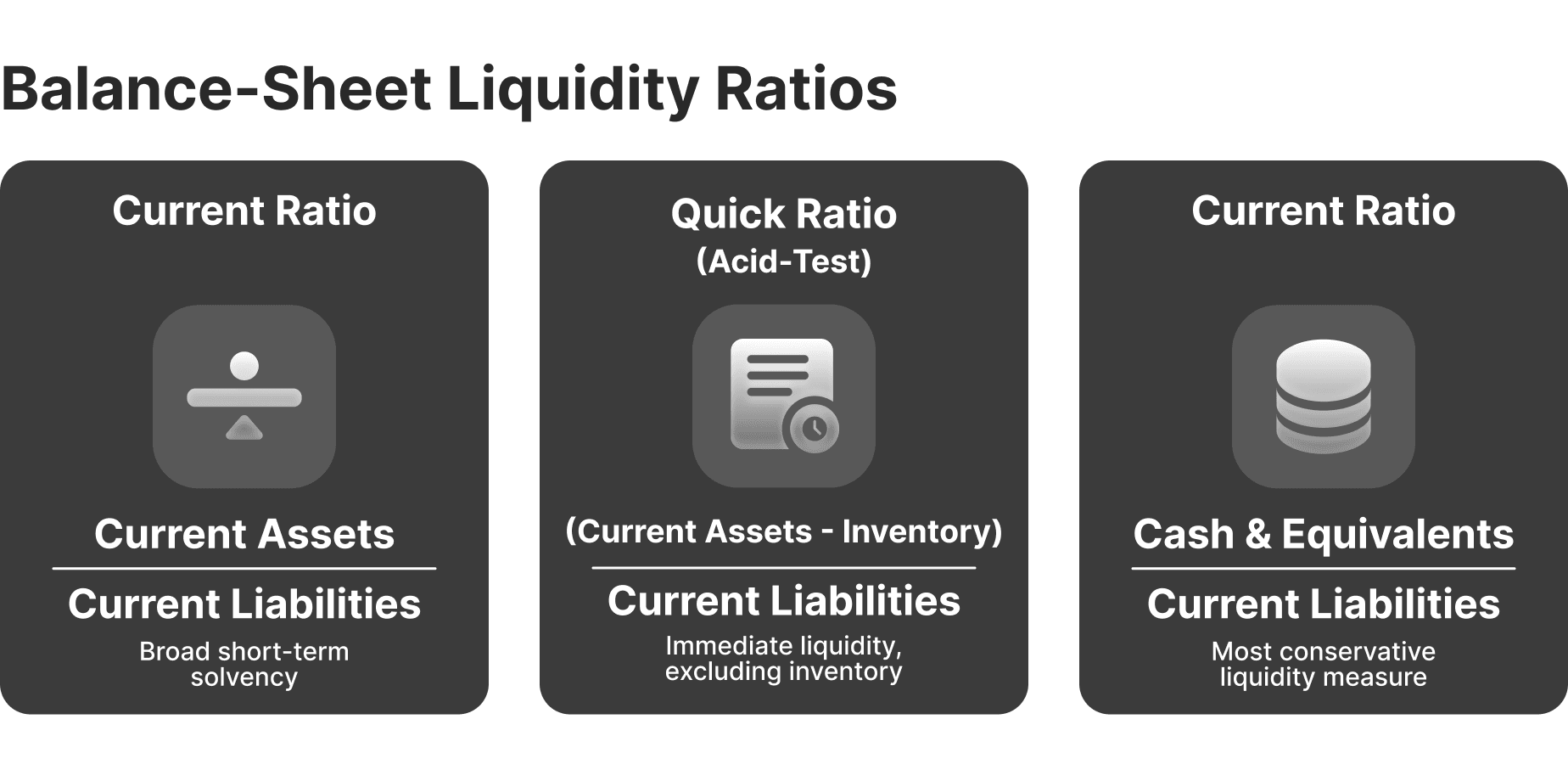
Audits and counterparty reviews emphasize balance-sheet ratios to gauge a brokerage’s financial health and ability to meet short-term obligations:
- Current Ratio: Compares current assets to current liabilities. Values below 1.0 often raise concerns about near-term solvency.
- Quick Ratio (Acid-Test Ratio): Excludes less liquid items and focuses on cash and receivables to assess immediate resilience.
- Cash Ratio: Uses only cash and cash equivalents. Counterparties rely on this metric when assessing creditworthiness before extending prime brokerage relationships.
These metrics help answer whether a broker can withstand funding stress or sudden withdrawals and do not describe execution quality. They set the foundation that supports trading operations during volatile periods.
Market-Based Liquidity Indicators
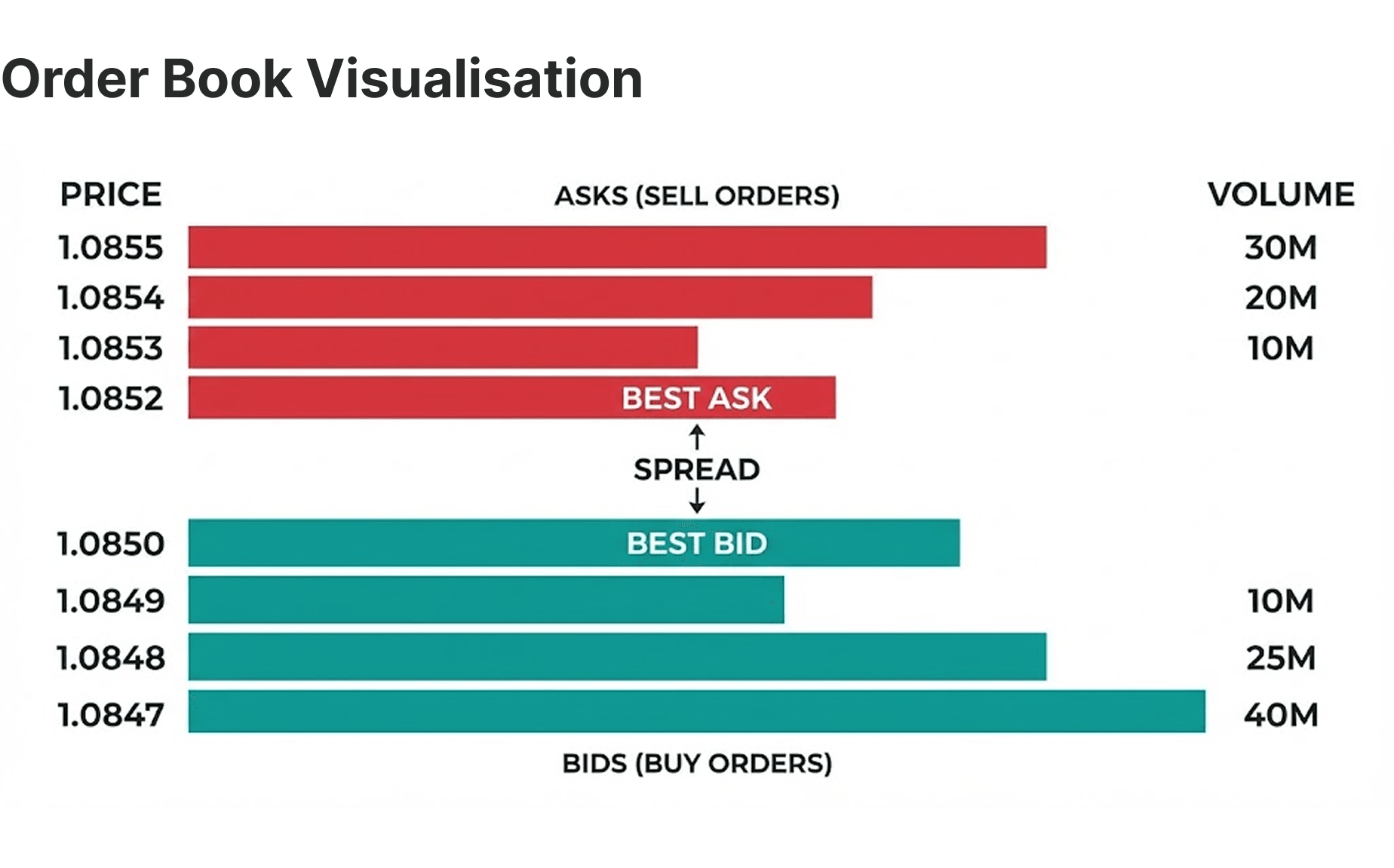
Traders rely on real-time data to gauge the cost of entering or exiting positions. The Bid-Ask Spread serves as the primary cost indicator; tight spreads generally signal healthy competition. However, spreads must be analyzed alongside Order Book Depth. A narrow spread with low volume availability often leads to slippage on larger tickets.
Average Daily Volume (ADV) provides a baseline for normal activity. Execution-focused firms also track time-to-fill and realized slippage. Widening spreads and shallow books often appear before liquidity stress becomes obvious. These signals grow more pronounced during off-hours, session transitions, or macro events.
Common Liquidity Risks Brokers Must Manage
Liquidity risk represents the operational failure to meet financial obligations or execute client orders at stable prices. It manifests when market depth disappears, forcing a firm to accept substantial losses to unwind positions. During systemic crises, this risk frequently spreads across multiple asset classes, rendering basic diversification strategies ineffective without active real-time monitoring.
Concentration, Timing, and Correlation Risks
Relying on a single liquidity provider creates a critical point of failure. If one counterparty pulls quotes or experiences a technical outage, the brokerage loses its ability to price assets correctly. This fragility forces firms to seek aggregated feeds blending streams from Tier-1 banks and non-bank market makers.
Timing risk emerges when liquidity evaporates during specific trading windows. Spreads often widen significantly during the daily rollover (5:00 PM EST) or regional bank holidays. Executing large orders during these thin sessions guarantees adverse fills and increases the likelihood of client disputes regarding execution quality.
Correlation risk occurs when seemingly unrelated instruments become non-liquid assets together. During macro shocks, liquidity often dries up in equities and corporate bonds alongside safe-haven assets. Brokers manage this exposure by prioritizing aggregated access to maintain connectivity across diverse pools even when global markets lock up.
Real-world Liquidity Examples Across Asset Classes
Execution logic cannot remain static across different instrument types. A single routing policy for both Bitcoin and EUR/USD invites operational risk because their liquidity structures differ fundamentally.
Brokers offering multi-asset access adapt their risk controls to the specific volatility profiles of each market to maintain consistent fill quality.
Forex Liquidity
The foreign exchange market sees over $9,6 trillion in daily turnover, yet deep liquidity remains concentrated in major pairs like EUR/USD and USD/JPY. These instruments trade with minimal impact during the critical London-New York session overlap.
However, depth evaporates quickly outside these main corridors. Trading exotic currencies like the Turkish Lira or South African Rand off-hours frequently results in gapped prices. Institutional market makers withdraw support during these windows, leaving only wider spreads available for execution.
Crypto Liquidity
Digital asset liquidity is highly fragmented across hundreds of decentralized and centralized exchanges. Unlike the stock market, there is no single "interbank" reference price. Bitcoin might trade with tight spreads on one venue while experiencing significant slippage on another due to a lack of local depth.
Professional execution relies on aggregation technology like B2CONNECT to bridge these gaps. By unifying order books from multiple sources, brokers create a synthetic depth that absorbs large orders
Equity Liquidity
Stock liquidity correlates directly with market capitalization and the primary listing venue. Blue-chip giants execute millions of shares daily with tight spreads during standard exchange hours. However, this liquidity is strictly time-bound.
Trading during pre-market or after-hours sessions introduces significant execution risk. With primary market makers offline, spreads on even liquid stocks often expand drastically. Executing large orders during these thin windows almost guarantees adverse pricing compared to the open session.
Deep, Reliable Liquidity Across 10 Major Asset Classes
FX, Crypto, Commodities, Indices & More from One Single Margin Account
Tight Spreads and Ultra-Low Latency Execution
Seamless API Integration with Your Trading Platform
How to Apply Liquidity Insights to Brokerage Operations
Deep knowledge of asset-specific liquidity profiles directly informs routing engine configuration. Smart Order Routers (SOR) must apply different logic for high-volume FX pairs versus thinly traded altcoins. Adjusting execution parameters based on real-time depth prevents toxic flow from reaching providers, protecting critical institutional relationships.
Operational teams leverage historical liquidity data to calibrate internal risk controls and product listings. Instead of applying static rules, effective management involves dynamic adjustments to the trading environment:
- Raising margin requirements for assets with frequent order book gaps.
- Delisting instruments that consistently fail time-to-fill benchmarks.
- Educating clients on executing large orders during peak sessions.
Strengthening Liquidity Access with B2BROKER
Relying on isolated liquidity feeds creates operational fragility. Volatility often exposes gaps in shallow order books, leading to rejected trades and eroded client trust. Modern brokerages require infrastructure capable of normalizing data from multiple Tier-1 sources simultaneously to prevent service interruptions.
B2BROKER provides the aggregated liquidity necessary to maintain consistent execution quality. With over a decade of market experience and 10 regulatory licenses, our ecosystem supports scalable operations across Forex, Crypto, and equity markets. We empower firms to focus on growth while our technology handles market complexity.
Contact our experts today to configure a liquidity solution tailored to your specific execution needs.
Build A Resilient Multi-Asset Brokerage
Leverage our decade of experience to deploy institutional-grade liquidity infrastructure for your business today.
Frequently Asked Questions about Liquidity
- What is a simple example of liquidity in trading?
Liquidity can be seen when a large order executes instantly at the expected price with minimal spread. In highly liquid markets, trades are absorbed into the order book without causing noticeable price movement.
- Why can an asset be liquid one day and illiquid the next?
Liquidity depends on market participation and sentiment, not just the asset itself. During volatility or uncertainty, participants withdraw, spreads widen, and execution becomes more difficult even for normally liquid instruments.
- How do brokers improve liquidity access for clients?
Brokers improve liquidity by aggregating multiple liquidity providers, monitoring execution quality in real time, and routing orders dynamically. This reduces reliance on any single source and improves fill consistency.
- Is high trading volume the same as high liquidity?
Not always. High volume can coexist with poor liquidity if spreads are wide or depth is shallow. True liquidity combines volume, tight spreads, and reliable execution.
- Why does liquidity matter more during volatile markets?
Volatility increases demand for immediate execution while reducing available supply. Liquidity determines whether trades execute smoothly or trigger slippage, delays, and cascading risk events.
Recommended articles